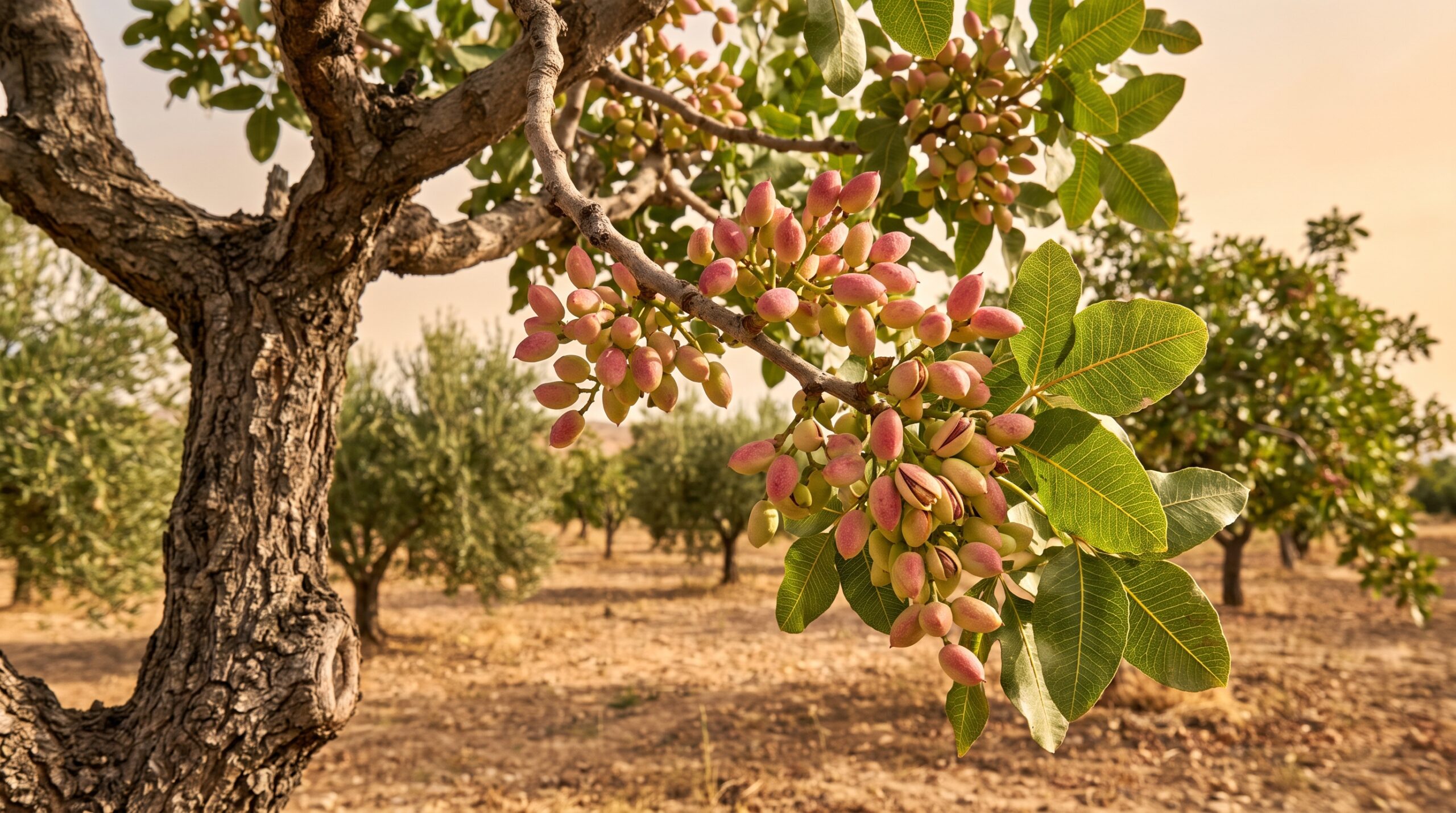
If you are thinking about planting pistachios, the first thing to understand is what kind of tree we are dealing with. The pistachio tree is a rewarding, long-lived crop, well adapted to the dry climates of the Mediterranean interior and other semi-arid regions. It is also demanding in the details that make the difference between an orchard that takes off and one that stalls. 🌳
At Agro Vivero del Mediterráneo, we have spent many years producing plants and supporting growers, both small-scale and large-scale, at every stage of pistachio cultivation. This guide brings together what we have learned in the field and in the nursery, from the biology of the pistachio tree to harvest, including climate, soil, varieties, irrigation, pruning and plant health. Our aim is that by the time you finish reading, you can make decisions with confidence and without surprises. ✅
🌳 What Is the Pistachio Tree and Why Does It Attract So Much Interest?
The pistachio tree (Pistacia vera) is a deciduous tree of the Anacardiaceae family, the same family as the cashew and the mango. It originates from central and western Asia, and from there it spread across the whole Mediterranean basin. Today it is grown in Iran, the United States, Türkiye and, with growing momentum, in many other producing countries across Europe, North Africa and the Middle East.
What makes the pistachio tree special is its ability to produce where other crops struggle: long, hot summers, calcareous soils, scarce rainfall and water of mediocre quality. Added to this is a growing demand for this nut, both for direct consumption and for the confectionery, ice cream and snack industries. 📈
Across the Mediterranean basin and neighbouring regions, the area planted with pistachio orchards has grown steadily. More and more growers in new regions are considering the crop as an alternative to cereals, vines or almonds. And it is not a passing fashion: this is a tree that, when well managed, can produce for more than 50 years.
🔍 Characteristics of the Pistachio Tree
Knowing how the pistachio tree works helps us make better decisions in the field. These are its most important characteristics:
- Habit: a tree with a broad, rounded canopy that reaches between 5 and 8 metres in height at maturity. 🌿
- Leaves: compound, made up of 3 to 5 leathery leaflets, which drop in autumn.
- Roots: taproot system, very deep, able to explore the soil in search of water, which explains its remarkable drought resistance.
- Sex: a dioecious species, meaning there are male trees and female trees. Only females produce pistachios.
- Flowers: petal-less and very discreet. Pollination is carried out by the wind (anemophilous pollination), not by bees.
- Fruit: a drupe made up of a fleshy outer covering (the hull), a shell that splits open naturally at maturity, and an edible green kernel.
- Longevity: a well-cared-for pistachio tree produces for more than 50 years, and some specimens exceed 100.
Another key characteristic is alternate bearing: the pistachio tree tends to alternate heavy-crop years with lighter-crop years. With correct management of pruning, irrigation and fertilisation, we can soften this alternation, although it never disappears entirely. 🔄
☀️ Ideal Climate and Soil for Planting Pistachios
The pistachio tree is hardy, but it does not accept just any location. It needs winters with enough cold to break dormancy, warm summers to ripen the nut properly, and a soil that does not waterlog. This table summarises the indicative values we work with:
| Factor | Indicative value | Why it matters |
|---|---|---|
| Chilling hours | 600 to 1,000 hours below 7 °C, depending on variety | Ensures uniform bud break and flowering |
| Summer temperature | Maximums above 35 °C | Favours kernel filling and ripening |
| Frost | Tolerates down to −15 °C when dormant, but is vulnerable to spring frosts | Frost damages buds and flowers during bud break |
| Rainfall | Minimum of 350 to 400 mm per year under rainfed conditions | Below this, yields fall sharply |
| Soil pH | 7 to 8.5 | Tolerates calcareous soils very well |
| Drainage | Deep, well-drained soil | Waterlogging causes root asphyxia and fungal diseases |
It is important to be very clear here: not every plot is suitable. Poorly drained land, an area with frequent late frosts or irrigation water with excessive salinity can compromise the orchard from the very first year. That is why we always recommend analysing the soil and the irrigation water before deciding anything. 🧪
In our technical advisory services, we study each farm individually, because two neighbouring plots can behave very differently.
🌱 Pistachio Tree Varieties and Rootstocks: How to Choose Well
Choosing the variety and the rootstock is probably the most important decision of the entire orchard, because it will accompany the tree throughout its life. These are some of the most widely planted female varieties:
| Variety | Main traits | Points to consider |
|---|---|---|
| Kerman | Global benchmark; good nut size and quality; late flowering | Requires plenty of chilling hours |
| Larnaka | Earlier ripening; lower chilling requirement | Early flowering, more exposed to frost |
| Sirora | Very early and undemanding in chilling | Should be validated in the region before planting |
| Avdat | Performs well in hot, dry areas | Requires a pollinator with matching flowering |
No variety is the best in every case. The key is that the chilling hours of the area match the requirements of the variety, and that the flowering of females and males overlaps. That is why we work with plants of several varieties and help you choose the one best suited to your region.
As for rootstocks, the most widely used are:
- Pistacia terebinthus (terebinth): very hardy, resistant to cold and lime, with slower growth.
- Pistacia atlantica: vigorous and well adapted to poor, dry soils, although susceptible to Verticillium wilt.
- UCB-1: a very vigorous hybrid, tolerant of Verticillium wilt, which performs best in deep, fertile soils and is more sensitive to cold.
If you would like to know how we work, take a look at our grafted pistachio plants, produced under quality and traceability criteria. 🌿
🌬️ Pollination: The Role of the Male Pistachio Tree
Because the pistachio tree is dioecious, without males there is no harvest. It is one of the most serious and frequent mistakes in new orchards: planting only females, or planting too few pollinators. Pistachio pollination depends on the wind, so the design of the plot matters a great deal.
These are the basic guidelines we follow:
- Leave one male pistachio tree for every 8 to 10 females, evenly distributed across the plot.
- Choose males whose flowering coincides with that of the chosen female variety (for example, Peters with Kerman).
- Take into account the prevailing wind during the flowering period so that males are placed where their pollen best reaches the rest of the trees.
- Quickly replace any male that fails, because its absence shows up in the harvest.
When pollination fails, blank pistachios appear: nuts with a shell but no kernel, which have no commercial value. 🥜 That is why the orchard layout must be planned from the outset with the males included.
🚜 How to Plant Pistachios: Site Preparation, Spacing and Planting
A well-planned orchard saves problems for many years. These are the steps we follow:
- Site selection and analysis: soil analysis (texture, pH, lime, salinity) and irrigation water analysis.
- Land preparation: subsoiling to break up plough pans, levelling and, if necessary, drainage.
- Planting layout design: depending on irrigation, machinery and soil fertility.
- Planting: in winter or early spring, with the plant in good condition and without damaging the root system.
- Protection and first irrigations: tree shelters, stakes and frequent irrigation during the first summer.
The planting spacing determines the number of trees per hectare and the ease of mechanisation. These are some common examples:
| Spacing | Trees per hectare | Typical use |
|---|---|---|
| 7 x 7 m | 204 | Rainfed conditions or low-fertility soils |
| 7 x 6 m | 238 | Irrigated orchards with large machinery |
| 7 x 5 m | 286 | Irrigated orchards, widely used |
| 6 x 5 m | 333 | Intensive irrigated orchards, earlier bearing |
A practical example: on a 10-hectare plot with a 7 x 5 metre spacing, we will need around 2,860 trees, of which about 290 will be males. This is the calculation we always start with when preparing a quote. 🧮
A quality orchard starts with quality plants. Before planting, we recommend checking four things:
- That the variety and rootstock are correctly identified.
- That the graft union is properly healed.
- That the roots are not spiralling inside the container.
- That the plant arrives healthy, with no signs of pests or fungi.
If you already know the area you want to plant, you can request your plant reservation and quote with no obligation.
💧 Pistachio Irrigation: How Much Water Does It Need?
The pistachio tree withstands drought better than almost any other tree, but withstanding is not producing. With irrigation, the difference in yield and nut size is very significant.
In mature irrigated orchards, water applications typically range between 2,500 and 4,500 m³ per hectare per year, depending on climate, soil and variety. The most common system is drip irrigation, which allows moisture control and the application of fertiliser with the water (fertigation). 🚿
A very valuable practice is regulated deficit irrigation. It consists of reducing water supply during shell hardening, approximately between May and June in the Northern Hemisphere, when the tree tolerates water stress better. Afterwards, water needs must be fully covered during kernel filling in summer.
And one fundamental point: avoid waterlogging. A pistachio tree with asphyxiated roots is an open door to fungi such as Phytophthora.
Can pistachios be planted under rainfed conditions? Yes, provided that rainfall exceeds 350–400 mm per year and the soil retains water well. However, yields will be more modest and more irregular.
🌿 Fertilisation and Pruning of the Pistachio Tree
A tree that produces heavily also extracts a lot of nutrients. Fertilisation should be based on soil analysis and, above all, on leaf analysis, which we usually carry out in mid-July.
The elements we monitor most closely are:
- Nitrogen: drives growth; in excess, it favours vegetative growth at the expense of the crop.
- Potassium: key for kernel filling and nut quality.
- Phosphorus, boron and zinc: occasional applications depending on what the analyses indicate.
As an indicative reference, in mature orchards nitrogen applications are around 80 to 150 units per hectare per year, although they must always be adjusted to the farm and the crop load.
As for pruning, we distinguish two stages:
- Training pruning (years 1 to 4): we aim for a trunk of 1 to 1.2 metres and 3 to 4 well-distributed main branches, to achieve a balanced canopy that is ready for mechanical shaking.
- Maintenance pruning: thinning of crossing branches, removal of dead wood and control of canopy size, without excessive cuts.
Overly severe pruning delays the onset of production, and a complete lack of pruning produces dense canopies with less light and more plant health problems. Balance is the key. ✂️
🐛 Pistachio Pests and Diseases
A healthy crop is the best investment. These are the pests and diseases we monitor most closely in the field:
- Pistachio psylla (Agonoscena pistaciae): sucks sap and leaves honeydew on leaves and fruit, on which sooty mould develops.
- Pistachio seed wasp (Megastigmus pistaciae): its larvae develop inside the kernel and destroy it.
- Pistachio twig borer (Kermania pistaciella): its larvae bore into shoots and twigs.
- True bugs (stink bugs and related species): their feeding causes spotting and blanking in the nut.
- Verticillium wilt (Verticillium dahliae): a soil-borne fungus that blocks the vascular system and can wilt the tree.
- Botryosphaeria blight and other fungal diseases: favoured by wet springs, they affect shoots, leaves and clusters.
- Root and crown rots (Phytophthora): linked to excess moisture and poor drainage.
The most effective strategy is prevention: choosing the rootstock well, taking care of drainage, monitoring the orchard regularly, using monitoring traps and applying treatments only when the level of damage justifies it. In this way we also protect the final quality of the nut. 🛡️
🧺 Harvest and Post-Harvest: From the Tree to the Table
In the Northern Hemisphere, pistachio harvest usually takes place between late August and October, depending on the variety and the area. We know the moment has arrived when the outer hull separates easily from the shell and the shell splits open naturally.
In professional orchards, harvesting is mechanical: a trunk shaker shakes the tree and the pistachios fall onto an inverted umbrella catch frame or a tarpaulin. It is quick work, and it requires that the branches and trunk are well formed from the training pruning stage. 🚜
Then comes the most delicate phase: post-harvest. These are the steps:
- Hulling: must be carried out within 24 hours of harvesting to avoid staining and fermentation.
- Washing and sorting: removal of debris and separation of blank pistachios.
- Drying: until reaching a moisture content of around 5–6%, which is essential for preserving the product.
- Storage: in a dry, cool, ventilated place, away from humidity.
Proper drying also reduces the risk of mould and aflatoxins, a key aspect for accessing the most demanding markets.
📅 Annual Pistachio Tree Calendar: What We Do in Each Season
Having a clear calendar helps organise work, labour and expenses throughout the year. This is a summary of the main tasks in most Mediterranean-climate regions of the Northern Hemisphere:
| Period | Tree stage | Main tasks |
|---|---|---|
| December to February | Winter dormancy | Pruning, planting of new plots, base fertilisation |
| March to April | Bud break and flowering | Frost monitoring, attention to pollination |
| May to June | Fruit set and shell hardening | Regulated deficit irrigation, preventive treatments |
| July | Kernel filling | Leaf analysis, full irrigation, pest control |
| August to October | Ripening and harvest | Harvesting, hulling and drying |
| November | Leaf fall | Review of irrigation and machinery, preparation of fertilisation |
This calendar is indicative and varies according to altitude, variety and climatic year, but it serves as a guide for planning. 📆
📈 When Does the Pistachio Tree Start Producing and What Return Can We Expect?
The pistachio tree requires patience, but it rewards it. This is the typical development of a well-managed orchard:
| Stage | Years from planting | What happens |
|---|---|---|
| Establishment | 1 to 3 | Tree growth and training pruning |
| First harvests | 4 to 5 | Token yields |
| Increasing production | 6 to 9 | The harvest grows each year |
| Full production | From year 10–12 | Stable yield, with alternate bearing |
Under irrigation and with proper management, a mature pistachio tree can yield between 8 and 12 kg of dried in-shell pistachios. With around 260 female trees per hectare, this means between 2,100 and 3,100 kg per hectare. Under rainfed conditions, figures are usually considerably lower. These are indicative values that depend on the area, variety, irrigation and year.
The final return depends on establishment costs, water, labour, mechanisation and the price of the nut in each season. To make realistic calculations, we have prepared a dedicated page on the profitability of a pistachio orchard, where we review the factors that weigh most heavily on the result. 💶
🌍 Pistachio Market and Demand: Why Does It Keep Growing?
From an economic perspective, the pistachio has become one of the nuts with the best outlook. World consumption has grown steadily in recent years thanks to its healthy image, its versatility in the kitchen and its increasing presence in processed products such as spreads, ice cream and pastry.
Many consuming countries across Europe, North Africa and the Middle East rely largely on imports to meet their demand. That reality opens up an opportunity for local and regional production: locally grown pistachios, with traceability and an added value that many buyers are beginning to appreciate. 🌍
That said, we must be realistic: prices vary from one season to another and an orchard is a long-term investment. That is why we insist on analysing each project with real figures, not with easy promises of profitability.
👨🌾 Planting Pistachios as a Small-Scale or Large-Scale Grower: Different Approaches
The pistachio tree adapts to projects of very different sizes, but the strategy is not the same on a 3-hectare plot as on a 200-hectare farm.
If you are a small-scale grower, the most practical approach is to:
- Start with an area that you can manage with your own labour and machinery.
- Share the shaker, the harvester or the drying plant with other growers or through a cooperative.
- Choose one or two well-adapted varieties, to simplify management.
- Plant in phases if the budget is limited.
If you are a large-scale grower, it is worth thinking about:
- Combining varieties with different ripening times to spread the harvest workload.
- Investing in your own machinery and in a post-harvest line that allows hulling and drying within 24 hours.
- Designing an irrigation and fertigation system by sectors, with automation and moisture control.
- Planning labour and harvest-season logistics well in advance.
In both cases, what matters is that the project is designed to measure. That is why we support each orchard on a personalised basis, from the choice of plot to the first harvest. 🤝
⚠️ Common Mistakes When Planting Pistachios
After so many years supporting orchards, there are mistakes we see repeated:
- Planting on plots with poor drainage or heavily compacted soils.
- Using too few males, or males whose flowering does not coincide with that of the females.
- Choosing a variety without checking the chilling hours of the region.
- Buying plants without guarantees of origin, plant health or a good graft.
- Over-irrigating or irrigating irregularly, with long dry periods in summer.
- Not planning the harvest, hulling and drying before September arrives.
Avoiding these mistakes costs nothing; what costs money is correcting them once the orchard is already established. 💡
❓ Frequently Asked Questions About the Pistachio Tree
How many years does a pistachio tree take to produce pistachios? The first harvests arrive between years 4 and 5, but truly significant production is reached around the seventh or eighth year.
How long does a pistachio tree live? It is a very long-lived tree: it can keep producing for more than 50 years if properly cared for.
Can pistachios be planted under rainfed conditions? Yes, in areas with more than 350–400 mm of rainfall and deep soils, although with lower and more irregular yields than under irrigation.
Is it compulsory to plant males? Yes. Without suitable pollinators there is no profitable harvest; the usual ratio is one male for every 8 to 10 females.
Which is the best pistachio tree, Kerman or other varieties? It depends on the area. Kerman is the global benchmark, but in hotter climates or with less winter chill, other varieties may perform better.
How much does it cost to plant one hectare of pistachios? It depends on planting density, the plants, the irrigation system and land preparation. The most sensible approach is to request a quote tailored to your farm.
🏡 How We Work at Agro Vivero del Mediterráneo
Our work starts in the nursery, but it does not end there. We produce pistachio plants with controlled grafting, select varieties and rootstocks according to each area, and visit farms to provide advice on site.
We believe in an honest approach: if a plot does not meet the conditions for growing pistachios, we prefer to tell you before we begin. A client who succeeds with their orchard is our best reference, and that is why we take care of every detail, from the plant material to the follow-up advice. 🌿
🌟 Our Advice for Getting Off to a Good Start
The pistachio tree is a crop with a great future for growers of all sizes, but it demands the right decisions from the start. It takes a suitable plot, the right variety and rootstock, a well-designed pollination scheme, efficient irrigation and careful plant health management.
At Agro Vivero del Mediterráneo, we have supported many growers along that path, and we love to see an empty plot become a living, productive orchard. If you are considering planting pistachios or expanding your orchard, contact us and we will study your case with no obligation.
And if you already have it clear, you can reserve your plants and request a quote through this form. We will be delighted to help you take the first step. 🌱
Need a quote?
Tell us about your project and we will send you a proposal with no obligation.
Request a quote