Choosing the right pistachio varieties for southern France is the decision that most influences the outcome of an orchard, and also the hardest to correct once the trees are in the ground. 🌳 A pistachio tree takes time to reach full production and stays in the plot for many years, so any mistake in variety, rootstock or location is paid for throughout the life of the orchard.
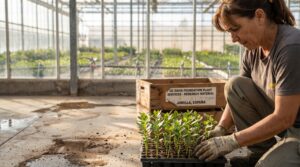
At Agro Vivero del Mediterráneo we support growers who want to plant pistachios in Mediterranean areas, from small family plots to projects covering dozens of hectares. We know that southern France offers a very attractive environment, but with its own particularities: more humidity than inland Mediterranean areas, spring frosts that can arrive late, and winds such as the mistral or the tramontane. That is why, in this guide, we explain how to make decisions on a technical basis, starting with climate and soil and ending with the specific plot.
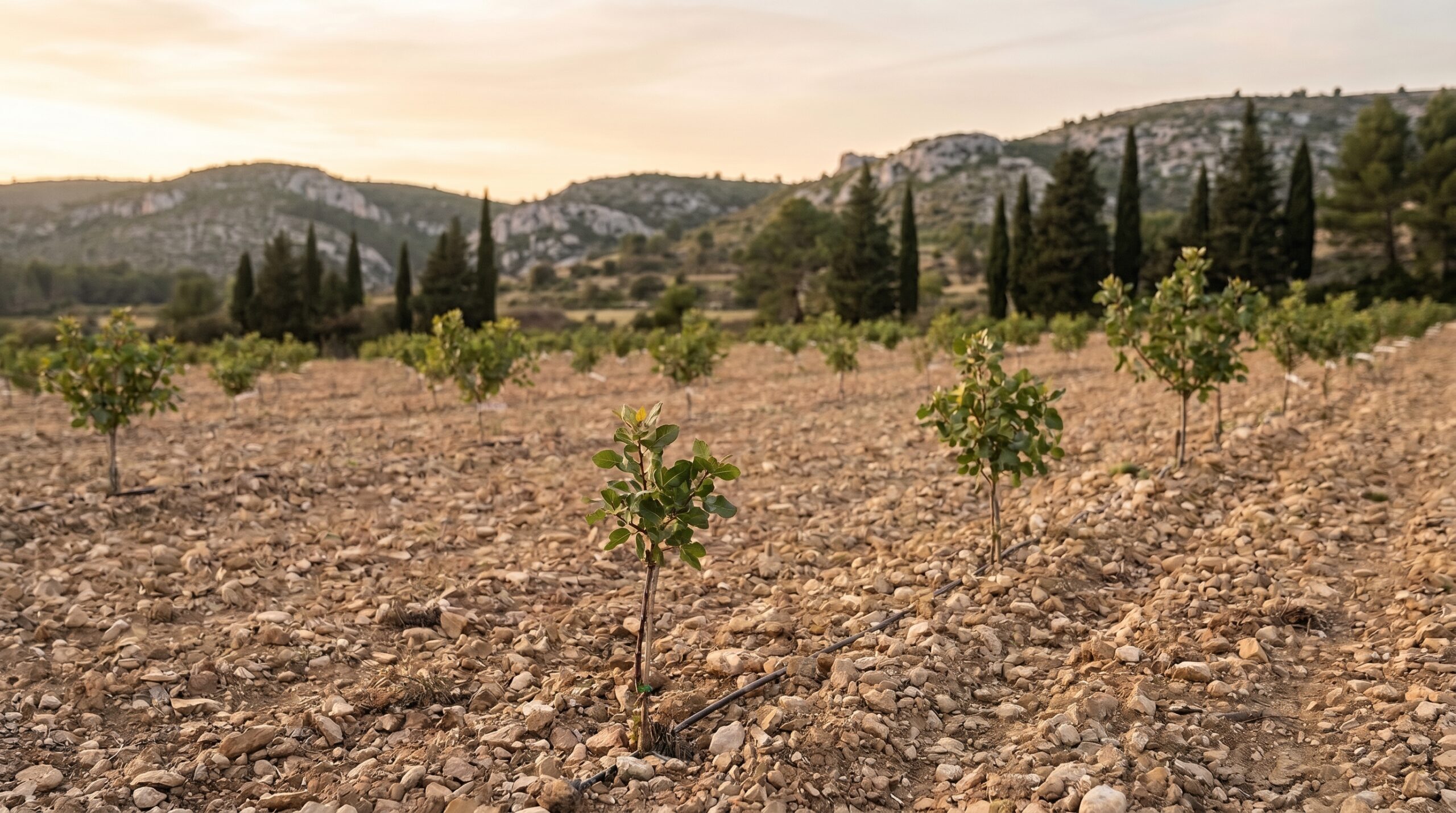
Why southern France is an area with potential for pistachio growing 🇫🇷
The pistachio is a tree that lives between two worlds: it needs winters cold enough to break dormancy, springs without severe frosts during flowering, and long, hot, dry summers to ripen the nut. ☀️ Much of southern France meets these conditions, especially in parts of Occitanie, Provence and the Rhône Valley, where summers are bright and winters usually provide enough chill hours.
But the territory is not uniform. Within a few kilometres you can find a sheltered plain, a valley floor where cold air pools, and a hillside battered by the wind. This variability explains why there is no “ideal” variety for the whole of southern France, only the right combination for each plot.
To plant with confidence, it is worth reviewing three layers of information: the climate of the area, the soil characteristics and the suitability of the plot. Only when all three fit does it make sense to talk about specific varieties.
The climate the pistachio needs and the climate we find in southern France 🌦️
Before browsing catalogues, it is important to be clear about the crop’s climatic thresholds. The figures in the table are indicative and should be checked against data from a weather station close to the plot:
| Factor | What the pistachio needs | What we need to check in southern France |
|---|---|---|
| Chill hours | Between 600 and 1,000 hours below 7 °C, depending on the variety | Records from several winters, not just the last one |
| Summer heat | Long, hot summers to complete ripening | Altitude, exposure and summer cloud cover |
| Frost | Tolerates cold while dormant, but suffers during budbreak and flowering | Average date of the last frost and cold-air pockets |
| Rainfall and humidity | Prefers dry environments, because humidity favours fungal diseases | Annual rainfall, which in many areas ranges between 500 and 800 mm |
| Wind | Tolerates moderate wind, which helps pollination | Strength of the mistral or tramontane and row orientation |
The big difference compared with the drier inland pistachio-growing regions of the Mediterranean is humidity. The pistachio tolerates drought well, but struggles when rain coincides with flowering, nut fill or harvest. 💧 That is why, in southern France, we place so much importance on plant health and on choosing varieties whose cycle suits each area.
A practical rule: if the plot has hot, dry summers, even when autumns and winters are rainy, the pistachio can adapt as long as the soil drains well and the planting layout allows the canopy to ventilate.
Areas of southern France and an indicative variety approach 🗺️
Southern France is not a homogeneous block. This classification, necessarily simplified, helps us guide the first conversation with each grower:
| Area type | Main advantage | What to watch | Variety approach |
|---|---|---|---|
| Mediterranean coast (Hérault, Aude, Pyrénées-Orientales, Var) | Mild winters and hot summers | Heavy autumn rains and marginal chill hours | Varieties with lower chill requirements and early ripening |
| Inland plains and hills (Gard, Vaucluse, Bouches-du-Rhône) | Plenty of sunshine and varied soils | Mistral, cold-air pockets and late frosts | A combination of varieties with staggered flowering |
| Rhône Valley and foothills | Sufficient winter chill and deep alluvial soils | Spring frosts and strong winds | Late flowering and wind protection |
This table is not a substitute for a plot study, but it helps avoid starting from wrong assumptions. Within each area, microtopography, altitude and proximity to watercourses significantly change the frost risk and ambient humidity.
Chill hours and variety cycle: the first filter ❄️
Each variety has different chill requirements. If winter does not meet them, budbreak becomes uneven, flowering is prolonged and yield drops. And if we choose a very early-flowering variety in an area with late frosts, the tree breaks bud early and is left exposed.
Kerman, the most widely planted variety in the world, is the most demanding: it usually needs between 800 and 1,000 chill hours. Others such as Larnaka, Sirora or Golden Hills adapt better to mild winters, although their behaviour varies from one area to another.
Along the coastal strip winters are milder, and it is worth checking that the chill hours the variety requires are actually reached. Inland and in the foothills the opposite occurs: chill is usually sufficient, but the risk of spring frost increases.
To decide on solid criteria, we recommend:
- Calculate the average chill hours over at least five winters.
- Rule out varieties whose requirements frequently exceed the real chill of the area.
- Observe how neighbouring orchards break bud and flower each spring.
Spring frosts: the risk that most influences the choice 🥶
A dormant pistachio tree tolerates sub-zero temperatures well, but a frost during budbreak or flowering can destroy the inflorescences and ruin that year’s crop. In southern France, where a mild March can bring budbreak forward and be followed by a cold night in April, this risk deserves special attention.
To reduce it, we work on three fronts:
- Location: we avoid valley floors and hollows where cold air collects, and prefer gentle slopes with good air circulation.
- Later flowering: it delays flower opening and reduces exposure to late frosts.
- Varietal diversification: combining two female varieties with different flowering dates spreads the risk.
In addition, on plots with a history of frost it is worth considering protection systems, such as fans or sprinklers, and planning for them from the orchard design stage rather than adding them later.
Soil: the foundation of any pistachio orchard 🪨
The pistachio is a hardy tree, but it does not tolerate poorly drained soils. Its deep roots need oxygen, and prolonged waterlogging favours diseases such as root rot. If we had to choose a single soil characteristic, it would be drainage.
This table summarises what we assess when studying a plot:
| Characteristic | Favourable value | Warning sign |
|---|---|---|
| Effective depth | More than 1 m | Rock or hardpan less than 60 cm deep |
| Drainage | Fast, no puddles after rain | Standing water for several days |
| Texture | Loam, sandy loam or clay loam | Heavy, compacted clays |
| pH | Between 6.5 and 8.5; tolerates calcareous soils well | Acidic soils, with a pH below 6 |
| Salinity | Low electrical conductivity | Salt crusts or saline irrigation water |
| History | Plots with no known soil-borne fungi | Previous crops susceptible to Verticillium, such as tomato, potato or cotton |
In southern France we find very varied soils: alluvial terraces of the Rhône, stony soils of river origin, marls and limestones of the garrigue, or clay-limestone terrain. 🪴 Stony and calcareous soils tend to be good allies if they are deep enough, although they retain less water and require a well-designed irrigation system. Heavy clays, on the other hand, are the main reason we advise against a plot.
Before deciding, we recommend digging at least one soil pit 1.2 m deep for each homogeneous zone of the plot, and completing the study with a physical-chemical soil analysis and, if in doubt, an analysis of the irrigation water.
Rootstocks: as important as the variety 🌱
The pistachio is grafted onto a rootstock that provides the root system. That root system determines vigour, cold tolerance, response to calcareous soils and resistance to certain fungi. That is why, in a pistachio orchard, we always talk about the rootstock and variety combination.
- Pistacia terebinthus (terebinth): very hardy, tolerates cold and calcareous soils well, although it grows more slowly. We consider it for cold areas or poor soils.
- Pistacia atlantica: more vigorous, with good anchorage and drought tolerance. It is a common choice on deep, well-drained plots.
- UCB-1-type hybrid rootstocks: notable for their vigour and tolerance to Verticillium, but more sensitive to severe cold, so we do not recommend them in every area.
If you would like to know the options in more detail, you can visit our pistachio plants page and see which combinations best suit each project.
Female varieties and pollinizers: how to combine them 🌿
The pistachio is a dioecious species: there are female trees, which produce the nut, and male trees, which only provide pollen. Without suitable pollinizers there is no crop, so choosing pistachio varieties for southern France means choosing both the females and the males.
| Variety | Flowering | Ripening | When we consider it |
|---|---|---|---|
| Kerman | Late | Mid-late | Areas with cold winters and dry autumns; benchmark quality |
| Larnaka | Early-mid | Early | Warm areas where we want to harvest before the autumn rains |
| Sirora | Early | Early | Mild winters and a long, hot summer |
| Golden Hills | Early-mid | Early | Areas with few chill hours and good ventilation |
Dates change from one year to the next and from one area to another, so we always adjust them to each project. In southern France there is a balance to strike: late flowering protects against frost but leads to later ripening, just when the autumn rains tend to begin. Early varieties allow earlier harvesting, but they flower earlier and are more exposed to cold. The answer depends on each plot, which is why we rarely recommend a single variety.
Among males, the most widely used are Peter and Randy, chosen according to how well their flowering synchronises with that of the females. As a guideline:
- One male for every 8 to 10 females, spread throughout the orchard.
- Males positioned on the side the prevailing wind comes from during flowering.
- Flowering periods of males and females that overlap.
Plant health and humidity: how they influence variety choice 🍃
In more humid climates, fungal diseases carry more weight. In pistachio we are mainly concerned with those that attack twigs, leaves and inflorescences, such as Botryosphaeria and Alternaria, as well as root rots associated with waterlogging, such as Phytophthora.
Variety is not the only tool, but it is the first:
- A ripening cycle that reduces the overlap of nut fill and harvest with rainy periods.
- A planting layout that allows ventilation, such as 6 × 5 m or 7 × 5 m depending on vigour and soil.
- Formative pruning that opens the canopy and promotes rapid leaf drying.
- Localised drip irrigation, avoiding wetting the foliage.
- A monitoring and preventive treatment plan coordinated with a technician.
A well-planned orchard, starting with the choice of varieties, needs fewer interventions and is easier to manage, which is especially useful for small growers. Always check the phytosanitary regulations in force in France, because authorised products vary from one country to another.
Irrigation and water: a factor that also influences the choice 💧
Although the pistachio withstands drought, a commercial orchard performs far better with localised irrigation. In areas of southern France with sufficient rainfall, the amount needed is lower than in drier inland Mediterranean areas, but it is important to ensure a reliable water supply during the critical summer months.
As a reference figure, a mature orchard may need between 1,500 and 3,000 m³ per hectare per year, depending on rainfall, soil and irrigation management. This is an indicative figure that must be calculated for each plot.
There are two aspects we always review: water quality, in terms of salinity and boron content, and the plot’s ability to drain excess water, because in rainy areas irrigation adds to rainfall.
How to assess the plot step by step 📋
Once climate, soil and varieties are understood, it is time to move on to the specific plot. This is the order of work we follow:
- Local climate data: chill hours, date of the last frosts and rainfall during flowering and harvest.
- Soil pit and soil analysis: depth, drainage, texture, pH and salinity.
- Topography: slopes, aspects and possible cold-air pockets.
- Available water: flow rate, quality and water-use rights.
- Cropping history: soil-borne fungi or remains of previous orchards.
- Wind: strength, direction and need for windbreaks.
- Logistics: access, machinery and proximity to drying and hulling facilities.
With this information we decide the combination of rootstock, varieties and planting layout. If you would prefer us to do it with you, on our services page we explain how we support you with technical advice from the initial study through to planting.
Practical example: imagine an 8-hectare plot on a gentle inland slope, with stony loam soil 1.5 m deep, cold winters and the occasional late frost in April. In such a case we usually propose a main late-flowering variety, a second early variety in a smaller proportion to stagger the harvest, a hardy rootstock and a 6 × 5 m layout, with around 333 trees per hectare.
Common mistakes when choosing pistachio varieties ⚠️
- Planting a single variety without a compatible pollinizer.
- Copying the model of another region, such as California, other Mediterranean countries or the Middle East, without adapting it to the local climate.
- Ignoring late frosts when choosing the flowering period.
- Not digging soil pits and relying only on the appearance of the soil.
- Choosing the rootstock solely on price or availability.
- Buying plants without guarantees of variety or plant health.
- Designing layouts that are too dense in humid areas, where the canopy needs ventilation.
Avoiding these mistakes does not make the project more expensive: on the contrary, it saves years of correction.
Project timeline: when to decide on varieties 🗓️
The choice of varieties cannot be left to the last moment, because quality plants are reserved in advance. This is the timeline we usually propose:
- Twelve to six months before: climate study, soil pits, and soil and water analysis.
- Six to four months before: decision on rootstock, varieties, pollinizers and planting layout.
- Four to three months before: plant reservation and land preparation.
- Late winter or spring: planting and irrigation installation.
- First years: training, supplemental irrigation and plant health monitoring.
Profitability: how variety influences the bottom line 📈
Variety determines when the orchard comes into production, how much nut yield it delivers consistently, nut size, the percentage of split nuts and ease of harvesting. A pistachio tree usually begins to produce appreciably around the fourth or fifth year and reaches full production several years later, so getting the choice right from day one is key.
If you would like to see how the economic analysis of a project is approached, you can consult our section on the profitability of a pistachio orchard and compare scenarios according to area, irrigation and variety type.
Frequently asked questions about pistachio varieties in southern France ❓
Can you grow pistachios in southern France?
Yes, provided the plot meets certain minimum requirements regarding soil, drainage and frost risk, and suitable varieties and rootstock are chosen.
Which variety is safest where there are late frosts?
There is no foolproof variety. We usually recommend later-flowering varieties, locations protected from cold air and a combination of two female varieties to spread the risk.
How many male pistachio trees do I need?
As a general rule, one male for every 8 to 10 females, spread out and oriented according to the prevailing wind.
When is the best time to plant?
In late winter or spring, once the risk of severe frost has passed, using quality plants and supplemental irrigation during the first months.
Can I start with a small plot?
Yes. Many growers start with small areas and expand later. The important thing is to plan the varieties, pollinizers and irrigation from the outset.
The next step 🚜
Choosing pistachio varieties for southern France well requires combining three perspectives: the climate, which sets the chill hours and the frost risk; the soil, which determines the rootstock and drainage success; and the plot, which defines the design, irrigation and pollination. 🌿 When these pieces fit together, the orchard starts with an advantage and costly mistakes are avoided.
If you are considering planting pistachios, whether on a small plot or a large area, at Agro Vivero del Mediterráneo we can study your case. You can contact our team to resolve your questions or request your quotation and plant reservation, and start the planting season with the backing of those of us who know pistachio growing at first hand.
Need a quote?
Tell us about your project and we will send you a proposal with no obligation.
Request a quote