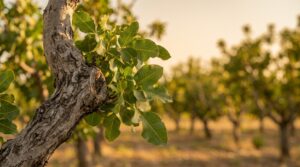
At Agro Vivero del Mediterráneo, we have spent years dedicated body and soul to a sector we are passionate about: the pistachio sector. Our experience is not measured in time, but in the number of successful projects we have seen born and thrive. We understand every phase of a plantation’s development, from land selection to harvest collection. That is why today we want to share with you the keys, strategies, and secrets we have learned to take the production of your pistachio plantations to the highest level. 📈
The path to a highly productive plantation is not a sprint, but a long-distance marathon. It requires planning, technical knowledge, and, above all, constant dedication. There are no magic formulas, but there is a set of best practices that, applied correctly and consistently, make an abysmal difference in final yield. Join us on this detailed tour of the strategies that will transform your plantation into a model of efficiency and profitability.
The foundation of success: Land selection and soil preparation
Every great project begins with solid foundations. In the case of pistachio, those foundations are the land and the soil. An incorrect choice in this initial phase can limit the plantation’s potential for life, no matter how hard we try in later stages.
The first thing we must analyze is the climate. The pistachio tree is demanding. It needs a large number of chill hours during winter (below 7 ºC) to break bud dormancy and ensure uniform budding and abundant flowering in spring. We are talking about a minimum of 700 to 1,000 chill hours, depending on the variety. At the same time, it requires long, hot, and dry summers for proper ripening of the appreciated nut. Late spring frosts are one of its greatest enemies, as they can damage flowers and ruin the harvest. Therefore, it is crucial to study the area’s climatic history and avoid hollows or closed valleys where cold air tends to stagnate.
Once the climate is validated, we focus on the soil. The pistachio tree has a surprising ability to thrive in soils that other woody plants would reject. It prefers deep, well-drained soils with a loam or sandy-loam texture. Waterlogging is its worst nightmare. A root system suffocated by excess water is an entry point for fungal diseases such as Verticillium wilt, which can be lethal. Therefore, we must avoid heavy, clayey, and poorly drained soils.
Before planting a single pistachio plant, it is essential to perform a complete soil analysis. This analysis will give us an X-ray of its status: pH, texture, organic matter levels, macro and micronutrients, and presence of salts. The ideal pH is in a range of 7.0 to 8.0, slightly alkaline. If the pH is too acidic, we must apply calcareous amendments. Land preparation should include deep subsoiling, at least 80-90 cm, to break compacted layers and facilitate root development. Next, deep plowing and incorporation of organic matter, such as well-composted manure, will improve soil structure and fertility in the long term. At Agro Vivero del Mediterráneo, we offer comprehensive advisory services that include studying farm suitability and planning these preparatory tasks.
Varietal choice and plantation design: Planning for the future
The correct choice of varieties and rootstock is undoubtedly one of the most important decisions the farmer will make. This choice will determine the flowering calendar, chill hour needs, disease resistance, and ultimately, productive potential.
The rootstock, or stock, is the base on which our tree will develop. It must be perfectly adapted to our soil and climate conditions. The most used and the one we recommend in most cases is Pistacia terebinthus (commonly known as cornicabra) for its great rusticity, drought resistance, and good affinity with main commercial varieties. Others like Pistacia atlantica can be interesting in salinity conditions, but terebinthus has demonstrated greater reliability in peninsula conditions.
Regarding varieties, the choice focuses on the female-male pair. The female variety is the one that will produce the pistachio, and the most widespread and valued worldwide is ‘Kerman’. ‘Kerman’ produces a large-caliber nut, with a white shell and a very high opening percentage, characteristics highly demanded by the snack market. However, it is a late variety, both in flowering and ripening, and very demanding in chill hours. For areas with milder winters, there are very interesting alternatives such as ‘Larnaka’ or ‘Sirora’.
Male choice is equally crucial. Male pollen must be available just when female flowers are receptive. To pollinate ‘Kerman’, the male par excellence is ‘Peter’. For other varieties like ‘Larnaka’, ‘C-Especial’ is usually used. An error in flowering synchronization between males and females will result in low fruit set and, therefore, a scarce harvest. It is highly recommended practice to include at least two male varieties with different flowering periods to ensure pollination even in years with anomalous weather conditions.
Plantation design, or planting frame, is also a determining factor. We must give trees enough space to develop without competing for light, water, and nutrients. Frames that are too dense may seem productive at first, but in the long run cause shading, hinder aeration, and favor disease appearance. A common planting frame is 6×6 meters or 7×5 meters, giving us a density of between 277 and 285 trees per hectare. Male distribution in the plot must be strategic to guarantee homogeneous pollen dispersal by wind. The recommended ratio is one male for every 8-10 females, located in the direction of prevailing winds during flowering.
Irrigation: Just enough water at the right time
Although the pistachio tree is known for its drought resistance, we must not confuse resistance with productivity. A dryland plantation can survive, but will never reach the production levels of a plantation with a well-managed irrigation system. Support irrigation is fundamental to maximize pistachio caliber, percentage of open nuts, and vegetative growth of the tree, which will guarantee future harvests.
The most efficient irrigation system for pistachio is drip irrigation. It allows applying water directly to the root zone, minimizing evaporation and runoff losses. In addition, it allows us to practice fertigation, that is, providing nutrients dissolved in irrigation water, a high-efficiency technique.
Pistachio tree water needs vary throughout the year. Critical moments when water cannot be missing are:
-
Post-set and fruit growth (May-June): Water is essential for initial development and size growth of the pistachio.
-
Kernel filling (July-August): This is the phase of greatest water demand. A deficit in this period will directly affect the final weight and caliber of the nut.
-
Post-harvest (September-October): Even if we have already harvested, it is vital to continue watering so the tree accumulates reserves in buds that will give rise to next year’s harvest.
Water allocation will depend on soil type, climatology, and plantation age. As a reference, an adult plantation in full production may need between 3,000 and 4,500 cubic meters per hectare per year. It is fundamental to monitor soil moisture using sensors to adjust irrigation to real tree needs and avoid both water stress and waterlogging. Precision agriculture, with the use of moisture probes and weather stations, allows us to optimize every drop of water, an increasingly valuable resource. 💧
Tailored nutrition: Feeding production
Adequate fertilization is another pillar to maximize production. It is not about fertilizing a lot, but fertilizing well. We must return to the soil the nutrients extracted by the harvest and ensure the tree has all elements it needs at each moment of its cycle.
Nitrogen (N) is the engine of vegetative growth. It is crucial in spring for shoot and leaf development. Excess nitrogen at the end of the cycle can delay ripening and make the tree more sensitive to pests. Phosphorus (P) is key for root development and energy transfer, being fundamental during flowering and fruit set. Potassium (K) is the most important element for pistachio filling and quality. Potassium demand skyrockets during summer, in the kernel filling phase. Potassium deficit translates into a higher percentage of empty and smaller caliber pistachios.
In addition to macronutrients (N, P, K), we cannot forget micronutrients. Zinc (Zn) and boron (B) are especially important. Zinc intervenes in growth hormone formation and boron is essential for pollen viability, fertilization, and fruit set. Foliar applications of zinc and boron before flowering usually give excellent results.
The best tool to design a fertilization plan is analysis. We must combine initial soil analysis with annual foliar analyses. Foliar analysis, usually performed in July, tells us what nutrients the tree is actually absorbing and if there are deficiencies or excesses. Based on these results and expected production, we can calculate exact needs for each nutrient. Fertigation allows us to adjust these contributions very precisely throughout the cycle, fractionating doses to maximize their use by the tree. At Agro Vivero del Mediterráneo, we help our clients interpret these analyses and develop personalized fertilization plans to maximize plantation profitability.
Pruning: Sculpting productivity 🌳
Pruning is an art and a science. Correct pruning not only shapes the tree and facilitates agricultural tasks, but is a fundamental tool to regulate production and maintain a balance between vegetative growth and fruiting.
During the first years, training pruning is key. The goal is to create a strong and balanced structure, usually vase-shaped with 3 or 4 main branches. This structure will allow good light and air penetration throughout the canopy, essential for nut quality and disease prevention. It is patient work that will lay the foundations for the tree’s entire productive life.
Once the tree enters production, we perform fruiting pruning. The pistachio tree has a marked tendency towards alternate bearing, that is, alternating a year of high production with another of very scarce harvest. Pruning is our main tool to mitigate this phenomenon. It consists of removing wood that has already fruited, thinning branches to improve lighting, and tipping current year’s shoots to stimulate flower bud formation for the next campaign.
Dry or diseased wood must be removed, as well as suckers and branches growing towards the inside of the canopy. Pruning intensity will depend on previous year’s load and forecast for current one. In “off” years (low harvest), pruning will be lighter so as not to remove potential flower buds. In “on” years (high harvest), pruning can be somewhat more severe to balance production and prevent tree exhaustion. Pruning is done in winter, during vegetative dormancy.
Pollination: The crucial encounter
As mentioned, pistachio is a dioecious species, with male and female trees. Pollination is anemophilous, meaning it depends on wind to transport pollen from male to female flowers. Without effective pollination, there is no harvest.
In addition to correct choice and distribution of males in plantation, strategies exist to ensure and improve this process. One is support or assisted pollination. In years when weather conditions during flowering are not favorable (rains, scarce winds, anomalous temperatures), we can collect pollen from male flowers and apply it directly to female trees.
Collection is done when male flower anthers are mature, just before releasing pollen. This pollen can be stored cold and in low humidity conditions for a while. Application can be done manually in small plantations or with specific machinery (dusters or nebulizers) in larger operations. Although involving additional cost, in complicated years it can be difference between having harvest or not. It is an investment guaranteeing production.
Plant health: Monitor and protect
A healthy plantation is a productive plantation. Pest and disease control is constant work requiring vigilance and knowledge. Goal is maintaining pest populations and disease incidence below economic damage threshold, always prioritizing biological control methods and cultural practices.
One of most feared diseases is Verticillium wilt (Verticillium dahliae), soil fungus potentially fatal. Best strategy is prevention: using resistant rootstocks like cornicabra and avoiding planting in land previously hosting sensitive crops like cotton or melon.
Another important fungal disease is Alternaria, potentially staining shell and affecting pistachio commercial quality. Favored by high ambient humidity, so good pruning facilitating aeration is first control measure.
Regarding pests, must closely watch psyllids (Agonoscena pistaciae), secreting honeydew dirtying leaves and fruits, and different bug species potentially stinging pistachio causing drop or deformation. Constant plantation monitoring, by placing traps and direct observation, will allow detecting first symptoms and acting in time, using only authorized phytosanitary products at right moment. Good integrated pest and disease management fundamental for sustainability and plantation profitability.
Harvest: Moment of truth 🎉
Reaching harvest with pistachios at optimal ripeness point is culmination of whole year’s work. Harvesting time is critical. If too early, high percentage of nut won’t have opened. If too late, risk shell stains and increased aflatoxin incidence.
Clearest visual maturity indicator is epicarp (outer skin) color change, passing from intense green to pinkish or yellowish tone and detaching easily from endocarp (hard shell).
Harvesting done mechanically in most commercial plantations. Vibrators with inverted umbrella used shaking tree and collecting product, preventing falling to ground and contamination. Operation must be done quickly. Once harvested, pistachio must be processed within following 24 hours. This processing includes peeling (epicarp removal), drying to 5-6% moisture, and separating open from closed pistachios. Fast and efficient processing key to guaranteeing maximum quality and food safety of final product.
At Agro Vivero del Mediterráneo, understand each plantation is world and path to maximum production full of details. Therefore, not only provide best pistachio plant, but offer comprehensive accompaniment. If thinking of starting plantation or want to improve performance of existing one, do not hesitate to contact us. Our team of experts at disposal to study case and offer solutions best suited to needs. Can also request quote without obligation through our booking and quote form. Together, can make pistachio project reach maximum potential. 💪💚
Need a quote?
Tell us about your project and we will send you a proposal with no obligation.
Request a quote