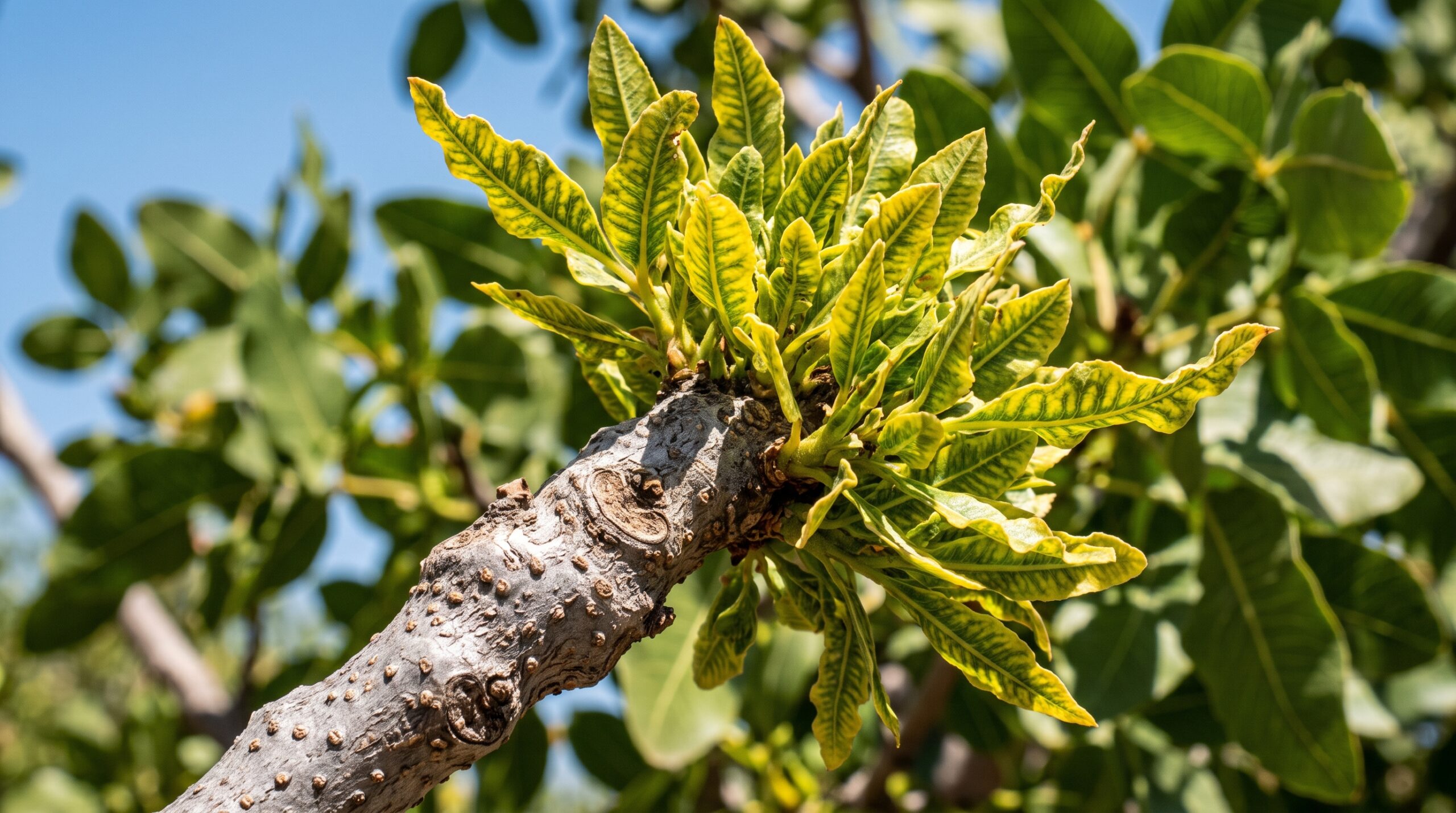
If we walk through a pistachio orchard in late spring and see shoots with tiny leaves, almost non-existent internodes and stunted-looking canopies, we are most likely dealing with zinc deficiency in pistachio. 🌱 It is one of the most common nutritional deficiencies in the arid and semi-arid Mediterranean-type growing regions, and one of the deficiencies that costs the most yield when nobody detects it in time.
At Agro Vivero del Mediterráneo, we support growers of every size at each stage of the crop, from choosing the right pistachio plants to establishing and maintaining the orchard. That is why we have seen many times how a small, easily corrected problem ends up causing a significant loss of harvest simply because its signs were not recognised.
In this article, we explain in clear language and from field experience how to recognise the symptoms of zinc deficiency, why it appears, how to confirm it and which solutions really work. We also explain how to prevent it from the design stage of the orchard. 🔍
What Is Zinc Deficiency in Pistachio and Why Is It So Common?
Zinc is a micronutrient: the tree needs it in very small amounts, but it cannot do without it. When it is lacking, shoot growth and normal leaf development are disrupted, and the whole tree suffers.
Zinc deficiency in pistachio trees is common for a simple reason: pistachio is often grown on land where zinc is present, but the plant cannot absorb it. We are talking about calcareous, alkaline soils with low organic matter or soils that are heavily leached. In other words, in many cases zinc is in the soil, but it is not available to the tree.
This explains why a soil analysis with apparently acceptable values guarantees nothing. It also explains why two neighbouring plots can behave very differently, depending on their pH, texture and irrigation management.
The Role of Zinc in Pistachio Nutrition
To understand how serious the problem is, it helps to know what zinc does inside the tree. In pistachio nutrition, this element takes part in key processes:
- 🌿 Auxin production, the hormones responsible for shoot and internode elongation.
- ⚙️ Enzyme activation involved in photosynthesis and protein synthesis.
- 🧬 Chlorophyll formation and maintenance of cell membrane structure.
- 🌸 Flower set and development, with a direct effect on nut yield.
If zinc is scarce, the plant cannot produce auxins normally and the shoots stay short. This results in the typical rosette on shoots, the most recognisable symptom of this deficiency.
Symptoms of Zinc Deficiency in Pistachio: How to Recognise Them
Symptoms appear first on young shoots and recently grown leaves, because zinc is poorly mobile within the plant. These are the signs we should watch for in the field:
- Small, narrow leaves 🍃. This is the so-called little leaf of pistachio: the leaflets are smaller than normal, sometimes lance-shaped and with wavy margins.
- Rosettes at the tips of shoots. The internodes become so short that the leaves cluster at the tip, like a small bouquet.
- Interveinal chlorosis in pistachio. The leaf blade lightens and takes on a yellowish or pale green tone, while the veins keep a more intense green.
- Delayed and uneven budbreak. Some branches break bud late or very poorly.
- Reduced annual growth and thin canopies, especially visible in young orchards.
- Leaf drop in severe cases, leading into a spiral of tree weakening.
- Lower fruit set and reduced yield, with smaller nuts and, occasionally, a higher percentage of blank nuts.
A practical detail: the deficiency rarely affects all trees equally. It tends to concentrate in patches within the plot, normally where the soil is more calcareous, more compacted or has poorer drainage. Walking through the orchard attentively, row by row, is the best way to detect it early. 👀
Severity Stages: From Mild to Severe Deficiency
Not all situations are the same. In our experience, it is worth distinguishing three levels, because the urgency and the strategy change:
| Level | What we observe | What it usually implies |
|---|---|---|
| Mild | Slight reduction in leaf size and slightly shorter shoots | Little visible loss, but yield potential is already declining |
| Moderate | Small leaves, interveinal chlorosis and isolated rosettes | Clear decline in growth and fruit set |
| Severe | Widespread rosettes, defoliation and dead branches | Significant crop loss and risk to the tree’s structure |
Detecting it at the mild stage is the most cost-effective approach: correction is simpler and cheaper, and recovery is faster.
Not Everything Yellow Is Zinc: How to Tell Other Deficiencies Apart
One of the most repeated mistakes in the field is treating a problem with zinc when it is actually something else, and vice versa. These are the most frequent confusions among nutritional deficiencies in pistachio:
| Deficiency | Where it appears first | Distinctive feature |
|---|---|---|
| Zinc | Shoots and young leaves | Small leaves, rosette and short internodes |
| Iron | Young leaves | Uniform yellowing with green veins, without internode shortening |
| Manganese | Young leaves | Chlorotic mottling, with normal leaf size |
| Nitrogen | Old leaves | General yellowing that starts at the bottom of the tree |
| Magnesium | Mature leaves | Yellowing at the margins with the central area remaining green |
The key distinguishing feature of zinc is the reduced leaf size and shortened internodes. When there is only chlorosis without that deformation, we tend to suspect iron or manganese. Even so, we never rely on visual observation alone: definitive confirmation comes from analysis. 🧪
Causes of Zinc Deficiency: Why It Appears in Your Orchard
Understanding the origin allows us to correct and, above all, to prevent. These are the causes we see most frequently:
- High soil pH. Above 7.5 or 8, zinc availability drops dramatically. This is the most common cause in our growing regions.
- Calcareous soils. Excess calcium carbonate fixes zinc and makes it hard to absorb. Calcareous soils are, in fact, the typical scenario for this deficiency.
- Low organic matter. Organic matter helps keep zinc in usable forms, and its scarcity aggravates the problem.
- Excess phosphorus. Very intensive phosphate fertilization can interfere with zinc uptake, a well-known antagonism.
- Sandy, leached soils. They lose micronutrients easily, especially with very heavy irrigation.
- Compaction and poor drainage. A weak or waterlogged root system absorbs any nutrient less effectively.
- Previous earthworks. Levelling plots can leave subsoil on the surface, which is much poorer in micronutrients.
- Unsuitable rootstock choice. Not all rootstocks behave the same way in terms of micronutrient uptake efficiency.
As we can see, the origin is almost never a single cause, but rather a combination. That is why technical advice before planting prevents a large share of these problems.
How to Diagnose Zinc Deficiency: Leaf and Soil Analysis
Seeing the symptoms is the first step, but treating “by eye” is expensive and ineffective. To decide with sound criteria, we recommend combining three tools:
- Field observation, locating the affected areas within the plot.
- Soil analysis, which tells us the pH, active lime, organic matter and total zinc content.
- Leaf analysis in pistachio, the most reliable test to find out what the tree has actually absorbed.
Leaf analysis in pistachio is normally carried out in mid-July, sampling fully developed leaves from current-season shoots, following a uniform sampling protocol per plot and variety. As a guide, these are the ranges we usually work with for leaf zinc:
| Leaf zinc level | Indicative interpretation |
|---|---|
| Below 7 mg/kg | Clear deficiency |
| Between 7 and 10 mg/kg | Marginal level, risk of deficiency |
| Between 10 and 15 mg/kg | Transition zone, monitoring advisable |
| Above 15 mg/kg | Sufficient level |
These values are general references and may vary depending on the laboratory, the variety and local conditions. A technician should interpret them together with all other elements, because in plant nutrition balances matter as much as isolated figures. ⚖️
Solutions to Correct Zinc Deficiency in Pistachio
There are three main routes to correct zinc deficiency, and in practice they work better combined than separately.
Foliar Zinc Application: The Fastest Solution
Foliar zinc application is the most direct route, because it bypasses the soil problem and the nutrient reaches the leaf. It is the correction of choice when the symptom is already visible. The most commonly used products are:
- Zinc sulphate, economical and widely used. It is applied in solution at moderate concentrations during the growing season, taking care not to cause foliar burn.
- Zinc chelates, normally with EDTA, which are more stable and better tolerated by the plant.
- Specific liquid zinc formulations, with adjuvants that improve adhesion and penetration.
Some practical tips from the field:
- 💧 We wet the foliage thoroughly, especially the young shoots, which need it most.
- 🌤️ We treat early in the morning or in the evening, avoiding the hours of intense heat and wind.
- 🚫 We do not mix products without checking compatibility.
- 📋 We always follow the manufacturer’s technical data sheet for dose and conditions of use.
A single application is rarely enough. The usual approach is to repeat the treatment after 15 to 20 days and, if the deficiency is recurrent, to plan it every season within the treatment calendar.
Soil Application and Fertigation
The root route is slower, but its effect is longer lasting. Zinc chelates applied to the soil, or through fertigation, help maintain a constant supply, especially in orchards with localised irrigation. In highly calcareous soils, it is essential to choose chelates that are stable at high pH, otherwise a large part of the product will be lost before reaching the root.
It is worth remembering that in soils with very high pH, correction through the soil alone is usually inefficient. Hence the safest strategy is to combine soil and foliar applications.
Improving Soil Conditions
Correcting the symptom is not enough if the cause persists. To reduce recurrence, we work on:
- 🌾 Increasing organic matter with compost, well-matured manure or cover crops.
- 🧱 Improving structure and drainage, avoiding compaction and waterlogging.
- 🔬 Adjusting phosphate fertilization, to avoid excesses that block zinc.
- 💦 Optimising irrigation, avoiding unnecessary leaching.
Indicative Action Calendar
To give a clear idea of when to act, this outline summarises how we organise crop management in relation to this deficiency:
| Timing | Recommended action |
|---|---|
| Winter | Review the soil analysis and plan the season’s fertilization |
| Start of budbreak | First preventive foliar application in plots with a history of deficiency |
| 15-20 days later | Second foliar application, monitoring the response of the shoots |
| Spring-summer | Chelate supply through fertigation if the irrigation system allows it |
| Mid-July | Leaf sampling for leaf analysis |
| Autumn | Assess the results, amend the soil and adjust the plan for the following year |
Every plot has its own particularities, and this calendar should be adapted to the climate, the variety and the age of the trees. 📅
Prevention from the Design Stage: The Best Way to Avoid Deficiency
Correcting costs money and time; preventing costs less. If we are planning a new orchard, there are decisions that make a difference from day one:
- Analyse the soil before planting, paying special attention to pH, active lime and texture.
- Choose the pistachio rootstock carefully, assessing its behaviour in calcareous soils and its micronutrient uptake efficiency.
- Prepare the plot with care, avoiding leaving poor subsoil on the surface after earthworks.
- Design a good irrigation system, one that allows precise fertigation.
- Start with quality planting material, healthy, well-formed and with a vigorous root system.
We insist on this last point. A pistachio plant produced in a nursery with high standards, with a well-developed root system and no starting stress, responds better to any soil condition and recovers sooner from any occasional deficiency. 🌳
Common Mistakes When Treating Zinc Deficiency
These are the mistakes we see most often, and which are worth avoiding:
- ❌ Diagnosing only by leaf colour without confirming with analysis.
- ❌ Applying zinc to calcareous soil with poorly stable products, losing a large part of the input.
- ❌ Treating during hours of maximum sunlight, causing burns.
- ❌ Waiting until the tree is very weakened before acting.
- ❌ Overusing phosphorus, without considering its antagonistic effect on zinc.
- ❌ Carrying out a single treatment and not checking the response.
- ❌ Ignoring the origin of the problem and merely fighting the symptom every year.
How Does Zinc Deficiency Affect Orchard Profitability?
Zinc seems a minor element, but its economic effect is not. A tree with a deficiency grows less, forms less productive wood and sets fruit worse. In young orchards, moreover, the delay in development translates directly into the moment when the investment begins to pay off.
That is why the control of nutritional deficiencies in pistachio is part of any serious analysis of orchard profitability. If you want to see how the costs, revenues and timelines of a farm fit together, you can consult our page on the profitability of a pistachio orchard. A well-planned micronutrient programme usually costs a fraction of what is lost by not carrying it out. 💰
Small and Large Growers: The Same Problem, Different Scale
Zinc deficiency affects a grower with a plot of a few hectares just as much as one managing hundreds. What changes is how it is tackled:
- Small growers: they usually benefit from an accurate diagnosis and a simple calendar, with a few well-chosen and well-justified treatments. The goal is not to overspend and not to fail on the essentials.
- Large growers: they need to systematise sampling by plot, plan treatment logistics and optimise fertigation in order to act efficiently over large areas.
In both cases, technical advice makes the difference between acting blindly and making decisions based on data. Through our services, we support you from the design of the orchard to the monitoring of every season. 🤝
Frequently Asked Questions About Zinc Deficiency in Pistachio
What is the first symptom of zinc deficiency in pistachio?
Normally, smaller and narrower leaves on new shoots, together with short internodes that give a rosette-like appearance.
Can a tree with zinc deficiency be recovered?
Yes, especially if it is detected early. Shoots that are already affected do not always recover, but subsequent growth usually returns to normal after proper correction.
When is the best time to apply zinc?
Foliar applications are made during the growing season, starting at the beginning of budbreak and repeating according to the response. Soil corrections are planned together with the season’s fertilization.
Is a soil analysis enough?
No. Soil analysis is very useful, but leaf analysis tells us what the tree has actually absorbed. The ideal is to combine both.
Can it reappear every year?
Yes, if the cause is not addressed. In calcareous or high-pH soils, it is common to need to maintain a preventive programme every season.
The Next Step to Protect Your Orchard
Zinc deficiency in pistachio is a very common problem, but a perfectly manageable one when we know how to recognise it, confirm it with analysis and treat it with sound criteria. We have seen that its clearest signs are little leaf, rosettes on the shoots and interveinal chlorosis, that its origin usually lies in high pH and calcareous soils, and that the best solution combines foliar application, soil inputs and improved soil conditions.
But above all, we have seen that prevention is best: starting with good planting material, choosing the right rootstock and planning nutrition from the beginning.
At Agro Vivero del Mediterráneo, we are by your side at every stage of the orchard. If you have doubts about the condition of your trees or want to plant with guarantees, contact us and we will advise you. And if you already have your project clear, you can request your quotation directly through our booking and quotation form. You can also learn more about us on our website. 🌰✨
Need a quote?
Tell us about your project and we will send you a proposal with no obligation.
Request a quote