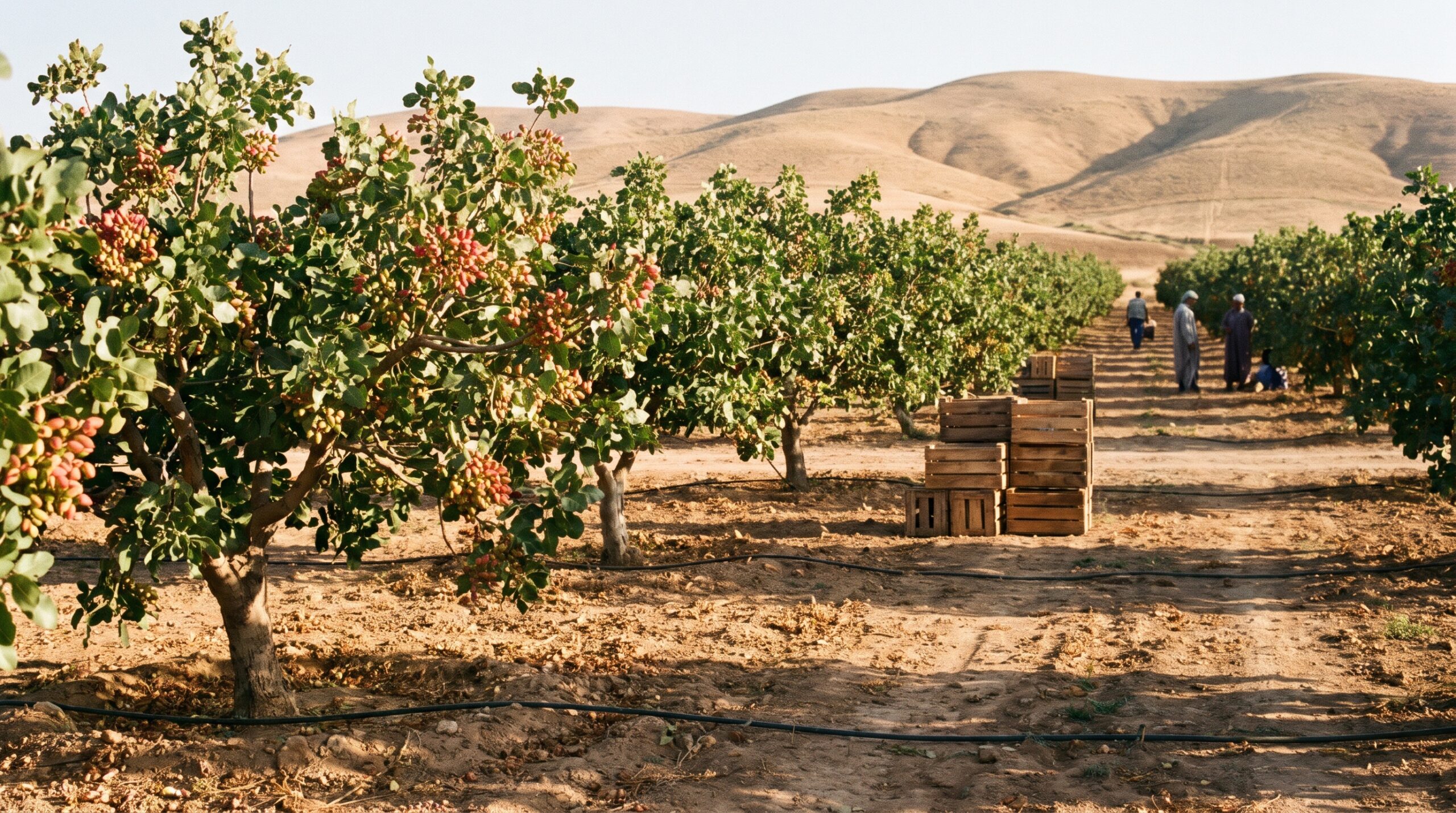
Yes, pistachio can become a commercial tree crop in Morocco, but not just anywhere and not in just any way. 🌳 The climate of much of the country’s interior suits the needs of the pistachio tree, domestic consumption is growing every year, and the Moroccan authorities have already placed this tree nut within their agricultural strategy. Even so, water, site selection and the quality of the planting material weigh as much as the climate.
At Agro Vivero del Mediterráneo we work every day with pistachio plants for growers who want to start or expand an orchard, and we know what separates a profitable operation from one that struggles for years. That is why we want to analyse, honestly and without hype, what it takes for pistachio cultivation in Morocco to work in practice, both for those starting with a few hectares and for those planning an investment of hundreds. 🔍
This guide is written for small-scale growers and large-scale growers who are considering planting pistachios in North Africa, or comparing this crop with other tree-crop options.
Why Morocco is now looking at pistachio 🇲🇦
Morocco has spent years looking for alternatives to the crops that consume the most water. After several consecutive drought seasons, the question of what to plant and with what water is no longer theoretical for thousands of growers.
The Generation Green 2020-2030 strategy includes pistachio among the crops it aims to promote in arid and semi-arid areas, with a twofold objective: diversifying production and reducing external dependence. The Oriental and Marrakech-Safi regions are two of the most frequently cited, and the varieties most often mentioned are Kerman and Larnaka.
There is also a market reason. In 2025 Morocco imported a record 4,050 tonnes of pistachios, worth USD 33.9 million. That is 27.5% more than the previous year and more than eleven times what it bought in 2019. Around 92% came from the United States.
Put differently: there is domestic demand, money is leaving the country, and almost all of the supply depends on a single supplier. Pistachio imports do not guarantee the success of any particular orchard, but they do confirm that there is a real opportunity worth serious analysis. 🎯
Moroccan climate and pistachio: where it fits best ☀️
The pistachio tree thrives in dry Mediterranean and continental climates: long, hot summers with low ambient humidity, and winters cold enough for the tree to rest and break bud vigorously in spring. That combination, which we know well in our own growing areas, occurs across large parts of Morocco’s interior.
When we assess a site, we look at four aspects:
- Chilling hours in winter sufficient for the chosen variety. Kerman is the world reference but needs considerable cold; in mild winters, other options such as Larnaka should be considered.
- Hot, dry summers, which favour nut filling and reduce disease pressure.
- Low risk of late frosts once the tree has broken bud.
- Moderate ambient humidity during ripening, to prevent fungal diseases.
The pistachio tree tolerates intense heat very well and, when dormant, withstands low temperatures. Its weak point is spring frost. That is why, before planting, we always ask for real climate data from the site itself and not just from the surrounding district. 🌡️
The Oriental and Marrakech-Safi areas broadly fit this profile. The Atlantic coast, more humid and with very mild winters, raises more questions and calls for a much finer analysis.
Another detail we usually check is the altitude and aspect of the site. A south-facing slope with good cold-air drainage can spare the trees from frosts that do hit a nearby low-lying hollow. Sometimes a few metres of difference between two plots on the same farm separate a full harvest from a lost season.
Water: the key issue for pistachio in Morocco 💧
Let us be clear. The pistachio tree is one of the most drought-resistant tree nut crops, but resistant does not mean it needs no water. Without irrigation it survives in harsh conditions; to produce regular commercial crops it needs water during fruit set and nut filling, and also during recovery after harvest.
In Spain, three models coexist: rainfed cultivation in areas with sufficient rainfall, regulated deficit irrigation with allocations below 1,500 cubic metres per hectare per year, and full irrigation with higher allocations. A similar range can be considered in Morocco, adapted to each basin and to real water availability.
There is also a lesson the country itself has already lived through. Earlier programmes promoted water-intensive plantings that put pressure on aquifers, and several studies warn that planting trees without sound water management can end up being a form of maladaptation to drought. Pistachio only makes sense if it is planned carefully:
- Drip irrigation scheduled on soil and climate data.
- Regulated deficit irrigation during the less sensitive stages of the cycle.
- Water analysis, covering quantity as well as quality and salinity.
- Soil cover to reduce evaporation.
- Clear water-use rights over wells, storage ponds or concessions.
Quality matters as much as quantity. Saline water accumulates salts in the soil year after year and, over time, limits growth and yield even if the tree is tolerant.
A plot without secured water is not a good candidate, however cheap the land. 🚫
Soils for planting pistachios in Morocco 🌱
The pistachio tree prefers deep, loose, well-drained soils. It tolerates limestone, high pH and salinity levels that would damage other species, which makes it interesting for marginal land in arid zones. What it does not forgive is waterlogging: excess water around the roots opens the door to diseases such as Phytophthora.
Before planting we always recommend:
- Digging soil pits to check effective depth and the presence of hardpans.
- Carrying out a complete physico-chemical soil analysis.
- Measuring infiltration and drainage.
- Avoiding compacted clay soils, even when they are cheap.
A good soil analysis costs a fraction of what it takes to replant a badly chosen plot. 🔬
Varieties and rootstocks: what shapes the result most 🌿
Choosing the variety and the rootstock is the technical decision hardest to correct later, because the tree will live and produce for many years.
Varieties. Kerman is the world reference variety for its nut size, quality and productivity, although it requires considerable winter cold. Larnaka, of Cypriot origin, is mentioned among those being used in Morocco and adapts better to milder winters. In both cases, the female tree needs a male with overlapping flowering: the pistachio is dioecious and pollination cannot be left to chance. As a guideline, we usually plant one male for every eight to ten females.
Rootstocks. There are several options here. Pistacia atlantica is a species native to North Africa and very hardy. Pistacia terebinthus, the terebinth, is widely used in rainfed orchards. And there are vigorous hybrids such as UCB-1, which develop well in fertile, warm soils but require careful consideration of cold risk.
The compatibility between variety, rootstock and soil matters more than it seems. A vigorous rootstock in a poor soil without enough water yields below expectations, and a hardy rootstock in a very fertile soil may waste the variety’s potential. That is why we never recommend generic combinations: we decide them with the data of each plot in front of us.
A practical piece of advice: always buy certified grafted plants with a phytosanitary guarantee. It is increasingly common to plant larger grafted plants that already have some development because, although they cost more, they bring forward the first harvests. You can see our range of pistachio plants and ask us which one best suits each area. 🌿
Areas of Morocco: a first orientation 🗺️
This table summarises our initial reading. It is only a guide and does not replace a site assessment of each plot.
| Area | In favour | To watch | First reading |
|---|---|---|---|
| Oriental | Continental semi-arid climate; cited as a priority | Water scarcity; local frosts | Promising with controlled irrigation |
| Marrakech-Safi | Hot, dry summers; experience with tree crops | Pressure on aquifers; extreme heat | Promising with secured water |
| Fez-Meknes | Winters with enough cold; deep soils | Spring humidity; frosts | Interesting on well-chosen plots |
| Draa-Tafilalet | Heat and salinity tolerance | Saline soils; scarce water | Specific cases and pilot plots |
| Atlantic coast | Water available in some areas | High humidity; few chilling hours | Maximum caution |
Pistachio compared with other tree crops in Morocco ⚖️
Many growers ask us whether pistachio pays off compared with what they already know. This comparison, always indicative, helps place it:
| Crop | Water use | Product value | Time to production | Point to watch |
|---|---|---|---|---|
| Pistachio | Moderate | High | Slow (5 to 7 years) | Value chain still emerging |
| Almond | High | Medium-high | Medium (3 to 4 years) | Early flowering and frosts |
| Olive | Moderate | Medium | Medium (3 to 5 years) | Prices and competition |
| Citrus | Very high | Medium | Medium (3 to 4 years) | Pressure on water |
| Carob and fig | Low | Medium-low | Slow | More limited market |
Pistachio does not have to replace the rest, and in fact it should not: diversification protects the farm. Its advantage lies in combining a high value per kilogram with moderate water demand. Its drawback is a slow start that demands patience and financial planning.
The first years: management that shapes the orchard 🛠️
The first three or four years decide much of the tree’s future. At this stage it is worth paying particular attention to the following:
- Establishment irrigation, frequent and light, so that the plant settles in without stress.
- Formative pruning that defines a clean trunk and three or four well-distributed main branches.
- Protection against rabbits, hares and rodents, with tree shelters or mesh.
- Weed control around the trunk to avoid competition for water and nutrients.
- Moderate fertilisation, based on analysis and not on generic recipes.
A common mistake is to push the tree with excess fertiliser and water to speed up the start of production. What this achieves is weak growth that is more vulnerable to disease. We prefer a balanced tree to a hurried one. 🌳
Market: domestic demand and added value 🛒
If demand is growing, what does Morocco need in order to take advantage of it? Producing is not enough. Pistachios are sold in the shell or shelled, roasted, as paste, in confectionery, as oil or as an ingredient. The more value is added at origin, the better the orchard withstands price fluctuations.
Three factors will make the difference:
- Post-harvest infrastructure: hulling, rapid drying, grading and storage. Without it, quality is lost within a few hours.
- Aflatoxin control, essential for any demanding market. A badly handled harvest may be excluded from sale.
- Grouping of producers, because cooperatives make it possible to share machinery, processing facilities and marketing.
We should also look at the consumer. In Morocco, pistachio is associated with pastry, traditional sweets and snacks, and that demand keeps growing. An orchard that thinks from the outset about nut size, colour and kernel cleanliness, and not only about kilograms, reaches any buyer in a better position.
In the medium term, geographical proximity to Europe and commercial ties with Africa could open the door to exporting tree nuts and processed products. But that step will only come when the country covers a relevant share of its own demand with local production of consistent quality. 📦
Pistachio profitability: timeframes, investment and realistic expectations 📊
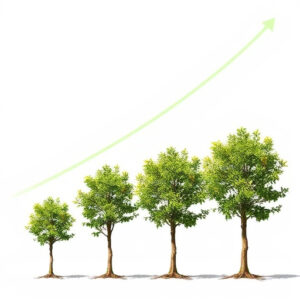
Plainly put: the pistachio tree is a long-term investment. A well-managed grafted plant may give its first harvests between the fifth and seventh year, commercial production consolidates around the seventh or eighth, and full production comes after twelve or fifteen years. From then on, a well-cared-for tree can produce for a long time.
A practical example: with a planting spacing of 6 × 5 metres, one hectare holds about 333 trees. In an adult orchard with good management, indicative yields range between 2,000 and 3,000 kg of in-shell nuts per hectare, although they vary with water, variety and alternate bearing. As the price changes every season, gross income per hectare can clearly exceed that of extensive crops, but the costs of irrigation, labour, treatments and harvesting must be deducted.
Four ideas for discussing pistachio profitability realistically:
- Plan liquidity for the first years without income.
- Phase the investment in stages.
- Calculate the cost of water with real data, not estimates.
- Review the scenario using conservative prices.
If you want to go deeper into the numbers, you can consult our page on the profitability of a pistachio orchard, where we explain scenarios and timeframes. 💶
Annual work calendar of the pistachio tree 📅
Knowing the tree’s annual rhythm helps plan labour, water and treatments. As a general guide for Mediterranean and semi-arid areas, the year is organised as follows:
| Season | What happens in the tree | Main tasks |
|---|---|---|
| Winter | Vegetative rest and accumulation of chilling | Formative or maintenance pruning, base fertilisation, irrigation system check |
| Spring | Bud break, flowering and fruit set | Frost monitoring, pollination, first irrigations and health control |
| Summer | Growth and nut filling | Adjusted irrigation, pest and disease control, ground cover management |
| Autumn | Ripening and harvest | Harvesting, immediate drying, grading and storage |
This calendar changes with the area and the variety, but it helps anticipate the moments of highest labour demand. Harvesting and drying, for example, concentrate activity into a few weeks, and a delay of a few hours between harvest and drying can affect the quality of the nuts. ⏱️
Risks and limitations we should not hide ⚠️
An honest article must also talk about what can go wrong. These are the main risks we see:
- Alternate bearing. The pistachio tree tends to alternate years of heavy crop with years of light crop. Good management of pruning, irrigation and nutrition reduces it, but does not eliminate it.
- Late frosts. A frost after bud break can ruin a year’s harvest.
- Fungal diseases. Botryosphaeria, Alternaria or Verticillium are the most feared, especially in humid areas or poorly drained soils.
- Pests. Insects such as stink bugs, which pierce the nut and spoil its quality, must be monitored.
- Labour and machinery. Pruning, management and harvesting require trained staff and, on large areas, specific machinery.
- Capital and timeframes. The first income takes years to arrive; financial strength or well-planned support schemes are needed.
- Planting material without guarantees. Poor-quality plants affect the orchard throughout its productive life.
None of these risks invalidates the crop. But all of them are better managed when anticipated from day one. 🧠
Sustainability and impact on the territory 🌍
Well planned, pistachio can offer more than a harvest. It is a long-lived tree with deep roots that helps hold the soil and curb erosion in arid areas. It creates rural employment in pruning, harvesting and processing, and can help farming families diversify their income.
For that impact to be positive, three aspects need care: not over-exploiting aquifers, maintaining ground covers that favour biodiversity, and avoiding monoculture over large areas. An orchard that coexists with other production and with native vegetation, such as the region’s own Pistacia species, is more resilient and better accepted by its surroundings. 🌾
Small-scale and large-scale growers: two ways in 👨🌾
Small-scale growers. A plot of between one and ten hectares can be a good starting point if suitable water and soil are available. The key is to diversify without giving up current income: plant in stages, keep other crops while the pistachios grow, and join other producers to process and sell together.
Large-scale growers and investors. With more land, scale allows mechanisation, setting up a processing plant of one’s own and negotiating with industrial buyers. But it also multiplies risk. We recommend a serious hydrogeological study, a phased planting plan and pilot plots before committing hundreds of hectares.
In both cases, the principle is the same: start with data and not with assumptions. Our team adapts the approach to the size and objectives of each project, as you can see in our technical advice services. 🤝
Roadmap for planting pistachios in Morocco in seven steps 🧭
- Site assessment: soil, water, climate and frost risk.
- Choice of variety and rootstock: based on chilling hours, salinity and the commercial objective.
- Orchard design: spacing, pollinisers, irrigation and fencing.
- Certified planting material: grafted plants with a health guarantee and with phytosanitary formalities in order for their transport.
- Planting and early care: protection, stakes and establishment irrigation.
- Training in pruning and management: the first years define the tree’s structure.
- Post-harvest and sales plan: drying, storage and marketing defined before the first harvest.
Each step builds on the previous one, and skipping any of them usually proves costly. If the plants come from Spain, it is also advisable to confirm in advance the import requirements set by the Moroccan phytosanitary authorities. 📋
Frequently asked questions about pistachio in Morocco ❓
Can pistachio be grown in Morocco without irrigation? In areas with sufficient rainfall and deep soils it can survive under rainfed conditions, but producing regularly usually requires at least supplementary irrigation at critical moments. The drier the area, the more necessary water becomes.
How long does an orchard take to produce a harvest? The first harvests come between the fifth and seventh year with grafted plants and good management. Production stabilises much later.
Which variety is best for Morocco? There is no single answer. Kerman and Larnaka are the most frequently mentioned today; the decision depends on chilling hours, frost risk and the type of market to be reached.
Does pistachio use less water than almond or citrus? Under comparable conditions it usually uses less, which is why it fits better in arid areas. Even so, it requires technical irrigation management.
Can small-scale growers take part? Yes, especially if they group together to share machinery, processing and sales.
What minimum area is worth planting? There is no single figure, but with very small areas it is hard to amortise irrigation, machinery and processing. That is why grouping among producers is so useful.
Should growers wait until the crop is established before planting? Not necessarily, but it is advisable to start with pilot plots and learn from the first cycle before expanding the area.
How we can support you at Agro Vivero del Mediterráneo 🌳
We support growers throughout the whole process: from choosing the plants to designing the orchard and following up afterwards. If you are considering planting pistachios in Morocco or in another Mediterranean area, we start by listening to your case: area, available water, climate and objectives. With that information we help you decide whether it is worthwhile and how to do it with confidence.
You can contact our team to put your questions to us or, if you are already clear about the project, request a quote and reserve plants through the form. The sooner an orchard is planned, the better the planting material for each season can be reserved. 📩
To wrap up ✅
Answering the initial question: yes, pistachio has real prospects of becoming a commercial tree crop in Morocco. There is a suitable climate in several areas, growing domestic demand, a dependence on imports that the country wants to reduce, and the backing of a national strategy that includes it.
But success will depend on doing it well. What we should remember:
- Choose plots with secured, good-quality water.
- Match the variety and rootstock to chilling hours and frost risk.
- Plant certified material and take care of the first years.
- Prepare post-harvest handling and sales before the first harvest.
- Accept long timeframes and calculate profitability prudently.
If you want to know whether your plot is suitable or need a quote for your orchard, we are at your disposal. Tell us about your project and we will study it together. 🌱
Need a quote?
Tell us about your project and we will send you a proposal with no obligation.
Request a quote