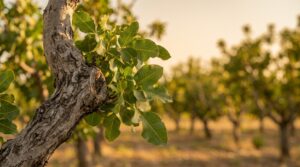
Greetings to all pistachio enthusiasts! From Agro Vivero del Mediterráneo, where we are specialists with years of experience in the fascinating world of the pistachio tree, we want to share with you an exhaustive guide on a crucial element, often underestimated, for the success of your plantations: the use of the stake. Correct staking during the first stages of the tree’s life is fundamental to ensure optimal growth, a strong structure and, ultimately, a more productive and profitable plantation in the long term. 📈
We understand that every detail counts when seeking excellence in pistachio cultivation. Therefore, we have poured our knowledge into this article so that you can make the best decisions on your farms. Join us on this tour!
The Strategic Importance of the Stake in the Young Pistachio Tree
When we start a new pistachio plantation, starting from pistachio plants of the highest quality, we find young and vulnerable specimens. During its first years, the pistachio tree concentrates its energy on developing a robust root system and a trunk that, over time, must support the weight of a productive canopy. This is where the stake becomes an indispensable ally.
Why is it so crucial? 🤔
-
Vertical Growth Guide: The main objective of the stake is to ensure that the pistachio tree trunk grows straight and upright. This is vital for the future structure of the tree, facilitating training pruning tasks and, later, mechanized harvesting. A crooked trunk can compromise the stability of the tree and greatly hinder agricultural operations.
-
Protection against External Agents: Young trees are susceptible to wind 🌬️, which can bend, snap or even uproot them if they are not well anchored. The stake offers firm support that mitigates these risks. In addition, it protects against accidental damage caused by agricultural machinery or animals during maintenance tasks.
-
Facilitates Tree Training: A straight trunk thanks to the stake allows for more precise and efficient training pruning. This is key to defining the height of the crotch (where the main branches will branch out) and the structure of the canopy, aspects that will directly influence entry into production and the longevity of the plantation.
-
Prevents Post-Transplant Water Stress: Although it may seem indirect, a well-staked and stable tree suffers less stress. If the wind moves it constantly, young roots have difficulty settling and absorbing water and nutrients efficiently.
-
Optimization for Future Mechanization: Thinking long-term is essential. A uniform and vertical trunk is a requirement for the efficient use of trunk shakers in harvesting, a practice increasingly widespread to optimize costs and times.
At Agro Vivero del Mediterráneo, we always insist that the initial investment in a good staking system translates into considerable savings and benefits throughout the life of the pistachio plantation.
Types of Stakes for Pistachios: Materials and Considerations
The market offers various stake options, and the choice will depend on several factors that we will analyze later. Let’s get to know the most common materials:
-
Bamboo Stakes: 🎋
-
Advantages: They are light, economical and relatively flexible. Their natural origin can be an attraction for some farmers.
-
Disadvantages: Their durability is limited, especially in contact with soil and moisture, potentially degrading in 2-4 years. They can be attacked by insects or rot. Their resistance to very strong winds may be insufficient for somewhat developed trees.
-
Considerations: They are a viable option for the first few years or in areas with low risk of strong winds. It is important to choose adequate diameters (minimum 20-22 mm for good initial rigidity).
-
-
Fiberglass Stakes: 💪
-
Advantages: Extremely durable (can last more than 15-20 years), resistant to corrosion, chemicals and UV rays. They are flexible, allowing some movement to the tree, stimulating trunk thickening, but recover their shape. They are light and easy to handle. They do not splinter.
-
Disadvantages: Their initial cost is higher than bamboo or wood.
-
Considerations: They represent a long-term investment. Their durability and resistance make them ideal for plantations seeking maximum efficiency and minimizing material replacement. In our experience, they are one of the most recommended options.
-
-
PVC or Rigid Plastic Stakes:
-
Advantages: Durable, resistant to moisture and chemicals. Can be reusable. Light.
-
Disadvantages: Some plastics can degrade with prolonged sun exposure if they do not have adequate UV treatment. Their rigidity can be excessive in some cases, not allowing the natural movement that favors trunk development. The environmental impact of plastics is a growing consideration.
-
Considerations: It is crucial to ensure the quality of the PVC and its UV treatment.
-
-
Treated Wood Stakes (Pine, Eucalyptus): 🌲
-
Advantages: Relatively economical and robust. If well treated (autoclave), they can have acceptable durability (5-8 years).
-
Disadvantages: Chemical treatment to increase durability can be an environmental concern. They can splinter over time. Their weight is greater than bamboo or fiberglass. Treatment quality is crucial for their longevity.
-
Considerations: Verify the type of treatment and wood certification.
-
-
Metal Stakes (Corrugated Steel, Rods): 🔩
-
Advantages: Very resistant and durable.
-
Disadvantages: They are the most expensive. They can rust if not galvanized or treated. In summer, they can reach high temperatures and damage the trunk if it comes into direct and prolonged contact. They are heavier and can be more difficult to install.
-
Considerations: Mainly used in trellises or very specific training systems, less common in pistachio for individual staking in its early stages, except for exceptions.
-
From Agro Vivero del Mediterráneo, we recommend weighing the initial investment against durability and replacement costs. Often, a higher quality and initial price stake, such as fiberglass, turns out to be more economical in the long run.
How to Choose the Ideal Stake for Our Pistachio Plantation?
Choosing the perfect stake is not universal; it depends on the specific characteristics of each plantation and the farmer’s objectives. Here are the key factors that we at Agro Vivero del Mediterráneo consider fundamental:
-
Graft Height and Desired Stake Height: The stake must exceed the height of the graft and the height at which the tree crotch will be formed. Generally, for pistachio trees, stakes of 1.50 to 1.80 meters, even 2 meters, are sought to ensure that the plant can be guided until the main trunk reaches the desired height for canopy formation (usually between 0.90 and 1.20 meters from the ground).
-
Variety and Rootstock Vigor: More vigorous plants may require more robust and taller stakes. It is important to know the characteristics of the pistachio plant we are using.
-
Climatic Conditions of the Area: In areas with strong and frequent winds, more resistant and deeply anchored stakes will be needed. 🌬️ Stake flexibility also plays a role: a stake that is too rigid can cause the tree to break above the last tie in case of hurricane-force winds, while one with some flexibility absorbs wind energy better.
-
Soil Type: In very loose or sandy soils, it may be necessary to drive stakes deeper or use stakes with special bases to ensure stability. In stony soils, installation can be more complicated.
-
Available Budget: 💰 Cost is undoubtedly a factor. However, as mentioned, long-term cost must be assessed, including replacement of lower quality stakes.
-
Expected Durability and Maintenance: If looking for an “install and forget” solution for several years, high-quality fiberglass or PVC stakes are preferable. If willing to perform more frequent checks and replacements, bamboo or treated wood can be options.
-
Sustainability and Environment: 🌍 For farmers with strong ecological awareness, bamboo (due to its rapid growth and biodegradability) or certified wood may be preferable, although their lower durability implies more replacements. Fiberglass, although synthetic, has such a long lifespan that its impact per year of use can be low.
-
Ease of Installation and Handling: Lighter stakes like bamboo or fiberglass are easier and faster to install, which can mean labor savings.
Our recommendation is not to skimp on stake quality. A good initial choice can make the difference in plantation establishment and development. If you need personalized advice, do not hesitate to consult our services.
The Optimal Time for Stake Placement
Technical consensus, and our usual practice at Agro Vivero del Mediterráneo, is clear: the stake must be placed at the time of planting the pistachio tree. 🕒
Why this urgency?
-
Minimize Root Damage: By placing the stake together with the plant, in the planting hole or immediately after covering it but before the first settling irrigation, damage to the root system that has not yet expanded is avoided. Trying to drive a stake months later, when roots have already begun to colonize the surrounding soil, carries a high risk of causing wounds that can be entry points for diseases or slow down initial plant development.
-
Immediate Support: The young plant, newly transplanted, is especially vulnerable. The stake offers stability from day one, protecting it from wind and helping it maintain verticality while settling into its new location.
-
Efficiency in Tasks: Integrating stake placement into the planting process optimizes labor and time. Doing it afterwards implies a new field operation.
If for some reason the stake could not be placed at the time of planting, it is crucial to do so as soon as possible, with extreme care not to damage roots. In this case, it is recommended to do so after irrigation, when the soil is softer and the stake penetrates more easily.
Detailed Stake Installation Process: Step by Step
Correct installation is as important as material choice. Here we detail the process we follow and recommend:
-
Necessary Tools: 🛠️
-
Stake Location:
-
Distance to Trunk: The stake should be placed about 5-8 cm from the plant trunk. Too close can prevent normal trunk thickening or cause chafing. Too far, it will not offer effective support.
-
Orientation Regarding Prevailing Wind: Generally, it is recommended to place the stake on the side of the prevailing wind. This way, the wind will push the plant against the stake, and not the other way around, which could loosen ties or damage the plant.
-
-
Driving Depth:
-
Driving or Insertion Technique:
-
If soil is compact, it may be useful to make a guide hole with a metal bar or small auger to facilitate stake penetration and ensure verticality.
-
Drive the stake with a suitable mallet, hitting the top centrally and progressively. If the stake is bamboo or wood, avoid splintering the head. For fiberglass stakes, some come with a pointed end that facilitates insertion.
-
Once driven, check its firmness by trying to move it laterally. It should not have excessive play.
-
-
Special Considerations:
-
In plantations with drip irrigation, be careful not to damage pipes or drippers when driving the stake.
-
Ensure the top of the stake has no splinters or sharp edges that could damage the tree or operators.
-
A well-installed stake is the basis for guided and safe growth.
Tying Systems: How and With What to Tie the Pistachio Tree to the Stake? 🔗
Once the stake is firmly placed, the next step is to tie the plant to it. This operation is delicate, as poor tying can be more harmful than beneficial.
Key Tying Principles:
-
Do Not Strangle: The tie MUST NEVER squeeze the trunk. It must allow progressive thickening of the tree. A tie that is too tight will cause a “strangulation” effect, damaging the cambium, hindering sap flow and potentially killing the tree or severely weakening it.
-
Firm but Flexible Hold: The plant must be held to the stake so that it fulfills its guiding function, but must have some slack to allow slight movement, which stimulates the development of a stronger trunk (thigmotropism).
-
Suitable Material: Tying material must be weather resistant, but at the same time soft so as not to damage the bark of the young pistachio tree.
Common Tying Materials:
-
Anchor Bands or Specific Agricultural Elastics: Are an excellent option. Their elasticity allows the tie to expand as the trunk thickens. They usually have UV protection for greater durability. They come in different thicknesses and lengths.
-
Elastic or Flexible PVC Tapes (Type “Buddy Tape” or similar): Materials that stretch and are sometimes self-adhesive. They are soft and adapt well to growth.
-
Synthetic or Natural Raffia: Natural raffia is biodegradable, but less durable. Synthetic lasts longer. It is economical but care must be taken not to tighten it too much.
-
Flexible Hollow PVC Tube (Macaroni): It is durable and gentle on the plant. Allows good hold without strangling if adequate slack is left.
-
Automatic or Semi-automatic Tape Tyers: These machines use plastic tape and staples. They speed up the process, but it is crucial to regulate tension well and use tapes that are not too rigid. They are more common in vineyards, but can be adapted.
Tying Technique (Figure Eight):
The most recommended technique is tying in a “figure eight” or “infinity” shape (∞):
-
Pass tying material around tree trunk.
-
Cross material ends between tree and stake.
-
Bring ends around stake and knot firmly on stake side opposite tree.
This technique ensures separation between trunk and stake, avoiding direct rubbing, and distributes pressure evenly.
Number and Height of Ties:
-
1 or 2 ties are usually placed initially, depending on plant height.
-
The first tie should be a few centimeters below the upper end of tender growth, to guide it, but without forcing it excessively.
-
As the plant grows, new ties will be added higher up, maintaining a distance of about 30-40 cm between them.
-
It is fundamental to check and adjust or redo ties periodically.
At Agro Vivero del Mediterráneo, we emphasize training our staff and farmers we advise on these techniques, as good tying is crucial.
Maintenance and Review of Stakes and Ties 🧐
Work does not end with installation. A maintenance and review program is essential:
-
Periodic Inspections: At least two or three times a year, especially after strong winds or storms, and coinciding with other cultural tasks.
-
Check Stake Firmness: Check that stakes remain well anchored and vertical. Re-drive or replace those that are loose, broken or rotten.
-
Condition of Ties: Verify that ties are not too tight (strangling trunk), nor too loose (not holding). Check integrity (not broken or degraded by sun).
-
-
Adjustment of Ties: As pistachio trunk thickens, it is ESSENTIAL to loosen or redo ties to avoid strangulation. This is one of the most common and damaging mistakes. If good quality elastic bands are used, this problem is minimized, but review is still necessary.
-
Add New Ties: As plant grows in height, new ties must be added on upper guide shoots to ensure growth remains vertical.
-
Replacement of Damaged Stakes: Bamboo or wood stakes may need to be replaced before tree is self-sufficient. It is important to do so carefully so as not to damage plant.
This monitoring is vital during first 2-4 years of tree life.
When is the Time to Remove the Stake?
The stake is not a permanent element. A time will come when the pistachio tree will have developed a trunk thick, lignified and strong enough to support itself and support its future canopy. 🌱➡️🌳
Criteria for Removal:
-
Trunk Thickness: Generally, when trunk reaches diameter of 5-7 cm at crotch height, it is usually sufficient. This may vary by variety and growing conditions.
-
Lignification and Rigidity: Trunk must be well lignified (woody) and not bend easily with wind once support is removed.
-
Self-support: Tree must be able to stand upright without stake, even under moderate wind conditions.
-
Tree Age: Usually coincides with 3-5 years after planting, but tree development is main indicator, not just age.
Removal Process:
-
Remove ties carefully first.
-
Extract stake from ground. If very stuck, may be necessary to move gently side to side to loosen before pulling up. Try not to disturb nearby roots too much.
-
If stake is reusable (fiberglass, PVC), clean and store properly for future plantings.
Removing stake too early can cause tree to bend or snap. Leaving too long can be unnecessary and even harmful if ties have not been managed correctly or if stake interferes with trunk thickening.
Common Mistakes in Pistachio Staking and How to Avoid Them ❌➡️✔️
In our trajectory at Agro Vivero del Mediterráneo, we have observed some recurring mistakes that can compromise staking success. Knowing them is first step to avoid them:
-
Using Stakes Too Short or Weak: A stake that does not exceed desired training height or bends easily with plant weight or wind will not fulfill its function.
-
Solution: Choose stakes of appropriate length and robustness according to recommendations.
-
-
Ties Too Tight (Strangulation): Most serious and common mistake. Causes severe damage to tree.
-
Solution: Use “figure eight” technique, elastic materials and check/loosen ties periodically.
-
-
Driving Stake Too Close to Trunk or Damaging Roots: Can cause wounds, impede development or affect nutrient absorption.
-
Not Checking or Maintaining Staking System: Thinking that once installed requires no more attention.
-
Solution: Establish review and maintenance schedule.
-
-
Removing Stake Prematurely: When tree is not yet able to support itself.
-
Solution: Carefully evaluate trunk development before deciding removal.
-
-
Leaving Ties After Removing Stake: Sometimes stake is removed, but ties are forgotten, which will continue to strangle tree.
-
Solution: ALWAYS remove all ties when removing stake.
-
-
Using Abrasive or Cutting Tying Materials: Can damage tree bark.
-
Solution: Choose soft materials specific for agricultural use.
-
Avoiding these mistakes is fundamental for staking to be a help and not a problem.
Long-Term Benefits of Correct Staking in Pistachio Plantations
Investment of time and resources in adequate staking translates into multiple benefits projected throughout entire productive life of pistachio plantation:
-
Stronger and Well-Structured Trees: With straight trunks and solid base to develop balanced and productive canopy.
-
Optimized Entry into Production: Correct initial formation, facilitated by stake, allows tree to reach adult structure sooner and begin producing quality nuts.
-
Ease for Agricultural Tasks:
-
Pruning: Straight trunk and well-defined crotch greatly simplify training and production pruning tasks.
-
Phytosanitary Treatments: Orderly structure allows better product penetration.
-
Harvesting: Especially crucial for mechanized harvesting with shakers, which require straight and cleared trunks at appropriate height. This directly impacts plantation profitability.
-
-
Greater Plantation Longevity: Well-formed and structurally sound trees are more resistant to diseases, pests and adverse weather conditions, contributing to longer productive life.
-
Reduction of Losses: Fewer trees broken or damaged by wind or poor development.
-
Uniformity in Plantation: Staking contributes to achieving greater homogeneity in tree development, facilitating general farm management.
In short, good staking is one of cornerstones for building efficient, productive and profitable pistachio plantation.
Agro Vivero del Mediterráneo: Your Ally in Pistachio Cultivation
At Agro Vivero del Mediterráneo, we not only dedicate ourselves to producing pistachio plants of highest genetic and sanitary quality, but we also offer complete range of technical advisory services to accompany you at every stage of your project. Our experience in field allows us to understand specific needs of each farmer and each plantation.
We consider staking smart investment. If you are planning new plantation or want to improve existing one, and have doubts about most suitable staking system, materials to use or installation and maintenance techniques, do not hesitate to get in contact with us. We will be happy to study your case and offer personalized solutions. You can even request quote through our budget reservation form.
Conclusion: The Stake, a Little Giant in Pistachio Tree Development
As we have seen throughout this complete guide, humble stake plays gigantic role in first and crucial years of pistachio tree life. Far from being superfluous expense, it is strategic investment that lays foundations for healthy, strong, well-formed and, ultimately, highly productive tree. 💯
From choice of suitable material and optimal installation time, to tying techniques and constant monitoring, every detail counts. At Agro Vivero del Mediterráneo, we are convinced that excellence in pistachio cultivation is achieved by paying attention to these fundamentals.
We hope this information is very useful to you and helps you make best decisions for your pistachio plantations. Future of your trees will thank you with abundant harvests of this precious nut! For any additional questions, remember that team at Agro Vivero del Mediterráneo is at your entire disposal. Much success in your plantations! 🌱✨
Need a quote?
Tell us about your project and we will send you a proposal with no obligation.
Request a quote