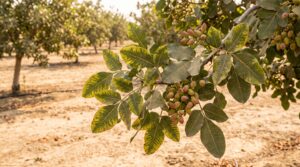
Greetings to all pistachio enthusiasts! 👋
We are the team at Agro Vivero del Mediterráneo, and we have spent years dedicated body and soul to the fascinating world of the pistachio. We not only produce the highest quality plants, but we accompany farmers like you every step of the way, from initial planning to full production. We know that the path to an abundant and profitable harvest inevitably involves maintaining a healthy and vigorous plantation. That is why today we want to share our accumulated experience on a crucial topic: the prevention of common diseases in pistachio.
Pistachio cultivation represents an exceptional opportunity in modern agriculture, especially in climates like ours. Its adaptability, growing market demand, and excellent profitability make it a bet for the future. However, as in any agricultural enterprise, there are challenges, and fungal and bacterial diseases are undoubtedly one of the main obstacles that can significantly reduce both the quantity and quality of your production, directly impacting the profitability of the plantation.
🛡️ But there is no need to be alarmed! The key, as in so many other facets of life and agriculture, lies in prevention. A proactive approach, based on knowledge and the application of good agricultural practices, is the best tool to keep these pathogens at bay and ensure the longevity and productivity of your trees. Throughout this article, we will break down the keys to achieving a healthy and resistant pistachio crop. Join us!
Why is Prevention So Important?
We might think that treating diseases once they appear is enough, but from our experience at Agro Vivero del Mediterráneo, we assure you that prevention is infinitely more effective and profitable in the long term. The reasons?
-
Direct Economic Impact: Diseases can drastically reduce yield. We are talking about premature nut drop, smaller size, stains that depreciate commercial value, and even the death of productive branches or entire trees. The costs of curative treatments (fungicides, bactericides, labor) can be high, adding to the losses from harvest reduction. Preventing is investing to avoid greater expenses and ensure stable income. 💰
-
Long-Term Plantation Health: A tree that constantly fights diseases weakens. Its growth slows down, it is more susceptible to other problems (such as frost or pests), and its productive life is shortened. A healthy plantation from the beginning, with strong and well-nourished trees, will better withstand any adversity and give you joy for decades. 🌱
-
Sustainability and Environment: Effective preventive management reduces the need to resort to intensive chemical treatments. This is not only beneficial for the pocket but also for the environment, soil biodiversity, and the health of applicators. We bet on integrated management where phytosanitary products are one more tool, but not the only or the first one. 🌍
-
Final Product Quality: A healthy pistachio, well developed on a vigorous tree, will have better organoleptic characteristics, a higher percentage of natural opening, and superior caliber. Prevention translates directly into quality. ✅
In summary, prevention is not an expense, it is the smartest investment you can make in your pistachio plantation.
Knowing the Enemy: The Most Common Pistachio Diseases
To prevent effectively, we must first know what we are facing. Although there are various pathologies, we will focus on some of the most relevant and frequent in our growing conditions:
Septoria Leaf Spot (Septoria pistaciarum and related species)
-
Description: It is one of the most common fungal foliar diseases. This fungus causes the appearance of small necrotic (dead) spots, circular or irregular, dark brown or blackish in color on the leaves, often surrounded by a yellowish halo. 🍂
-
Symptoms: Spots on leaves that can coalesce (join) forming larger necrotic areas. In severe attacks, it causes premature defoliation, especially in the lower and inner parts of the tree, which are the first to get wet and take the longest to dry.
-
Favorable Conditions: Humid and temperate springs and autumns. Frequent rains, prolonged dews, and high relative humidity favor spore dispersal and infection. Dense plantations with poor aeration are more prone.
-
Impact: Defoliation reduces the tree’s photosynthetic capacity, weakening it, affecting pistachio filling that year and flower bud formation for the next. Decreases yield and general vigor.
Alternaria Late Blight (Alternaria alternata and other species)
-
Description: Another very common fungus that mainly affects leaves, but can also damage the shell of the developing pistachio. It is an opportunistic pathogen, often attacking tissues already weakened by other causes.
-
Symptoms: On leaves, it produces necrotic spots larger than Septoria, often with concentric rings (target appearance) and dark brown to black color. Can cause blight (burning) and defoliation. On the nut, it causes dark and sunken spots on the outer shell (epicarp), which can progress and affect the quality of the inner pistachio, as well as favoring the entry of other fungi.
-
Favorable Conditions: Similar to Septoria, high humidity and moderate temperatures (20-27 °C) are ideal. Periods of rain followed by warm and humid weather are especially dangerous. Water or nutritional stress can make trees more susceptible.
-
Impact: Defoliation, reduction of photosynthesis, and very importantly, depreciation of nut quality due to shell spots, which hinders its marketing, especially for direct consumption (snack).
Botryosphaeria (Botryosphaeria dothidea and related species)
-
Description: This is a more serious fungal disease, as it not only affects leaves and nuts but can cause cankers (sunken lesions) on branches and trunk, and cause dieback of entire branches and even the tree. 😱
-
Symptoms: Blight of inflorescences (panicles) and young shoots, which wither and die. Irregular leaf spots. Dieback of branches, often with gummy exudations at the boundaries between healthy and diseased tissue. Cankers on wood. Pistachio clusters that remain black and mummified on the tree.
-
Favorable Conditions: The fungus penetrates through wounds (pruning, frost cracks, insect damage) or natural structures such as lenticels and stomata. Tree stress (drought, extreme heat, nutritional deficiencies) makes it much more vulnerable. Warm temperatures and humidity favor its development.
-
Impact: Very severe. Can kill entire productive branches, drastically reducing the tree’s productive capacity. In strong attacks or on young trees, it can cause the death of the individual. It is one of the most worrying diseases in many producing areas.
Fusicoccum (Fusicoccum aesculi / Neofusicoccum spp. – Sometimes associated with Anthracnose or Botryosphaeria complex)
-
Description: Another significant fungal pathogen, closely related to or often found together with Botryosphaeria. Causes very similar symptoms, including blights, cankers, and nut rots. Contributes to the complex of wood diseases and dieback.
-
Symptoms: Necrotic lesions on leaves, blight of young shoots and panicles (very similar to Botryosphaeria). Development of cankers on branches and trunk, which may exude gum. Dark spots and rot on the outer shell of the pistachio, affecting its development and quality. Dieback of branches.
-
Favorable Conditions: Very similar to Botryosphaeria. High humidity, moderate to warm temperatures. Penetrates through pruning wounds, frost damage, insects, or machinery. Tree stress (water, nutritional) increases susceptibility. Spores disperse easily with rain and wind.
-
Impact: Considerable. Contributes to branch dieback, reduces photosynthetically active leaf surface, and causes direct losses due to damage to pistachios. Its presence, often alongside Botryosphaeria, complicates management and can have devastating effects on tree production and longevity.
Bacteriosis (Xanthomonas arboricola pv. pistaciae)
-
Description: Unlike the previous ones, this is a disease caused by a bacterium. Affects leaves, tender shoots, and, very characteristically, the pistachio shell. 🦠
-
Symptoms: On leaves, causes small spots, initially watery looking (translucent), which quickly become necrotic, dark brown to black and angular in shape, as their advance is usually limited by leaf veins. These spots may be surrounded by a yellowish halo. Can cause blight on young shoots. The most distinctive symptom is usually on the nut: black lesions, sometimes slightly sunken, on the outer shell. In high humidity conditions, these lesions may exude a sticky liquid (bacterial exudate).
-
Favorable Conditions: Warm and humid weather, especially with spring and summer rains. The bacteria disperses very easily by wind and rain splashes from pre-existing lesions (cankers on branches, leaves, or infected nuts from the previous year). Wounds (pruning, hail, insects) facilitate entry, but can also penetrate through natural openings. Transmission by contaminated pruning tools is very important.
-
Impact: Defoliation can weaken the tree. However, the greatest economic impact usually derives from direct damage to pistachios. Black spots on the shell greatly depreciate its commercial value, making them unviable for the in-shell market. Can cause premature nut drop and, in severe infections, shoot death.
Verticillium Wilt (Verticillium dahliae)
-
Description: Vascular disease caused by a fungus inhabiting the soil. Infects roots and moves upward through the xylem (vessels transporting water and nutrients), obstructing them.
-
Symptoms: Sudden wilting of leaves on one or several branches, often on only one side of the tree (symptom called “flagging”). Leaves turn yellow, then brown and die, but usually remain attached to the tree for a while. If an affected branch is cut, vascular discoloration (dark rings or streaks in the wood) is observed. General tree growth is affected. 🥀
-
Favorable Conditions: The fungus can survive many years in the soil in the form of microsclerotia (resistance structures). Cool soil temperatures in spring favor root infection. Soils previously cultivated with susceptible species (cotton, tomato, olive, etc.) may have high inoculum levels.
-
Impact: Can be very destructive, especially in young plantations. Causes progressive weakening and can lead to tree death. Its control is complicated once established, so prevention (plot and rootstock choice) is fundamental.
Root and Crown Rot (Phytophthora spp.)
-
Description: Caused by oomycetes (similar to fungi) of the genus Phytophthora, which thrive in poorly drained or excessively wet soils. Attack the root system and trunk base (crown).
-
Symptoms: Above ground, symptoms are nonspecific: poor growth, small and yellowish leaves, generalized wilting, especially in hot weather. Key diagnosis is underground: rotten roots (dark, soft, easily detached) and necrotic reddish-brown lesions on the crown, often with a clear demarcation line with healthy tissue. There may be gummy exudations at the base of the trunk. 💧
-
Favorable Conditions: Excess water is the key factor! Heavy, compacted, poorly drained soils. Excessive or improper irrigation (wetting the trunk). Water puddles around the tree base.
-
Impact: Severe weakening of the tree due to root system destruction. Drastic reduction in water and nutrient absorption. Can cause tree death, sometimes relatively quickly if infection in the crown is extensive.
Knowing these diseases, their symptoms, and conditions favoring them is the first step. Now, let’s see how we can combat them from active prevention.
Pillars of Prevention: Our Integrated Strategy at Agro Vivero del Mediterráneo
In our work philosophy, prevention is not an isolated action, but a set of integrated practices applied continuously throughout the life of the plantation. These are the pillars we consider fundamental:
1. The Basis of Everything: Site Selection and Land Preparation
Everything starts even before planting the first tree. Proper land choice is crucial:
-
Soil Analysis: Essential. We need to know texture (sandy loam or loam ideally), pH (slightly alkaline is well tolerated), organic matter content, and, above all, drainage capacity. Heavy and clayey soils prone to waterlogging are a focus of problems for Phytophthora. 👨🔬
-
Plot History: Avoid land where species very susceptible to Verticillium (cotton, tomato, pepper, eggplant, olive) have previously been grown if specific measures (solarization, resistant rootstocks) are not taken. Investigate if there were previous bacteriosis problems in nearby woody crops.
-
Drainage, Drainage, and More Drainage: If natural drainage is not optimal, it is vital to invest in improving it: deep subsoiling to break compacted layers, proper land leveling to avoid waterlogging, and even installation of underground drainage systems in extreme cases. Stagnant water is the enemy of pistachio!
-
Orientation and Exposure: Seek good sun exposure and ventilation. Avoid cold and humid hollows where air does not circulate well and humidity persists, favoring both fungi and bacteria.
2. Guaranteed Quality: Start with Healthy and Suitable Plant
Plant material quality is a direct investment in the future health of the plantation. At Agro Vivero del Mediterráneo, we place extreme emphasis on this point:
-
Certified and Disease-Free Plant: We exclusively use rootstocks and variety buds from health certification programs guaranteeing absence of major pathogens, especially viruses, Verticillium, and, as far as possible, free from initial foci of bacteria like Xanthomonas. Acquiring pistachio plant from recognized nurseries with guarantees is fundamental. 🌱
-
Choosing the Right Rootstock: Not all rootstocks are the same. Selecting the appropriate rootstock for your specific soil conditions is vital. For example:
-
Pistacia terebinthus (Cornicabra): Very rustic, tolerant to drought and calcareous soils, but more sensitive to Verticillium and Phytophthora and slower growing.
-
Pistacia atlantica: Vigorous and with good resistance to drought and nematodes, but also sensitive to Verticillium.
-
UCB-1 (Hybrid of P. atlantica x P. integerrima): Most currently used for its great vigor, precocity in entering production, good tolerance to salinity and, very importantly, greater tolerance to Verticillium and Phytophthora compared to previous ones. It is our main recommendation in most cases, always ensuring its certified origin. Tolerance to Xanthomonas or Fusicoccum is less defined at rootstock level, depending more on variety and management.
-
-
Visual Inspection: Before planting, check each plant: healthy roots (white, firm), without rot or galls; well-welded and healed graft point; trunk without wounds or cankers; vigorous shoots without symptoms of suspicious spots on leaves or stems.
3. Intelligent Plantation Design
How we distribute trees on the land also influences health:
-
Adequate Planting Frame: Avoid frames that are too dense. Sufficient separation between trees (typically 6×6, 7×5, 7×6 meters or even wider depending on expected vigor) allows good air circulation and sunlight penetration into the canopy. This helps leaves dry faster after rains or dews, hindering proliferation of foliar fungi (Septoria, Alternaria) and dispersal of bacteria like Xanthomonas. 💨☀️
-
Row Orientation: Whenever possible, orient rows in direction of prevailing winds to favor aeration.
4. Precise Water Management: Smart Irrigation
Irrigation is essential for pistachio, but poor management is one of main causes of root and crown diseases, and can favor dispersal of foliar pathogens:
-
Avoid Excess Irrigation: It is most common and dangerous mistake! Pistachio tolerates some drought, but not waterlogging. Irrigate only when necessary, based on tree needs and soil moisture (sensors, trial pits).
-
Localized Irrigation (Drip): Most recommended system. Applies water directly to root zone, keeping trunk and most foliage dry. Avoid sprinkler or microsprinkler systems wetting trunk, leaves and nuts, creating ideal conditions for Phytophthora, foliar fungi and dispersal of Xanthomonas by splashing. 💧
-
Do Not Wet Trunk: Place drippers at prudent distance (at least 30-50 cm) from trunk base, especially in young trees.
-
Frequency vs. Quantity: Preferable to give deeper and more spaced irrigations over time than frequent and superficial irrigations, always adapting to soil type and weather.
-
Water Quality: Analyze irrigation water quality. Excess salts can weaken tree and make it more susceptible.
5. Balanced Nutrition: Strong and Resistant Trees
Well-nourished tree like healthy person: has better natural defenses against diseases.
-
Periodic Analyses: Perform soil and foliar analyses regularly to know real nutritional needs of plantation and adjust fertilization plan.
-
N-P-K Balance and Micronutrients: Provide all essential nutrients in appropriate amounts. Avoid excesses, especially nitrogen (N), as overly vigorous and tender growth can be more susceptible to certain fungi (Alternaria, Botryosphaeria, Fusicoccum), bacteria (Xanthomonas) and pests. Potassium (K) plays important role in general tree resistance. Calcium (Ca) strengthens cell walls, hindering pathogen penetration.
-
Organic Matter: Incorporating organic matter into soil improves structure, water retention, aeration and biological activity, contributing to healthier root system and better nutrient availability.
6. Sanitary and Training Pruning: Aerating Canopy and Removing Inoculum
Pruning fundamental tool not only to form tree and regulate production, but also for disease prevention:
-
Pruning Time: Perform main pruning during winter break (dormancy), when tree less active and conditions less favorable for wound infection and pathogen dispersal like Xanthomonas. Avoid severe green pruning, especially in wet periods.
-
Removal of Infection Foci: Cut and destroy dead, diseased, damaged branches or with presence of cankers (Botryosphaeria, Fusicoccum, possible refuge for Xanthomonas). Always cut several centimeters below visible lesion, in healthy tissue! Remove suckers and crossing or rubbing branches. Immediately remove pruning remains from plot and burn or manage properly. 🔥
-
Improve Aeration and Lighting: Open canopy center to facilitate air circulation and sunlight penetration. This helps dry foliage quickly and reduces incidence of foliar diseases and bacteriosis.
-
Rigorous Tool Disinfection!: This point ABSOLUTELY CRITICAL, especially if presence of Botryosphaeria, Fusicoccum or, above all, Xanthomonas suspected or confirmed. Disinfect pruning tools (shears, saws) with diluted bleach solution (1 part commercial bleach to 9 water), burning alcohol, or specific commercial disinfectants, between each tree. Vital not to spread disease throughout plantation. ✂️✨
-
Protect Large Wounds: In pruning cuts of considerable diameter (>2-3 cm), highly recommended to apply healing paste with fungicide and/or bactericide (copper) to protect wound from pathogen entry, especially wood fungi and bacteria.
7. Soil and Waste Management: Cleanliness and Order
What happens in soil around trees also matters:
-
Weed Control: Weeds compete for water and nutrients, weakening trees. Also, some can be hosts for pests or diseases and hinder aeration at trunk base. Keep tree line clean (superficial tillage, herbicides with caution, weed control fabrics).
-
Debris Sanitation: Many fungi (Septoria, Alternaria, Fusicoccum) survive on infected fallen leaves. Xanthomonas can also survive on plant debris. If disease pressure high previous year, very beneficial to collect or incorporate fallen leaves deeply into soil during winter to reduce initial inoculum in spring. Likewise, remove mummified nuts remaining on tree or ground, as can harbor Botryosphaeria, Fusicoccum and other pathogens.
-
Cover Crops: Use of controlled cover crops in rows can be beneficial to improve soil structure and biodiversity, but must be managed properly so not to compete excessively with trees or hinder aeration or sanitation tasks.
8. Constant Surveillance: Monitoring and Early Detection
Prevention also implies being alert to detect any problem as soon as possible:
-
Regular Inspections: Walk through plantation frequently (weekly or biweekly in critical times like spring and early summer) observing state of leaves, shoots, branches, trunk and nuts. Knowing normal appearance of your trees will help detect anomalies quickly! 👀 Pay special attention after rainy periods.
-
Early Identification: Learn to recognize first symptoms of most common diseases, including angular spots of Xanthomonas or blights of Botryosphaeria/Fusicoccum. Early detection allows acting before problem spreads and becomes harder to control, for example, removing first affected shoots.
-
Keep Records: Note dates of symptom appearance, location in plot, weather conditions, etc. This information valuable to understand disease dynamics in your plantation and plan future strategies better. 📝
9. Integrated Pest Management (IPM): Global Approach
Although focusing on diseases today, important to remember pests (like aphids, psylla, borers, bugs) can weaken tree and, more importantly, their bites or galleries can be entry routes for pathogenic fungi like Botryosphaeria and Fusicoccum, and also for bacteria like Xanthomonas. Good Integrated Pest Management program, prioritizing biological and cultural methods and resorting to insecticides only when strictly necessary, contributes indirectly to disease prevention. 🐞
10. Rational Use of Phytosanitary Treatments (When Necessary)
Despite applying all preventive measures, sometimes weather conditions or high inoculum pressure may make specific phytosanitary treatments necessary:
-
Correct Diagnosis: Before treating, ensure diagnosis. Not all fungicides work for all fungi, and fungicides DO NOT control bacteria like Xanthomonas. If doubts, consult specialized technicians. At Agro Vivero del Mediterráneo we offer technical advice.
-
Preventive Treatments: Are key. Applied before favorable conditions for infection occur.
-
Fungi: Copper-based treatments (oxychloride, hydroxide, cuprous oxide) applied in winter (at leaf fall) and/or start of budding fundamental to reduce initial inoculum of many fungi (Septoria, Alternaria, Botryosphaeria, Fusicoccum) and also have bactericidal action against Xanthomonas. During vegetation, specific fungicides may be necessary depending on dominant disease and conditions.
-
Bacteria (Xanthomonas): Strategy based almost exclusively on preventive treatments with copper compounds, applied before predicted rainy periods during spring and early summer, when infection risk highest. Efficacy of treatments once infection established very limited.
-
-
Choice of Suitable Product: Always use products authorized for pistachio cultivation and effective against target pathogen. Alternate active ingredients with different modes of action (in case of fungicides) to avoid appearance of resistance.
-
Timing and Application Technique: Apply at opportune moment (consult prediction models if exist, follow phytosanitary notices) and ensure excellent coverage of entire plant (leaves, shoots, nuts), especially with contact products like copper. Always follow product label instructions (dose, safety periods, etc.).
-
Curative Treatments: Efficacy generally low for most of these diseases once established, especially for bacteriosis and wood diseases. Prevention much more effective.
Remember: chemical treatments one more tool within integrated strategy, not sole solution. Basis must always be cultural and biological prevention.
Agro Vivero del Mediterráneo: Your Ally in Pistachio Cultivation
As you see, disease prevention in pistachio constant work requiring knowledge, attention to detail and application of multiple techniques in integrated way. Inclusion of pathogens like Fusicoccum and Xanthomonas further underlines importance of practices like tool disinfection and proper irrigation and pruning management. At Agro Vivero del Mediterráneo, not only dedicated to producing pistachio plant of highest sanitary and genetic quality, but put all our experience at your disposal. 🤝
We offer personalized technical advisory services, helping you design your plantation, choose most suitable varieties and rootstocks, establish optimal fertilization and irrigation plans, and develop integrated pest and disease management strategies adapted to your specific conditions.
We firmly believe in pistachio potential and want to help you achieve success. Healthy plantation first step towards high productivity and excellent profitability.
Conclusion: A Healthy Future for Your Pistachios
Disease prevention fundamental pillar for any farmer wishing to have thriving and lasting pistachio plantation. Requires holistic approach, from careful initial selection of land and plant, to daily management of irrigation, nutrition, pruning and surveillance.
Keys are:
-
Start on right foot: suitable land and certified healthy plant. ✅
-
Precise water and nutrient management. 💧🌱
-
Sanitary pruning and rigorous disinfection of tools. ✂️✨
-
Cleanliness and order in plot, removing infected remains. 🧹
-
Constant surveillance and early detection. 👀
-
Integrate all practices into coherent strategy. 🧩
-
Resort to phytosanitary treatments (fungicides and/or bactericides) in preventive, rational and justified manner. 🧪
We know it may seem complex, but benefits of keeping diseases like Septoria, Alternaria, Botryosphaeria, Fusicoccum, Xanthomonas, Verticillium or Phytophthora at bay more than compensate effort. Healthy plantation not only produces more and better, but more resilient and sustainable long term. 📈
At Agro Vivero del Mediterráneo, here to accompany you on this path. If any doubt, need advice or thinking of starting pistachio plantation, do not hesitate to contact us. Delighted to help. Can also request personalized quote through our booking form.
Together can ensure your pistachios grow healthy, strong and productive for many years! Much encouragement and happy farming! 🌳💚
Need a quote?
Tell us about your project and we will send you a proposal with no obligation.
Request a quote