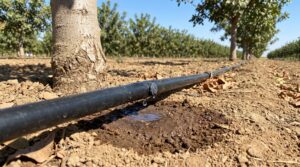
If we are thinking about setting up a pistachio orchard, the first question we are asked is almost always the same: how many litres of water does a pistachio tree need per day. 💧 It is a logical question, because water determines the investment, the design of the irrigation system and, ultimately, the nut yield of every harvest.
The short answer is that a mature pistachio tree can need between 80 and 130 litres per day at the height of summer under regulated deficit irrigation, and considerably more if irrigated without restrictions. But a single figure can be misleading: it changes with the age of the tree, the phenological stage, the soil, the climate and the planting spacing.
At Agro Vivero del Mediterráneo, we support both small and large growers in pistachio cultivation, and we have seen how good irrigation management makes the difference between a profitable orchard and one that falls short. In this guide, we explain how to calculate the water requirements of the pistachio tree, how much water to apply at each stage and which mistakes to avoid. 🌳
How Many Litres of Water Does a Pistachio Tree Need per Day: The Quick Answer 📌
As a starting point, these are the reference values we use in pistachio orchards in a continental Mediterranean climate, with drip irrigation and a 6 × 5 metre spacing (around 333 trees per hectare):
| Situation | Litres per tree per day (summer) | Cubic metres per hectare per year |
|---|---|---|
| Young pistachio tree (years 1 to 3) | 3 to 30 | 500 to 2,500 |
| Developing pistachio tree (years 4 and 5) | 30 to 80 | 2,200 to 4,500 |
| Mature pistachio tree under regulated deficit irrigation | 80 to 130 | 3,000 to 5,000 |
| Mature pistachio tree under full irrigation | 150 to 220 | 7,000 to 10,000 |
These are reference figures, not a universal recipe. ⚠️ The actual consumption of each orchard depends on factors we detail below, and we always recommend adjusting it with data from your own plot.
It is important to distinguish between what the tree could consume and what it is worth supplying. The pistachio tree tolerates an application below its maximum demand very well, and this is one of the keys to its profitability.
Why the Pistachio Tree Withstands Drought and Still Rewards Irrigation 🌵
The pistachio tree originates from arid regions of Central Asia and the Middle East, and this is evident in its physiology. It develops a deep root system that explores large volumes of soil, effectively regulates the opening of its stomata during the hottest hours and tolerates temperatures and salinity levels that would rule out many other woody crops.
This hardiness leads to a common mistake: thinking that the pistachio tree “does not need irrigation”. It can survive without it, but producing well is a different matter. Without enough water at key moments, the tree reduces nut size, increases the percentage of blank nuts and accentuates alternate bearing, that is, the swing between years of heavy and light crops. 📉
That is why we talk about giving the pistachio tree the right amount of water at the right time. This way, we ensure nut quality without wasting an increasingly scarce resource.
Water Requirements of the Pistachio Tree: How They Are Calculated 🧮
To know how many litres a pistachio tree needs, we start from crop evapotranspiration (ETc), which sums up the water the tree loses through transpiration and through evaporation from the soil. It is obtained with a simple formula:
ETc = ETo × Kc
- ETo is the reference evapotranspiration, published by the agro-meteorological stations of each area in millimetres per day.
- Kc is the crop coefficient. In the pistachio tree it changes throughout the year: it starts from low values, around 0.3, at the beginning of budbreak and reaches values close to 1.0 at the height of summer.
One millimetre equals one litre per square metre. Let us look at a practical example for a day in July:
- With an ETo of 6.5 mm and a Kc of 1.0, the ETc is 6.5 mm per day.
- With a 6 × 5 metre spacing, each tree has 30 square metres available: 6.5 × 30 = 195 litres per tree per day.
- With a drip irrigation efficiency of 90%, around 215 litres must be applied so that what the tree consumes actually reaches the roots. 💦
That would be the consumption under full irrigation. Under regulated deficit irrigation, which supplies between 40% and 60% of ETc during certain stages, the dose drops to around 90–130 litres. From all of this, effective rainfall must be subtracted, which in many inland areas covers a significant part of the spring and autumn requirements.
Litres per Tree per Day According to the Age of the Orchard 🌱
Demand grows with canopy size and leaf area. This table summarises what we usually recommend as a reference for the summer months, with a 6 × 5 metre spacing:
| Orchard year | Litres per tree per day (summer) | Cubic metres per hectare per year |
|---|---|---|
| 1st | 3 to 6 | 500 to 800 |
| 2nd | 8 to 15 | 900 to 1,500 |
| 3rd | 15 to 30 | 1,500 to 2,500 |
| 4th | 30 to 55 | 2,200 to 3,500 |
| 5th | 50 to 80 | 3,000 to 4,500 |
| 6th onwards | 80 to 130 | 3,000 to 5,000 |
In a young pistachio tree, the goal is not to squeeze out a crop, but to achieve a well-formed tree with a deep root system and a solid structure. We irrigate frequently and in small doses, keeping the area around the plant moist without waterlogging. Excess water is just as harmful as lack of water, because it favours root asphyxia and root diseases.
The quality of the starting material also matters: a healthy, well-formed root system makes better use of every litre. That is why, in our nursery, we carefully select the pistachio plants that reach each orchard. 🌿
When the mature pistachio tree enters full production, from approximately the sixth year onwards, requirements stabilise and the challenge becomes distributing water well across the different stages of the cycle.
Litres of Water According to the Pistachio Tree Growth Stage 📅
A good irrigation schedule does not distribute water evenly. The pistachio tree has moments when it tolerates some deficit and others when it does not. These are the stages, with indicative consumption for a mature tree in a continental Mediterranean climate:
- Winter dormancy (December to February) ❄️: we normally do not irrigate. If the winter has been very dry, one irrigation is advisable to fill the soil profile before budbreak.
- Budbreak and flowering (March and April) 🌸: demand is low, around 20 to 40 litres per day when rainfall is insufficient. The important thing is that the tree starts the season without a deficit.
- Nut growth (April to mid-May) 🌱: this is when size is defined. We apply between 40 and 70 litres per tree per day.
- Shell hardening (late May to early July) 🪨: the tree tolerates a lower supply well, from 40 to 70 litres, and this is the typical stage for applying restriction.
- Kernel filling (July and August) 🥜: this is the period of maximum demand and the most sensitive one. We increase to 90–130 litres per day so that the kernel fills well and the percentage of blank nuts falls.
- Harvest (late August and September) 🚜: we gradually reduce irrigation, depending on the variety and the harvesting machinery.
- Post-harvest (September and October) 🍂: a moderate post-harvest irrigation, of 30 to 60 litres, helps the tree replenish reserves for next year’s flowering and moderate alternate bearing.
Dates vary by area and variety. A late-flowering, late-ripening variety such as Kerman does not behave like an earlier one such as Larnaka, which is why we adapt the schedule to each orchard.
Regulated Deficit Irrigation: Less Water Without Giving Up the Crop 🎯
Regulated deficit irrigation consists of applying less water during the stages when the tree is least sensitive, specifically during shell hardening, and restoring the full dose when kernel filling begins.
When properly applied, this strategy allows significant water savings without seriously penalising production, and it also curbs excessive vegetative growth, which makes pruning easier and reduces costs. It is especially useful in areas where water is limited or expensive. 💰
However, “deficit” does not mean “scarce”. Severe or prolonged water stress, especially if it coincides with the wrong stage, ends up taking its toll on nut size, on the percentage of split nuts and on tree vigour. To apply this technique safely, we recommend:
- Starting with a moderate restriction and adjusting it over time.
- Measuring the water status of the tree rather than relying only on the calendar.
- Restoring the full dose as soon as kernel filling begins.
- Avoiding pronounced deficits during the first years of the orchard.
Cubic Metres per Hectare: The Calculation We Are Asked for Most 🚜
When planning an orchard, in addition to litres per tree, we need to know how much water the whole farm requires, because the water permit, the size of the storage reservoir and the sizing of the network depend on it. This is the daily consumption at the summer peak of a mature pistachio tree receiving 100 litres per tree, according to spacing:
| Planting spacing | Trees per hectare | Cubic metres per hectare per day |
|---|---|---|
| 6 × 4 m | 417 | 41.7 |
| 6 × 5 m | 333 | 33.3 |
| 7 × 5 m | 286 | 28.6 |
| 7 × 7 m | 204 | 20.4 |
With a 6 × 5 metre spacing and 10 hectares, consumption at the summer peak would be around 333 cubic metres per day. For the whole season, with applications of 3,000 to 5,000 cubic metres per hectare, we would be talking about between 30,000 and 50,000 cubic metres per year. 📐
The cost of water weighs heavily on the bottom line. If you want to see how it fits into the profitability of a pistachio orchard, we recommend reviewing the full numbers before deciding on the spacing and the planted area.
Factors That Modify the Litres of Water a Pistachio Tree Needs 🔍
The tables above are a starting point. On each farm, we adjust the doses according to these factors:
Soil type. In a clay soil, which retains a lot of water, it is advisable to irrigate less frequently and with longer irrigation events, always watching for waterlogging, because the pistachio tree does not tolerate root asphyxia. In a sandy soil, which retains little, short and frequent irrigation events are better, although nutrient leaching must be managed. Loam soils, with a good balance, are the most rewarding. 🌍
Climate and evapotranspiration. A hotter, windier area has a higher ETo and requires more water than another with milder summers. That is why data from the nearest agro-meteorological station is an essential working tool.
Planting spacing. A denser spacing increases the cubic metres per hectare, even if consumption per tree is similar.
Crop load. A year of heavy production requires more water during kernel filling than a year of light load. 🌰
Variety and rootstock. The rootstock influences how the roots explore the soil, and the variety determines the dates of the stages of the cycle, so schedule adjustments change from one orchard to another.
Water quality. The pistachio tree tolerates salinity better than most woody crops, but the salinity of irrigation water cannot be ignored. With water of higher conductivity, a leaching fraction must be added to prevent salt accumulation in the root zone. That is why we always ask for a water analysis before planting. 🧪
Rainfall and cover crop. We must deduct effective rainfall and bear in mind that a summer cover crop competes with the tree for water.
Drip Irrigation in Pistachio: Doses, Frequency and Fertigation 💦
Drip irrigation is the most common system in pistachio orchards because it allows precise dosing, achieves high efficiencies and makes it possible to apply nutrients dissolved in the water. Our general recommendation is:
- One or two drip lines per row, depending on the soil and the age of the tree. In a mature pistachio tree, it is common to work with two lines to expand the volume of wetted soil.
- Emitters of 2 to 4 litres per hour, with spacing adapted to the soil texture.
- Irrigation frequency adapted to the soil: every one or two days in sandy soils and every three to five days in clay soils, with longer irrigation events.
- Constant maintenance: checking filters, flushing the lines and making sure the emitters do not clog, because a clogged emitter means a tree under deficit without our noticing.
Fertigation makes it possible to supply nitrogen, potassium and other nutrients at the moment the tree needs them, with fewer losses and fewer field operations. That said, it requires a good knowledge of the water and the soil so as not to unbalance fertilisation.
If we lack experience in designing the installation, good technical advice from the outset saves many problems later, because correcting a poorly sized installation once the orchard is already under way is expensive. 🔧
How to Know Whether We Are Irrigating Properly 📊
The schedule is a guide, but the key is to check how the tree responds. These tools help us fine-tune irrigation efficiency:
- Soil moisture probes: they measure the soil water content at different depths and show how far the irrigation reaches and whether water is being lost below the roots. 📡
- Tensiometers: they indicate how strongly the soil holds water and when it is time to irrigate again.
- Stem water potential: this is the most reliable measure of the water status of the tree and is very useful for applying deficit irrigation safely.
- Soil pits: digging a trench lets us see at a glance the depth of the roots and the real moisture of the profile.
- Water meter and records: noting down each season what was applied and the yield obtained helps us improve from one year to the next.
And, of course, observing the tree: dull leaves outside the hottest hours, shoots that stop growing early or nuts with reduced size are signs that something is wrong. 👀
Pistachio Trees Under Rainfed Conditions: How Many Litres Do They Need? 🌦️
There are rainfed pistachio orchards, mainly in areas with more than 300 or 350 millimetres of annual rainfall and deep soils that store water. In them, the tree lives off soil reserves and autumn, winter and spring rains.
Yields under rainfed pistachio cultivation are lower and vary greatly from one year to the next, but a small supplementary application makes a big difference. One or two supplementary irrigations in summer, of around 50 to 100 litres per tree, can noticeably improve kernel filling and nut size. The important thing is to assess each case, because in rainfed conditions any planting decision requires a close look at rainfall and soil. 🔎
Common Mistakes We See in Pistachio Irrigation ❌
These are the most frequent failures we detect when visiting orchards:
- Irrigating on a fixed schedule, without taking into account the weather and the rainfall of each week.
- Irrigating little and often in mature trees, which leads to shallow roots and trees that are more vulnerable to heat.
- Neglecting post-harvest irrigation, so that the tree reaches flowering with fewer reserves.
- Applying too severe a deficit, especially during kernel filling.
- Not analysing the water, with the risk of soil salinisation in the medium term.
- Waterlogging heavy soils, which favours root problems and diseases.
- Not maintaining the installation, with clogged emitters and uneven pressures between sectors.
Avoiding them is simpler than it seems if we plan well from the start and check the installation regularly. ✅
Frequently Asked Questions About Pistachio Tree Irrigation ❓
How many litres does a newly planted pistachio tree need?
Between 3 and 6 litres per day in summer during the first year, spread over frequent, low-volume irrigation events, avoiding waterlogging.
How many cubic metres of water does one hectare of pistachios need?
Under regulated deficit irrigation, around 3,000 to 5,000 cubic metres per year at full production. Under full irrigation, the figure can reach 7,000–10,000.
Can pistachio trees be irrigated with saline water?
They tolerate salinity better than most crops, but the water must be analysed and a leaching fraction applied so that salts do not accumulate in the root zone.
When do we stop irrigating before harvest?
We reduce irrigation progressively in the weeks before harvesting. The exact moment depends on the variety, the soil and the machinery.
Is it profitable to irrigate a pistachio tree?
In most areas, yes, because irrigation improves nut size, reduces blank nuts and provides consistency from one season to the next, which is key to profitability.
The Next Step: Let Us Plan the Irrigation of Your Orchard Together 🤝
Let us summarise the essentials. A mature pistachio tree needs, at the height of summer, between 80 and 130 litres per day under regulated deficit irrigation and up to around 220 under full irrigation. The young pistachio tree needs far less, and demand grows year by year. Water should not be distributed evenly: it should be adjusted to each stage, with more supply during kernel filling and less during shell hardening. And the soil, the climate, the spacing and the water quality modify any reference figure.
At Agro Vivero del Mediterráneo, we have been working with pistachio cultivation for years, and we know that every farm is different. If you are considering a new orchard or want to expand the one you already have, contact us and we will help you calculate water requirements and design the irrigation system. If you prefer to take the first step now, you can request a quote and reserve your plants through our form. 🌳💧
Need a quote?
Tell us about your project and we will send you a proposal with no obligation.
Request a quote