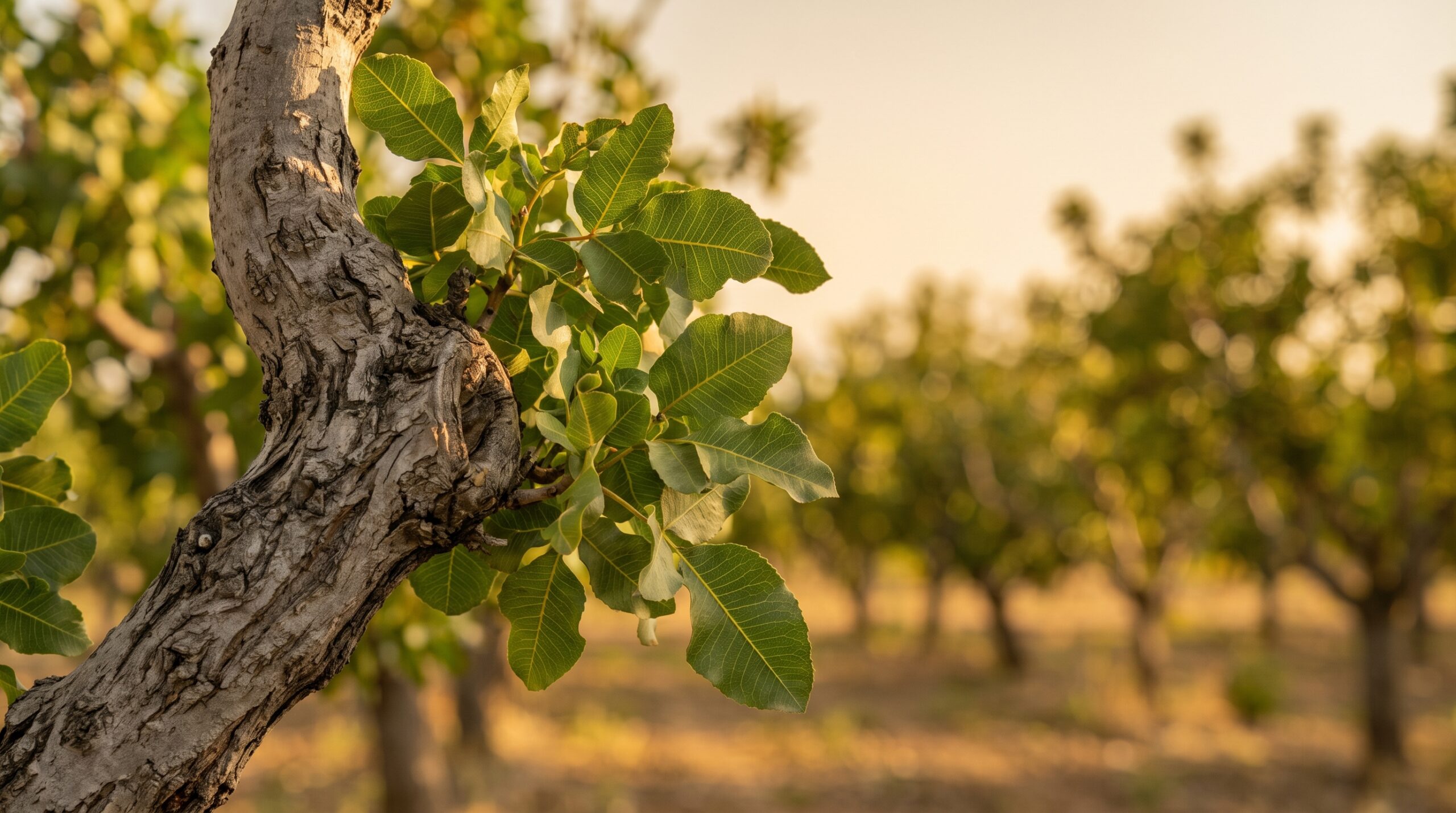
When we plant a pistachio tree, we do so with the fruit that will arrive years later in mind. That’s why, when a tree is slow to reach production or simply fails to yield a harvest, the concern is understandable. At Agro Vivero del Mediterráneo, we have spent our entire professional career supporting growers who face this very question: why isn’t my pistachio tree producing? 🤔
Throughout this article, we will go through, one by one, the most common causes behind a lack of production in a pistachio planting, whether we’re talking about a young tree that hasn’t yet entered production or mature trees that suddenly see their harvest decline. Our goal is that, after reading these lines, you will have all the information you need to diagnose the problem and, above all, to solve it.
If you are considering starting a planting from scratch, we recommend visiting our website to learn everything we offer as specialized pistachio nurserymen.
Why It’s So Important to Understand the Pistachio Tree’s Production Cycle Before Looking for Solutions
Before getting into the specific causes, it’s worth remembering something essential: the pistachio tree is not just any fruit tree. It is a species with a particular productive behavior, marked by alternate bearing, deep root development, and very specific requirements in terms of soil, climate, and management.
Many growers, especially those new to this crop, expect to see abundant production from the second or third year, when in reality the pistachio tree needs considerably more time to reach its full productive maturity. Understanding this is the first step to avoid confusing a natural process with an actual problem.
That said, there are situations where a clear limiting factor really is preventing production, and it is precisely in those cases that it’s worth stopping to analyze each variable. Let’s look at them in detail. 👇
1. The Pistachio Tree Is Still Young and Hasn’t Reached Productive Age
This is, by far, the most frequent reason growers reach out to us about. A newly planted pistachio tree needs between 5 and 7 years to begin producing noticeably, and doesn’t reach its full productive capacity until 8 to 10 years after planting.
During the first years, the tree invests most of its energy in developing a deep, extensive root system, which makes sense considering this species originates from arid regions and is accustomed to seeking water at depth. This rooting phase is fundamental and should not be artificially rushed, because the future longevity and productivity of the planting depend on it.
📌 What we recommend in these cases:
- Be patient during the first years and avoid forcing production with excessive nitrogen fertilization.
- Monitor that vegetative growth is balanced (neither excessive nor insufficient).
- Consult a specialized technician if you have doubts about whether the growth rate is appropriate for the tree’s age.
If you are planning a new planting, we explain in detail what type of planting stock we offer and how the quality of the plant material influences the time it takes to reach production.
2. Poor Pollination: The Most Decisive Technical Factor
The pistachio tree is a dioecious species, meaning male and female trees exist separately. Only female trees produce fruit, but they absolutely require nearby male trees for pollination to occur, which in this crop is wind-pollinated (anemophilous).
When pollination fails, production suffers dramatically, even in mature, perfectly healthy trees. The most common causes of poor pollination are:
- An incorrect ratio of male to female trees (the recommended range is usually between 6% and 10% male trees, depending on variety and planting design).
- A mismatch in flowering timing: the male tree flowers before or after the female, so pollen release doesn’t coincide with receptivity.
- Excessive distance between male trees and female rows, given that wind loses pollinating effectiveness beyond a certain distance.
- Adverse weather conditions during flowering (rain, excessive wind, or very high relative humidity), which hinder pollen dispersal.
| Pollination Factor | Consequence if It Fails | Recommended Solution |
|---|---|---|
| Male/female ratio | Very low or no production | Adjust planting design with technical advice |
| Flowering synchrony | Pollen unavailable within the receptive window | Select varieties with compatible flowering times |
| Distance between trees | Insufficient pollen in the furthest rows | Redistribute or add pollinizers |
| Adverse weather | Pollination failure in a specific year | Consider assisted or mechanical pollination |
In more complex cases, an increasing number of growers are turning to assisted or mechanical pollination as a complement, especially in years with unfavorable weather during flowering. If you need to assess your specific situation, we offer specialized technical advisory services to analyze planting design and propose solutions.
3. Poor Choice of Variety or Rootstock for the Area
Not all pistachio varieties adapt equally well to any given soil or climate. A variety poorly suited to the specific conditions of a farm can result in production far below expectations, even years after planting.
Likewise, the rootstock directly influences the tree’s vigor, its tolerance to calcareous or saline soils, and its resistance to certain soil-borne diseases. A poorly adapted rootstock can seriously limit productive potential, even when the grafted variety is excellent.
🔍 Aspects worth reviewing:
- Adaptation of the variety to the winter chilling hours of the area.
- Rootstock resistance to active limestone in the soil.
- Compatibility between variety and rootstock.
- Prior track record of that combination on nearby farms with similar conditions.
Choosing well from the start is, without doubt, the decision that most determines the long-term success of a planting. That’s why, before planting, we always recommend requesting personalized advice, where we analyze the soil, climate, and objectives of each grower to recommend the most suitable combination.
4. Poorly Drained Soil or Inappropriate pH
The pistachio tree tolerates calcareous, arid soils well, but is very sensitive to excess moisture around the roots. Poorly drained soil causes root asphyxiation, which in turn limits nutrient and water uptake, directly resulting in lower production, yellowing leaves, and, in severe cases, root death.
On the other hand, although the pistachio tree adapts to a wide pH range, extremely acidic soils or those with severe salinity problems can also limit its development and productive capacity.
💧 Warning signs related to soil:
- Frequent waterlogging after irrigation or rainfall.
- Dark or rotten-looking roots when sampled.
- Widespread leaf chlorosis (yellowing).
- Very uneven vegetative growth within the same plot.
📌 Recommended solutions:
- Conduct a soil analysis before planting (and repeat it periodically in established plantings).
- Improve drainage through subsoiling or surface drainage systems.
- Avoid excessive irrigation, especially in clay soils.
- Correct pH when necessary, always under technical guidance.
Understanding the soil well before planting is one of the keys to future profitability. We explain how these factors affect the economic results of a pistachio planting over the medium and long term.
5. Poorly Managed Irrigation: Both Excess and Deficit Are Harmful
The pistachio tree has a reputation for being drought-resistant, and it’s true that it withstands moderate periods of water stress well. However, that doesn’t mean it doesn’t need water to produce. Poorly adjusted irrigation management is one of the most frequent causes of low production, especially during key moments of the phenological cycle.
Excess irrigation: promotes root asphyxiation, increases the risk of root fungal diseases (such as verticillium wilt), and can cause premature drop of developing fruit.
Irrigation deficit: if water stress coincides with critical moments such as fruit set or fruit filling, the tree aborts part of the crop to prioritize its own survival.
📅 Particularly sensitive moments for irrigation:
- Flowering and fruit set (spring).
- Fruit filling (summer).
- Shell hardening.
| Crop Stage | Water Requirement | Risk if It Fails |
|---|---|---|
| Flowering | Moderate | Poor pollination, flower drop |
| Fruit set | High | Abortion of young fruit |
| Kernel filling | Very high | Empty or poorly developed nuts |
| Post-harvest | Low-moderate | Lower nutrient reserves for the following year |
A well-designed irrigation system, with moisture sensors and a schedule adjusted to each phenological stage, makes an enormous difference to production results. 🌦️
6. Unbalanced Fertilization
A very common mistake is focusing fertilization exclusively on nitrogen, thinking that “more fertilizer means more production.” In reality, the pistachio tree needs a much broader nutritional balance, and excess nitrogen without the rest of the nutrients can even harm production, promoting excessive vegetative growth at the expense of fruiting.
Nutrients particularly important for pistachio:
- Potassium: essential during fruit filling; its deficiency causes empty or poorly filled nuts.
- Boron: directly involved in pollination and fruit set; its deficiency significantly reduces production.
- Zinc: its deficiency results in small leaves and short internodes, affecting overall vigor.
- Nitrogen: necessary, but in the right amount and at the right point in the cycle.
🧪 Practical recommendation: conduct an annual leaf analysis, ideally during the summer period, to adjust fertilization to the tree’s actual needs rather than generic assumptions.
7. Incorrect or Absent Pruning
Pruning a pistachio tree has a very clear purpose: to maintain a balanced structure that promotes light penetration and ventilation, and that facilitates the renewal of productive wood. Poorly executed pruning (excessive, insufficient, or poorly oriented) can significantly reduce production.
- Overly severe pruning that removes a large part of the productive wood.
- Complete absence of pruning, creating very dense trees with little light penetration into the canopy interior.
- Pruning carried out at the wrong phenological stage.
- Failing to respect the species’ natural alternation between floral and vegetative buds.
✂️ Ideally, formative pruning should be carried out during the first years, aimed at creating a solid structure, with maintenance pruning in maturity, focused on renewing wood and balancing production across different areas of the canopy.
8. Presence of Pests or Diseases
Certain pests and diseases can drastically reduce the harvest, even without being obvious to the naked eye in the early stages. Among the most significant in pistachio cultivation are:
- Pistachio psyllid: causes general weakening of the tree and promotes the appearance of sooty mold, affecting photosynthesis and, therefore, production.
- Verticillium wilt: a soil-borne disease particularly dangerous on plots with a history of other susceptible crops; causes wilting and branch death.
- Root rot: normally associated with excess moisture and poor drainage.
- Fungal diseases affecting the fruit, reducing its commercial quality and marketability.
🛡️ Recommendations:
- Conduct periodic inspections, especially in spring and summer.
- Avoid planting on soils with a history of compatible soil-borne diseases.
- Maintain balanced irrigation management, since many diseases are favored by excess moisture.
- Act preventively, since in pistachio, as with most fruit trees, prevention is far more effective than curative treatment.
9. Alternate Bearing
The pistachio tree is a species particularly prone to alternate bearing, meaning it naturally alternates high-yield years with low-yield years. This is due to a physiological mechanism: during a high-production year, the tree devotes so many resources to forming fruit that it doesn’t have enough reserves left to form abundant flower buds for the following year.
📉 Although alternate bearing has a genetic, natural component that cannot be eliminated entirely, it can be mitigated through good management:
- Fertilization adjusted to each phase of the biennial cycle.
- Consistent irrigation, avoiding peaks of water stress that worsen the imbalance.
- Pruning aimed at balancing fruit load across different areas of the tree.
- Fruit thinning in overproduction years, when technically feasible.
Understanding alternate bearing is key to not becoming unnecessarily alarmed by a lower-production year, as long as it corresponds to this natural pattern and not to an additional problem.
10. Adverse Weather Conditions During Critical Moments
Finally, we cannot overlook the role of climate. Late frosts during flowering, extreme heat waves during fruit filling, or episodes of strong wind that hinder pollination are external factors beyond the grower’s control, but they explain many sudden drops in production.
🌡️ Although we cannot control the weather, we can minimize its impact:
- Choosing varieties adapted to the local climate regime from the moment of planting.
- Installing frost protection systems in at-risk areas.
- Adjusting irrigation to reduce heat stress during extreme heat episodes.
- Carrying out phenological monitoring to anticipate risks based on weather forecasts.
Summary Table: Main Causes and Solutions
| Cause | Main Solution |
|---|---|
| Young tree, productive age | Patience and balanced management |
| Poor pollination | Adjust ratio and distance of pollinizers |
| Unsuitable variety or rootstock | Technical advice prior to planting |
| Poorly drained soil or inappropriate pH | Soil analysis and drainage improvement |
| Poorly managed irrigation | Irrigation schedule by phenological stage |
| Unbalanced fertilization | Leaf analysis and complete nutrition |
| Incorrect pruning | Technical pruning according to tree age |
| Pests and diseases | Periodic preventive inspection |
| Alternate bearing | Balanced agronomic management |
| Adverse weather | Adapted varieties and protection |
Frequently Asked Questions About Low Pistachio Production 🌰
How many years does it take for a pistachio tree to bear its first harvest?
Generally between 5 and 7 years, although truly significant production usually arrives from the eighth or ninth year onward.
Is it normal for a mature pistachio tree to have a very low production year?
Yes, if it corresponds to the species’ natural alternate bearing pattern, provided there are no other limiting factors involved.
Can a female pistachio tree produce without nearby male trees?
No. Without adequate pollination from male trees, production will be practically nil, regardless of how healthy the tree is.
Can excess irrigation reduce production?
Yes, and in fact it is one of the most frequent causes, since it promotes root asphyxiation and soil-borne diseases.
Next Steps for Your Pistachio Planting
As we have seen, low production in a pistachio tree is rarely the result of a single isolated cause. It’s usually a combination of factors: tree age, planting design, irrigation management, nutrition, pruning, and, occasionally, external elements such as weather or certain pests.
The most important thing is not to let frustration take over or make hasty decisions without first carrying out a complete diagnosis of the situation. Every farm has its own particularities, and what works on one plot may not be the right solution on another.
At Agro Vivero del Mediterráneo, we have spent our entire professional career working hand in hand with growers, from small family operations to large professional plantings, supporting them from the choice of planting stock through to agronomic management once the planting is established. 🌳
If your pistachio tree isn’t yielding the expected results, or if you’re planning a new planting and want to avoid these problems from day one, we encourage you to get in touch with our team. You can also request a personalized quote directly, where we will analyze your specific case and propose the best technical and economic solution.
A timely, accurate diagnosis is often the difference between a profitable planting and years of below-expected results. 🌿
Need a quote?
Tell us about your project and we will send you a proposal with no obligation.
Request a quote