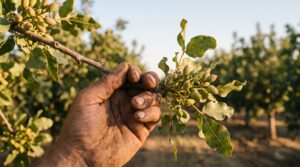
At Agro Vivero del Mediterráneo, we have accumulated years of experience and passion for the pistachio, a noble crop that rewards dedication and knowledge. Today, we want to share with you our vision and recommendations on a crucial aspect for the success and sustainability of your plantations: organic fertilizer alternatives for pistachios. Adopting organic practices is not just a trend, but a smart investment in the health of your soil, the quality of your harvest, and the long-term profitability of your operation. 🌱
The Importance of Organic Fertilizer in Pistachio Plantations
The transition towards organic fertilization or complementing conventional strategies with organic amendments represents a fundamental paradigm shift in the management of pistachio plantations. We, at Agro Vivero del Mediterráneo, have witnessed firsthand the multiple benefits this approach offers, going far beyond simple tree nutrition.
The soil is the fundamental pillar of any successful agricultural operation. A living soil, rich in organic matter and with adequate structure, is capable of retaining water better 💧, facilitating root aeration, and harboring a diverse and active microbial community. This soil microbiology is essential, as its members (bacteria, fungi, actinomycetes) are the true architects of transforming organic matter into nutrients assimilable by the roots of the pistachio plant. Organic fertilizers feed this life in the soil, creating a virtuous cycle of fertility.
Unlike synthetic fertilizers, which often provide nutrients immediately but can have detrimental long-term effects on soil structure and biology, organic fertilizers release nutrients gradually. This slow and sustained release synchronizes better with the nutritional needs of the pistachio tree throughout its development cycle, minimizing losses through leaching and ensuring more balanced nutrition. This is especially important for a long-cycle tree like the pistachio, which requires a constant supply for optimal development and sustained production year after year.
Furthermore, sustainability is an increasingly valued factor. The use of organic fertilizers reduces dependence on external inputs derived from energy-expensive industrial processes, decreases the operation’s carbon footprint, and contributes to environmental conservation. By recycling local or regional organic matter, we close nutrient cycles and promote agriculture that is more resilient and in harmony with the environment. These aspects are crucial if we consider plantation profitability from a comprehensive and long-term perspective.
Finally, though no less important, the quality of the nut obtained is usually favored. A tree nourished in a balanced and natural way, in healthy soil, tends to produce pistachios with better organoleptic characteristics, larger caliber, and, in some cases, better post-harvest conservation. Consumers are increasingly aware and demand products obtained through respectful practices, which can open new market opportunities.
Featured Organic Fertilizer Alternatives for Pistachio
Exploring organic fertilizer options opens up a range of possibilities, each with its own particularities and benefits. From our experience at Agro Vivero del Mediterráneo, we have worked on and advised on the implementation of various sources, adapting them to the specific conditions of each plantation.
Compost: The Pillar of Organic Fertility 🌟
Compost is, without a doubt, one of the most complete and beneficial organic fertilizers. It is obtained through the controlled aerobic decomposition of diverse organic materials, such as crop residues, shredded prunings, animal manures, kitchen waste (vegetables), etc. Well-mature compost is a treasure for the soil:
-
Types of Compost: We can distinguish between vegetable compost (mainly from plant remains), manure compost (with a higher proportion of animal droppings), or a balanced mixture of both. The choice will depend on the availability of materials and the specific needs of the soil. It is crucial that the composting process reaches sanitizing temperatures (above 55-60°C) to eliminate pathogens and weed seeds.
-
Comprehensive Benefits:
-
Structural Improvement: It provides humified organic matter that helps aggregate soil particles, improving its structure in both clay soils (increasing porosity) and sandy soils (increasing water and nutrient retention capacity).
-
Balanced Nutrition: It contains a wide range of macro and micronutrients that are released slowly, adapting to the absorption rhythm of the pistachio trees.
-
Biological Stimulus: It introduces and feeds a great diversity of beneficial microorganisms that improve soil health and nutrient availability.
-
pH Regulation: It tends to have a buffer effect, helping to stabilize soil pH in optimal ranges for nutrient absorption.
-
-
Strategic Application: We recommend applying compost in autumn or late winter, distributing it in the tree’s canopy projection zone or in bands along the planting rows. Slight surface incorporation can be beneficial, although it can also be left as mulch. Doses vary considerably depending on the quality of the compost and the initial fertility of the soil, ranging between 5,000 and 20,000 kg/ha . It is fundamental to perform soil and compost analysis to adjust quantities. For young plantations, doses will be lower and more localized around the pistachio plant.
Animal Manures: Nutritional Power with Caution 🐄🐑🐔
Manures from different animal species (sheep, goat, cattle, horse, poultry) are concentrated sources of nutrients, especially nitrogen, phosphorus, and potassium. However, their use requires careful management:
-
Variety and Composition:
-
Sheep/Goat Manure: It is relatively balanced and rich in organic matter. It decomposes easily.
-
Cattle Manure: Less concentrated in nutrients than sheep manure, but an excellent improver of soil structure due to its high straw content (if from deep bedding).
-
Horse Manure: Similar to cattle manure, but tends to be “hotter” (ferments faster).
-
Poultry Manure (Chicken litter): Very rich in nitrogen and phosphorus, but also in salts. It must be used with extreme caution and always well-composted and in low doses to avoid root burn or saline imbalances.
-
-
The Vital Importance of Composting or Maturation: Never apply fresh manure directly to trees! Fresh manure can contain high concentrations of ammonia (toxic to roots), viable weed seeds, and pathogens (such as E. coli or Salmonella). Composting or adequate maturation (minimum 6-12 months, depending on the type and conditions) stabilizes nutrients, reduces volume, eliminates pathogens and undesirable seeds, and transforms the material into a safe and beneficial product.
-
Application Guidelines: Like compost, it is preferably applied in autumn-winter. Doses should be calculated based on the nutrient content of the composted manure (which varies enormously) and the crop needs detected by foliar and soil analysis. As a general reference, for composted sheep or cattle manure, doses can vary between 10,000 and 30,000 kg/ha every 2-3 years, adjusting according to richness. For composted poultry manure, doses are much lower, in the order of 2,000 to 5,000 kg/ha .
Integrating these fertilizers into a fertilization plan is part of the services we offer, advising on correct management and application.
Green Manures: Cultivating Soil Fertility 🌱🌾
Green manures or cover crops consist of sowing certain plant species (generally legumes, grasses, crucifers, or mixtures thereof) with the main objective of improving soil fertility and not for harvest. Once they reach optimal development, they are mowed and incorporated superficially into the soil, or left on the surface as mulch.
-
Mechanisms of Action:
-
Nitrogen Fixation: Legumes (vetch, bitter vetch, peas, clovers) establish symbiosis with bacteria of the genus Rhizobium in their roots, capable of fixing atmospheric nitrogen and converting it into assimilable forms, enriching the soil naturally. They can contribute between 50 and 150 kg of N/ha!
-
Organic Matter Contribution: The incorporated biomass increases the soil’s organic matter content, improving its structure, water retention capacity, and biological activity.
-
Soil Structure Improvement: The root systems of green manures (especially grasses like oats or rye) explore the soil, creating channels that improve infiltration and aeration.
-
Erosion and Weed Control: A plant cover protects the soil from the impact of rain and wind, and competes effectively with weeds for light, water, and nutrients.
-
Nutrient Mobilization: Some species, such as crucifers (mustard, phacelia), have the ability to extract nutrients from deeper soil layers and make them available to subsequent crops upon decomposition.
-
-
Species Selection: The choice will depend on the soil type, climate, and specific objectives. Mixtures are usually highly recommended to combine benefits. For example, a mixture of vetch (legume) with oats (grass) is a classic and very effective option.
-
Management and Incorporation: They are usually sown in autumn. Mowing and incorporation are normally done in spring, before the cover crop completes its cycle and produces seeds (to avoid it becoming a weed) and before it competes excessively for water with the pistachio trees, especially in areas with limited rainfall. Incorporation should be superficial to favor aerobic decomposition.
Vermicompost (Worm Castings): The Alchemy of the Earth 🐛
Vermicompost or worm castings is the product resulting from the digestion of organic matter by certain species of earthworms, mainly the California red worm (Eisenia foetida). It is a very high-quality organic fertilizer.
-
Composition and Outstanding Advantages:
-
Nutritional Richness: It contains macro and micronutrients in very assimilable forms, in addition to a huge load of beneficial microorganisms (bacteria, fungi, actinomycetes).
-
Natural Phytohormones: It possesses plant growth-regulating substances (auxins, gibberellins, cytokinins) that stimulate root and general plant development.
-
Disease Suppression: The microbial activity of vermicompost can help suppress certain soil pathogens.
-
Soil Improvement: Even in small doses, it significantly improves the physical, chemical, and biological properties of the soil.
-
-
Application in Pistachio Trees: It can be applied locally in the planting hole of young trees (0.5-1 kg/plant ) to favor good rooting. In adult trees, it can be spread in the drip zone at a rate of 1,000 to 3,000 kg/ha , or used to make “compost teas” for foliar application or fertigation. Given its concentration and cost, it is usually used more strategically.
If you are interested in exploring these options for your plantation, do not hesitate to contact us for personalized advice.
Biochar: Ancestral Wisdom for Modern Soils 🔥
Biochar is a carbonaceous material obtained through pyrolysis (heating in the absence or with very little oxygen) of organic biomass (wood scraps, prunings, shells, etc.). It is not a fertilizer in itself in the sense of providing large amounts of nutrients, but a soil improver with very long-lasting effects.
-
How Does Biochar Work?
-
Water and Nutrient Retention: Its highly porous structure acts like a sponge, increasing water and nutrient retention capacity (preventing leaching).
-
Microbial Habitat: The pores offer an ideal refuge for beneficial soil microorganisms, enhancing their activity.
-
Carbon Sequestration: It is a very stable form of carbon, so its incorporation into the soil contributes to mitigating climate change.
-
pH Improvement: Depending on the raw material and pyrolysis temperature, it can have an alkalizing effect, useful in acidic soils.
-
-
Use in Pistachio Plantations: It is recommended to apply it “charged” or “activated”, that is, previously mixed with compost or composted manure for a few weeks. This allows the biochar pores to become saturated with nutrients and microorganisms, enhancing its effectiveness from the start. Doses can vary between 500 and 5,000 kg/ha , depending on the soil type and the biochar. Its effect is very persistent in the soil (hundreds of years).
Liquid Organic Fertilizers: An Additional Boost 💧🌿
In addition to solid amendments, there are liquid organic fertilizers that can complement pistachio nutrition, especially at key moments or to correct specific deficiencies.
-
Seaweed Extracts: They are rich in micronutrients, amino acids, vitamins, and phytohormones (such as cytokinins and auxins). They act as biostimulants, improving resistance to stress (drought, frost), flowering, fruit set, and general tree development. They are applied via foliar spray or fertigation.
-
Fish Emulsions: Obtained from by-products of the fishing industry, they are a good source of organic nitrogen, phosphorus, and trace elements. They also have a biostimulant effect. They must be used diluted and with care to avoid odors or attracting unwanted wildlife if applied to the soil.
-
Compost or Vermicompost Teas: These are aerated liquid extracts obtained from mature compost or vermicompost. They contain a large amount of beneficial microorganisms and soluble nutrients. They can be applied to the soil or foliarly to improve plant health and nutrition.
These products usually have a faster effect than solid amendments, but their action is less long-lasting. They are excellent complements, but not substitutes for a good base fertilization program with solid organic matter.
Other Concentrated Organic Fertilizers and Specific Amendments 🦴🩸🪶
There are other organic products that can be useful in specific situations, generally as more concentrated sources of a particular nutrient:
-
Bone Meal: Rich in phosphorus and calcium, slow release.
-
Blood Meal: Very rich in nitrogen, relatively fast action (for organic). Use with caution so as not to exceed N levels.
-
Feather Meal: Another source of slow-release nitrogen.
-
Vinasse: By-product of the sugar or alcohol industry, rich in potassium and organic matter. Must be used with care due to possible salt content or extreme pH, depending on its origin.
-
Rock Phosphate: Natural source of phosphorus, very slow release, suitable for long-term corrections in soils poor in this element.
-
Natural Origin Potassium Sulphate (Patentkali): Allowed in organic farming, provides potassium and magnesium.
The use of these more specific products should be based on a clear diagnosis of the crop’s needs. For a detailed evaluation and a tailored fertilization plan, you can request a quote through our reservation-quote form.
The Key to Success: Soil and Foliar Analysis 🔬
Regardless of the organic fertilizer alternatives we decide to employ, it is absolutely fundamental to base our fertilization program on a precise diagnosis. This is achieved through:
-
Soil Analysis: Provides detailed information on soil texture, pH, organic matter content, cation exchange capacity (CEC), and levels of available macro and micronutrients. It is recommended to perform it every 3-4 years.
-
Foliar Analysis: Reflects the actual nutritional status of the tree at a given moment. It is done by taking leaf samples in a specific period (generally in July for pistachios). It is a very useful tool to detect deficiencies or excesses before they manifest visually and to adjust the fertilization program for the following year.
At Agro Vivero del Mediterráneo, we consider these analyses indispensable tools for designing efficient and sustainable fertilization strategies, whether organic, conventional, or mixed. A good diagnosis allows applying only what the tree and soil need, optimizing investment and minimizing any negative environmental impact.
Integration of Organic Fertilization into Global Plantation Management
The transition or incorporation of organic fertilization practices is not an isolated act, but must be part of a comprehensive management strategy for the pistachio plantation.
-
Long-Term Planning: The deepest effects of organic fertilization, especially in improving soil health, are observed in the medium and long term. It requires patience and consistency.
-
Irrigation Management: Soil with more organic matter retains water better, which may allow adjusting irrigation patterns, making it more efficient.
-
Weed Control: Green manures and organic mulching are excellent tools for non-chemical weed control.
-
Plant Health: Healthy and biologically active soil, together with well-nourished trees, are less susceptible to pests and diseases.
-
Economic Considerations: Although some organic fertilizers may have an initial acquisition or production cost, the long-term benefits in terms of improved fertility, reduced need for synthetic inputs, and potential improvement in plantation profitability usually offset the investment. Furthermore, the possibility of certifying production as organic can open access to markets with better prices.
Conclusion: Your Ally for an Organic and Profitable Pistachio
At Agro Vivero del Mediterráneo, we are convinced that the future of pistachio cultivation involves increasingly sustainable and environmentally friendly practices. Organic fertilization is a cornerstone of this vision. It offers a path to improve the health of our soils, the resilience of our plantations, and the quality of the precious nuts we obtain.
We understand that every plantation is unique, with its own soil, climate, and management characteristics. Therefore, our team of experts is at your disposal to advise you on the choice and implementation of the most suitable organic fertilizer alternatives for your pistachio trees. From interpreting analyses to designing personalized fertilization plans and supplying pistachio plants of the highest quality, we want to be your partner on the path towards more productive, sustainable, and profitable pistachio cultivation.
Do not hesitate to visit our website agrovivero.com to learn more about our services or to get in direct contact with us. Together we can make your pistachio plantation reach its maximum potential naturally. The organic path is a path to the future! 🌳💚
Need a quote?
Tell us about your project and we will send you a proposal with no obligation.
Request a quote