Finding a dry pistachio tree in the middle of the orchard raises the same question for almost every grower: is it really dead, or can we still save it? 🌳 The answer is not obvious at first glance, because the pistachio is a deciduous species that spends months without leaves and looks very much like a lifeless tree.
At Agro Vivero del Mediterráneo we have spent years working with growers who are establishing a new orchard and with those expanding an existing one, from a few hectares to large estates. This question is one of the most common we receive, by phone and during orchard visits. That is why we have gathered here the tests we apply ourselves to find out whether a pistachio tree is dead, the causes that usually lie behind it, and the decisions that make sense in each case. 🔎
First, a word of caution: do not pull out or cut anything in a hurry. A well-made diagnosis can save us the cost of new plants, while a rushed one can cost us a tree that would have regrown. If in doubt, we wait: a living tree almost always shows signs of life during the spring.
🌿 A Dry Pistachio Tree Is Not Always a Dead Pistachio Tree
The pistachio tree loses its leaves in autumn and enters dormancy. During winter, all the trees in the orchard, healthy or sick, look the same: bare branches, grey bark and closed buds. For that reason, a pistachio tree without leaves in January tells us nothing about its real condition.
The pistachio is a hardy, long-lived species with a strong capacity to regrow from the base. That resilience explains why many trees that seem lost recover, and also why, when one does die, there is almost always a specific reason behind it.
There are also several situations in which a tree looks dry and is still alive:
- 🌡️ Mild winters. When chilling hours are insufficient, budbreak is late and uneven, and some pistachio trees take weeks longer than their neighbours.
- 🌳 Varieties with different calendars. Early-budding and later-budding varieties often grow side by side in the same orchard.
- 💧 Weakened trees. A very heavy crop or a summer of intense drought can cause late, weak budbreak.
- ❄️ Late frosts. They scorch tender shoots and leave the canopy looking dry, although the lower buds may still be alive.
- 🌱 Dry aerial part with healthy roots. The graft has dried out, but the rootstock resprouts below it.
Telling these cases apart is what separates a recoverable dry pistachio tree from a dead one.
🗓️ When to Inspect a Pistachio Tree Without Leaves or Shoots
The rule we repeat most often is this: budbreak is the moment to decide. In the main pistachio-growing regions of the Northern Hemisphere, it starts in late March and continues through April, with differences depending on climate, variety and year. A pistachio tree with no shoots by mid-May, when the rest of the orchard is already in leaf, deserves a thorough inspection. Before that date, the sensible approach is to wait.
It is always worth comparing with trees of the same variety, the same age and a similar position. A tree at the edge of the orchard, exposed to wind, does not behave like one in the centre, and a tree planted in a low spot with moister soil does not develop like one on a high, dry area.
This is the guide we follow throughout the year:
| Season | What we observe | What we do |
|---|---|---|
| Winter | Trees without leaves, all looking alike | We only look for obvious damage: split, gnawed or wounded trunks, and we mark suspicious trees |
| Spring (March–April) | Swelling buds and first leaves | We compare each tree with its neighbours |
| May–June | Trees without leaves or with dried shoots | We apply the bark, branch and bud tests |
| Summer | Sudden wilting or dry leaves that do not drop | We suspect vascular disease or lack of water and take samples |
| Autumn | Early or partial leaf drop | We check irrigation, root collar and roots |
💡 Practical tip: we mark suspicious pistachio trees with coloured tape and note the row, the variety and the date. With that record, in May we will know which trees have progressed and which remain unchanged.
🧰 What We Need to Inspect a Pistachio Tree
No special equipment is required. This kit is enough for a reliable diagnosis in the orchard:
- A sharp pocket knife or grafting knife.
- Pruning shears or a pruning saw, disinfected with alcohol.
- A small shovel or hoe to uncover the root collar.
- Coloured tape to mark suspicious trees.
- Bags and a small cooler to carry samples to the laboratory.
- A mobile phone, to photograph each tree and record its position.
Spending a few minutes photographing and noting down each case lets us compare progress week by week and, if necessary, consult a technician with data in hand.
🔍 How to Tell If a Pistachio Tree Is Dead: Step-by-Step Tests
With a knife, a small shovel and a few minutes per tree, we can obtain very reliable information. These are the checks we carry out in the field, in the order we recommend.
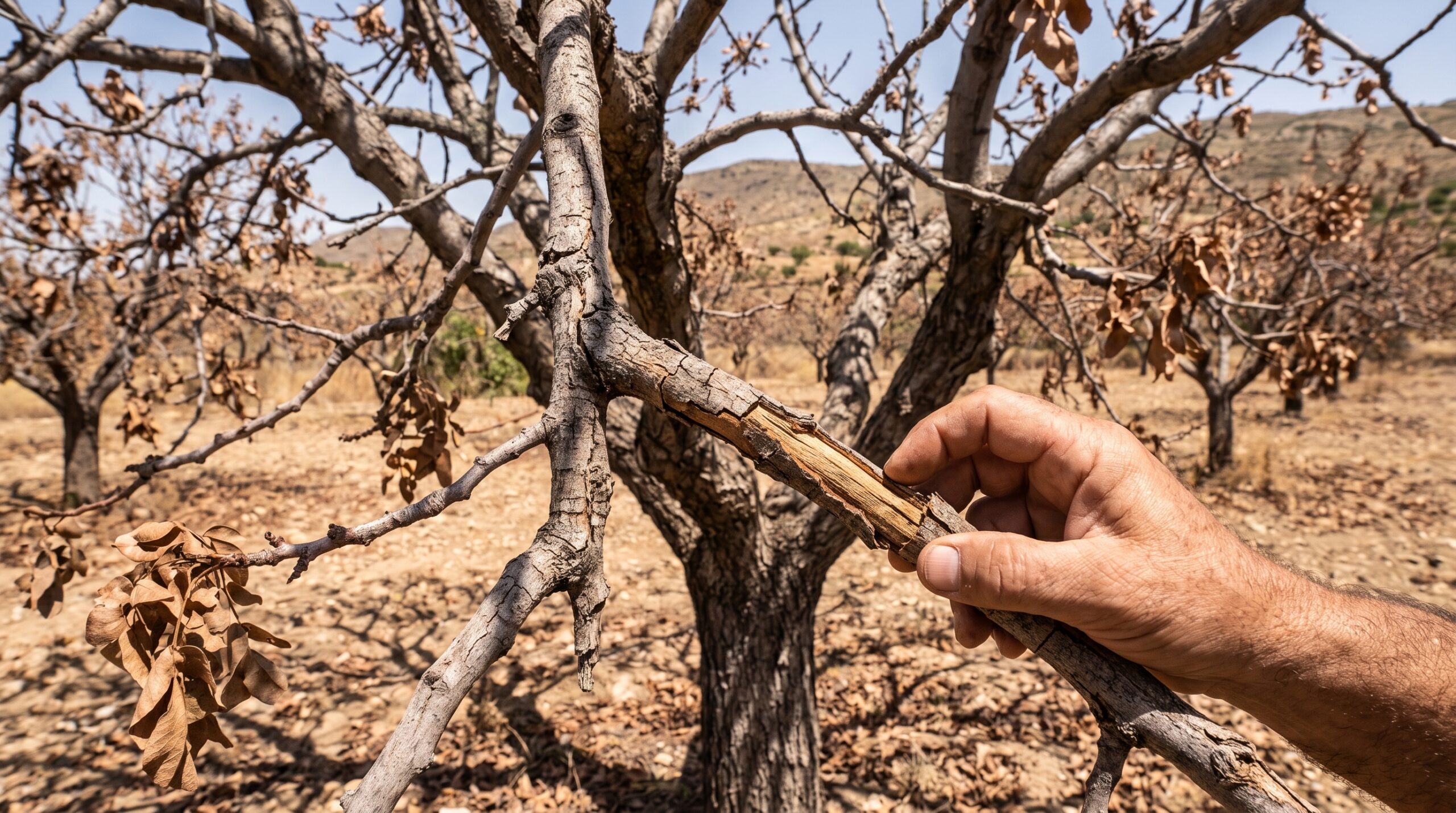
1. Scratching the bark (the fingernail test). This is the simplest check and the one that provides the most information. We scratch a small piece of bark with a fingernail or the tip of a knife on a thin shoot, on a main branch and at the base of the trunk. If green, moist, shiny tissue appears underneath, that green cambium confirms the area is still alive. If the tissue is brown, dry and brittle, that part has died. The test should be repeated in several places, because a tree can be dead in the branches and alive in the trunk.
2. Flexibility test. We bend a twig from last year’s growth. If it is alive, it bends without breaking; if it is dead, it snaps with a dry crack and the break is clean, without fibres.
3. Condition of the buds. Living buds are firm, plump and greenish-brown. Dead ones look wrinkled, dry or dark and come off easily. If we cut one in half, a living interior is light green.
4. Cutting the wood. We cut an affected branch 1 to 2 cm in diameter and examine the cross-section. Clear, uniform wood raises no suspicion. If dark brown streaks or arcs appear in the outer ring, we may be dealing with a vascular disease such as Verticillium.
5. Root collar and roots. We carefully move the soil away from the root collar and the main roots down to about 15 to 20 cm deep. Living roots are white or cream-coloured and firm; dead roots are black, soft and often smell bad. A dark lesion at the root collar that spreads under the bark is typical of root rot. We also check the graft union, which should sit above soil level.
6. Regrowth from the rootstock. If shoots emerge below the graft union, the root is still alive. They often have leaves that look different from those of the grafted variety. We do not remove them until we have decided what to do with the tree, because they can be used to re-graft the pistachio tree.
7. Trunk pull test. We gently pull on the trunk. If the tree gives way easily with almost no resistance, the roots are probably rotten or have been gnawed by voles.
A simple rule: if the pistachio tree passes even one of these tests in the trunk, the root collar or the roots, it is not dead and deserves continued observation. Only when all of them fail, even at the base, can we speak of a dead pistachio tree.
📊 Live Pistachio Tree vs Dead Pistachio Tree: Visual Summary
To keep it at hand in the orchard, we summarise the main signs in this table:
| Test | Live pistachio tree ✅ | Dead pistachio tree ❌ |
|---|---|---|
| Scratched bark | Green, moist and shiny | Brown, dry and brittle |
| Twigs | Bend without breaking | Rigid, snap with a crack |
| Buds | Firm and plump | Wrinkled, dry or dark |
| Cut wood | Clear and uniform | Dark brown, with streaks or arcs |
| Roots | White or cream-coloured and firm | Black, soft and foul-smelling |
| Regrowth | Shoots below the graft or at the base | None |
🌲 When Only Part of the Pistachio Tree Is Dry
The whole tree does not always die. We often see pistachio trees in which one main branch or one side of the canopy dries out while the rest buds normally. In such cases, the goal is to locate how far the dead zone extends.
We follow the branch from the tip towards the trunk and scratch the bark every few centimetres until we find green tissue. We then cut a few centimetres below the last affected area, with a disinfected tool and, if possible, in dry weather. If the cut wood still shows dark streaks, we go a little further until we see clean wood.
If the dead zone reaches the main trunk or girdles the root collar, the prognosis worsens, because the flow of sap to the entire canopy is interrupted. In that case, we return to assessing the rootstock and any possible regrowth.
🦠 Why a Pistachio Tree Dries Out: Most Common Causes
Knowing that a tree is dead is only half the work. The other half is understanding why it died, so that the problem is not repeated with the replacement plant. These are the causes we encounter most often, both pistachio diseases and management errors.
Verticillium in pistachio trees. This is a soil-borne fungus, Verticillium dahliae, that invades the vascular tissue and blocks the circulation of sap. It causes sudden wilting of a branch or an entire sector, leaves that dry out without dropping, and the dark streaks in the wood described above. It survives for years in the soil, so the orchard’s history matters: cotton, tomato, potato, sunflower and olive groves are previous crops we must take into account.
Phytophthora in pistachio trees and root asphyxia. Heavy soils, poor soil drainage and drippers placed too close to the trunk create the ideal environment for this organism, which rots the root collar and the roots. The tree turns yellow, develops small leaves and declines gradually. Even without a pathogen, prolonged waterlogging leaves the roots without oxygen and causes root asphyxia.
Botryosphaeria and other wood fungi. They cause shoot dieback and cankers on branches. They spread from dead wood left in the orchard and enter through pruning wounds made in wet weather. For that reason, dry pistachio branches should not be left hanging or lying between the rows.
Armillaria. It forms a white, fan-shaped mycelium under the bark of the root collar and appears more often in orchards established on former woodland or after other tree crops.
Frost in pistachio orchards. The pistachio tree buds late and avoids many frosts, but a late frost can scorch shoots and flowers, and a very harsh winter mainly damages young, poorly lignified plants.
Poorly adjusted irrigation. The pistachio tolerates drought well once established, but a young plant without enough water in summer can die within a few weeks. At the other extreme, excess water kills roots. Pistachio irrigation must be adjusted to the age of the tree, the type of soil and the time of year.
Voles and mechanical damage. Voles in the orchard gnaw roots and root collars and cause sudden dieback. Brush cutters, implements and trunk shakers open wounds in the bark through which fungi enter. And a herbicide applied to young bark can also kill a tree.
Often there is no single cause. A tree stressed by waterlogging is more vulnerable to fungi, and a pruning or machinery wound opens the door to others. That is why we always analyse the whole picture: soil, water, orchard history and management.
As a guide, this is the main clue each cause gives us:
| Cause | Main clue |
|---|---|
| Verticillium | Dark streaks in the wood and wilting of a branch |
| Phytophthora or asphyxia | Dark lesion at the root collar and waterlogged soil |
| Voles | Tree that gives way when pulled and tunnels in the soil |
| Frost | Tender shoots blackened after a cold night |
| Lack of irrigation | Dry leaves across the whole canopy and dry soil |
🌱 Tree Losses in Young Orchards: What to Check in the First Years
In a young orchard, a good share of the pistachio trees that dry out do so not because of disease but because of planting material or management errors. These are the causes of tree losses in new orchards that we see most often:
- Plants set too deep, with the graft buried.
- Air pockets around the roots caused by poorly settled soil.
- Roots dried out or damaged before planting.
- Insufficient or excessive early irrigation.
- Weed competition next to the trunk.
- Areas of the field where water accumulates.
The quality of the plant material makes a big difference. A pistachio plant with a well-formed root system and a well-healed graft copes much better with the stress of the first months. That is why we take such care over this point in our nursery, and you can see our pistachio plants on our website.
During the first summer, supplementary irrigation makes the difference. Young plants have a shallow root system and depend on water reaching their root zone regularly, without waterlogging. Short, frequent irrigation at first, spaced out as the tree grows, usually gives better results than long, widely spaced irrigation.
Missing trees should be replaced during the first or second year. A tree replaced late competes at a disadvantage with its neighbours, which already have more root and more canopy.
✂️ What to Do When the Pistachio Tree Is Dead
Once the diagnosis is confirmed, we follow this order:
- Confirm the cause. If we suspect a soil-borne disease, it is advisable to send a sample to a laboratory: branches including the transition zone between living and dead tissue, well protected and kept cold. A plant pathology diagnostic laboratory will tell us which fungus is involved.
- Assess re-grafting. If the rootstock has resprouted, it is sometimes possible to re-graft the pistachio tree with the desired variety and save time, because the root system is already developed. This is a technical task carried out at the right time of year, so we recommend seeking technical advice.
- Decide when to remove a pistachio tree. If all the tests are negative and there is no regrowth, it is best to wait until spring has passed and then remove the tree, extracting as much of the root system as possible and without dragging soil towards other rows.
- Disinfect tools and machinery. Between one tree and the next, we clean with alcohol or a bleach solution so as not to carry the problem to another pistachio tree.
- Remove the dead wood. We take it out of the orchard. If it has to be burned, we first check local regulations, as a permit is often required.
- Prepare the planting hole and replace. If the origin was excess water, we improve drainage or plant on raised ridges. If it was Verticillium, we consider the pistachio rootstock, since not all of them show the same tolerance. In any case, replanting pistachio trees requires correcting the cause first.
- Record and monitor. We record the row, the variety, the probable cause and the date of each loss. These data help to detect patterns from one year to the next.
One detail that is often forgotten: if the dead tree was a male, we lose part of the orchard’s pistachio pollinators. As a reference, an orchard usually needs one male for every eight to ten females, and the replacement male must match the flowering period of the female varieties.
📐 Practical Example: How Many Tree Losses Can We Accept?
Let us imagine a 10-hectare orchard with a 6 x 5 m spacing, that is, about 333 pistachio trees per hectare and 3,330 trees in total.
- With 2% losses, about 67 pistachio trees are missing, which can be replaced in one season without major complications.
- With 10% losses, 333 trees are missing, the equivalent of an entire hectare out of production.
Besides the percentage, the distribution matters. If the tree losses are scattered, we tend to think of individual causes: a planting error, a vole or a wound. If they are clustered in one area, we suspect a disease focus, a drainage problem or an irrigation fault. As an approximate guide, when more than 5% of the trees are lost in a single season, we recommend extending the review to the soil, the water and the management.
Time must also be factored in: a replacement pistachio tree takes several years to come into production while the trees around it are already producing. For this reason, where possible, re-grafting onto a healthy rootstock shortens the path.
Every missing pistachio tree reduces production for years, which is why the calculation of the profitability of a pistachio orchard must include a realistic margin for replacements.
⚠️ Common Mistakes When Diagnosing a Dry Pistachio Tree
These are the mistakes we see most often when reviewing orchards, and all of them can be avoided:
- Writing off the tree as dead in winter. Without leaves, they all look the same. We wait for budbreak.
- Pruning a doubtful tree severely. Heavy pruning of a weakened tree removes its reserves and opens more wounds.
- Irrigating more when the problem is excess water. A tree that turns yellow is interpreted as thirsty, and the extra irrigation worsens the asphyxia.
- Treating without a diagnosis. Applying fungicides or fertilisers without knowing the cause usually costs money and wastes time.
- Leaving dead wood in the orchard. It becomes a source of wood fungi.
- Forgetting the rootstock. Looking only at the canopy and not checking for regrowth below the graft.
- Replanting immediately without correcting the cause. The new tree will suffer the same fate as the previous one.
Avoiding these mistakes does not require major resources, only method and patience.
🛡️ How to Prevent a Pistachio Tree from Drying Out in an Orchard
Many problems can be prevented before planting. These are the measures we recommend:
- 🧪 Know the site. We analyse the soil, the irrigation water and the cropping history before choosing the plant.
- 🌊 Prioritise drainage. Deep, well-drained soils are best; in heavy soils, we plant on raised ridges.
- 🌳 Choose the rootstock and variety carefully according to climate, soil and available pollinators.
- 💧 Design the irrigation with care. Drippers set away from the trunk and irrigation adjusted to the tree’s real demand.
- ✂️ Prune in dry weather with clean tools, and remove the debris from the orchard.
- 🐭 Monitor rodents and weeds around the trunk, especially on young plants.
- 🚜 Protect the trunk from machinery with guards or careful driving.
- 👣 Walk the orchard regularly, especially during budbreak and in midsummer.
If support is needed on any of these points, our services include technical advice for pistachio cultivation, from orchard design to annual follow-up.
❓ Frequently Asked Questions About the Dry Pistachio Tree
When does a pistachio tree bud after winter? In most Northern Hemisphere growing regions, between late March and April. Until mid-May, it is not advisable to give up on a tree.
Can a pistachio tree that looks dry resprout? Yes, as long as the cambium of the trunk or the base is still green, or the rootstock produces shoots. The canopy may be lost while the tree recovers from below.
Is there a cure for Verticillium? There is no curative treatment. In mild cases, removing the affected branches and maintaining balanced irrigation may allow the tree to live with the disease, although it must be monitored closely. The best tool is prevention from the orchard design stage.
Can we plant another pistachio tree in the same hole? It is possible, but the cause must be known first. If the reason was excess water or a vole, it is corrected and the tree is replaced. If there was a soil-borne disease, it is advisable to confirm it, improve the conditions and choose the plant carefully.
How often should the orchard be inspected? We recommend one full walk-through at peak budbreak, another in early summer and a third in autumn. If there are tree losses, we repeat the inspection every few weeks until their progress is clear.
What do we do if we do not know why a pistachio tree is drying out? The first step is to take photos of the canopy, the trunk and the roots, note when the problem appeared and contact us. With that information, we can help guide the diagnosis.
🤝 To Wrap Up
A dry pistachio tree is not necessarily a dead pistachio tree. To find out, we wait for budbreak, scratch the bark until we see the green cambium, check buds, wood, roots and regrowth, and only then do we decide. ✅ Afterwards, we identify the cause, correct the management and replace with quality plants so that the orchard maintains its density and its production.
At Agro Vivero del Mediterráneo we work with growers of all sizes and we know that every tree counts. If you have doubts about a pistachio tree in your orchard, write to us through our contact page and we will review it with you. And if you need to replace missing trees or expand your orchard, you can request a quote through our reservation and quotation form. 🌳
Need a quote?
Tell us about your project and we will send you a proposal with no obligation.
Request a quote