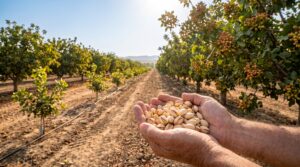
At Agro Vivero del Mediterráneo, one of the questions we hear most from farmers venturing into the exciting world of pistachios is: “But when will I start making real money?”. It is the million-dollar question, the one that separates the initial illusion from the reality of a long-term agricultural project. And we love being asked this, because an honest and detailed answer is the first pillar for building a successful plantation. 🌳
The profitability of a pistachio plantation is not a switch that turns on one specific day. It is a process, a gradual climb that depends on a symphony of fine-tuned factors: plant genetics, agronomic management, climate, soil, and, of course, a good dose of strategic patience. As experts with decades of experience in the sector, we want to accompany you on this journey and break down, year by year, the path a plantation travels from being a simple project on paper to becoming a sustainable and lasting economic engine.
So, if you are thinking of investing in “green gold”, we invite you to keep reading. We are going to demystify the timelines, put numbers on the table, and give you the keys so that your wait is not only shorter but also much safer and more productive. Because your success is our success.
Patience is Gold: Understanding the Pistachio Tree Cycles
Before getting out the calculator, it is fundamental to understand the nature of the tree that will give us such a precious nut. The pistachio tree (Pistacia vera) is not a short-cycle crop like a vegetable or a cereal. It is a woody tree, slow-growing in its early years, which is genetically programmed to invest a huge amount of energy in building a strong structure and a deep root system before dedicating itself to production. This is its survival strategy, which allows it to live for more than 100 years and withstand extreme weather conditions.
This characteristic implies that the initial investment in a pistachio plantation must be viewed as a life project, a legacy for future generations. We will not see an immediate economic return, but the long-term reward can be extraordinary. Understanding this from the beginning avoids frustration and allows for correct decision-making.
Another concept inherent to the pistachio tree is alternate bearing (vecería). This means that the tree tends to alternate a year of abundant harvest with another of much lower harvest. It is a natural physiological phenomenon that seeks the tree’s energy balance. Good agronomic management can attenuate alternate bearing, but never eliminate it completely. Therefore, when planning plantation profitability, we must always think in two-year cycles to have a realistic view of income.
The basis of everything, the starting point that can significantly shorten timelines, is the choice of plant material. Starting a project with a pistachio plant of maximum quality, with guaranteed sanitary and genetic certification, is the most profitable decision a farmer can make. A weak plant or one of dubious origin will not only take longer to grow but will be more susceptible to diseases and will never reach the productive potential of an elite plant. At Agro Vivero del Mediterráneo, this is our main commitment: offering plants that are a guarantee for the future.
The Journey Year by Year: From Planting to the First Significant Harvest
To better visualize the process, let’s break down what you can expect at each stage of your plantation’s development. These timelines are a guide based on our experience with well-managed plantations, especially those using vigorous rootstocks like UCB-1 and receiving professional agronomic management.
Years 1 to 3: The Establishment and Growth Phase 🌱
These first years are critical and focus exclusively on the vegetative development of the tree. Production is zero, but the investment in time and resources is constant and fundamental. The main objective is one: to create a strong and well-structured pistachio “factory”.
-
Main tasks: During this stage, all our efforts are concentrated on:
-
Precise irrigation: Water is vital, but waterlogging is deadly for young roots. A well-designed and managed drip irrigation system is key.
-
Weed control: They compete directly for water and nutrients, slowing down the growth of our young trees.
-
Training pruning: It is a craft. We give the tree the vase or central leader structure that will allow good aeration, correct insolation, and facilitate harvesting in the future. A poorly formed tree will drag problems throughout its life.
-
Balanced fertilization: We provide the necessary nutrients for the tree to develop a robust trunk, strong primary branches, and, above all, a powerful root system.
-
Phytosanitary protection: Young trees are more vulnerable to certain pests and diseases. Vigilance must be constant.
-
In this phase, every euro invested in care will translate into an earlier and more abundant entry into production. It is here that our technical advisory services team plays a crucial role, helping farmers make the right decisions at every moment, optimizing resources, and laying the foundations for success. Forget about seeing a single pistachio; the only fruit you will harvest here is the satisfaction of seeing your trees grow healthy and vigorous.
Years 4 to 5: The First Signs and Productive Awakening ✨
The excitement begins to be palpable! Around the fourth or fifth year, if all has gone well, the tree reaches sexual maturity. It is the moment when, if we have not planted an already grafted plant, we will perform the grafting of the desired variety (Kerman, Larnaka, Sirora…) onto the rootstock.
-
First blooms: We will see the first flowers, both on female trees and male pollinators. It is an unequivocal sign that the plantation is progressing adequately.
-
Symbolic harvest: It is very likely that the first pistachios will set. We are talking about a symbolic production, perhaps 50 to 200 grams per tree. This harvest has no commercial value; in fact, many technicians recommend removing it so that the tree does not divert energy from growth. However, its emotional value and as an indicator is incalculable. It confirms that your trees are fertile and that the chosen path is the correct one!
This stage is a psychological turning point for the farmer. The wait begins to materialize into something tangible. Although there is still no economic profitability, the emotional profitability is maximum.
Years 6 to 7: Entry into Production and the Break-Even Point 📈
This is the biennium that marks a before and after. The plantation officially enters production. Harvests are no longer symbolic but begin to have real weight in the farm’s economy.
-
Expected production: In a well-managed plantation, we can expect productions ranging between 300 and 700 kilograms of dry, hulled pistachio per hectare. This range is wide because it depends enormously on the planting layout, the variety, the climate of that year, and, of course, alternate bearing.
-
The operational break-even point: With an average selling price (which can vary between €6.50 and €9.00 per kilo, depending on quality, caliber, and whether it is organic or conventional), the income generated at this point is usually sufficient to cover the annual maintenance costs of the plantation (irrigation, fertilization, pruning, harvesting, etc.). That is, the plantation starts to “pay for itself”. We are not yet amortizing the initial investment, but we have stopped putting money from our pocket every year to maintain it.
Reaching this milestone is a great victory. It demonstrates that the project is viable and that the phase of greatest profitability is just around the corner. It is the moment to analyze the first real production and cost data to adjust our strategy for the future, an analysis we detail in our section on plantation profitability.
When Does Real Profitability Arrive? The Path to Full Production 💰
Once the barrier of entry into production is overcome, the climb accelerates. The trees are bigger, stronger, and their productive capacity skyrockets.
Years 8 to 10: Consolidation and Net Profits
The plantation enters a cruising phase. Production growth is no longer linear, but exponential.
-
Expected production: Harvests consolidate and increase significantly. In this period, it is realistic to expect productions of between 1,000 and 1,800 kg per hectare. The quantitative leap compared to the previous stage is huge.
-
Amortization of investment: With these production levels, income far exceeds annual expenses. Now, we start generating significant net profits. This positive cash flow is what allows us to begin amortizing the initial investment made in the early years (land preparation, irrigation system, plant purchase, etc.).
The farmer begins to reap the fruits of their patience and good work. The plantation becomes a profitable asset, and the feeling of having made a good decision is complete. Management now focuses on maintaining tree health and optimizing tasks to maximize pistachio quality, which will result in a better selling price.
Years 12 Onwards: The Longed-For Full Production and Long-Term Stability 🏆
From year 12 onwards, approximately, the pistachio plantation is considered to reach its productive maturity or full production. The trees have reached a considerable size and their productive potential stabilizes at its peak, always with the fluctuations inherent to alternate bearing.
-
Expected production: In a modern, well-designed pistachio plantation with impeccable management, productions at full maturity can sit between 2,000 and over 3,000 kg per hectare in high harvest years. These are the numbers that make pistachio one of the most profitable woody crops in the world.
-
Maximum profitability and sustainability: In this scenario, profitability is very high. The initial investment is more than amortized, and the plantation generates substantial net profits year after year. The most extraordinary thing is that this situation is not a fleeting moment. A well-cared-for pistachio plantation can maintain these production levels for decades, easily exceeding 60, 70, or even more years of useful life. It is an investment that not only you will enjoy, but also your children and grandchildren.
Reaching this phase is the culmination of a long journey. It is proof that careful planning, the choice of top-quality material, and expert advice are the indispensable ingredients for success. If you want to start designing your path to this phase, you can request a personalized study through our reservation and quote form.
Factors That Accelerate (or Delay) Your Path to Profitability
As we have seen, timelines are not set in stone. There are a series of decisions and factors that can significantly shorten or lengthen the waiting time to obtain a profitable harvest. At Agro Vivero del Mediterráneo, we always insist on the following points:
-
Genetics is Queen (and King): We will not tire of repeating it. Starting with a pistachio plant of certified quality, on a vigorous rootstock adapted to your soil like UCB-1, can advance entry into production by one or even two years. The initial vigor of these plants allows them to develop much faster, shortening the establishment phase. Saving on plant purchase is the most expensive mistake one can make.
-
Smart Plantation Design: Good design from the start is crucial.
-
Planting layout: More intensive layouts (6×4, 6×5) can yield more kilos per hectare in the early years, although they require more intense pruning management in the long term.
-
Pollination: The correct distribution and proportion of male trees (approximately 1 for every 8-10 females) and the choice of compatible pollinator varieties with an overlapping flowering period are absolutely critical to ensure good fruit set. A failure here means zero harvest.
-
-
Professional Agronomic Management: This is where the day-to-day battle is fought.
-
Precision irrigation: Controlled deficit drip irrigation is the technique that has revolutionized the crop. Providing just the right amount of water at key phenological moments (bud break, flowering, kernel filling) not only increases production but also advances entry into production and improves pistachio caliber, which translates into a better price.
-
Tailored nutrition: A fertilization plan based on soil and foliar analysis allows giving the tree what it needs at each moment, avoiding deficiencies that hinder its growth or excesses that harm the environment and your pocket.
-
Expert pruning: Training pruning in the early years and subsequent production and rejuvenation pruning are essential to maintain tree balance, favor light entry, control alternate bearing, and facilitate harvesting. These are our star services, where we contribute all our knowledge.
-
-
Soil and Climate: The pistachio tree is resistant, but not immortal. It needs deep, well-drained soils to develop its powerful root system. It does not tolerate waterlogging. Furthermore, it requires a sufficient number of winter chill hours for correct bud break and long, hot summers for good pistachio ripening. Choosing the varieties and rootstocks that best adapt to your edaphoclimatic conditions is a strategic decision.
A Practical Example: Profitability Simulation 📊
To give you a clearer idea, let’s propose a simplified scenario of costs and income per hectare. Remember that these are estimates and actual values may vary!
Assumptions:
-
Planting layout: 6×5 meters (333 trees/ha).
-
Average selling price: €7.50/kg (dry, hulled, conventional pistachio).
Initial Investment (Year 0):
-
Land preparation: €800
-
Drip irrigation system: €3,500
-
Plant purchase (333 units x €15/unit): €4,995
-
Planting and protectors: €1,200
-
Total Initial Investment per Hectare: €10,495
Annual Maintenance Expenses (average):
-
Irrigation, energy, fertilizers, treatments, pruning, harvesting, etc.: €2,000 – €2,500/ha
Income and Profitability Projection:
-
Year 6: 450 kg/ha x €7.50/kg = €3,375.
-
Result: Income (€3,375) > Expenses (€2,500). Operational break-even point reached!
-
-
Year 8: 1,300 kg/ha x €7.50/kg = €9,750.
-
Result: Net profit of approx. €7,250/ha. We start amortizing the investment.
-
-
Year 10: 1,800 kg/ha x €7.50/kg = €13,500.
-
Result: Net profit of approx. €11,000/ha. The initial investment is practically amortized.
-
-
Year 12 (Full production): 2,500 kg/ha x €7.50/kg = €18,750.
-
Result: Net profit of approx. €16,250/ha. The plantation is at its peak profitability.
-
As you can see, although the initial wait requires investment and patience, the reward from year 8-10 is exceptional and sustained over time.
Conclusion: A Marathon with a Golden Finish Line
In summary, the answer to “how long to wait for a profitable pistachio harvest?” is: it depends on how you manage the race. It is not a sprint. It is a marathon that, if run with intelligence, strategy, and the best travel companions, has a golden finish line.
From Agro Vivero del Mediterráneo, our recommendation is clear: do not obsess solely over time. Obsess over quality. Invest in the best pistachio plant, rely on a professional technical advisory service, and plan your profitability with a long-term vision.
If you do it this way, entry into production will arrive sooner, harvests will be more abundant, and profitability will exceed your expectations. Patience, in pistachio cultivation, is not passive waiting; it is an active investment in the future.
Are you ready to start building your future with green gold? We are here to help you take every step with confidence. Do not hesitate to contact us or request your personalized quote without obligation. The journey towards your profitable plantation starts today! 📞✅
Need a quote?
Tell us about your project and we will send you a proposal with no obligation.
Request a quote