
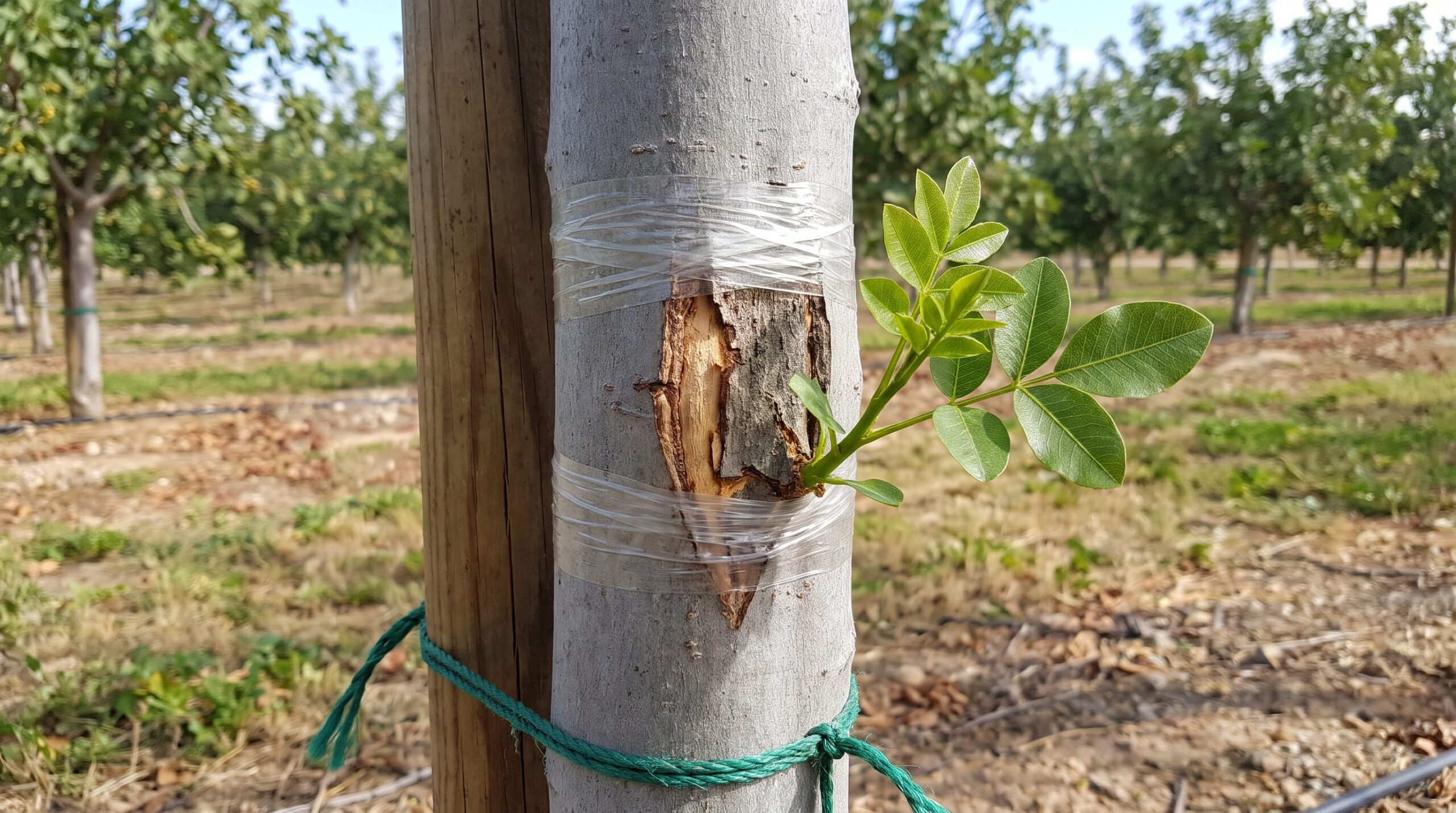
UCB1: Advantages and Drawbacks of the Most Widely Used Rootstock
When a grower visits us to plan their first pistachio orchard, they almost always arrive with the same question: which rootstock should we graft onto? 🌳 In most cases the conversation ends up revolving around UCB1, the most widely used rootstock in irrigated pistachio orchards around the world.
Its popularity is well founded, but that does not make it the ideal solution for every farm. A pistachio rootstock is chosen once and stays with the orchard for its entire productive life. A mistake here cannot be corrected with a treatment or an irrigation adjustment. It is paid for over many years. 💸
In this article we review the advantages and drawbacks of UCB1 based on the experience we have built in the nursery and in real orchards. We do so with both growers in mind: those starting with a few hectares and those planning a large-scale operation. And if you need a personalized opinion, at Agro Vivero del Mediterráneo we study each farm individually.
What Is UCB1 and Where Does It Come From? 🧬
UCB1 is a hybrid rootstock resulting from a cross between Pistacia atlantica and Pistacia integerrima. It was selected in California as part of the University of California’s breeding programs, with a clear objective: a more vigorous, more uniform rootstock with better performance against Verticillium wilt than seed-grown rootstocks.
Combining the two species makes agronomic sense. Pistacia atlantica contributes hardiness and the ability to adapt to demanding climate and soil conditions. Pistacia integerrima contributes vigor and greater tolerance to Verticillium dahliae, the soil-borne fungus that causes Verticillium wilt, one of the most feared diseases of the pistachio tree.
In practice, the UCB1 plants used in modern orchards come from micropropagation, that is, in vitro culture. Thanks to this system, all plants are genetically identical and behave very similarly in the field. As we will see later, this is both a great virtue and a small risk. 🔬
Pistachio grafting is carried out on this rootstock with commercial varieties such as Kerman, Sirora, Larnaka or Avdat, and with their pollinators.
Why UCB1 Is the Most Widely Used Rootstock in Pistachio Orchards 📈
There are three main reasons behind its success:
- Proven track record. It has been planted over large areas for many years, generating a huge amount of trials, data and management experience.
- Uniform, available plants. Micropropagation makes it possible to produce large batches of plants with very similar characteristics, which is essential in projects covering hundreds of hectares.
- Balance between vigor and disease tolerance. Under irrigation it grows quickly and, in addition, defends itself against Verticillium wilt better than many seed-grown rootstocks.
On top of this, a large part of modern irrigated pistachio growing has been built on the Californian model, and in that model UCB1 has been the benchmark rootstock. The same pattern is seen in many other pistachio-growing regions: in new irrigated orchards it is often the first choice.
However, being the most widely used rootstock does not mean being the best in every circumstance. It means it performs very well under specific conditions. Understanding what those conditions are is what makes the difference between a profitable orchard and one that carries problems. 🎯
Advantages of the UCB1 Rootstock ✅
These are the advantages we value most when advising our clients:
1. Vigor and Fast Entry into Production 🚀
Vigor is its best-known trait. Trees grafted onto UCB1 quickly develop a good structure and occupy their space rapidly, which shortens the time to the first harvests. As a guideline, in a well-managed irrigated orchard we usually speak of first harvests around year four or five and full production around year ten, although every farm has its own pace.
2. Orchard Uniformity 📏
Because the plants come from micropropagation, they are practically identical. Orchard uniformity translates into trees of similar size, similar irrigation needs and more even ripening. For those managing many hectares, it simplifies pruning, treatments and mechanical harvesting. For the small grower, it means fewer surprises.
3. Tolerance to Verticillium dahliae 🛡️
This is the advantage that carries the most weight on plots with a history of the disease. UCB1 is considered tolerant to Verticillium wilt, which gives it a clear advantage over seed-grown Pistacia atlantica rootstocks, which are more susceptible. On plots that follow olive groves or vegetable crops, it is a decisive argument. That said, we are talking about tolerance, not immunity.
4. Good Performance in Calcareous Soils and Under Some Salinity 🧂
The pistachio is a hardy tree, and UCB1 adapts well to calcareous soils and reasonably tolerates salinity in both the soil and the irrigation water. This opens the door to farms in Mediterranean and inland regions where other crops struggle. Even so, we always recommend analyzing electrical conductivity and boron content before deciding.
5. Good Compatibility with Commercial Varieties 🤝
The graft works well with the most important varieties, such as Kerman, Sirora, Larnaka or Avdat, and with the usual pollinators. Good compatibility shows in graft take, in the quality of the union and in the longevity of the tree.
6. Response to Intensive Irrigated Management 💧
With adjusted irrigation and fertilization, UCB1 responds: it grows, branches and produces consistently. For those committed to irrigated pistachios and aiming for high yields, this is a significant asset. In addition, technical knowledge about its management is widespread, which makes it easier to find advice.
Drawbacks of UCB1 You Should Know About ⚠️
No rootstock is perfect, and being transparent about weak points is part of our job. These are the ones we watch most closely:
1. Tolerant Does Not Mean Resistant 🍂
Although UCB1 tolerates Verticillium wilt better than other rootstocks, it is not immune. On plots with very high fungal pressure, for example after years of olive groves affected by Verticillium wilt or affected vegetable crops, trees with symptoms may appear. That is why we recommend knowing the plot history and, if in doubt, carrying out a specific soil analysis for Verticillium dahliae before planting.
2. Sensitivity to Waterlogging 🌊
This is probably its greatest weak point. UCB1 does not tolerate soils that retain water well. In heavy soils, with poor drainage or with poorly sized irrigation, the risk of root asphyxia and rots caused by fungi such as Phytophthora increases. Good drainage and, when necessary, planting on ridges are basic measures.
3. A Vigor You Need to Know How to Direct 🌿
Vigor is an advantage, but it is also a responsibility. A very vigorous tree needs space, a well-planned formative pruning and cautious fertilization. If nitrogen is overused in the early years, the tree may keep growing late in the season and reach winter with poorly hardened wood, which increases the risk of cold damage.
4. Extreme Cold Zones ❄️
The pistachio needs winters with sufficient chilling, but extreme winters and late frosts are another matter. In marginal zones, UCB1 is not the hardiest rootstock, and the decision must be studied together with the variety and the location of the plot.
5. Higher Plant Cost 💶
Micropropagated plants usually cost more than those of seed-grown rootstocks, because they require a more complex and controlled production process. In most cases this investment is offset by uniformity and lower risk, but it should be kept in mind when preparing the initial budget.
6. Genetic Uniformity: A Risk to Consider 🧬
If all plants are identical, they also all share the same weaknesses. If a pathogen capable of overcoming its tolerance were to appear in the future, the problem could affect the entire orchard at once. That is why, on large areas, it is worth considering from a technical standpoint whether to diversify rootstocks across plots.
7. Less Suitable for Rainfed Conditions and Very Poor Soils 🏜️
UCB1 is designed for irrigated orchards. In rainfed conditions or in shallow, very poor soils, hardier rootstocks such as Pistacia terebinthus tend to adapt better, although with slower growth and more modest yields.
Summary of UCB1 Advantages and Drawbacks 📊
For a quick overview, we summarize the key points in this table:
| Aspect | Advantage | Drawback |
|---|---|---|
| Vigor | Fast entry into production | Requires space and formative pruning |
| Uniformity | Homogeneous orchard that is easy to manage | Risk due to genetic uniformity |
| Verticillium wilt | Greater tolerance than seed-grown rootstocks | Not immune under high pressure |
| Soil | Good adaptation to calcareous soils and some salinity | Poor performance under waterlogging |
| Climate | Very good development in warm irrigated zones | Not the hardiest in extreme cold |
| Cost | Lower risk of failures and variability | More expensive plants than seed-grown rootstocks |
| Water | Responds well to intensive management | Not recommended for rainfed conditions |
UCB1 Compared with Other Pistachio Rootstocks 🔍
The choice is not between “good” and “bad,” but between different profiles. This comparison is indicative, because actual performance depends on the origin of the plant, the soil and the management:
| Rootstock | Vigor | Uniformity | Verticillium wilt | Most common use |
|---|---|---|---|---|
| UCB1 | Very high | Very high | Tolerant | Irrigated and intensive orchards |
| Pistacia atlantica (seed) | Medium-high | Low | Lower tolerance | Cold zones and demanding soils |
| Pistacia terebinthus (seed) | Low-medium | Low | Variable | Rainfed conditions and poor soils |
The seed-grown Pistacia atlantica rootstock is hardy and resistant to cold and drought, but it shows considerable variability between plants, so very different trees coexist within the same plot. The Pistacia terebinthus rootstock is the classic resource for rainfed conditions and poor soils: it grows slowly, but it holds up under very harsh conditions.
There are also other hybrids and selections of Pistacia integerrima developed to improve tolerance to certain diseases. We follow them with interest, although their track record under our conditions is still shorter than that of UCB1. In short, there is no universal rootstock: there is the right rootstock for each farm. 🌾
When We Recommend UCB1 and When We Consider Other Options 🎯
After seeing many farms, we have learned to quickly identify the scenarios in which UCB1 is a good fit.
We usually recommend it when:
- irrigation is available and guaranteed throughout the whole season;
- the soil is deep, with a loam or sandy-loam texture and good drainage;
- the plot has a history of Verticillium wilt or follows host crops such as olive, tomato or cotton;
- the water or soil has moderate salinity;
- the goal is a homogeneous, productive orchard suited to mechanization.
We consider other options when:
- the orchard will be rainfed or have very little water;
- the soil is heavy and we cannot guarantee drainage;
- the area has extreme winters or a high risk of frost;
- the soil is shallow, stony and very poor.
No single criterion decides on its own. What we do is combine them and, when in doubt, propose a preliminary analysis. If you would like us to review your plot, you can contact our team and we will advise you with no commitment. 📞
Planting Layout with UCB1: How Its Vigor Shapes It 📐
Because UCB1 develops large trees, the planting layout must leave enough space for the canopy to develop without competing for light or water. These are the most common layouts, always as a guideline:
| Planting layout | Plants per hectare | When it usually fits |
|---|---|---|
| 7 x 6 m | 238 | Very fertile soils and fully mechanized management |
| 6 x 6 m | 278 | Vigorous farms with good soil and irrigation |
| 6 x 5 m | 333 | Balanced and widely used option |
| 5 x 5 m | 400 | Less fertile soils; requires more pruning control |
Let us look at two practical examples:
Small grower 🧑🌾 On a 3-hectare farm with a 6 x 5 m layout, we need about 999 plants. With 5% replacement, we are talking about roughly 1,050 plants, including around a hundred male pollinators, since one male is usually planted for every 8 to 10 females.
Large-scale operation 🚜 On 50 hectares with a 6 x 6 m layout, the figure rises to about 13,900 plants. Here the uniformity of UCB1 carries a lot of weight: it facilitates the design of irrigation by sectors and the mechanization of pruning and harvesting.
A layout that is too tight on such a vigorous rootstock ends up causing internal shading, poorer ventilation and more difficulty controlling pests and diseases. A layout that is too wide, on the other hand, delays the use of the soil in the early years. We always look for the right balance.
If you want to calculate your needs, you can find out more about our pistachio plants and write to us to specify quantities.
Managing UCB1 in the Field: Irrigation, Fertilization and Pruning 💧
The rootstock sets the potential, but management decides whether it is realized. These are our keys:
Irrigation. The pistachio tolerates drought, but in intensive orchards on UCB1, pistachio irrigation makes the difference. More important than the quantity is the method: localized drip irrigation, frequency adjusted to soil texture and zero waterlogging. In many regions, regulated deficit irrigation is applied during the shell-hardening stage, always with technical supervision, because a poor adjustment can cost harvest. 🚿
Fertilization. We recommend basing it on leaf analysis and soil analysis, not on generic recipes. In the early years we moderate nitrogen and avoid late applications so that the wood reaches winter well hardened. We pay special attention to potassium, zinc and boron. 🌱
Formative pruning. It is the great ally of vigor. In the first three or four years, formative pruning defines the structure of the tree (central leader or open vase, depending on the system), distributes the main branches and facilitates machinery access. Intervening early avoids large cuts later on. ✂️
If you prefer to delegate some of these tasks, you can learn about our services and count on our technical advice throughout the establishment of your orchard.
UCB1 Plants: Why Nursery Quality Matters 🏡
Choosing the right rootstock is only half the job. The other half is the quality of the plant that arrives at the farm. A well-produced grafted UCB1 plant starts from healthy material, goes through a careful acclimatization phase after in vitro culture and is grafted with the desired variety under controlled conditions.
When we evaluate a plant, we look at these details:
- an abundant root system, with no coiled or deformed roots;
- a clean, well-healed graft union;
- a straight stem, with no wounds or signs of disease;
- traceability of the material and full phytosanitary documentation (plant passport or phytosanitary certificate, depending on the destination);
- uniformity within the batch.
A plant of doubtful quality can ruin the advantages of the best rootstock. That is why we insist on working with material of guaranteed origin and verified plant health, something we take great care of at Agro Vivero del Mediterráneo.
Common Mistakes When Choosing UCB1 🚫
In our day-to-day dealings with growers, we see some mistakes repeated:
- Choosing it out of habit. Because “it’s the one everyone plants.” An informed decision starts with the soil, not with trends.
- Underestimating drainage. A soil that waterlogs for a few days a year is enough to cause serious problems on a sensitive rootstock.
- Ignoring the plot history. Planting without knowing what was there before, and without analysis, is gambling with the investment.
- Making the layout too tight. With such a vigorous rootstock, a tight layout makes pruning, ventilation and machinery passage more difficult.
- Overusing nitrogen at the start. It produces a lot of growth, but soft wood and greater sensitivity to cold.
- Irrigating without criteria. More water does not equal more production; sometimes it is the origin of root problems.
Avoiding these six mistakes already represents an enormous advantage over many orchards.
A Practical Case: From an Olive Grove with Verticillium Wilt to a Pistachio Orchard 🫒
Imagine a grower in an inland Mediterranean region who removes 10 hectares of irrigated olive grove affected by Verticillium wilt and wants to convert the farm to pistachios. It is a situation that comes up frequently.
Our approach would be as follows. First, a soil and Verticillium dahliae analysis to determine the real fungal pressure. Second, a drainage review, because UCB1 does not forgive waterlogging. Third, a 6 x 5 m layout, which means about 3,330 plants, and planting on ridges if the terrain calls for it. Fourth, a moderate irrigation and fertilization plan in the early years.
If the analysis revealed very high fungal pressure, we would not take the decision lightly: we would consider additional measures or even a different approach for that plot. The key is not to improvise. ✅
Before Planting: Our Checklist ✔️
Before recommending UCB1 or another rootstock, we always go through these points:
- Soil analysis: texture, pH, active lime, electrical conductivity, organic matter and drainage capacity.
- Irrigation water analysis: salinity, boron and general quality.
- Plot history: previous crops, presence of Verticillium wilt and waterlogging episodes.
- Local climate: winter chilling hours, frost risk and summer temperatures.
- Variety and pollinators: consistent with the climate and with the goal of the orchard.
- Orchard design: layout, orientation, irrigation sectors and drainage.
Devoting a few days to this phase saves a lot of trouble later. A soil analysis costs a fraction of what it takes to replace lost trees. 🔍
Frequently Asked Questions About UCB1 ❓
Is UCB1 resistant to Verticillium wilt?
No. It is tolerant, which means it withstands the disease better than other rootstocks, but it is not immune. The fungal pressure on the plot remains a decisive factor.
Can UCB1 be used in rainfed conditions?
We do not recommend it. It is designed for irrigated orchards. In rainfed conditions, hardier rootstocks such as Pistacia terebinthus tend to work better, accepting slower growth.
How long does an orchard grafted onto UCB1 take to produce?
As a reference, the first harvests come around year four or five and full production around year ten, provided management is correct. This is an indicative estimate that depends on the farm, the variety and the climate.
Is UCB1 better than Pistacia atlantica?
It depends on the farm. UCB1 offers more vigor, uniformity and tolerance to Verticillium; the Pistacia atlantica rootstock stands out for its hardiness against cold and drought.
Can I plant UCB1 on a plot that used to be an olive grove?
It is possible, but it is advisable to first analyze the presence of Verticillium dahliae and consider management measures. This is one of the cases where we insist most on prior analysis.
How much does a UCB1 plant cost?
The price depends on the type of plant, the variety and the quantity. The most practical approach is to request a quote through our reservation and quotation form, and we will reply with a proposal tailored to your project. 💬
Rootstock and Orchard Profitability 💶
The rootstock does not generate income by itself, but it conditions the profitability of the orchard indirectly: it influences how quickly production begins, the uniformity of the nut harvest, the risk of tree loss and management costs. A well-chosen rootstock reduces uncertainty and makes the investment calculation more reliable.
Every project is different, and that is why we prefer to work with the real figures of your farm. If you want an idea of the economic approach, you can consult our page on the profitability of a pistachio orchard and then tell us about your case. 📊
The Future of Rootstocks: Will UCB1 Remain the Benchmark? 🔭
Pistachio growing is expanding rapidly, and with it research on rootstocks. Breeding programs are working on selections with greater pathogen resistance, better performance under salinity and better water-use efficiency, which is key in a context of increasingly frequent droughts in the Mediterranean basin and other semi-arid regions.
For now, UCB1 remains the benchmark because of its track record and the amount of data that supports it. Even so, we recommend looking to the future with caution: testing new rootstocks on controlled areas, diversifying when the size of the project allows it and staying informed. We evaluate new developments rigorously before recommending them, because a pistachio orchard is a long-term investment and it is not advisable to experiment with the entire farm.
Our Final Advice 🌳
UCB1 is an excellent rootstock: its vigor, uniformity and tolerance to Verticillium wilt explain why it is the most widely used. It also has clear limits: it does not tolerate waterlogging, it is not designed for rainfed conditions and it requires careful management of vigor and fertilization.
Our advice is simple: do not choose the rootstock out of habit or trend. Choose it after analyzing your soil, your water, your climate and the history of your plot. If you do it well, UCB1 can be the foundation of a productive and long-lasting pistachio orchard. 🌱
At Agro Vivero del Mediterráneo we support both small growers and large-scale operations. If you are assessing your project, write to us through our contact page or request a quote for pistachio plants through the reservation form. We will be glad to help you take the next step. 🤝
Need a quote?
Tell us about your project and we will send you a proposal with no obligation.
Request a quote



