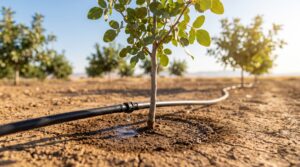
At Agro Vivero del Mediterráneo, with years of experience dedicated to the fascinating world of the pistachio, we have learned a fundamental lesson: the success of a plantation begins long before the first plant touches the soil. It begins, in fact, under our feet, in the soil. A thorough and well-interpreted soil analysis is not an expense, but the smartest investment any farmer or investor can make when embarking on pistachio cultivation. 🌳💰
This green gold, as many call it, is a noble but demanding crop. It requires meticulous planning, and the soil is the canvas on which we will paint the future of our plantation. Ignoring its characteristics is like navigating without a compass; we can have the best pistachio plant, but if the medium is not right, the results will hardly reach their potential. Join us on this journey where we will reveal why soil analysis is the pillar of a thriving and profitable pistachio plantation.
Why is Soil Analysis Absolutely Crucial for Pistachio?
Many wonder if it is really necessary. Our answer is a resounding yes. Think of it this way: the soil is the home and pantry of your pistachio trees for decades. Knowing it thoroughly allows us to:
-
Optimize Initial Investment: Establishing a pistachio plantation involves a significant financial outlay. A prior soil analysis helps us determine the viability of the land for this crop, avoiding investments in unsuitable land or land that would require excessively expensive amendments. Knowing the soil allows us to make informed decisions from the start.
-
Avoid Future and Costly Problems: Nutritional deficiencies, pH problems, excess salts, or poor drainage can reduce plant growth, reduce nut production, and even cause tree death. Identifying these problems before planting allows us to correct them in time, saving many headaches and money in the long run.
-
Design a Tailored Fertilization Plan: Not all soils are the same, nor do all plantations have the same needs. A detailed analysis tells us what nutrients are available, which are missing, and in what proportion. With this information, we can design a precise fertilization plan, providing only what the plant needs, when it needs it. This not only optimizes growth and production but is also more sustainable and environmentally friendly. 🌍
-
Select the Most Suitable Rootstock: There are different rootstocks or stocks for pistachio, each with different tolerances to specific soil conditions (salinity, active lime, root diseases, etc.). Soil analysis provides vital information to choose the rootstock that will best adapt to our land, thus ensuring the longevity and productivity of the plantation.
-
Maximize Yield and Nut Quality: Balanced and well-nourished soil is synonymous with vigorous and healthy trees, capable of producing abundant harvests of excellent quality pistachios. Nutrition directly influences the size, filling, and organoleptic characteristics of the appreciated nut.
-
Ensure Plantation Profitability: All previous points converge on this one. Proper soil management, based on scientific analysis, is a determining factor in achieving and maintaining high profitability in pistachio cultivation.
At Agro Vivero del Mediterráneo, we consider soil analysis as the first step of our complete package of services, because we know it is the basis for building a successful project.
The Ideal Time: When to Perform Soil Analysis?
The timing of soil analysis is as important as the analysis itself. We recommend performing it at several key moments:
-
Before Purchasing or Leasing Land: If you are considering acquiring or leasing a farm to plant pistachios, this is the first analysis you should perform. It can save you from a bad investment.
-
Before Planting (Fundamental): This is the most critical analysis. It must be done well in advance (several months before land preparation) to be able to interpret the results and apply the necessary amendments. Correcting soil is much easier and more effective before trees are planted.
-
During Plantation Growth (Follow-up Analysis): We recommend periodic analyses (every 2-4 years, depending on soil characteristics and management) to monitor the evolution of fertility, pH, salinity, and adjust fertilization plans. This is especially important in young plantations to ensure optimal development and in adult plantations to maintain productivity.
-
When Problems are Detected: If you observe deficiency symptoms, abnormal growth, or an inexplicable drop in production, a soil analysis (often complemented with a foliar analysis) can help diagnose the cause of the problem.
Soil Sampling: The Basis of a Good Diagnosis – Do Not Underestimate Its Importance!
A laboratory analysis will only be as good as the sample sent to it. A poorly taken sample can lead to erroneous interpretations and, therefore, incorrect management decisions. From Agro Vivero del Mediterráneo, we insist on the importance of proper sampling. Follow these steps:
-
Sampling Planning:
-
Divide the Farm into Homogeneous Units: If your farm has areas with different soil types (color, texture), crop history, topography (slopes vs. plains), or previous yield, you must take separate samples for each of these units. A sampling unit should not exceed 5-10 hectares if the terrain is uniform. For more heterogeneous terrain, units will be smaller.
-
Necessary Materials: You will need an auger or shovel (preferably stainless steel to avoid contamination), a clean bucket (plastic, never rusty metal), clean and labeled plastic bags, and a permanent marker.
-
-
Taking Subsamples:
-
Route: For each sampling unit, traverse the land in a zigzag or grid pattern, taking between 15 and 25 random subsamples. Avoid anomalous areas such as road edges, burned areas, near livestock feeders, or waterlogged areas, unless those are the problematic areas you specifically want to analyze.
-
Depth: For new plantations, knowing the soil profile is crucial. We recommend taking samples at two depths:
-
Superficial (0-30 cm): Where most root activity and nutrients are concentrated in the first years.
-
Deep (30-60 cm, and even 60-90 cm): To know subsoil characteristics, possible compacted layers, drainage, and deep salinity. The pistachio tree is a tree with a powerful and deep root system.
For follow-up analysis in established plantations, a 0-40 cm sample is usually sufficient to evaluate fertility.
-
-
Cleaning: Before taking each subsample, clean the surface of plant debris or leaf litter.
-
Amount per Subsample: Take approximately the same amount of soil at each sampling point.
-
-
Preparation of Composite Sample:
-
Deposit all subsamples from the same homogeneous unit and same depth in the clean bucket.
-
Mix all the soil well, removing large stones and plant debris. This mixture is your “composite sample”.
-
From this composite sample, take approximately 0.5-1 kg of soil, which will be the one you send to the laboratory. Place it in a clean plastic bag.
-
-
Identification and Shipping:
-
Labeling: Clearly label each bag with: farm name, plot number or name or sampling unit, sample depth, date, and your name. It is vital to keep a record of where each sample was taken.
-
Fast Shipping: Send samples to the laboratory as soon as possible. If you cannot send them immediately, store them in a cool, dry place, but do not leave them in the sun or in very hot places.
-
At Agro Vivero del Mediterráneo, we offer advice for correct sampling, and we can even perform it for you, guaranteeing that the process is done with maximum rigor.
Key Parameters to Analyze: Unveiling Soil Secrets for Pistachio
A complete soil analysis will provide us with a large amount of data. Below, we detail the most important parameters for pistachio cultivation and how we interpret them:
1. Physical Properties:
-
Texture (Sand, Silt, Clay): Determines water and nutrient retention capacity, drainage, and aeration.
-
Sandy Soils: Good drainage and aeration, but low water and nutrient retention. Require more frequent irrigation and organic matter contributions.
-
Clay Soils: High water and nutrient retention, but can have drainage and compaction problems, leading to root asphyxia. Pistachio does not tolerate prolonged waterlogging.
-
Loam Soils (Balanced): Are ideal, with a good combination of the above properties.
Pistachio prefers sandy loam or clay loam soils, deep and, above all, well-drained.
-
-
Soil Structure: Refers to how sand, silt, and clay particles group together. Good structure (granular, in small blocks) favors water infiltration, gas exchange, and root development. Compaction is a serious structural problem.
-
Effective Depth: Is the depth of soil that roots can explore without encountering a physical barrier (bedrock, compacted layer, high water table). Pistachio needs deep soils, ideally more than 1.5 meters.
-
Drainage: Absolutely critical! Pistachio is very sensitive to root asphyxia. Poor drainage is one of the main causes of failure. Soil capacity to evacuate excess water must be evaluated.
2. Chemical Properties:
-
pH (Potential of Hydrogen): Measures soil acidity or alkalinity. Pistachio thrives in a pH range between 7.0 and 8.5 (neutral to slightly alkaline).
-
Acidic pH (<6.5): Can limit availability of Phosphorus, Calcium, Magnesium, and Molybdenum, and increase toxicity from Aluminum or Manganese. Corrected with calcareous amendments.
-
Very Alkaline pH (>8.5): Can reduce availability of Phosphorus, Iron, Manganese, Zinc, and Copper, causing chlorosis and other deficiencies.
-
-
Electrical Conductivity (ECe saturation extract): Measures total concentration of soluble salts in soil. Pistachio has moderate tolerance to salinity.
-
Values < 2 dS/m: No problems.
-
Values between 2-4 dS/m: Slightly saline, can start affecting sensitive varieties.
-
Values between 4-8 dS/m: Moderately saline, requires choice of tolerant rootstocks (like UCB-1) and proper irrigation management.
-
Values > 8 dS/m: High salinity, not recommended for most pistachio plantations without very specialized and costly management.
-
-
Organic Matter (OM): Essential for soil health! Improves structure, water and nutrient retention capacity, biological activity, and nutrient availability.
-
Desirable levels: >1.5%. In many soils of arid and semi-arid zones where pistachio is grown, it is common to find low levels (<1%). Improving OM is a priority.
-
-
Total Nitrogen (N): Key macronutrient for vegetative growth. Total N analysis gives an idea of reserve, but available N (nitrates, ammonium) is more dynamic and often evaluated with foliar analysis.
-
Assimilable Phosphorus (P) (Olsen or Bray): Essential for root development, flowering, nut set, and energy transfer.
-
Optimal levels are usually above 20-30 ppm (mg/kg) by Olsen method.
-
-
Assimilable Potassium (K): Very important for nut quality, disease resistance, tolerance to water stress and frost. Pistachio is a large consumer of potassium.
-
Optimal levels: >150-250 ppm (mg/kg), depending on texture and CEC.
-
-
Exchangeable Calcium (Ca): Important for soil structure, cell division, and membrane integrity. Usually not deficient in calcareous soils, but its balance with Magnesium and Potassium is important.
-
Exchangeable Magnesium (Mg): Component of chlorophyll, essential for photosynthesis. Its deficiency can be induced by high levels of Potassium or Calcium.
-
Sulfur (S): Necessary for protein synthesis and some vitamins. Its availability depends on organic matter mineralization.
-
Micronutrients (Iron, Manganese, Zinc, Copper, Boron, Molybdenum): Needed in small amounts, but essential.
-
Iron (Fe): Iron chlorosis (interveinal yellowing in young leaves) is common in calcareous and high pH soils.
-
Zinc (Zn): Important for growth hormone formation. Its deficiency causes small leaves and short internodes (“rosette”).
-
Boron (B): Crucial for pollination, fruit set, and nut development. Has a narrow range between deficiency and toxicity. Be very careful with its application.
-
-
Total Calcium Carbonate (%): Pistachio tolerates calcareous soils well.
-
Active Lime (%): Is the finest fraction of calcium carbonate and the one that can cause most Iron (and other micros) blocking problems. Levels >8-10% may require use of tolerant rootstocks and iron chelates.
-
Cation Exchange Capacity (CEC): Measures soil capacity to retain cations (positively charged nutrients like K+, Ca2+, Mg2+). Soils with higher clay and organic matter content have higher CEC.
3. Biological Properties (Less common in routine analysis, but very valuable):
-
Soil Pathogen Analysis: Especially important if diseases like Verticillium dahliae (Verticillium wilt), a serious vascular disease for pistachio, are suspected. Knowing its presence before planting is crucial.
-
Microbial Biomass / Biological Activity: Indicators of general soil health.
Interpreting Results: Our Approach at Agro Vivero del Mediterráneo
Receiving a laboratory report full of numbers can be overwhelming. At Agro Vivero del Mediterráneo, we don’t just hand you those numbers. Our team of expert agronomists interprets these results in the specific context of your farm and your goals. We consider:
-
Specific needs of pistachio cultivation.
-
Interactions between different nutrients (for example, excess Phosphorus can induce Zinc deficiency).
-
Soil type and its influence on nutrient availability.
-
Plot history.
With all this information, we prepare a clear and understandable report, highlighting the main limitations and strengths of your soil, and most importantly: a personalized action plan and recommendations. This plan may include:
-
Need for amendments (organic, calcareous, gypsum).
-
A basal fertilization program (before planting).
-
Recommendations on land preparation (subsoiling if there is compaction).
-
Suggestions on the most suitable irrigation system.
-
Choosing the most suitable pistachio plant rootstock.
Soil Correction and Improvement Strategies: Getting to Work 🌱
Once we know our soil characteristics, we can start improving it:
-
Organic Amendments: Adding well-composted manure, plant compost, or using cover crops are excellent practices to increase organic matter, improve structure, water retention, and biological activity. We recommend doses of 20,000 to 40,000 kg/ha of well-matured manure, depending on initial OM content.
-
Calcareous Amendments: If pH is too acidic, calcium carbonate or dolomite can be applied to raise it. Amount will depend on current pH, target pH, and neutralizing power of material.
-
Agricultural Gypsum (Calcium Sulfate): Useful in sodic soils or with structural problems in clay soils, as it improves infiltration and reduces clay dispersion.
-
Basal Fertilization: Before planting, it is time to incorporate Phosphorus and Potassium (and Magnesium if necessary) deeply, as they are poorly mobile in soil. Amounts will be determined according to analysis.
-
Land Preparation: Deep subsoiling (60-80 cm) may be necessary if compacted layers preventing drainage and root development are detected.
-
Irrigation Management: In soils prone to salinity, proper irrigation allowing periodic leaching can help control salt accumulation in root zone.
These are just some strategies. Each soil is a world, and solutions must be personalized.
Beyond Analysis: Our Commitment to Your Pistachio Plantation
At Agro Vivero del Mediterráneo, our relationship with you does not end with delivery of soil analysis. It is just the beginning. Our commitment is to accompany you at every stage:
-
Comprehensive Advice: From initial planning to full production. Our services are designed to cover all your needs.
-
Certified Quality Plant: We provide you with best pistachio plant, with rootstocks and varieties most suitable for your land and climate.
-
Plantation Planning and Design: We help you design planting frame, irrigation system, and initial management plan.
-
Technical Monitoring: We perform field visits, foliar analyses, and adjustments to fertilization plan to ensure your plantation reaches maximum potential and profitability.
Pistachio cultivation is long-term investment, exciting and with great potential. Starting with deep knowledge of your soil through detailed analysis is undoubtedly first big step towards success. 🚀
If you are thinking of starting pistachio plantation or wish to optimize existing one, do not hesitate. Let us be your allies. Contact us today or request personalized quote through our booking form. At Agro Vivero del Mediterráneo, we are ready to put our experience at your service and help you turn your project into prosperous and lasting reality. Future of your plantation is in soil, and we help you discover it!
Need a quote?
Tell us about your project and we will send you a proposal with no obligation.
Request a quote