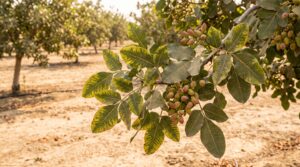
At Agro Vivero del Mediterráneo, with our years of experience accompanying farmers in the exciting world of pistachio farming, we have learned that the success of an orchard does not rest solely on the choice of pistachio plant or the initial field design. True mastery of the crop is demonstrated through meticulous attention to detail, and one of the most crucial — often underestimated — aspects is the precise calibration of spraying equipment for phytosanitary treatments. 🚜💨
We know that dealing with pests and diseases is an unavoidable part of the agricultural cycle. However, the way in which we apply phytosanitary products can make an enormous difference — not only in the effectiveness of the treatment, but also in the health of our trees, the sustainability of our operation, and, of course, in the profitability of the orchard. Poor calibration can be just as harmful as not treating at all, leading to product waste, environmental contamination, and in the worst case, the loss of a significant portion of the harvest.
That is why we have decided to create this comprehensive and detailed guide. We want to share our knowledge and methodology so that every farmer can master this essential technique. This is not simply a technical procedure — it is a working philosophy that seeks maximum efficiency, respect for the environment, and optimization of resources. Join us on this journey to ensure that every drop of treatment counts and contributes to the success of your pistachio orchard.
The vital importance of perfect calibration
Let us imagine for a moment that our pistachio orchard is a patient who needs an exact dose of a medication. If we apply an insufficient dose, the disease will persist and may even grow stronger. If, on the contrary, we apply an overdose, we risk poisoning the patient, damaging their vital organs, and generating unwanted side effects. This analogy perfectly illustrates what happens in our fields.
A poor application — with drops too large that run off the leaves or with uneven distribution — leaves unprotected areas where pests and pathogens can thrive. This forces us to carry out additional treatments, increasing costs and workload. On the other hand, over-application not only means unnecessary expenditure on expensive phytosanitary products, but also increases the risk of phytotoxicity in the trees, the development of pest resistance, and the contamination of soils and aquifers. 🌍
From our perspective at Agro Vivero del Mediterráneo, precise calibration is the cornerstone of an Integrated Pest Management (IPM) strategy. It allows us to:
-
Maximize treatment efficacy: We ensure that the correct dose of the product reaches the target (leaves, branches, etc.) uniformly, covering the entire surface to be treated.
-
Optimize costs: We avoid product waste, which translates into direct financial savings. Every euro counts! 💰
-
Protect the environment: We minimize drift (product that deviates from its target) and leaching (product that filters into the soil), reducing environmental impact.
-
Guarantee food safety: By applying the exact necessary dose, we ensure that Maximum Residue Limits (MRL) in the nut are not exceeded — an indispensable requirement for its commercialization.
-
Protect the health of our trees: A correct application prevents leaf burn and other phytotoxicity symptoms that can weaken the pistachio tree and reduce its production.
In short, calibration is not a waste of time — it is an investment in the health and profitability of our orchard.
Knowing our equipment: Types of sprayers in pistachio farming
To calibrate correctly, we must first thoroughly understand the tool we are going to use. In pistachio cultivation, given the characteristics of the tree (size and foliage density), the most common equipment consists of hydropneumatic sprayers, also known as airblast sprayers or mist blowers.
These machines use a high-speed airflow generated by a fan to transport and distribute the spray droplets. The key to their effectiveness lies in their ability to penetrate the tree’s leaf canopy, ensuring complete coverage even in the innermost parts, which are often the most difficult to reach.
Within airblast sprayers, we can find different configurations:
-
Trailed sprayers: These are the most common in medium to large orchards. They are towed behind the tractor and have large-capacity tanks (from 1,000 to 3,000 liters or more). They typically feature powerful fans and a nozzle system distributed along an arc.
-
Mounted sprayers: These attach to the tractor’s three-point hitch. They have smaller tanks (generally between 400 and 1,000 liters) and are more maneuverable, making them ideal for smaller orchards, narrow row spacings, or steeply sloped terrain.
Regardless of the type, the key components we must inspect and understand for correct calibration are always the same:
-
The tank: It must be clean, with no residue from previous treatments. It is essential to ensure that the level indicator is working correctly.
-
The pump: It is the heart of the system. It must provide constant pressure and sufficient flow rate to supply all the nozzles.
-
The pressure regulator and gauge: These allow us to select and control the working pressure. The gauge must be accurate and in good condition. A faulty gauge will give us incorrect readings and ruin the entire calibration! 😱
-
The nozzles: These are the final component and one of the most critical. They determine droplet size, spray angle, and flow rate. Various types (hollow cone, flat fan, anti-drift) and materials (ceramic, polymer, brass) are available.
-
The fan: It generates the airflow that carries the droplets. The air speed and volume must be appropriate for the size and density of our trees.
Before beginning any calibration, it is imperative to carry out a visual inspection and basic maintenance of the entire equipment. Cleaning filters, checking hoses, ensuring there are no leaks, and verifying that all nozzles are of the same type and in good condition is the first unavoidable step. A single blocked or worn nozzle can throw off the entire application.
The step-by-step calibration process: Our methodology
Calibrating a sprayer may seem like a complex task, but if we follow an orderly and systematic method, it becomes a straightforward and repeatable process. At Agro Vivero del Mediterráneo, we recommend following these steps. Take note! 📝
Step 1: Determine the forward speed
The speed at which we travel with the tractor is a critical factor. Excessive speed reduces product penetration into the tree, while too slow a speed can cause over-application and runoff.
-
How do we measure it? The most reliable method is to do so in the orchard itself, with the tractor and sprayer loaded with water to half capacity (to simulate real working conditions).
-
The procedure: We mark a known distance, for example 100 meters. With the tractor at the engine speed and in the gear we will normally use for the treatment, we time how long it takes to cover that distance.
-
The calculation:
-
Speed (m/s) = Distance (m) / Time (s)
-
Speed (km/h) = Speed (m/s) x 3.6
Example: If it takes 72 seconds to cover 100 meters:
-
Speed = 100 m / 72 s = 1.39 m/s
-
Speed = 1.39 m/s x 3.6 = 5.0 km/h
-
It is essential to take this measurement several times and calculate an average to obtain a precise value. And very importantly: record the gear and engine speed so that exactly the same conditions can be replicated in every subsequent treatment.
Step 2: Select the working pressure and nozzles
Working pressure directly influences nozzle flow rate and droplet size. Higher pressure means greater flow rate and smaller droplets (with a higher risk of drift). Lower pressure means lower flow rate and larger droplets (with a higher risk of runoff).
-
Pressure: For pistachio treatments, we typically work at pressures ranging between 15 and 25 bar, depending on the nozzle type and the phenological stage of the tree.
-
Nozzles: The choice of nozzle is crucial. We must consult the manufacturer’s charts, which indicate the flow rate provided by each nozzle at different pressures. For mature pistachio trees with good foliage density, hollow cone nozzles are commonly used as they facilitate good penetration and coverage. It is vital that all nozzles on the sprayer are identical in type and flow rate to ensure uniform distribution.
We recommend replacing nozzles when their actual flow rate exceeds the manufacturer’s stated theoretical flow rate by more than 10%. Worn nozzles apply more product than intended.
Step 3: Check the actual nozzle flow rate
Manufacturer charts are a guide, but actual flow rates can vary due to nozzle wear or pressure gauge inaccuracies. That is why we must always measure it directly.
-
The procedure: With the tractor at the selected engine speed and working pressure, we collect the water output from each nozzle for one minute in a graduated measuring jug.
-
The check: We repeat the operation for all nozzles on the equipment. The values obtained should not differ from one another by more than 5%. If a nozzle deviates beyond this percentage, it must be cleaned or replaced.
-
Calculating the total flow rate: We add up the flow rate of all nozzles to obtain the total sprayer flow rate in liters per minute (L/min).
Example: If we have a sprayer with 12 nozzles and each produces an average flow rate of 2.1 L/min:
-
Total Flow Rate = 12 nozzles x 2.1 L/min/nozzle = 25.2 L/min
-
Step 4: Calculate the spray volume per hectare (L/ha)
Now that we have all the data, we can calculate how many liters of spray mixture (water + product) we are applying per hectare of our orchard. This is the key figure of the entire calibration.
The formula is as follows:
Volume (L/ha) = (Total Flow Rate (L/min) x 600) / (Speed (km/h) x Row width (m))
-
Total Flow Rate (L/min): As calculated in the previous step.
-
Speed (km/h): As measured in the first step.
-
Row width (m): The distance between the centers of two tree rows.
-
The factor 600: This is a constant that allows us to unify the units (minutes to hours, meters to hectares).
Continuing with our example:
-
Total Flow Rate = 25.2 L/min
-
Speed = 5.0 km/h
-
Row width = 7 m
Volume (L/ha) = (25.2 x 600) / (5.0 x 7) = 15,120 / 35 = 432 L/ha
-
This means that, with this configuration, our equipment is applying 432 liters of spray mixture per hectare.
Step 5: Adjust and verify
The calculated volume (432 L/ha in our example) must be compared with the recommended volume for the specific treatment we are going to carry out. The recommendation is usually indicated on the phytosanitary product label or provided by a qualified technician.
-
What if our volume differs from the recommended one? We have three options to adjust it:
-
Modify the forward speed: This is the simplest method. If we want to apply less volume, we increase the speed; if we want to apply more, we reduce it. But always within sensible limits so as not to compromise application quality!
-
Change the working pressure: Increasing pressure will raise the flow rate and therefore the volume per hectare. Decreasing it will have the opposite effect. Bear in mind that this also modifies droplet size.
-
Change the nozzles: This is the most advisable option when a significant adjustment is needed. Installing higher or lower flow rate nozzles will allow us to reach the desired volume while maintaining optimal working pressure and speed.
-
Once the adjustment has been made, we must recalculate the volume per hectare to confirm that we have achieved our target.
Finally, it never hurts to carry out a final field test using only water. We can place water-sensitive papers in different parts of the tree (outer canopy, inner canopy, upper and lower zones) to visually check coverage quality. These papers change color on contact with water, showing us the density and uniformity of the droplets. It is an inexpensive and highly visual way of confirming that our calibration work has been a success. 👍
Common mistakes we must avoid at all costs
Throughout our experience, we have seen certain mistakes made repeatedly. Identifying them is the first step toward not making them ourselves:
-
Relying on guesswork: Calibrating by eye or based on the previous year’s settings is the most serious mistake. Nozzle wear, changes in the pressure gauge, or even the different foliage density of the trees all require periodic recalibration.
-
Failing to consider the condition of the orchard: Treating a young tree with sparse foliage is not the same as treating a mature tree in full production. The spray volume must be adapted to the leaf surface area to be treated. This is referred to as “dose adaptation to the tree” or TRV (Tree Row Volume), a more advanced technique that adjusts the dose based on the actual volume of vegetation.
-
Overlooking weather conditions: Applying treatments in winds exceeding 10–12 km/h, at high temperatures, or with low relative humidity is a recipe for failure. Wind causes uncontrollable drift, and excessive heat causes droplets to evaporate before reaching their target. Always check the weather forecast! ☀️🌬️
-
Not cleaning the equipment properly: Residue from a previous treatment can react with the new product, reducing its efficacy or even causing phytotoxicity. Cleaning the tank and the entire circuit after each use is an essential practice.
-
Using a faulty pressure gauge: As already mentioned, it is our primary pressure reference. A malfunctioning gauge will give us a false reading and make the entire calibration incorrect. They are inexpensive and easy to replace — there is no excuse!
Avoiding these mistakes and following a rigorous methodology sets us on the path toward professionalization and excellence in orchard management. If you need personalized advice or an equipment review, do not hesitate to get in touch with us. At Agro Vivero del Mediterráneo, we offer a comprehensive range of services to assist you at every stage of your project.
Calibration as part of an integrated strategy
Sprayer calibration is not an isolated act, but a fundamental component of a sustainable and profitable production strategy. It integrates perfectly with other good agricultural practices that we promote at Agro Vivero del Mediterráneo:
-
Pest and disease monitoring: Before deciding to treat, we must be certain that it is necessary. Constant orchard monitoring allows us to identify problems in their early stages and determine the treatment threshold — that is, the precise moment at which the potential damage caused by the pest outweighs the cost of the treatment.
-
Appropriate choice of phytosanitary product: Using the right product for the specific problem, rotating active substances to prevent the development of resistance, and always prioritizing options that are most respectful of beneficial fauna (those beneficial insects that are our allies in the field).
-
Proper orchard management: Good pruning, irrigation, and nutrition management gives us stronger, healthier trees that are better able to resist pest and disease attack. A well-ventilated tree with correct sun exposure makes it harder for many pathogenic fungi to proliferate.
The combination of all these practices, with precise calibration as the cornerstone of treatment application, leads us toward a model of farming that is more efficient, safer, and more respectful of the environment. A model that not only guarantees the short-term economic viability of our operations, but also ensures their sustainability for future generations.
Mastering calibration technique is, without a doubt, one of the most valuable skills a pistachio producer can acquire. It is the difference between simply “applying a product” and “carrying out a phytosanitary treatment” in a professional manner. It requires dedication, rigor, and attention to detail, but the benefits it delivers are immense: cost savings, crop protection, regulatory compliance, and ultimately, the production of a top-quality nut that will allow us to achieve the best prices on the market.
At Agro Vivero del Mediterráneo, we are convinced that the future of the sector lies in the adoption of technology and professionalization. That is why we encourage all farmers not to underestimate this task. Take the time needed to understand your equipment, to measure, calculate, and verify. Make calibration an indispensable ritual before each treatment campaign. If you wish to take the next step and start your own orchard or improve the management of your current one, you can request a personalized quote through our reservation form. We are here to accompany you on the path to success, ensuring that every step — from plant selection to harvesting of the prized nut — is carried out with the utmost precision and professionalism. Your orchard will thank you for it, and so will your bottom line. 🌱💚
Need a quote?
Tell us about your project and we will send you a proposal with no obligation.
Request a quote