
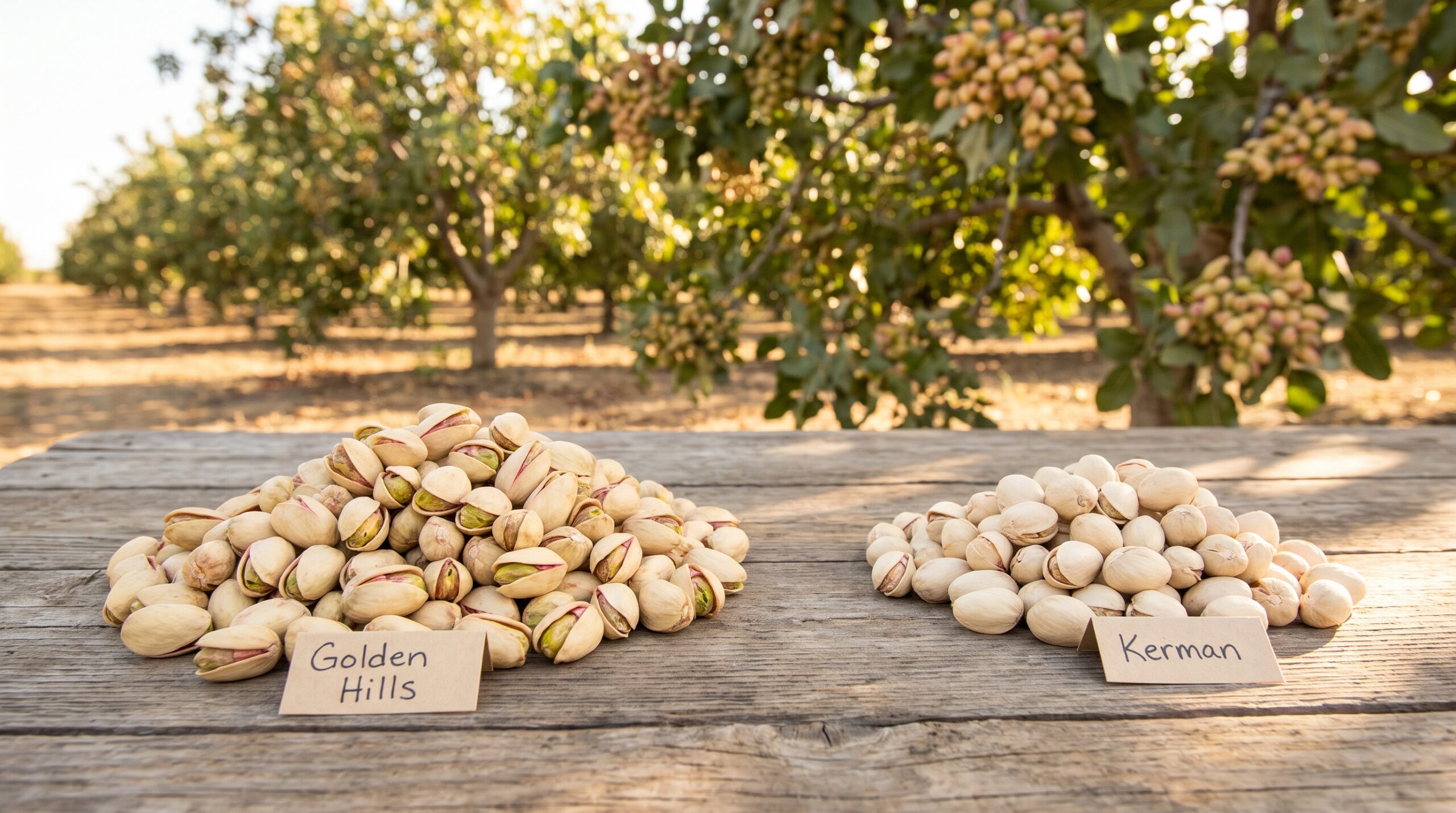
If you are about to plant or expand your orchard, you have probably already come across the big question of the moment: Golden Hills vs Kerman 🌳. One is the long-established variety, the most widely planted in Spain. The other is a more recent selection that comes with the promise of an earlier harvest, more split pistachios and fewer blanks.
At Agro Vivero del Mediterráneo we talk to growers who face this same decision, and almost all of them start with the wrong question: which one is better? The right question is a different one: which one fits best with my farm, my climate and the way I work? 🤔
In this article we compare the two varieties point by point: flowering and harvest calendar, nut quality, productivity, chilling hours, pollination and orchard management. We draw on University of California trials, on studies carried out in Spain and on what we see every day while advising on pistachio orchards. At the end you will find a summary table, answers to the most common questions and a guide to help you decide according to your profile ✅.
What Golden Hills and Kerman Are: Two Female Varieties with Different Histories
Before comparing these two pistachio varieties, it helps to understand where each one comes from, because its origin explains a good part of its strengths and limitations 🌱.
Kerman has been the reference female variety for more than half a century. It was released in 1957 and, in Spain, it remains the most widely planted female variety, almost always paired with the Peters male. Its long track record gives it something very valuable: we know quite precisely how it behaves. Growers and processors know its strengths, such as good hull strength and clean, unstained shells.
Golden Hills comes from a University of California breeding programme started in 1989. At that time, more than 99% of California’s pistachios came from a single female variety, Kerman, pollinated by a single male, Peters. That dependence meant enormous vulnerability to any new pest or disease. After years of comparative trials, Golden Hills and Lost Hills were released in 2005, together with the Randy male.
Since then, Golden Hills has been gaining ground in California, mainly thanks to its early harvest. In Spain it has a shorter track record than Kerman, which obliges us to be honest: we must distinguish between what has been proven in other countries and what has already been verified in orchards in our own region. That is exactly what we do when we advise a grower 🤝.
Golden Hills vs Kerman: Flowering and Harvest, Where the Calendar Makes the Difference
The first contrast between the two varieties is the calendar 📅.
In University of California trials, Golden Hills reached full bloom about five or six days earlier than Kerman. More recent studies report an advance of one week. That difference widens over the months: the Golden Hills harvest arrives, on average, about two weeks earlier. In some seasons the advance has been even greater; one study on nut development measured a difference of up to four weeks in one of them.
In a cold-winter region of Spain, a study carried out on seven farms over three seasons confirmed the same trend: both flowering and harvest were later in Kerman than in Golden Hills and Lost Hills.
Why does this harvest calendar matter so much?
- 🚜 Less pressure at harvest. Kerman ripens within a window of about three weeks, and everything coincides at the same moment: shaking, transport, hulling and drying. A variety that ripens earlier spreads the workload and avoids bottlenecks with machinery.
- 🌧️ Less exposure at the end of the season. An early harvest can help you get ahead of the autumn rains. In California, moreover, harvesting earlier avoids the last flight of the navel orangeworm, a very important pest there.
- 🤝 Coordination with your surroundings. If your neighbours, your cooperative or your processing plant work with Kerman and you need to harvest at the same time, that coincidence has its value. California technical advisers sum it up like this: if everyone around you grows Kerman and you want to harvest at the same time, stay with Kerman.
⚠️ Watch out for frost. Early flowering also means greater exposure to late spring frosts. In areas where frosts are common in April, a few days’ advance can be a real risk. It is one of the first factors we analyse when assessing the location of a farm.
Pistachio Nut Quality: Split Pistachios, Non-Split Pistachios and Blanks
This is where Golden Hills tends to stand out most 🌰.
The market values split pistachios more highly, those eaten directly in the shell. Non-split pistachios normally end up in industry (ice cream, confectionery, cosmetics) and at a lower value. And blanks add nothing: just extra weight that has to be transported and waste that has to be handled at the processing plant.
University of California trials agree: Golden Hills shows a higher percentage of split pistachios, fewer non-split pistachios and fewer blanks than Kerman. In harvest data from commercial orchards, non-split pistachios were around 7% in Golden Hills versus 15% in Kerman.
In Spain, the study from the cold-winter region points in the same direction: Kerman yielded more kilos, but with more non-split pistachios and more blanks. The authors flag this as something to consider in future orchards.
🧮 Practical example. Imagine a harvest of 10,000 kg of in-shell pistachios. With 15% non-split pistachios, that means 1,500 kg of lower value. With 7%, it would be 700 kg. That 800 kg difference moves into the split category. It is an illustrative example, not a price, but it shows why net yield matters more than gross yield.
What about size? California trials found no clear differences in individual nut weight and size between Golden Hills and Kerman, although some commercial companies refer to a large nut size for Golden Hills. On flavour, the tastings carried out are limited but favourable. Kerman, for its part, retains very well-known advantages: a strong hull, a clean shell and an attractive green kernel colour.
Productivity and Start of Production: What to Expect from Each Variety
When a grower asks us which one produces more, we answer with another question: more kilos, or more good kilos? 📈
Yield. In University of California trials, the grower-paid yield (the net yield, after deducting blanks and non-split nuts) was similar for Golden Hills and Kerman. In the cold-winter region of Spain, however, Kerman had higher gross production, at the cost of more non-split pistachios and more blanks. Neither variety always wins: it depends on how we measure and where we plant.
Alternate bearing. Kerman has a marked tendency towards alternate bearing, that is, alternating seasons of heavy and light production. With Golden Hills the sources do not agree: some companies describe it as less prone to alternate bearing, while University of California trials showed an alternation pattern similar to that of Kerman. In the comparison carried out between 1997 and 2011, it was Lost Hills that showed less alternate bearing. That is why we do not promise more stable production: the prudent approach is to plan crop load, pruning and irrigation to cushion alternate bearing in either variety.
Start of production. Several sources agree that Golden Hills has an earlier start of production. Some companies place it in the fourth or fifth year, compared with the sixth or even the eighth for Kerman, provided management is correct. Its Randy male is also precocious and usually flowers as early as the third or fourth year.
Bringing forward the first revenues by one or two years can greatly improve an orchard’s cash flow, although this advantage must be weighed alongside all the other factors. If you want to see how this translates into numbers, we recommend reviewing our information on the profitability of a pistachio orchard 💶.
Chilling Hours and Mediterranean Climate: Where Each Variety Fits Best
Climate decides more orchards than it seems ❄️🔥.
Kerman is a late variety with high chilling demands: it needs around 800 chilling hours below 7 ºC to break dormancy properly. In winters with little chilling it can show longer, disordered flowering, and its usual male, Peters, may shed pollen late. The result is irregular pollination and a lower nut set.
Golden Hills flowers earlier and, according to University of California work, performs better than Kerman with little chilling. It also needs less heat accumulation to ripen: in one California trial, about 340 fewer heat units. Some seed companies point out that this widens the areas of Spain where it can be planted. That said, data on its exact chilling requirements are still incomplete.
Context matters too. A study on pistachio phenology in Spain notes that the country has warmed by 1.3 ºC since pre-industrial times, above the global average, and points out that a lack of chilling hours could reduce pollination.
In cold inland areas the opposite occurs. The study from the cold-winter region concluded that winter chilling was met without difficulty and that the limiting factor could be accumulated heat. There, a variety that needs less heat to complete its cycle may have an advantage, but early flowering exposes it more to frost. There is no single answer: it depends on the microclimate of your plot.
Humidity. Pistachio does not tolerate humid environments well, and University of California observations indicate that Golden Hills is more susceptible to Alternaria in humid areas. In a dry Mediterranean climate with a long summer, this risk is lower.
Rainfed and irrigated conditions. Companies that market Golden Hills describe it as adaptable both to a rainfed pistachio orchard and to intensive irrigated pistachio production. Kerman is generally recommended and, above all, on good soils or with irrigation. In any case, in the cold-winter region of Spain, applying more water increased production but worsened nut quality.
Pollination: The Peters Male, the Randy Male and the Right Pollinator
Pistachio is a dioecious species: there are female trees, which produce the nuts, and male trees, which provide the pollen. Without well-chosen males there is no harvest, however good the female variety may be 🌬️.
For Kerman, the classic pollinator is the Peters male. In Spain other males are also used, such as Chaparrillo or Guerrero, and in California Famoso was released in 2016 as an alternative. Peters works very well in normal years, but its flowering may be delayed when chilling is low.
For Golden Hills, the recommended male is Randy. It flowers 10 to 15 days earlier than Peters, has a longer flowering period, its pollen lasts longer and it usually starts flowering as early as the third or fourth year. And here is the key detail: Randy flowers too early to be the main pollinator for Kerman, so the males of one variety do not work for the other.
✅ Practical rule: each female variety needs its own male pollinator, with synchronised flowering. If you combine varieties on the same farm, the ideal is to separate them into blocks and design the males for each block.
There is another nuance. In the technical documentation of a Spanish agricultural research centre, Golden Hills and Lost Hills were still listed as varieties under evaluation in Spain. That is why, before planting, it is advisable to check the availability of the male and its suitability for each area.
Orchard Management: Formative Pruning, Rootstock and Plant Health ✂️
The variety also changes the way you work your farm.
Pruning and training. Golden Hills has a more upright habit and requires less training than Kerman. Over the years it also needs less maintenance pruning, which saves labour. In Kerman, much of the formative pruning consists of removing branches that droop. In Golden Hills the aim is the opposite: to encourage somewhat more horizontal growth and not to tip late.
Grafting and rootstock. Trials show that Golden Hills is harder to graft and has a greater scion-to-rootstock diameter ratio than Kerman on the usual rootstocks. In other words, the quality of the plant material and the choice of rootstock matter a great deal. Moreover, Kerman on its own roots is sensitive to nematodes and Phytophthora, so the rootstock matters in both cases. That is why we recommend starting with well-produced pistachio plants adapted to your soil.
Plant health and logistics. In Golden Hills, watch for Alternaria if your area is humid. In Kerman, alternate bearing and a concentrated harvest require careful planning of crop load and harvest logistics.
If you prefer not to improvise, you can consult our technical advice services, designed to support you in the design of your farm and in the first years of the orchard.
Comparison Table: Differences Between Golden Hills and Kerman 📊
| Aspect | Golden Hills | Kerman |
|---|---|---|
| Origin | University of California breeding programme, released in 2005 | Released in 1957, the reference variety for more than half a century |
| Flowering | About 5 to 7 days earlier | Later |
| Harvest | About 2 weeks earlier on average | Window of about 3 weeks, later |
| Split pistachios | Higher percentage | Lower percentage |
| Non-split pistachios | Around 7% in commercial data | Around 15% |
| Blanks | Fewer | More, especially in some years |
| Yield | Similar net yield in California trials | Higher gross production in the cold-winter region of Spain |
| Start of production | Earlier according to several sources | Later |
| Chilling hours | Appears to need fewer | Around 800 hours |
| Male pollinator | Randy | Peters, Famoso, Chaparrillo, Guerrero |
| Pruning | Upright habit, less training | More training work |
| Points to watch | Late frosts, Alternaria in humid areas, shorter track record in Spain | Alternate bearing, non-split pistachios, blanks, concentrated harvest |
How to read this table: it is not a matter of adding up points, but of seeing which advantages weigh most in your case. For a farm with frost risk, the later flowering of Kerman may be worth more than any advantage of Golden Hills. For a large operation with machinery constraints at harvest, the earlier calendar of Golden Hills may be decisive.
Common Mistakes When Choosing Between Golden Hills and Kerman ⚠️
After supporting many growers in this decision, we have seen the same mistakes repeated again and again. They are worth avoiding:
- Deciding purely on fashion. A variety being the novelty does not mean it is right for your plot. Nor is it right simply because it is the traditional one.
- Looking only at the earlier harvest. Harvesting earlier is an advantage, but if your farm suffers late frosts during flowering, that advance can be costly.
- Forgetting the male pollinator. An excellent female variety with a poorly synchronised male produces little, and it is a mistake that is hard to correct once the orchard is planted.
- Comparing gross kilos. What matters is net yield: how many split pistachios, how many non-split pistachios and how many blanks there are in each harvest.
- Copying the California model. The data there are very solid, but the climate, water, soils and rootstocks are not those of your farm. Results must be adapted, not simply transferred.
- Leaving your plant order until the last moment. Quality plant material needs to be planned well ahead, and it is advisable to reserve in advance in order to plant at the right time.
Which Variety to Choose According to Your Profile: Small or Large Grower 👨🌾
There is no universal answer, but there are clear criteria for deciding.
Kerman may be your option if:
- You have good soil and irrigation, and you value a variety with a very long track record.
- Your surroundings work with Kerman and you need to harvest at the same time as your neighbours or your cooperative.
- Your area has cold, stable winters.
- You prefer a variety whose behaviour is known throughout the sector.
Golden Hills may be your option if:
- You want an early harvest to spread the harvesting work more evenly.
- You are looking for a higher percentage of split pistachios and fewer blanks.
- Your farm has mild winters or limited heat accumulation.
- You are interested in bringing forward the start of production.
- Your area is dry and the risk of late frost is low.
If you are a small grower. With few hectares, simplicity counts: one variety, one well-chosen male and a calendar that is easy to manage. If you already have Kerman, expanding with Golden Hills in a separate block lets you compare without putting all your eggs in one basket.
If you are a large grower. With a large area, combining both varieties in separate blocks spreads the harvest season, diversifies risk (climate, alternate bearing, market) and avoids overloading machinery in a single window. That said, each block needs its own male and a design planned from the outset.
Profitability and Budget: How to Turn the Comparison into Numbers 💶
Choosing a variety is also an economic decision. Before requesting a quotation, we recommend calculating at least three scenarios for each variety: a cautious one, an intermediate one and an optimistic one. And not just with kilos, but taking these factors into account:
- The year production starts, which determines when the investment begins to be recovered.
- The proportion of split pistachios, non-split pistachios and blanks, which changes the value of each kilo harvested.
- Harvesting and transport costs, which depend on the harvest window and the machinery available.
- Alternate bearing, which creates very uneven seasons and requires cash-flow planning.
- Water: the cost of irrigation and its real availability in the critical months.
- Replacement of failed trees and male design, which affect the regularity of the orchard.
With this data you can make a realistic first estimate. And if you want to draw on our experience, we can help you adjust the numbers to your specific case, whether you are a small grower with a few hectares or a large operation expanding its area 📞.
Frequently Asked Questions About Golden Hills vs Kerman ❓
Does Golden Hills produce more than Kerman? It depends on how it is measured. In California trials the net yield is similar. In a study in a cold-winter region of Spain, Kerman produced more in gross terms, but with more non-split pistachios and more blanks.
Can I plant both varieties on the same farm? Yes, provided you separate them into blocks and each has its own suitable male. On large farms it is a very useful strategy.
What pollinator does Golden Hills need? The Randy male, whose flowering coincides with that of this female variety. With Kerman, Peters and other later-flowering males work well.
When does a Golden Hills orchard start producing? According to several sources, in the fourth or fifth year with correct management. It depends on irrigation, rootstock, training and area.
Is Golden Hills suitable for rainfed conditions? It is described as adaptable, but for a rainfed pistachio orchard we first analyse rainfall, soil depth and water-holding capacity.
What is the best pistachio variety to plant? The one that best fits your climate, your soil, your water and the way you work. That is why we study each farm before making a recommendation.
Which variety suits me if my area has frost risk? As Kerman flowers later, it is somewhat less exposed to late spring frosts. Even so, the risk depends on the location of the plot, its aspect and whether cold air pools there, so we study this before deciding.
I already have a Kerman orchard. Can I expand with Golden Hills? Yes, and it is a prudent way to try a new variety without changing the whole farm. Ideally, do it in a separate block, with its own male and with pruning adapted to its more upright habit.
The Next Step 🌱
To sum up the essentials: Kerman offers a track record, knowledge across the sector and a very well-proven variety. Golden Hills offers an early harvest, more split pistachios, fewer blanks and a faster start of production, at the cost of flowering that is more exposed to frost and a shorter track record in Spain. Neither is better in every situation.
The right decision comes from analysing your farm: chilling hours, frost risk, humidity, available water, rootstock, male pollinator and how you will organise the harvest. With that information, the comparison between Golden Hills and Kerman stops being a doubt and becomes a well-founded choice.
If you would like us to study it together, contact us and we will advise you with no obligation. And if you already know what you need, you can request a quotation and reserve your plants through our reservation and quotation form. At Agro Vivero del Mediterráneo we will be glad to support you from day one 🤝.
Need a quote?
Tell us about your project and we will send you a proposal with no obligation.
Request a quote



