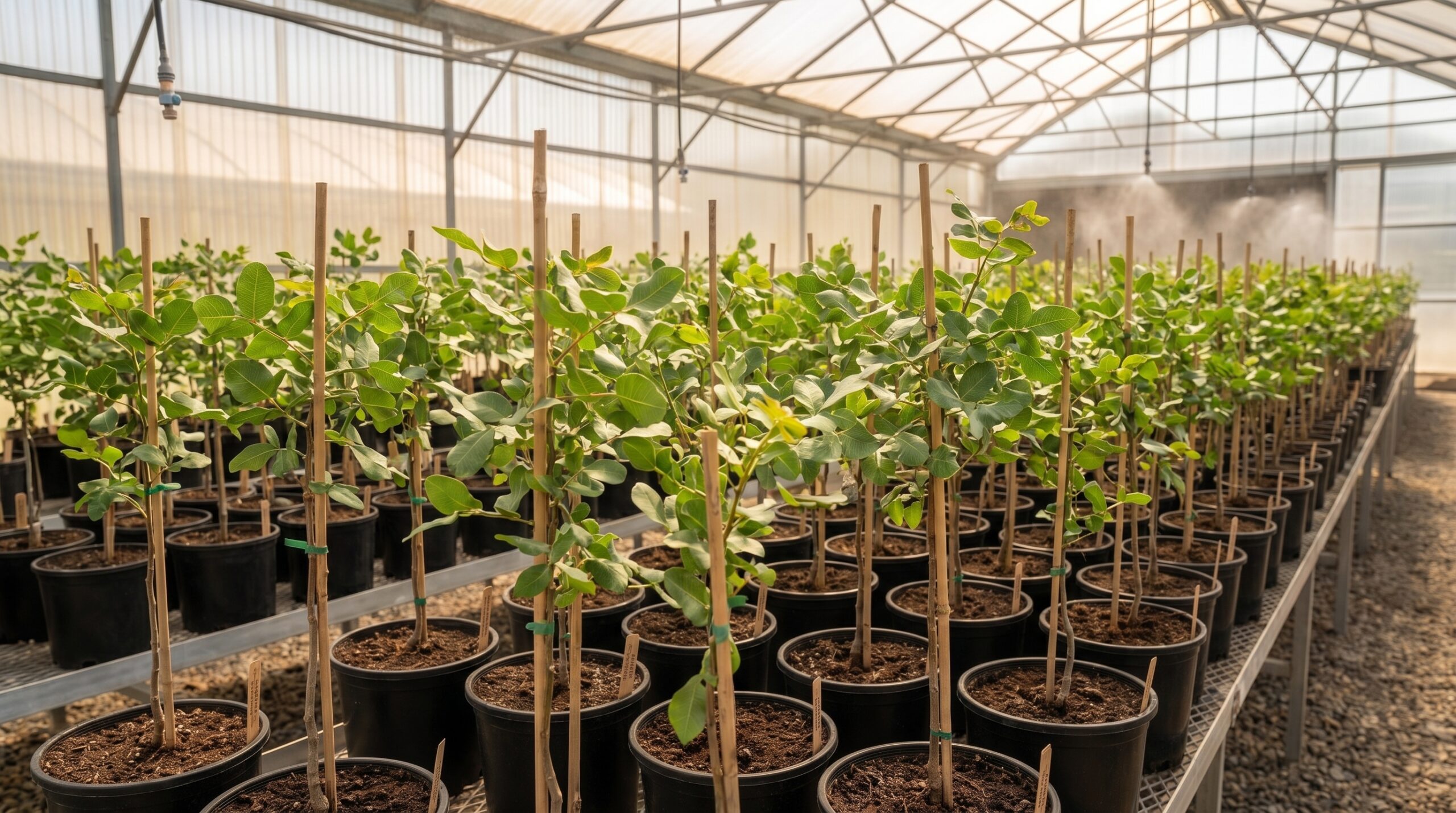
When a grower visits us to talk about their future orchard, the first question is almost always about yield: how many kilos per hectare, in how many years and at what return. These are sensible questions, but the answer starts much earlier, at the moment of deciding how to choose a certified pistachio plant. 🌳
A pistachio orchard is a long-term investment. The trees we plant today will stay with us through many harvest cycles, and any error at source, whether in rootstock, variety or plant health, is carried forward year after year. If the plant material fails, no amount of pruning, irrigation or fertilisation can fully make up for it.
In this article we share what we have learned from our daily work in the nursery and in the field. We will look at what it really means for a plant to be certified, which documents we should require, how to assess plant quality at a glance and which questions to ask any supplier before paying. Whether you are planting a few hectares or expanding a large estate, this guide will help you decide with confidence. 🧭
What Is a Certified Pistachio Plant and Why Does It Matter? 📋
A certified pistachio plant is one produced under an official control system that guarantees three things: that the variety and rootstock are what the label says, that the material comes from identified and controlled mother plants, and that the nursery meets the phytosanitary requirements for production and trade.
In practice, this means traceability. We must be able to know where the plant comes from, which rootstock it carries, which variety has been grafted onto it and under what conditions it has been grown. Without that information, every plant is an unknown.
It is worth distinguishing between “a good-looking plant” and “a certified plant”:
- A plant can look good and still carry a rootstock unsuitable for your soil.
- It can look healthy and carry a latent root disease.
- It can be labelled as Kerman and not be Kerman.
Certification reduces these risks. It does not replace the grower’s judgement, but it gives a solid base to work from. In our range of pistachio plants we work with exactly this philosophy: controlled, identified material prepared to perform well in the field.
The Risks of Buying Uncertified Pistachio Plants ⚠️
We know that price weighs on any purchasing decision. However, the cost of the plant usually represents a small share of the total invested in an orchard (land preparation, irrigation, installation, labour, maintenance during the unproductive years). Saving a few cents per plant and putting the whole investment at risk rarely pays off.
These are the problems we have seen most often in orchards established with material lacking guarantees:
- Variety mix-ups. Trees appear that do not correspond to what was ordered, with different flowering calendars and uneven production.
- Unsuitable rootstocks. Plants with rootstocks that have poor tolerance to root asphyxia, salinity or certain soil-borne fungi.
- Plant health problems. Fungi such as Verticillium or Phytophthora can enter the farm with the plants and remain in the soil for a long time.
- Root malformations. Roots that are coiled or strangled by unsuitable containers or by staying too long in the pot.
- Lack of uniformity. An orchard with trees of very uneven vigour complicates irrigation, pruning, fertilisation and mechanised harvesting.
- Unknown origin. If something goes wrong, there is nobody to claim against and no way of knowing what failed.
A practical example: on a 10-hectare farm with 6 x 6 metre spacing, around 2,780 plants are planted. If 10% show problems of origin, that means 278 trees that will produce less, take longer to establish or need replacing. That replacement also creates plants of different ages within the same plot, with all the complications that entails.
What Documentation Should Accompany the Plants 📑
Before accepting any consignment, we must request and review the documentation. A serious supplier will not be bothered by this; on the contrary, they will consider it normal.
Documents and information we should require:
- Plant passport / phytosanitary certificate for the plants, proving that the material complies with the plant health regulations required for movement and, where applicable, for export to the destination country.
- Labelling of the plant material showing species, variety, rootstock and material category.
- Registration of the nursery in the official register of plant material producers.
- Detailed invoice with the number of plants by variety and by rootstock, including the number of male and female trees.
- Delivery note or packing list that allows the consignment to be matched with the order.
One piece of advice we always give: keep all this documentation together with the orchard map. In a few years, when we want to know which variety is in each row, that record will be worth its weight in gold. 🗂️
If you have questions about how to review these documents or what they should contain, our services section explains how we support you throughout the whole process, from selecting the material to initial follow-up.
The Rootstock: The Foundation of a Long-Lasting Pistachio Orchard 🌿
A commercial pistachio tree is almost always a grafted plant: a lower part, the rootstock, which provides the root system, and an upper part, the scion variety, which provides the production. That is why, when someone asks us how to choose a certified pistachio plant, we start with the rootstock.
Why is it so important? Because the rootstock determines vigour, tolerance to calcareous or saline soils, resistance to root diseases, adaptation to waterlogging and the longevity of the tree.
The most common rootstocks in pistachio orchards are:
- Pistacia terebinthus. Hardy, well adapted to poor, dry Mediterranean-type soils, with moderate vigour.
- Pistacia atlantica. Vigorous, with good adaptation to a range of soils, although with some genetic variability when seed-propagated.
- Hybrid rootstocks such as UCB-1. Highly uniform thanks to clonal propagation, and with good vigour. Because of this uniformity they are increasingly attractive for professional orchards.
There is no “best” rootstock in absolute terms. There is the most suitable rootstock for each farm, depending on:
- soil type (texture, pH, active lime, salinity);
- drainage and risk of waterlogging;
- irrigation water quality and quantity;
- the plot’s history (previous crops, presence of fungi);
- the local climate (frost, summer heat, chill hours).
Ordering the plant with a specific rootstock and having the nursery certify it is one of the most profitable decisions you can make. If you are torn between several options, it is better to analyse the soil and water first than to decide on price.
Variety and Pollinators: Getting the Combination Right 🌸
The pistachio is a dioecious species: there are female trees, which produce the nut crop, and male trees, which provide the pollen. Without suitable males, the harvest suffers. That is why a certified pistachio plant must be identified both as a female variety and as a pollinator.
Most widely planted female varieties in our growing regions:
- Kerman: the world’s benchmark variety. It requires a good number of chill hours and flowers somewhat late.
- Larnaka: earlier flowering, with good performance in areas with less winter chill.
- Avdat: of Israeli origin, of interest in areas with mild winters.
- Golden Hills and Lost Hills: Californian varieties with good nut quality, highly valued in modern orchards.
Common pollinators:
- Peter: flowering that coincides very well with Kerman.
- Sirora: frequently used in areas and varieties with earlier flowering.
- Aegina and other local males: used depending on the flowering calendar of the area.
The basic rule is that the male’s flowering calendar must overlap with that of the females. If they do not coincide, pollination will be poor and production irregular, however good the rest of the management may be.
| Aspect to assess | What we should check | Why it matters |
|---|---|---|
| Female variety | Adaptation to chill and local climate | Determines yield and quality |
| Male pollinator | Flowering overlap | Ensures fruit set |
| Proportion of males | Usually around 10% of the total | Covers pollination without wasting land |
| Distribution in the plot | Males spread according to the prevailing wind | Improves pollen effectiveness |
| Identification | Clear label per variety | Avoids mix-ups and management errors |
As a guide, with 6 x 6 metre spacing, a 1-hectare orchard has around 278 plants, of which about 25 to 28 would be males. These figures are always adjusted according to the farm design, the variety and the wind direction.
Before placing the order, it is worth analysing the expected profitability of each combination. You can consult our data on orchard profitability for a realistic reference on how variety and management influence financial results. 📈
How to Recognise a Quality Plant at a Glance 🔍
Documentation is essential, but we must also look at the plant with a grower’s eye. We check several aspects on every delivery, and we recommend doing the same with any supplier.
Aerial part:
- A straight main stem, without twists or wounds.
- A well-healed graft union, without cracks or open scars.
- Healthy buds and foliage free of spots, deformities and signs of pests.
- A stem diameter proportionate to height, without “leggy” or etiolated plants.
- A straight taproot, not curled or coiled at the bottom of the container.
- A compact root ball, with fine, white roots well distributed.
- No strange odours or dark, soft areas, which would indicate rot.
- Clean substrate, without weeds or excessive moss.
Batch uniformity:
- Plants of similar height and diameter.
- Consistent, clear labelling.
- Correct moisture status: neither dry nor waterlogged.
A very simple trick: when you receive the order, take one or two plants at random from the container and check the root ball. It is the best way to know how the whole consignment has been grown. 👀
| Characteristic | Quality plant | Warning sign |
|---|---|---|
| Root | Straight, well distributed | Coiled or strangled |
| Graft | Healed and clean | Cracks, poor finish |
| Leaves | Green and uniform | Spots, deformities |
| Root ball | Compact and healthy | Falls apart or smells bad |
| Batch | Homogeneous | Very uneven plants |
What to Ask the Nursery Before Buying 🤝
Choosing a nursery is as important as choosing the plant. A reliable supplier answers clearly, with data and without rushing. These are the questions we recommend asking:
- Which mother plants does the graft material come from, and how is it controlled?
- Which rootstock does each plant carry, and why is it suitable for my soil?
- What plant health guarantees do you offer, and what documentation do you provide?
- How long have the plants been in the container, and how has irrigation been managed?
- Can you supply the proportion of males and females I need?
- Do you offer technical advice for orchard design and planting?
- What happens if there are problems with the consignment?
- Can I visit the nursery and see the material before deciding?
That last question is especially revealing. A nursery that shows its facilities, its mother plants and its working process inspires confidence. At Agro Vivero del Mediterráneo we gladly welcome growers who want to see how we produce and have each step explained to them.
If you would like to know more about who we are and how we work, you can visit the Agro Vivero del Mediterráneo home page, where you will find all the information about our project.
Planning Your Order: Lead Times, Reservation and Planting Calendar 🗓️
Pistachio plants are not produced overnight. The process of sowing the rootstock, grafting and growing on to the right size takes time, so planning ahead is a real advantage.
Why it pays to reserve early:
- We secure the availability of the variety and rootstock we need.
- We can adjust the proportion of males and females calmly.
- We avoid buying whatever is “left” at the last minute.
- We coordinate delivery with land preparation and irrigation installation.
The planting calendar depends on the region, although in Mediterranean-type climates planting usually takes place between late winter and spring, avoiding hard frosts and waterlogged soils. The plant must arrive at a plot that is already prepared: tillage, marking out, planting holes or rows, irrigation and protection if needed.
A very common mistake is receiving the plants before the farm is ready. Plants become stressed in the container, their reserves are depleted and establishment in the field suffers. Ideally, the time between delivery and planting should be as short as possible.
If your project is already clear, you can request your reservation and quotation directly through our reservation and quotation form. The sooner you do so, the more room we will have to adjust the material to your needs. ✍️
Common Mistakes When Choosing Pistachio Plants ❌
Throughout our work we have seen the same mistakes repeated. We list them here so you can avoid them:
- Deciding on price alone. The cost of the plant is a small part of the project, and a fault at source is very expensive to correct.
- Not analysing the soil and water. Without that data, choosing a rootstock is guesswork.
- Forgetting the pollinators. An orchard without suitable males produces below its potential.
- Buying without documentation. Without a plant passport or labelling, there is no traceability and no possibility of a claim.
- Accepting plants with deformed roots. It is a defect that can hardly be corrected later.
- Improvising the delivery date. The plant needs to arrive when the farm is ready.
- Mixing different origins without a record. It later becomes hard to identify problems or differences in behaviour.
- Not seeking advice. A technical consultation at the start prevents years of problems.
None of these mistakes is serious in itself if caught in time. The problem is that most of them only become visible when the tree has been in the field for several years, and by then there is no going back.
Small and Large Growers: Does the Selection Criteria Change? 👨🌾
The foundation is the same for everyone: certified material, a suitable rootstock, well-combined varieties and a trusted supplier. However, the practical approach varies slightly depending on scale.
For the small grower:
- They usually plant plots of a few hectares, so every plant counts.
- They particularly value close advice and the ability to resolve questions easily.
- They can start with a modest area and expand later with material from the same source, which helps uniformity.
For the large grower or professional operation:
- They need large consignments, with total uniformity and well-coordinated delivery schedules.
- They tend to opt for clonal rootstocks and for designs planned for mechanisation.
- They require advance planning and very well-organised documentation to manage hundreds of hectares.
In both cases, the starting point is the same: speaking with a technical team that knows the crop and can advise on each decision. If you would like to discuss your project, you can contact our team and we will reply with proposals tailored to your farm.
Frequently Asked Questions About Certified Pistachio Plants ❓
How long does a pistachio plant take to produce?
It depends on the variety, rootstock, management and climate. With proper care, the first commercial crops arrive several years after planting, and production increases progressively over the following cycles.
Does the plant have to be certified?
Legally, the material must comply with the applicable plant health and marketing regulations, including the plant passport or phytosanitary certificate. Beyond the legal requirement, choosing certified material is the best guarantee of origin and traceability.
What percentage of males should we plant?
As a guide, around 10% of the total, although this is adjusted according to the variety, the flowering calendar and the plot design.
Can any variety be planted in any region?
No. Each variety has different requirements for chill, heat and humidity. That is why it is essential to match the choice to the region and the specific climate of the farm.
How do I know whether the rootstock is suitable for my soil?
Ideally, carry out a soil and water analysis first and discuss the results with a technician. With that data, you can choose confidently among the different options.
Can I visit the nursery before buying?
Of course, and we recommend it. Seeing the plants, the production system and the nursery management gives you a great deal of information.
How to Care for the Plants From the Moment They Arrive at the Farm 🚜
A good choice can be spoiled if the plant is not handled properly on arrival and in the first few days. These are the basic care steps:
- Receiving: check the consignment, compare it with the delivery note and verify the general condition.
- Temporary storage: keep the plants in the shade, with gentle irrigation, and do not expose them to dry wind or frost.
- Planting: avoid coiling the root, place the graft union above soil level and firm the soil well.
- Initial irrigation: provide sufficient water, without waterlogging, so the plant establishes.
- Protection: consider stakes and tree guards against rabbits, wind and intense sun.
- Follow-up: inspect frequently during the first few weeks, replace losses in time and record any incidents.
An orchard that is well established in its first year makes everything that follows much easier. It is worth devoting time and resources to this stage. 💧
Our Advice for Choosing Well 🌟
If we had to sum everything up in a few ideas, they would be these:
- Always require a certified pistachio plant with its plant passport and labelling.
- Choose the rootstock according to the soil, the water and the plot’s history, not the price.
- Combine female varieties and male pollinators well, with a proportion of around 10%.
- Inspect the plant carefully: root, graft, root ball and batch uniformity.
- Ask the nursery everything and visit its facilities if possible.
- Plan the order in advance and coordinate it with farm preparation.
- Seek technical advice from the start.
At Agro Vivero del Mediterráneo we have spent years supporting small and large growers in establishing and expanding their pistachio orchards. We know how important it is to get it right from day one, and that is why we put all our knowledge at the service of every project.
If you are thinking of planting or expanding your farm, we invite you to talk to us. Tell us about your project and we will help you choose the most suitable material, transparently and without obligation. 🌰
Need a quote?
Tell us about your project and we will send you a proposal with no obligation.
Request a quote