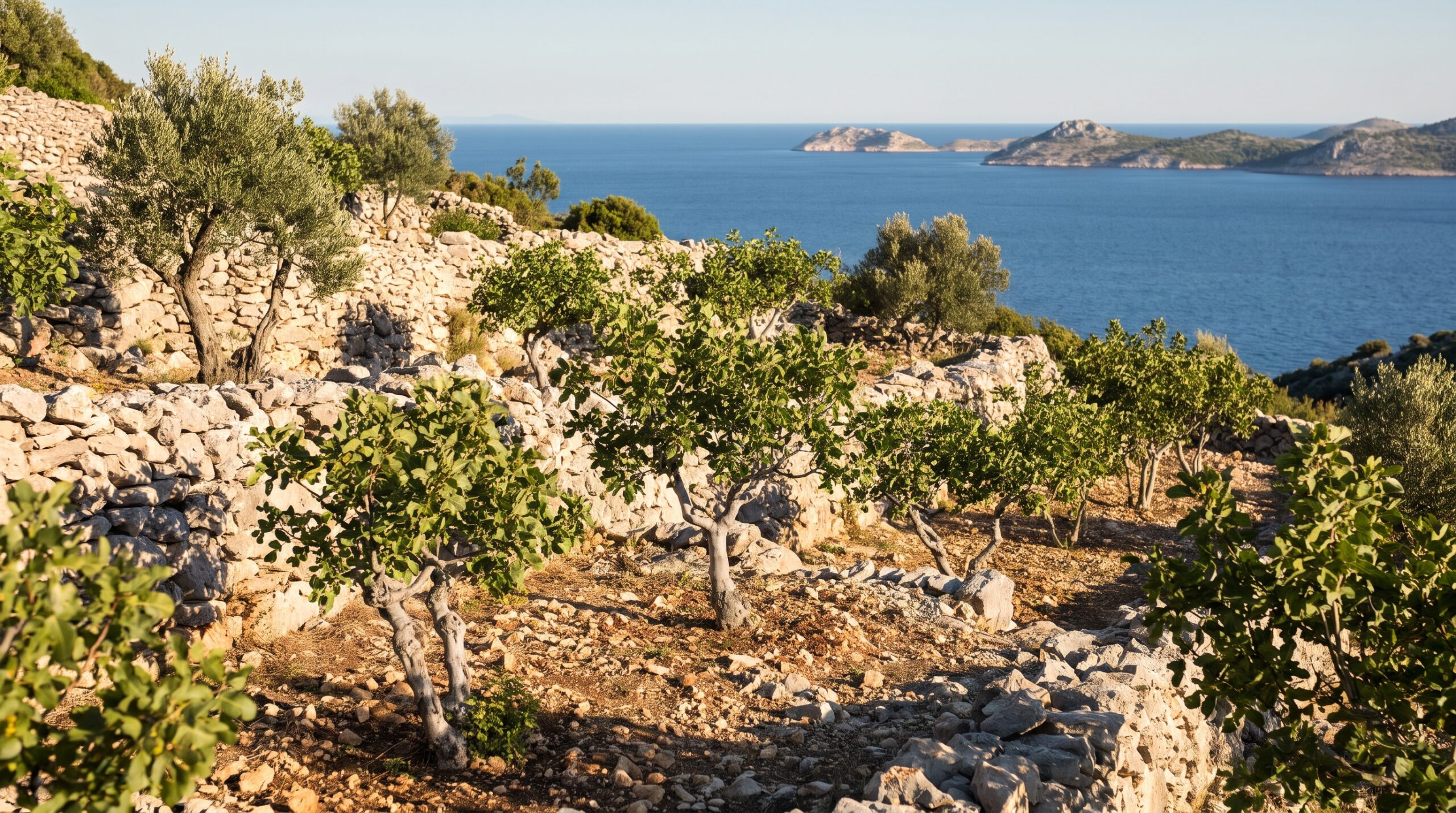
We are receiving more and more enquiries from growers who look towards the Adriatic with the same question: can pistachio trees grow in Croatia? 🌳 It is a perfectly reasonable question. The Croatian coast combines sunny summers, mild winters and a landscape of olive trees, vines, fig trees and even wild mastic and terebinth trees, close relatives of the pistachio tree.
However, a Mediterranean landscape does not guarantee that a nut as demanding as the pistachio will perform well. ☀️ The difference between a profitable orchard and an expensive mistake comes down to very specific data: chilling hours, frost risk, summer humidity, soil type and available water.
In this guide we analyse, from an agronomic perspective, how far pistachio cultivation can go in Croatia, which areas offer the best prospects and what we must check before planting. We write from our experience at Agro Vivero del Mediterráneo, where we produce plants and support small and large growers with their pistachio orchards.
If you are considering land in Dalmatia, Istria or any other Mediterranean area, what follows will help you make a grounded decision. 🧭
Short Answer: Yes, but Not in Every Corner of the Country 🇭🇷
Yes, pistachio trees can grow in Croatia, but only in certain areas and with a very careful choice of site, variety and management. Pistachio is not a traditional crop in the country, so there is no local agronomic track record we can use as a direct reference. That is why we recommend being cautious and working with data.
This is how we see the starting point:
- Coastal and sub-coastal Dalmatia (Zadar, Šibenik, Split and their warmer hinterlands): this is where we see the most potential, provided that winter chill and humidity are kept under control.
- Southern Istria and sheltered areas of Kvarner: limited prospects, with a higher risk of late frosts and less heat accumulation.
- Islands and very rainy coastal strips: difficult areas, either because of insufficient winter chill or because of excess rainfall.
- Continental Croatia (Zagreb, Slavonia): we do not recommend it for pistachio cultivation because of the risk of severe winter frosts and late spring frosts, as well as summer humidity higher than desirable.
The key idea is simple: the pistachio tree tolerates drought far better than humidity. The more a Croatian site resembles the inland areas of the Mediterranean, with dry summers and clear skies, the better its chances. The more it resembles a humid, oceanic climate, the fewer.
Before buying a single pistachio plant, we recommend studying the site’s climate data and, if possible, starting with a pilot plot.
What a Pistachio Tree Needs to Grow Well 🌱
The pistachio tree (Pistacia vera) comes from the arid and semi-arid regions of western and central Asia, with cold winters and long, hot, very dry summers. That origin explains almost all of its requirements.
In practice, a pistachio orchard needs:
- ☀️ Long, warm and dry summers, allowing proper kernel filling and ripening of the nut.
- ❄️ Winters with sufficient chill to break dormancy and achieve uniform budbreak and flowering.
- 🌸 No frost during budbreak and flowering, when the tree is most vulnerable.
- 💨 Low ambient humidity in spring and summer, to limit fungal diseases.
- 🪨 Well-drained soils, with reasonable depth and no waterlogging.
- 💧 Supplementary irrigation water, especially in the hottest months.
- 🐝 Guaranteed pollination, because the pistachio is a dioecious species: there are female trees, which produce the nuts, and male trees, which provide the pollen.
When a site meets almost all of these points, the crop works. If one of the three critical factors fails (winter chill, late frost or humidity), the whole orchard can be compromised.
Croatia’s Climate Seen from the Field 🌦️
Broadly speaking, Croatia has three climates: Mediterranean on the coast and islands, continental in the north and east, and mountain in the interior, along the Dinaric Alps. For the pistachio tree, the first one is what matters, but with important nuances.
The Croatian Mediterranean climate is characterised by hot, fairly dry summers and mild, rainy winters. That pattern is favourable. The problem lies in the details:
- The coastal winter is too mild in some areas. The closer to the sea and the further south, the fewer chilling hours accumulate.
- Annual rainfall is higher than in classic pistachio-growing areas. Depending on the location, we are talking about roughly 700 to 1,400 mm per year, compared with the 300–450 mm typical of many traditional inland pistachio-growing areas.
- The coastal summer is less extreme. The sea breeze moderates maximum temperatures. This is pleasant for people, but less so for a nut that benefits from many hours of heat.
- Autumn can be rainy. September and October bring rainfall episodes on the Adriatic coast, just when pistachios are harvested.
These figures are indicative. What matters is that, even along the same coastline, there are very different microclimates. The most interesting ones for us are in the low-altitude sub-coastal Dalmatian hinterland, where winters are somewhat colder than at the seashore and summers are warmer and drier.
Chilling Hours: The Factor That Matters Most ❄️
Chilling hours are the winter hours during which the temperature stays below approximately 7.2 °C. The pistachio tree needs them to come out of dormancy properly. The Kerman variety, the most widely planted in the world, requires approximately 800 to 1,000 chilling hours. Other varieties, such as Sirora, are somewhat less demanding.
What happens if they are not reached?
- Budbreak is delayed and becomes irregular.
- Flowering is sparse or stretches out for too long.
- Male and female flowering no longer coincide, and pollination suffers.
- Empty nuts increase and yields fall.
A practical example: imagine a plot whose nearest weather station records an average of 550 hours below 7.2 °C between November and February. For Kerman, that would clearly be insufficient, and we would have to consider less demanding varieties or rule out the site. If the average were 900 hours, the figure would be very encouraging. 📊
In Croatia, the southernmost coastal strip and the islands are likely to fall short. The Dalmatian sub-coastal area and some sheltered inland areas come closer to what is needed. Even so, nothing should be taken for granted. The right approach is to calculate the figure from data series of at least ten years.
We must also bear in mind that global warming is reducing chilling hours across the whole Mediterranean basin. Plant with the climate of the coming years in mind, not just that of the past.
Spring Frosts, the Bora and Other Risks 🌬️
The pistachio tree’s greatest enemy in cold climates is not winter but late frost. While dormant, the tree withstands very low temperatures, in the order of -15 °C. But once it breaks bud, buds and flowers can be damaged at temperatures close to -2 °C. A single bad night in April can ruin an entire year’s harvest.
These are the risks we watch most closely in the Croatian case:
- 🥶 Cold pockets in the karst. Closed karst fields, known as poljes, and valley bottoms accumulate cold air on clear nights. We do not recommend planting in them.
- 🌬️ The bora. This cold, dry, gusty Adriatic wind can break branches, dry out stigmas during flowering and hinder pollination. Exposed plots need windbreaks and good formative pruning.
- 🌊 Sea spray. The pistachio tree has moderate salinity tolerance, but direct exposure to salty sea breezes damages the leaves. The distance to the sea should be assessed.
- ⛰️ Aspect and slope. A ventilated slope, through which cold air can drain away, is much safer than a hollow.
To reduce the risk of spring frosts, we choose well-ventilated plots, study the flowering calendar of each variety and plan the pollinator males well in advance.
Rain, Humidity and Diseases: The Weak Point of the Adriatic 🍄
The pistachio tree withstands drought with remarkable ease, but it copes poorly with humidity. That is why the greatest challenge in Croatia’s coastal areas is not a lack of water but an excess.
These are the problems that tend to appear:
- Aerial fungal diseases, such as Botryosphaeria, Alternaria or Septoria, which thrive on spring and summer rain and dew.
- Root and crown rots (Phytophthora), associated with waterlogging and heavy soils.
- Verticillium wilt, a risk if the plot comes from sensitive crops such as olives, potatoes or tomatoes. This is a point to check in Croatia, where olive growing is very common.
- Rain during flowering, which hinders pollination.
- Rain at harvest, which stains the shell, encourages fungi and complicates drying.
To manage humidity, we work with a preventive approach:
- Ventilated, well-drained plots.
- A planting layout that allows air circulation.
- Open pruning, which lets light and wind into the canopy.
- Drip irrigation, to avoid wetting the foliage.
- A scheduled plant health programme before problems appear.
- Early-ripening varieties, which can be harvested before the autumn rains.
- Fast harvesting and immediate drying.
In humid climates, pistachio growing demands more preventive work. This must be accepted from the start, not halfway through the season.
Croatian Soils: Limestone Is Not the Problem 🪨
There is good news. Much of the Croatian coast is karst, with calcareous, stony soils and, in Istria and Dalmatia, the well-known terra rossa, a reddish, clayey soil. The pistachio tree has proven its hardiness in calcareous, alkaline and relatively poor soils in several parts of the Mediterranean. Limestone, therefore, does not worry us.
What can limit an orchard:
- Lack of depth. If the bedrock appears just a few centimetres down, the roots do not develop well. We look for at least 80 to 100 cm of explorable soil.
- Poor drainage. Heavy clay soils and depressions where water collects in winter are enemies of the pistachio tree.
- Low water retention. Very shallow, stony soils require more frequent irrigation.
- Extreme stoniness. It makes land preparation and mechanisation difficult.
That is why we always recommend a complete soil analysis (texture, pH, active lime, salinity and organic matter) and digging soil pits to check the real depth and drainage. It is a small investment compared with the cost of an orchard. 🔍
Varieties and Rootstocks: What We Would Consider for Croatia 🌿
Genetic choice is one of the most important decisions. Depending on the chill and humidity of each site, this is what we usually consider:
| Element | Common options | When it may suit Croatia |
|---|---|---|
| Female variety | Kerman | Areas with sufficient winter chill and a warm summer. It is the market reference variety for its quality |
| Female variety | Sirora | Areas with slightly milder winters or rainy autumns, thanks to its earlier ripening |
| Female variety | Larnaka | A Mediterranean alternative that we assess site by site |
| Male pollinator | Peter, Avdat | Always with flowering that coincides with that of the female variety |
| Rootstock | Pistacia terebinthus | Calcareous, poor soils and areas with a risk of winter cold. Slower growth, but very hardy |
| Rootstock | Pistacia atlantica | Very hardy, tolerant of cold and drought |
| Rootstock | UCB-1-type hybrids | Deep soils and milder climates. Vigorous, with good tolerance to soil-borne diseases |
As a general rule, in areas with a risk of winter cold, hardier rootstocks are the more prudent option. Vigorous hybrids call for milder climates.
Pollination must also be taken into account. We calculate approximately 1 male for every 8–10 females, distributed so that the wind carries pollen to the entire orchard.
Finally, the plant must be grafted, with phytosanitary guarantees and a known origin. It is the starting point of any orchard that is meant to last, which is why we take such care with our pistachio plants.
Pistachio Cultivation in Croatia by Area 🗺️
To organise our ideas, this is our initial assessment by area:
| Area | Advantages | Main risks | Initial assessment |
|---|---|---|---|
| Sub-coastal Dalmatia (Zadar, Šibenik, Split), low altitude | Warm, dry summers; well-drained calcareous soils | Frost in hollows, autumn rains | ✅ Interesting potential |
| Dalmatian hinterland at low altitude (Zagora) | More winter chill, good chilling hours | Severe late frosts, poljes | 🟡 Possible with well-chosen plots |
| Southern Dalmatian coast (Dubrovnik area) | Heat, sun and mild winters | Few chilling hours, high rainfall (1,100–1,400 mm) | 🟠 Limited |
| Istria | Agricultural tradition, terra rossa soils | More humidity, less warm summers, late frosts | 🟠 Limited, only in microclimates |
| Adriatic islands | Sun and calcareous soils | Little chill, wind, salinity and limited water | 🔴 Very limited |
| Continental Croatia (Slavonia, Zagreb) | Deep soils | Summer humidity, frosts, incomplete ripening | 🔴 Not recommended |
This table is a general guide and does not replace the study of each site. Within a single district there can be enormous differences between a ventilated slope and a hollow in the same area.
Irrigation: How Much Water Does a Pistachio Orchard Need? 💧
The pistachio tree withstands drought, but it yields more and better with a well-scheduled water supply. In established pistachio-growing areas such as Spain, we work with regulated deficit irrigation, with volumes that, depending on climate and soil, usually range between 2,000 and 3,500 m³ per hectare per year.
In Croatia the approach is different, because winter and spring rains cover a good part of the initial needs. What makes the difference is the dry summer, and for that we speak of supplementary irrigation. It is best concentrated in the weeks of nut filling, when the tree benefits from it most.
Some guidelines we recommend:
- Install drip irrigation, which saves water and avoids wetting leaves and nuts.
- Do not over-irrigate. Excess water encourages root rots and hull splitting.
- Analyse water quality, because aquifers close to the coast may show salinity due to seawater intrusion.
- Ensure real availability in midsummer. In karst terrain, wells and reservoirs can fall short.
Water is a limiting factor on many sites, and it must be resolved before planting, not afterwards. 🚰
How to Set Up a Pistachio Orchard in Croatia, Step by Step 📋
If the site passes the first filter, this is the path we would follow:
- Collect at least ten years of climate data. Minimum temperatures, chilling hours, date of the last frost, April and May rainfall, and September rainfall.
- Visit the plot in winter and in spring. We need to see with our own eyes where the cold collects and how the wind moves.
- Carry out a soil analysis and dig soil pits. This confirms depth, drainage, pH and active lime.
- Confirm the available water. Quantity, quality and cost.
- Define variety, rootstock and pollinators. This decision must be specific to each site.
- Start with a pilot plot. An area of 0.5 to 1 ha makes it possible to check how the crop behaves before expanding.
- Plan the management. Formative pruning, fertilisation, plant health and weed control.
- Resolve post-harvest handling. Pistachios must be hulled and dried quickly after harvest. It is necessary to check in advance where and with whom this will be done, and to whom the crop will be sold.
To take these steps with confidence, our services include technical advice tailored to each site, from the preliminary study to the follow-up of the orchard.
Profitability: What to Expect from a Pistachio Orchard in Croatia 💶
Pistachio is a long-term crop. The first harvests arrive around the fourth or fifth year, and full production is reached from approximately year 10 or 12. In addition, the pistachio tree tends towards alternate bearing: one year it carries a heavy crop and the next a lighter one.
The profitability of pistachio growing depends on four factors:
- the yield per hectare;
- the price of in-shell pistachios, which changes each season;
- the costs (plants, irrigation, labour, harvesting and drying);
- access to a buyer or a processing facility.
A typical planting layout, such as 6 x 5 m or 7 x 5 m, means between 285 and 333 trees per hectare. With that starting point, this example illustrates how revenue varies:
| Yield (kg/ha of in-shell pistachios) | Illustrative price (€/kg) | Approximate gross revenue (€/ha) |
|---|---|---|
| 1,500 | 5.00 | 7,500 |
| 2,000 | 6.00 | 12,000 |
| 2,500 | 7.00 | 17,500 |
These figures are purely illustrative. They are not a revenue forecast and do not deduct costs. In marginal areas, such as those we have described in Croatia, yields may fall below those of the major producing regions, and this must be reflected in any honest calculation.
If you would like to look into the numbers in more depth, our page on the profitability of a pistachio orchard explains how each case is studied. 📈
Frequently Asked Questions About Pistachios in Croatia ❓
How long does a pistachio tree take to start producing?
The first harvests usually arrive between the fourth and fifth year. Full production is reached at around 10–12 years, provided that management is correct.
What is the minimum temperature a pistachio tree can withstand?
In winter dormancy it withstands around -15 °C. During budbreak and flowering, however, frosts of around -2 °C can already damage buds and flowers.
Can pistachios be grown without irrigation in Croatia?
In some areas with deep soils and sufficient rainfall it is possible, but yields tend to be lower and more irregular. We recommend having at least supplementary irrigation.
Which variety is better: Kerman or Sirora?
It depends on the site. Kerman suits places with sufficient winter chill and a warm summer. Sirora may be more interesting where chill is borderline or autumn is rainy, thanks to its earlier ripening.
Can plants be shipped from Spain to Croatia?
Both countries belong to the European Union, and the movement of plants within the single market is governed by common plant health rules, with a plant passport. We study each case individually.
Is it advisable to start with a pilot plot?
Yes, especially in a country with no pistachio-growing tradition. A small area makes it possible to check chilling hours, frosts, plant health and variety performance before committing more investment.
The Next Step 🚀
Pistachio trees can grow in Croatia, but not just anywhere and not in just any way. The areas with the best prospects are in sub-coastal Dalmatia and in some low-altitude inland areas, where warm, dry summers, well-drained calcareous soils and sufficient chilling hours come together. The major risks are spring frosts, humidity and a lack of water in summer.
It is not a crop to rush into blindly, but neither is it one to dismiss without studying it. With climate data, a good soil analysis, the right variety and a pilot plot, you can decide with sound judgement and reduce risk.
If you have land in Croatia, or in any other Mediterranean-climate area, and want to know whether it suits pistachios, contact us and we will assess your case. And if you are already sure, you can request a quotation and reserve plants through our reservation and quotation form. 🌰
Need a quote?
Tell us about your project and we will send you a proposal with no obligation.
Request a quote