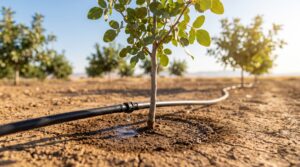
At Agro Vivero del Mediterráneo, we have been dedicated to the exciting world of pistachios for years. Our experience is not limited to the production of the highest quality pistachio plants; we have also specialized in advising and developing solutions for the most complex challenges farmers face. One of the most significant, and often underestimated, challenges is the establishment and management of pistachio plantations on sloping terrain. 🏞️
Over the years, we have seen how many farmers feel intimidated by hillsides, considering them second-rate or outright unviable land. However, in our experience, these plots can become extraordinarily productive and profitable if managed with the right knowledge and techniques. In fact, some of the best productions of this prized nut come from farms on slopes, where natural drainage and sun exposure are optimal.
This article is the result of years of fieldwork, trial, error, and, above all, success. We want to share with you, from the perspective of our technicians and experts, how to transform a challenge into an opportunity. We will delve into two fundamental pillars: erosion control, a silent but devastating enemy, and machinery adaptation, key to efficient and safe management. If you are thinking of undertaking a pistachio project on a slope or already have one underway and are looking to optimize it, we assure you that you will find valuable and practical information here. Join us on this technical journey and discover how to master the art of pistachio cultivation in the most demanding conditions.
The Challenge of the Slope: Understanding Erosion and its Consequences
When we talk about planting pistachios on hillsides, the first and most important factor to consider is soil erosion. The inclination of the terrain, combined with the action of rainwater and, to a lesser extent, wind, can cause the progressive loss of the most fertile layer of soil. This process is not a minor problem; it is a direct threat to the long-term viability of the plantation.
Water erosion is the main protagonist in most of our growing areas. Torrential rains, increasingly common due to climate change, can wash away enormous amounts of soil in a matter of hours. This lost soil not only contains the organic matter essential for tree nutrition but also the mineral nutrients we so painstakingly provide through fertilization. In essence, erosion is like having a hole in your pocket: everything we invest in improving our soil is gradually lost. 💸
The consequences are multiple and worsen over time. In the short term, we will observe a decrease in tree vigor, slower growth, and lower production. Young trees are especially vulnerable, as their root systems are not yet developed enough to anchor firmly and explore a large volume of soil in search of water and nutrients. In the long term, continuous soil loss can expose the shallowest roots, making them vulnerable to mechanical damage and desiccation. In extreme cases, soil degradation can be so severe that the plantation becomes economically unviable, compromising an investment that takes years to mature.
Furthermore, erosion does not only affect our farm. The washed-away soil and fertilizers can clog riverbeds, pollute aquifers, and affect neighboring plots, generating environmental and legal problems. For all these reasons, at Agro Vivero del Mediterráneo, we insist that erosion control is not an option, but an obligation and the fundamental first step even before planting the first tree.
Plantation Design Strategies to Minimize Erosion
The best way to combat erosion is to prevent it from the initial design of the plantation. A proactive approach will save us countless problems and expenses in the future. Based on our extensive experience, we recommend a series of key strategies in the planning phase.
The first decision, and one of the most crucial, is the orientation of the planting rows. The golden rule is always to plant following the contour lines. This means that the tree rows must be perpendicular to the direction of the maximum slope. Why? Because each row acts as a small natural barrier that slows down the speed of runoff water. By reducing the speed, we drastically decrease its ability to carry away soil particles. Planting down the slope, on the contrary, is creating veritable highways for water, accelerating erosion exponentially.
On very steep or irregular slopes, it may not be possible to follow the contour lines perfectly. In these cases, we design terrace systems. Terracing is an ancestral technique that has proven its effectiveness for centuries in mountain agriculture. Although it requires a larger initial investment in earthmoving, the benefits are enormous. Each terrace creates a practically horizontal surface for planting, almost completely eliminating the risk of erosion within the growing area. In addition, it greatly facilitates all subsequent agricultural tasks, from applying treatments to harvesting. The design of these terraces, their width, the inclination of the slope between them, and the associated drainage systems are critical aspects that must be calculated by professionals. At Agro Vivero del Mediterráneo we offer topography and plantation design services to ensure the maximum effectiveness and sustainability of the project.
Another fundamental strategy in the design is the planning of roads and service paths. These roads are critical points for erosion, as they compact the soil and concentrate water flow. They must be designed with gentle slopes, never excessive, and equipped with water evacuation systems, such as ditches, dips, or culverts sized for the heaviest rains. A poorly designed road can become a gully that destabilizes an entire hillside.
Soil Management Techniques: Cover Crops as Allies
Once the plantation is designed and established, soil management becomes the daily tool to control erosion. The philosophy we promote from Agro Vivero del Mediterráneo is simple: bare soil is vulnerable soil. Therefore, our main recommendation is the establishment of cover crops. 🌿
A cover crop consists of maintaining a layer of living vegetation (usually grasses and legumes) in the plantation alleys. This green carpet offers multiple protection. First, the plant canopy intercepts the direct impact of raindrops, which is the first step in the erosive process. Instead of violently hitting the soil and breaking up its aggregates, the rain falls gently on the leaves and slides to the ground.
Second, the dense root network of the cover crop “sews” the soil, increasing its cohesion and resistance to being washed away. The roots create a network that holds soil particles in place, even when water flows over it.
Third, the cover crop improves soil structure in the long term. Roots, as they grow and die, create channels and pores that increase water infiltration capacity. This means that more rain penetrates the soil profile, becoming available to the pistachios, instead of running over the surface taking the soil with it. In addition, the organic matter provided by mowing the cover feeds soil life, improving its fertility and stability.
The choice of species for the cover is important. We look for species that do not compete excessively for water and nutrients with the pistachios, that are low-growing or tolerate mowing well, and that adapt to the climatic conditions of the area. Mixtures of grasses such as fescue or ryegrass with legumes such as clover or vetch usually give excellent results. Legumes have the added advantage of fixing atmospheric nitrogen, providing extra fertility to the system.
Cover management consists of periodic mowing, preventing it from growing too much and competing with the trees, especially during the driest months. The mowing residues are left on the ground, acting as a natural “mulch” that protects the soil from evaporation and provides organic matter.
Other Conservation Practices: Mulching, Trenches, and Small Works
In addition to cover crops, there are other complementary practices that can be very effective, especially in high-risk situations.
“Mulching” consists of covering the soil around the trees (in the planting line) with a layer of organic or inorganic material. Organic mulch, such as straw, shredded pruning residues, or compost, is ideal. It not only protects the soil from the impact of rain and reduces erosion, but also conserves moisture, reduces weed emergence, and provides organic matter as it decomposes. We recommend applying a layer at least 10-15 cm thick, without it touching the tree trunk to avoid fungal disease problems.
On very steep slopes or in areas where runoff concentrates, small engineering works may be necessary. The construction of infiltration trenches against the slope is a very effective technique. These shallow trenches intercept runoff water and give it time to infiltrate the ground, recharging the moisture profile.
Ridges or mounds of earth at the base of the tree rows can also help direct water and reduce its speed. At critical points, such as the ends of rows or road drains, the construction of small retaining dams with stones (gabions) or masonry may be necessary to dissipate the water’s energy and prevent the formation of gullies.
The combination of several of these techniques, adapted to the specific conditions of each plot, is what will guarantee effective and lasting erosion control. Our technical team can help you evaluate your farm and design the most appropriate soil management plan. Do not hesitate to contact us to request a field visit.
Machinery: Key to Efficiency and Safety on Slopes
Managing a plantation on a slope requires not only soil conservation techniques but also specific and adapted machinery. Using conventional machinery on hillsides is not only inefficient but extremely dangerous. Stability is the number one factor to consider. 🚜
Tractors are the heart of agricultural mechanization. To work on slopes, it is essential to use specialized tractors, known as “orchard” or narrow-track tractors, but with additional features. They must have a very low center of gravity to maximize stability. This is achieved with a lower and wider design. Some advanced models even have extendable axles that allow the track width to be increased to work on the steepest slopes.
Four-wheel drive (4WD) is non-negotiable. It provides far superior grip and holding capacity than two-wheel drive, both uphill and, very importantly, downhill. The braking system must also be robust and effective on all four wheels.
For extreme slopes, there are tractors with self-leveling systems for the cabin and the driving position. These sophisticated systems keep the operator upright, greatly improving comfort and safety. Although they represent a larger investment, they are the only viable option in certain topographical conditions.
We must also talk about implements. All the tools we use (sprayers, mulchers, trailers) must be compatible with working on slopes. They must be low-profile, robust, and have a secure hitch to the tractor. Sprayers, for example, must have tanks designed to prevent the liquid from shifting, which could destabilize the assembly. Mulchers for cover crops must be robust and capable of working on uneven terrain.
An increasingly popular alternative for certain tasks are remote-controlled or autonomous vehicles. Small robotic mulchers or sprayers that can work on very steep slopes without putting any operator at risk. Although the technology is still developing, at Agro Vivero del Mediterráneo we closely follow these advances, as we believe they will play a crucial role in the future of mountain agriculture.
Adaptation of Agricultural Tasks: From Pruning to Harvesting
Management on slopes not only conditions the machinery but also the way we carry out each of the tasks throughout the year.
Pruning, for example, must always be done with maximum safety. The use of self-propelled and self-leveling aerial platforms is highly recommended to avoid the risk associated with using ladders on sloping terrain. Tree training can also be slightly adapted, seeking a slightly lower and more open structure that facilitates access.
The application of phytosanitary treatments requires special attention. Drift is a major problem on slopes, as the wind can carry the product downhill. It is crucial to treat in calm conditions, use anti-drift nozzles, and, if possible, use sprayers with air towers that direct the product straight to the tree’s foliar mass. The forward speed must be slow and constant to ensure uniform coverage.
Fertilization, as we have already mentioned, must be done in a way that minimizes runoff losses. Localized application through fertigation (if irrigation is available) is the most efficient method. If we fertilize in dryland, it is preferable to apply the fertilizer just before a light rain and, if possible, bury it shallowly or apply it under the cover crop or mulch.
Harvesting is undoubtedly the most critical operation and the one that has the greatest impact on plantation profitability. The use of tractor-mounted trunk shakers is the norm. Here, the stability of the tractor-shaker assembly is vital. The operator must have great skill to position the machine correctly on each tree.
Collecting the nuts from the ground is traditionally done with nets or tarps spread under the trees. On a slope, this task becomes complicated. A solution that we have successfully implemented on several farms is the use of inverted “umbrella” systems attached to the shaker itself. These umbrellas open around the trunk before vibration, collecting the product directly and channeling it to a hopper. This not only avoids the tedious task of spreading and collecting the nets but also prevents the nuts from rolling downhill and getting lost or mixed with dirt and stones. This equipment, although expensive, can pay for itself quickly thanks to labor savings and reduced losses. You can request a profitability and budget study for your specific project.
An Integrated Approach for Sustainable Success
As we have seen throughout this extensive analysis, success in pistachio cultivation on slopes does not depend on a single magic solution. It depends on an integrated and holistic approach that begins long before planting and continues throughout the life of the farm. 🏆
It is the synergistic combination of a smart plantation design that respects contour lines, the use of permanent cover crops that protect and improve the soil, the application of conservation techniques such as mulching, the choice of specific and safe machinery, and the meticulous adaptation of each agricultural task.
At Agro Vivero del Mediterráneo, our philosophy is based on working with nature, not against it. A hillside is not an enemy to be beaten, but an ecosystem with its own rules that we must understand and respect. By doing so, we are not only ensuring the long-term productivity and profitability of our plantation, but we are also practicing more sustainable agriculture, which conserves the most valuable resource we have: the soil.
The initial investment in time, planning, and sometimes in specific infrastructure and machinery, may seem high. However, our experience shows us time and again that this investment more than pays off. A well-managed plantation on a slope can reach productions of more than 1,500 kg/ha of high-quality nuts, with controlled production costs and, most importantly, with the peace of mind of knowing that we are building a lasting and environmentally friendly project.
If you are considering a project of these characteristics, we invite you to rely on professionals with proven experience. Every farm is a world of its own, and personalized advice is key to making the right decisions from day one. We are entirely at your disposal to study your case, visit your plot, and offer you the solutions that best suit your needs and goals. Together, we can turn those hillsides into a sea of green and profitable pistachios. 🌳✅
Need a quote?
Tell us about your project and we will send you a proposal with no obligation.
Request a quote