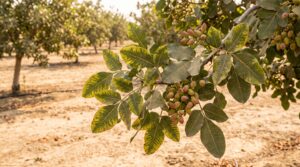
At Agro Vivero del Mediterráneo, we have spent years wholeheartedly dedicated to the fascinating world of pistachio farming. Our experience has allowed us to gain an in-depth understanding of every challenge farmers face. One of the most recurring problems and the one that causes the greatest concern in orchards is, without a doubt, Septoria. 🍃 This fungal disease, if not controlled in time, can seriously compromise the health of our trees and, consequently, the profitability of the harvest.
Throughout this article, we are going to share with you all our knowledge on how to identify, prevent, and combat Septoria in your pistachio orchards. Our goal is that, by the time you finish reading, you feel much more confident and prepared to protect your investment and ensure the success of your project. Because your success is also ours. 💪
What Exactly Is Septoria and Why Is It a Threat to Pistachio?
Septoria, technically known as Septoria pistaciarum, is a disease caused by a fungus that primarily attacks the leaves of the pistachio tree (Pistacia vera). Although its main target is the leaves, in very severe attacks it can also affect the petioles and even the outer skin of the nut, reducing its commercial value.
Let us think of leaves as the tree’s solar panels. They are responsible for carrying out photosynthesis, a vital process through which the plant generates the energy needed to grow, develop, and — most importantly for us — produce those prized nuts. When Septoria strikes, it progressively covers the leaf surface with necrotic spots. These spots are not just an aesthetic problem; they are dead tissue, areas of the leaf that can no longer carry out photosynthesis. ☀️
If the infection spreads, the tree suffers premature defoliation — that is, it loses its leaves before the natural time. This has devastating consequences:
-
General Tree Weakening: By losing its ability to generate energy, the tree becomes weakened, making it more vulnerable to other diseases and pests, as well as to stress conditions such as drought or frost.
-
Reduced Nut Size: Lower photosynthetic capacity translates into less “nourishment” for the nuts as they develop. This prevents them from reaching their optimal size, which directly affects the total harvest weight.
-
Kernel Filling Problems: The lack of energy also affects proper kernel filling. We may find a higher percentage of empty nuts, which represents a direct financial loss.
-
Reduced Reserve Accumulation: The tree needs to accumulate energy reserves in its buds for the following year’s budding and flowering. Early defoliation prevents this process, jeopardizing the next season’s production.
In short, Septoria is not just a leaf spot; it is a silent enemy that undermines the health and productive capacity of our pistachio trees in both the short and long term. That is why at Agro Vivero del Mediterráneo we place so much emphasis on the importance of constant vigilance and swift action.
Identifying the Symptoms: How to Know If Septoria Has Reached Your Orchard
Early detection is our best weapon against Septoria. 🕵️♂️ Knowing how to recognize its symptoms will allow us to act before the disease spreads out of control. The signs are quite characteristic, although in the early stages they could be confused with other pathologies or nutrient deficiencies.
The first symptoms usually appear in late spring or early summer, coinciding with rising temperatures and ambient humidity. Pay attention to the following:
-
Small Angular Spots: The disease initially manifests as small angular or polygonal spots on the leaves. They are barely 1–2 mm in size. At first, their color is brownish-red or dark brown.
-
Chlorotic Halo: As the lesion progresses, these spots become surrounded by a characteristic yellowish or chlorotic halo. This is a distinguishing sign that helps differentiate it from other leaf spots.
-
Growth and Necrosis: The spots grow and merge with one another, forming larger necrotic areas (dead tissue). The center of older spots takes on a grayish or whitish hue.
-
Black Dots (Pycnidia): This is the key symptom for unambiguous identification. In the center of those grayish spots, if we look carefully (sometimes a magnifying glass is needed), we will see tiny black dots. These are the pycnidia — the fungal fruiting bodies where spores (conidia) are produced, which will spread the infection.
-
Premature Defoliation: In severe attacks, affected leaves turn completely yellow and fall to the ground en masse, especially in the lower and inner parts of the tree, where there is usually less ventilation and greater humidity. A tree that loses its leaves in the middle of August is a very clear warning sign.
It is crucial to regularly inspect our orchards, especially after periods of spring or summer rainfall. A careful walk between the trees can save us a great deal of trouble and money.
The Disease Cycle: Knowing the Enemy to Defeat It
To establish an effective control strategy, it is essential to understand how the fungus Septoria pistaciarum lives, reproduces, and spreads. Understanding its biological cycle will allow us to attack its weak points and break the chain of infection. ⛓️
The Septoria cycle is relatively straightforward, but highly effective:
-
Winter Survival Phase: The fungus overwinters sheltered in infected leaves that have fallen to the ground. It remains dormant, patiently waiting for the right conditions to return to action. This is its main inoculum reservoir.
-
Primary Infection (Spring): With the arrival of spring, rising temperatures and, above all, rainfall reactivate the fungus. Raindrops splashing from the ground transport spores from the fallen leaves to the new, healthy leaves on the lower part of the tree. For the spore to germinate and infect the leaf, the leaf must remain wet for an extended period (several hours). This is why rainy springs are particularly dangerous.
-
Incubation Period: Once the spore has penetrated the leaf, an incubation period begins during which the fungus develops inside the leaf tissue. At this stage, no visible symptoms will appear on the exterior. The duration of this period varies depending on environmental conditions, but it usually lasts several weeks.
-
Appearance of Symptoms and Production of New Spores: After the incubation period, the first spots appear. It is at this point that the fungus forms pycnidia (the tiny black dots) in the center of the lesions. Inside these pycnidia, thousands of new spores (conidia) are produced.
-
Secondary Infections (Summer): These new spores are responsible for secondary infections, which spread the disease across the rest of the tree and to neighboring trees. Dispersal occurs primarily through rain (droplets carry spores from one leaf to another) and also, to a lesser extent, through wind. Each episode of rainfall during the summer can trigger a new wave of infections, causing the disease to spread exponentially if no measures are taken.
By understanding this cycle, we can identify two critical points for control: the elimination of the winter inoculum (fallen leaves) and the protection of leaves during rainy periods in spring and summer. At Agro Vivero del Mediterráneo, we always advise our clients to focus their efforts on these two intervention windows.
Integrated Septoria Control Strategies
Combating Septoria is not about applying a single miracle product, but about implementing a coordinated set of strategies that combine preventive, cultural, and — when necessary — chemical measures. We call this approach Integrated Disease Management (IDM). It is the most sustainable, effective, and cost-efficient way to keep the disease under control.
Preventive and Cultural Measures: The First Line of Defense
Prevention is always the best tool. If we create an environment in our orchard that is unfavorable to the fungus, we will have won a large part of the battle. These practices are fundamental and should form the basis of any control program.
-
Choosing the Right Pistachio Plant: Although no pistachio variety is completely immune to Septoria, there are differences in susceptibility. When planning a new orchard, it is important to seek expert advice. At our nursery, we offer plants of the highest genetic and phytosanitary quality, providing an excellent starting point for a healthy, vigorous crop.
-
Appropriate Planting Layout: An overly dense planting layout impedes air circulation between trees. This causes leaves to take longer to dry after rain or dew, creating the humid environment ideal for spore germination. We recommend wide planting layouts (for example, 7×6 or 7×5 meters) that ensure good ventilation.
-
Formative and Maintenance Pruning: Correct pruning is essential. We should aim for an open tree structure with a well-ventilated canopy that facilitates the entry of light and air into the interior. This not only helps prevent Septoria, but also other fungal diseases. It is important to remove low branches that may be in contact with the ground or susceptible to rain splash.
-
Irrigation Management: Overhead irrigation or any method that wets the aerial parts of the tree is strongly inadvisable in areas with Septoria incidence. The most recommended irrigation system is localized drip irrigation, which applies water directly to the root zone without wetting the leaves. It is also essential to avoid waterlogging, as excess ambient humidity favors the fungus.
-
Removal of Fallen Leaves: As we have seen, infected leaves on the ground are the main source of inoculum for the following season. Therefore, one of the most effective measures is their elimination. This can be done in several ways:
-
Collection and Burning: This is the most drastic method but also the safest for eliminating the fungus.
-
Incorporation into the Soil: Tilling the soil in autumn or winter to bury the leaves accelerates their decomposition and prevents spores from reaching the surface in spring.
-
Urea Treatment: Applying a 5% urea solution to fallen leaves in autumn accelerates their decomposition and significantly reduces the viability of the fungus.
-
-
Balanced Fertilization: A well-nourished tree is a more disease-resistant tree. It is crucial to supply all the necessary nutrients, while avoiding excess nitrogen. Too much vigor caused by excessive nitrogen generates very dense, tender foliage that is more susceptible to Septoria attack. Soil and leaf analyses will help us design a tailored fertilization plan. In our catalog of services, we offer comprehensive technical advice to optimize the nutrition of your orchards.
These cultural practices are the foundation of good management. They reduce disease pressure and make subsequent treatments, if needed, far more effective.
Chemical Control: When and How to Intervene
Despite applying all preventive measures, there are years in which climatic conditions are so favorable to the fungus (very rainy springs) that cultural control is not sufficient. In these cases, chemical control becomes necessary. 🛡️
It is vital to understand that chemical treatments must be a tool within an integrated strategy, not the only solution. Their use must be rational, justified, and always based on the recommendations of a qualified technician.
When to begin treatments?
The timing of application is critical. It is not about applying treatments indiscriminately. Treatments must be preventive — that is, they should be carried out before the infection becomes established, or at the very latest upon observing the very first symptoms. Waiting until the tree is covered in spots before treating is a common mistake that drastically reduces treatment effectiveness.
The key protection period runs from late spring to mid-summer. Following the phytosanitary alerts in your region or seeking guidance from a technician is essential for deciding the optimal timing for the first application. Generally, the first treatment is recommended after the first significant spring rains, once the leaves have already developed.
Which products to use?
A range of fungicides are authorized for the control of Septoria in pistachio. It is very important to always consult the official register of plant protection products in your country or region to ensure that the product is approved for this use.
Fungicides can be classified into two main groups:
-
Contact Fungicides (Preventive): These work by forming a protective barrier on the leaf surface, preventing spores from germinating and penetrating. Products such as copper oxychloride, copper hydroxide, mancozeb, or captan fall into this category. Their effectiveness depends on good coverage of the entire plant, and they are washed off by rain, so their persistence is limited. They are ideal for the first treatments of the season.
-
Systemic and Penetrant Fungicides (Curative and Preventive): These products are absorbed by the plant and move within it (systemic action). They have the ability to halt infections that have already begun (curative action) as well as protect leaves (preventive action). They generally have greater persistence. Active substances in this category include difenoconazole, tebuconazole, myclobutanil, and strobilurins (azoxystrobin, trifloxystrobin).
Application Strategy and Rotation of Active Substances
An effective treatment strategy could be as follows:
-
First treatment (Preventive): Carry it out in spring, after the first at-risk rains, using a copper-based contact fungicide. Copper, in addition to being effective, has a bactericidal effect and hardens plant tissues.
-
Subsequent treatments: If rainy and humid conditions persist, additional treatments will be necessary every 15–21 days. This is where rotation of active substances comes into play. Always using the same systemic fungicide can lead to resistance developing in the fungus, causing the product to lose effectiveness over time.
It is therefore essential to alternate fungicides with different modes of action. For example, we can alternate a treatment with a triazole (difenoconazole) with one from a different family, such as a strobilurin. This practice is key to ensuring the sustainability and long-term effectiveness of treatments.
Keys to Effective Application
For a treatment to work, choosing the right product is not enough. How it is applied is equally important:
-
Thorough Coverage: It is essential to ensure complete coverage of all the tree’s leaves, both on the upper and lower surfaces. Using adequate spray volumes and well-calibrated spraying equipment is fundamental.
-
Time of Day: Applications should be made in the early morning or late afternoon, avoiding the hours of peak heat and wind, to minimize losses from evaporation and drift.
-
Use of Adjuvants: Adding an adjuvant or wetting agent to the spray mixture can improve the adherence and distribution of the product on the leaf surface, increasing its effectiveness.
If you have any questions about which strategy to follow, which products to use, or when the best time to intervene is, do not hesitate to contact our technical team. We are here to help you design a tailored treatment plan for your orchard.
The Profitability of Good Control
Some farmers may see Septoria control as a cost. At Agro Vivero del Mediterráneo, we see it as an investment. 📈 The investment in prevention and treatment translates directly into greater orchard profitability.
Let us think about the numbers. Severe Septoria defoliation can cause production losses of between 20% and 50% in a year, or even more in extreme cases. On top of this, there is the reduction in nut size and the weakening of the tree, which will affect the following year’s harvest. The cost of treatments is negligible compared to the financial losses the disease can cause if left unchecked.
Maintaining a healthy leaf canopy through to the end of the natural autumn cycle is the best guarantee of a good harvest in the current year and proper preparation of the tree for the following season. A healthy, strong tree is a productive and profitable tree.
On the complex path of pistachio cultivation, every detail matters. Septoria is one of those details we cannot afford to overlook. From Agro Vivero del Mediterráneo, we encourage you to be proactive, to observe your trees, and to act with determination. Prevention, through proper cultural practices, is and always will be your best ally. And when intervention becomes necessary, act with knowledge, using the right tools at the precise moment.
The fight against Septoria is a long-distance race, but with the right strategy, it is a race we can and must win. Protecting the health of your orchards is protecting your future and your investment.
If you are thinking of starting a new orchard or need advice for your existing one, we invite you to fill out our reservation and quote form. Together, we can build a solid, healthy, and above all, highly profitable project. 🌳💚
Need a quote?
Tell us about your project and we will send you a proposal with no obligation.
Request a quote