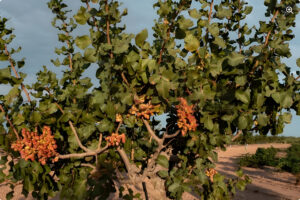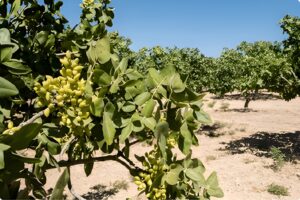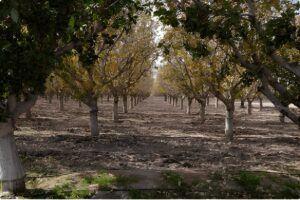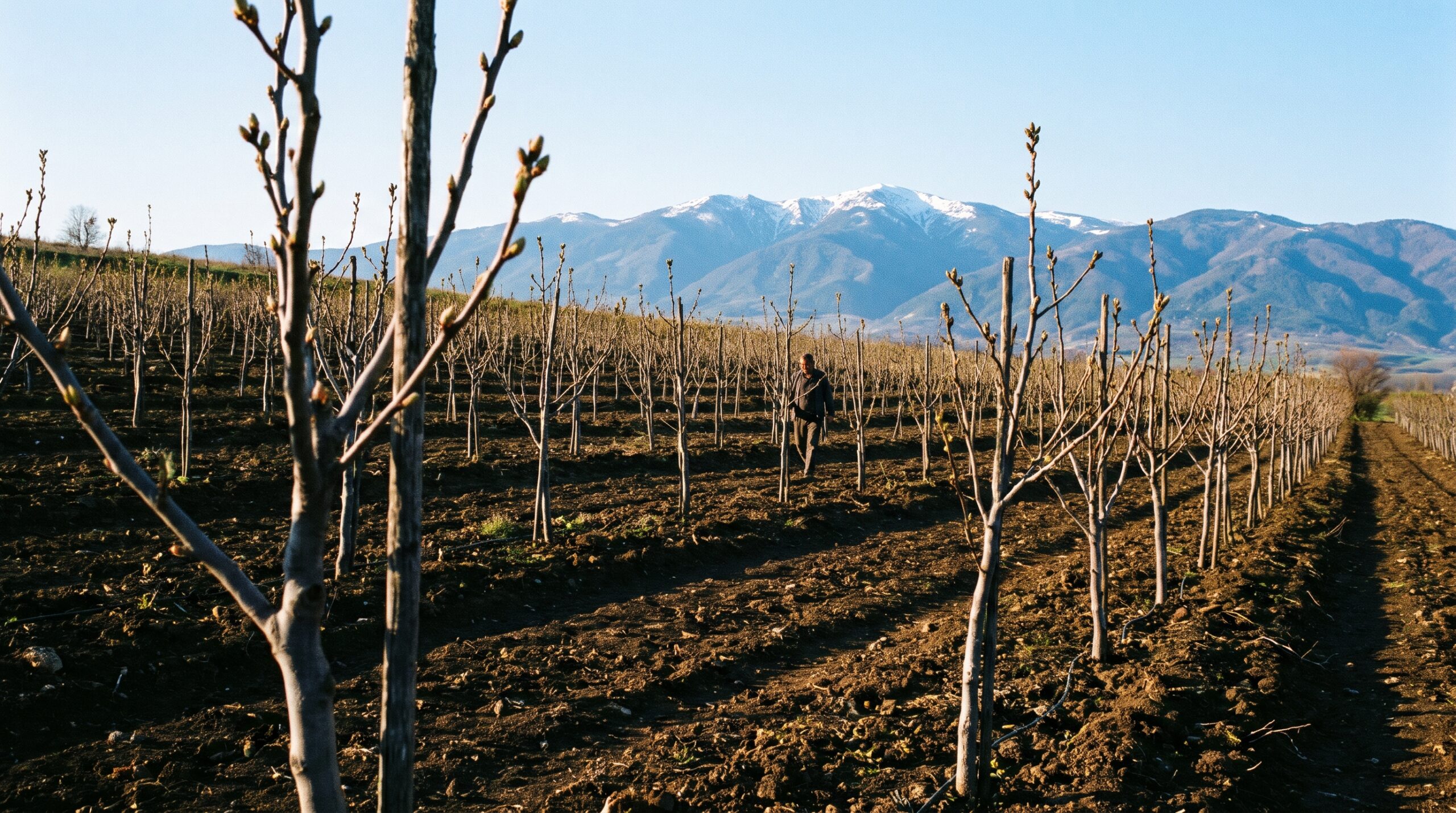
Bulgaria does not appear on the classic maps of pistachio production, and yet the question of whether pistachios can be grown in Bulgaria makes perfect sense. 🌍 It is a country with hot summers, valleys with a Mediterranean influence and a long agricultural tradition in vines, vegetables and woody crops. Moreover, a first pioneering plot has already been planted there, so the curiosity is more than justified.
The short answer is yes, but not just anywhere and not just any way. ❄️ The main constraint is not the summer heat but the winter cold and, above all, late spring frosts.
In this article, drawing on the experience of the technical team at Agro Vivero del Mediterráneo, we review which Bulgarian regions have the best prospects, what winter temperatures a pistachio tree can withstand and how to go about careful plot selection. We do so with real climate data and with the caution that a little-explored area demands. 🔍
Growing pistachios in Bulgaria: the short answer
Yes, it is possible to grow pistachios in Bulgaria, provided the pistachio orchard is sited in suitable areas and technical decisions are adapted to a climate colder than that of our usual growing regions. ✅
A good reflection of the current moment is the news reported by Bulgarian public radio: the country’s first pistachio orchard, of around 2.2 hectares, near Sandanski in the southwest. It is a small and still experimental area, but it confirms that the interest exists and that the warmest region of Bulgaria is the first candidate.
We should be honest about what we know and what we do not:
- ✅ What is clear: the pistachio tree needs long, hot, dry summers, and southern Bulgaria has valleys that offer them.
- ⚠️ What limits it: winters with extreme minimum temperatures and frosts during flowering.
- 🔬 What is missing: continuous production data from Bulgarian soil, so any project should start with caution and sound advice.
The climate pistachios need to produce well
Before looking at the map of Bulgaria, let us recall what the pistachio tree asks for. It is a species native to Central Asia that grows naturally where summers are long, hot and dry and winters are moderately cold. 🌞
These are the four factors that weigh most:
| Factor | What pistachio needs | Why it matters |
|---|---|---|
| Summer heat | Long, hot summers with low humidity | Allows the pistachio nuts to ripen well and reduces the risk of fungal disease |
| Winter chill | Around 900–1,000 chilling hours in varieties such as Kerman | Without them, bud break is irregular and yields fall |
| Extreme cold | Avoid very low minimum temperatures, especially in young trees | Damages buds, branches and wood |
| Spring frosts | Flowering protected from sub-zero temperatures | A single night can ruin the harvest |
Here is good news for Bulgaria: chilling hours will not be in short supply. When a pistachio tree does not meet its chilling requirement, it produces leaves with three leaflets instead of five and breaks bud poorly, a problem typical of areas that are too warm, not of Bulgarian ones. 🌱
The challenge is the opposite: finding the point where the cold is sufficient for dormancy but not so intense that it damages the tree.
Summer heat, humidity and ripening: the other side of the climate
Winter grabs the attention, but summer matters too. The pistachio tree needs a lot of accumulated heat for the nuts to fill well and ripen evenly, and it prefers a dry atmosphere throughout the cycle. 🔥
In the Sandanski–Petrich Valley, with July averages close to 28 °C, that requirement appears to be met. In cooler areas or those with rainy summers, the risk is twofold: more empty or unsplit nuts and greater pressure from fungal diseases on leaves and nuts, which calls for extra phytosanitary vigilance. 🍃
For this reason, in addition to winter minimums, it is worth checking:
- maximum temperatures and accumulated heat between May and September;
- days of rain in summer and relative humidity;
- the frequency of fog and heavy dew, especially on river floodplains;
- rainfall during harvest, in late summer or early autumn.
The climate of Bulgaria: a country with two faces
Bulgaria combines two influences. North of the Balkan Mountains the continental climate prevails, with cold winters and summers ranging from mild to hot. In the south, the Mediterranean climate softens the winter and lengthens the hot months. 🌡️
Some indicative figures to get our bearings:
- North and high plateaus: the mean January temperature ranges between -2 and 1 °C.
- Black Sea coast, Upper Thracian Plain and Struma Valley: the January mean ranges between 0 and 4 °C.
- National cold record: below -38 °C, recorded in 1947 in Trun, a town in the west of the country.
These averages are misleading. What decides the fate of an orchard is not the average but the absolute minimum temperatures and how long they last. A January with a 1 °C mean can hide nights of -15 or -20 °C during a cold spell. 🥶
Bulgarian regions with the greatest potential for pistachio orchards
We have grouped the country into zones according to their winter climate and risk profile. These are average, indicative values: before planting, the data for the specific plot must be studied. 🗺️
| Zone | January mean | Winter cold risk | Indicative viability |
|---|---|---|---|
| Sandanski–Petrich Valley | 3–4 °C | Low | High |
| Upper Thracian Plain (Plovdiv, Pazardzhik, Stara Zagora, Haskovo) | 0–4 °C | Moderate | Medium-high on well-chosen plots |
| Black Sea coast (Burgas, Varna) | 0–4 °C | Low-moderate | Medium, because of humidity |
| Danubian Plain (Ruse, Pleven, Vidin) | Around 0 °C | High | Low, trials only |
| High plateaus and mountains | -2 °C or below | Very high | Not recommended |
Sandanski–Petrich Valley: the top candidate
It is the warmest area in the country: 16.3 °C mean annual temperature in Sandanski and 15.5 °C in Petrich, with January means of 3 and 4 °C and July means of 28.6 and 27 °C. It rains between 470 and 530 mm per year and snow lasts only a few days. ☀️
It is by far the scenario that most closely resembles our inland growing areas. That said, floodplains close to rivers can become waterlogged, so plots with good drainage should be prioritised.
Upper Thracian Plain and the south of the country: potential with caveats
In Plovdiv the January mean is around 1.5 °C and summers are hot, but the lowest minimums of the past twenty years have been around -20 °C. This does not rule out cultivation, but it calls for choosing well-ventilated slopes and hardy rootstocks and for protecting young trees. 🌄
Black Sea coast: mild winters, but humid
On the Black Sea coast, Burgas has a January mean of 3.3 °C and around 24 °C in midsummer. The winter is mild, but ambient humidity and winter winds are a drawback, because the pistachio tree tolerates humid environments poorly and fungal diseases multiply. 🌊
We would only consider plots set back from the seafront, dry and well ventilated.
Danubian Plain and high ground: better approached with caution
In the Danubian Plain, record minimums of the past twenty years are around -25 °C, and in the north and on the high plateaus the January mean is negative or barely positive. On a commercial scale, we do not recommend it without prior trials over several winters. 🚫
Winter temperatures: how much cold can a pistachio tree withstand
The pistachio tree is a deciduous tree and, while dormant, it withstands frost with more leeway than many people imagine. But there are important nuances. ❄️
A study carried out in Iran on the flower buds of several pistachio varieties during dormancy put the critical survival temperature at around -15 °C, and more than 70% of the buds were killed at -30 °C. Maximum hardiness was reached in December and January, and it varied according to the variety and according to whether the tree came from a year of heavy or light cropping.
Other technical references mention adult trees that tolerate minimums of -7 to -9 °C without damage during dormancy. The thresholds change depending on the source, the variety and the condition of the tree, so they should be taken as guidance and not as a guarantee:
| Minimum temperature | What to expect in a dormant tree |
|---|---|
| 0 to -7 °C | No problem for a mature tree |
| -7 to -12 °C | Watch zone; possible damage in young or poorly hardened trees |
| -12 to -15 °C | Real risk of loss of buds and young wood |
| Below -15 °C | Damage likely; at -30 °C most buds die |
There are three more ideas worth keeping in mind. 🔎
- Speed and duration matter as much as the figure. On clear nights with dry air, the temperature falls faster and stays low for longer, and the damage is greater.
- A heavy-crop year weakens trees. Trees coming off an abundant season enter winter with fewer reserves and tolerate cold less well than those that rested. Alternate bearing and cold reinforce each other.
- Young trees are the most vulnerable. In California, winter damage is described in trees from one to six years old that spikes after early autumn frosts, when they have not yet hardened off, and that affects very vigorous rootstocks and varieties more severely.
In Bulgaria, the first winters of an orchard will therefore be the most delicate.
Spring frosts: the real enemy
As winter ends, the pistachio tree rapidly loses its cold hardiness. When the buds begin to swell and flowers appear, temperatures around -2 °C can already damage shoots and inflorescences, and with them a significant part of the harvest. 🌸
It is what worries us most in Bulgarian regions, even the warm ones, because April frosts are not rare. To reduce the risk:
- Analyse historical series of March and April minimum temperatures from the nearest weather station.
- Avoid valley bottoms and hollows, where cold air collects.
- Choose varieties and pollinizers with late flowering.
- Keep the soil clean and firm before flowering: bare, moist soil retains more heat overnight.
No single measure removes the risk entirely, but together they greatly reduce the probability of losing a season. 🛡️
A practical example: two plots in the same district
Imagine two one-hectare plots 800 metres apart, in the same district of southern Bulgaria. 🧪
Plot A is on a river floodplain: flat, fertile and at an altitude of 280 metres. Plot B occupies a gentle south-facing slope, about 40 metres higher up.
On a clear, windless April night, cold air slides downslope and pools on the floodplain. It can happen that plot A drops to -3 °C while plot B stays at -0.5 °C. That difference amounts to losing the blossom or saving the harvest.
The curious thing is that plot A tends to be the more convenient and the cheaper one, which is why so many projects start in the wrong place. The example is illustrative, but it reflects a very real phenomenon, temperature inversion, which should be kept in mind when choosing where to plant. 💭
How to interpret the climate data for a plot
A January mean is not enough to decide whether to plant. These are the figures we review before giving a project the green light: 📊
| Data | What it tells us |
|---|---|
| Absolute minimum of each winter | The most intense frost the area has endured |
| Number of frost days | Total exposure time to cold |
| Date of the last spring frost | When flowering is reasonably safe |
| March and April minimums | The real risk during bud break and flowering |
| Accumulated chilling hours | Whether winter dormancy is fully satisfied |
Ideally, work with a series of at least fifteen years rather than a single winter. National meteorological services and nearby agricultural stations are the main source.
If the terrain of the plot is uneven, a couple of minimum thermometers placed at different heights over a full winter provide very valuable information, because on a clear night the difference between the upper and lower parts of a slope can be several degrees. 🌙
Varieties and rootstocks for pistachios in cold climates
In an area with harsher winters, the choice of plant material weighs almost as much as the choice of plot. 🌳
Variety. We look for the latest possible flowering and good adaptation to winters with real cold. Kerman, a female variety of international reference, and its pollinizers with coinciding flowering are the usual starting point. Varieties with low chilling requirements solve a problem that Bulgaria does not have, and they tend to break bud earlier, which exposes them more to frost.
Rootstock. The rootstock determines the hardiness of the orchard. Pistacia atlantica provides resistance to cold, drought and calcareous soils, and Pistacia terebinthus is considered one of the most cold-hardy, albeit with lower vigour. Very vigorous rootstocks with Pistacia integerrima parentage respond less well to the signals that winter is coming, which is why in cold areas we prefer hardy ones.
If you would like to know the options available, you can browse our pistachio plants and ask us for guidance according to your area. 📋
How to carry out plot selection for planting pistachios in Bulgaria
This is where the most is gained or lost in a project. This is our checklist, step by step: 📝
- Altitude. As a guide, preferably below 400–500 metres. Every hundred metres of ascent adds cold and shortens the frost-free period.
- Relief and cold air. Cold air is heavier and collects in low-lying areas. We prefer gentle slopes that allow that air to drain away, and we avoid gullies, hollows and valley bottoms.
- Plot aspect. South, southeast and southwest exposures, sheltered from cold northerly winds.
- Soil. Deep, well-drained soil, loam or sandy loam in texture, with a neutral to slightly alkaline pH. The pistachio tree tolerates limestone and some salinity but not waterlogging: root asphyxiation and root diseases are serious enemies.
- Water availability. With 470–530 mm per year in the warmest areas, rainfall is not enough for a productive orchard. A source of irrigation must be secured, its quality checked and water abstraction permits reviewed.
- Climate data. Series of at least fifteen years from the nearest weather station and, if possible, your own thermometer on the plot for a full winter.
- Indicators in the surroundings. If fig trees, pomegranates or olive trees thrive in the area without protection, it is a good sign of mild winters.
- Logistics. Access for machinery, electricity and proximity to a hulling and drying facility, because pistachios must be processed within a very short time after harvest.
- Legal framework and support. Land use, water rights and applicable agricultural subsidies. It is best to consult a local adviser.
In our technical advisory service we review these points with the grower before they take the first step, something especially useful in an unusual climate. 🤝
Orchard design: spacing, pollination and orientation
Once the plot has been chosen, the design also influences how the orchard copes with cold and wind. 📐
- Planting layout. Usual spacings are around 6 x 5 m or 7 x 5 m, which means between 285 and 333 trees per hectare. In cold areas, a slightly wider spacing favours ventilation and reduces humidity inside the orchard.
- Pollination. The pistachio tree is dioecious: there are female trees, which bear the nuts, and male trees, which provide the pollen. One male is usually planted for every eight to ten females, with coinciding flowering. In climates with frost, it is advisable to ensure synchronised, late flowering.
- Row orientation. Wherever the terrain allows, rows that follow the slope so as not to create barriers that hold back cold air.
- Windbreaks. A vegetation screen on the side of the prevailing winds protects against dry wind, but it must never block the downslope outlet for cold air.
How to protect the orchard during the first winters
Protecting young trees makes the difference between an orchard that starts well and one that has to replace trees every spring. ❄️🌱
- Plant in spring, with well-developed plants and a stake, so that the tree reaches its first winter with its roots established.
- Encourage hardening-off. Avoid nitrogen and late irrigation from midsummer onwards, so that the wood lignifies before the first frosts.
- Protect the trunk with white trunk guards or lime wash, against frost and winter sunscald.
- Mound soil over the graft union in the harshest winters in cold areas, removing it in spring.
- Keep the soil moist ahead of a cold spell: a moist, firm soil stores more heat than a dry, loose one.
- Record the minimum temperatures of each winter to adjust management year by year.
Climate change: does it make pistachios more viable in Bulgaria?
It is a logical question: if winters are becoming milder, do new areas open up for pistachios? 🌡️ The answer has two sides.
On the one hand, rising average temperatures and summer heat favour a crop that welcomes them. On the other, variability is greater: mild winters can bring bud break forward and leave the orchard exposed to late frosts, and episodes of extreme heat and drought, such as those that have affected the Balkans in recent summers, increase water demand.
Our recommendation is not to plant on the strength of an average trend, but on the worst reasonable scenario for each plot. If the project works with the harshest historical minimums, any climatic improvement will be an extra margin.
Profitability and timelines: what to expect from a pistachio orchard
The pistachio tree does not produce straight away. It is usual for the first harvests to be token ones around the fourth or fifth year, with full production arriving between the eighth and the tenth. In addition, it is a species prone to alternate bearing, that is, it alternates years of heavy and light crops. ⏳
That is why the forecasts of a first harvest within two or three years that accompanied the Sandanski news caught our attention. In our view they are very optimistic, and it is wise to plan with more cautious timelines.
On our page about the profitability of a pistachio orchard we have gathered scenarios and reference figures. Remember to adapt them to Bulgaria, where labour, water and energy costs, land prices and support schemes will be different. 💶
Common mistakes when planting pistachios in a new climate
These are the mistakes we see most often when someone ventures into an area with no reference points: ⚠️
- Choosing the plot on price rather than climate.
- Planting in valley bottoms because they are flat and fertile.
- Ignoring spring minimum temperature data and looking only at the January mean.
- Planting a large area at once, without a prior trial plot.
- Underestimating water availability: without reliable irrigation there is no profitable orchard.
- Using less hardy rootstocks or varieties just because they grow faster.
A trial plot of one or two hectares over several winters is the best way to gain certainty before expanding.
Action plan: six steps before planting
If the project is still on the table after reading this, this is the path we recommend: 🧭
- Visit the area and walk several candidate plots, at different times of day and in different seasons.
- Gather climate data from the nearest station and check winter and spring minimums.
- Analyse the soil and water in a laboratory: texture, pH, limestone content, salinity and irrigation water quality.
- Define the plant material: female variety, pollinizers and rootstock, according to the cold risk of the plot.
- Plant a trial plot first and record its performance over several winters.
- Prepare a realistic budget, with planting, irrigation, labour and mechanisation costs, and several years without income.
This order avoids irreversible decisions until the data are in. When you have a candidate plot, you can request a quote from us and we will study its viability together. 💡
Frequently asked questions about growing pistachios in Bulgaria
Which is the best area of Bulgaria for planting pistachios?
In terms of climate, the Sandanski–Petrich Valley in the southwest is today the soundest option. It is followed by the low-lying, sunny areas of the Upper Thracian Plain, always with careful plot selection.
How many degrees below zero can a pistachio tree withstand?
It depends on the variety, the rootstock, the age and the time of year. When dormant, a mature tree withstands moderate frosts, and between -12 and -15 °C the real risk begins. After bud break, a frost of around -2 °C is enough to damage flowers and shoots.
Can pistachios be planted in northern Bulgaria?
Given the minimum temperatures recorded in the Danubian Plain and on the high plateaus, we do not recommend it on a commercial scale without prior trials.
How long does an orchard take to produce?
The first harvests come around the fourth or fifth year, and full production between the eighth and the tenth.
Is irrigation needed?
Yes. With 470–530 mm of annual rainfall in the warmest areas, irrigation is essential for producing consistently.
Which pistachio variety is best to plant?
A female variety with late flowering and coinciding pollinizers. Kerman is the usual starting point, and the final choice must be adjusted to each plot.
Can I start with a small orchard?
Yes, and in a new area we recommend it. A trial plot lets you check how the pistachio tree behaves before investing in large areas.
To finish
Pistachios can be grown in Bulgaria, yes, but with judgement. The southwest, above all the Sandanski–Petrich Valley, offers the best balance between summer heat and mild winters, while the Upper Thracian Plain offers potential on well-chosen plots. The north and the high ground remain, for now, outside the commercial equation. 🌟
What makes the difference is looking beyond the January mean: studying absolute minimum temperatures, avoiding hollows, opting for hardy rootstocks and late-flowering varieties, and protecting the trees during their first winters.
If you are considering a project in Bulgaria or in any area with demanding winters, we can help you analyse it. Get in touch through our contact page or request your proposal directly through the booking and quotation form. We would be delighted to accompany you from the first visit to the plot through to planting. 🌳🤝
Need a quote?
Tell us about your project and we will send you a proposal with no obligation.
Request a quote