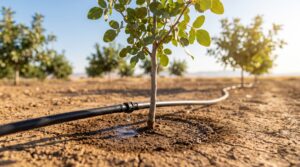
From Agro Vivero del Mediterráneo, we have been dedicated with passion and science to the fascinating world of pistachios for years. We have accompanied hundreds of farmers on their journey, transforming seemingly unfavorable land into thriving and profitable pistachio plantations. Today, we want to share with you our experience and knowledge on a topic that raises many questions: is it possible to successfully grow pistachios in poor soils? The answer is a resounding YES, and here we will explain how.
The pistachio tree (Pistacia Vera) is a noble and resistant tree, a true jewel of nature that, with proper management, can offer excellent results even where other crops fail. At Agro Vivero del Mediterráneo, we not only provide pistachio plants of the highest quality, but we also offer comprehensive advice to ensure the success of your investment.
Why is Pistachio a Smart Choice for Poor Soils? 🤔
The adaptability of the pistachio tree to limiting soil conditions is one of its great virtues. This capacity is not accidental, but the result of millennia of evolution in arid and semi-arid regions of the Middle East and Central Asia, where soils are often marginal.
-
Inherent Rusticity: The pistachio tree is a born survivor. It possesses remarkable drought tolerance once established, thanks to a deep and extensive root system capable of exploring a large volume of soil in search of water and nutrients.
-
Nutritional Efficiency: Although, like any plant, it needs nutrients to thrive, the pistachio tree can manage with fertility levels that would be insufficient for many other fruit trees. Its metabolism is adapted to optimize the absorption and utilization of available resources.
-
Limestone Tolerance: Many varieties and, especially, certain rootstocks, show excellent tolerance to soils with high active calcium carbonate contents, a common problem in many regions of Spain.
-
Resistance to Certain Salinities: Although not immune, the pistachio tree presents moderate tolerance to soil and irrigation water salinity, superior to that of other woody plants.
It is this combination of factors that allows us, as experts at Agro Vivero del Mediterráneo, to affirm that pistachio cultivation represents an exceptional opportunity to enhance land that would otherwise have limited agricultural use.
Defining “Poor Soils”: An Overcomable Challenge 🏜️➡️🌳
Before delving into strategies, it is crucial to understand what we consider “poor soil” in the context of pistachio. It is not a single definition, but a spectrum of conditions:
-
Sandy Soils: Present low water and nutrient retention. Water percolates quickly, dragging essential elements with it. They are usually poor in organic matter.
-
Compacted Clay Soils: Although they can be rich in nutrients, their dense structure hinders root penetration, drainage, and aeration, potentially causing root asphyxia.
-
Stony or Shallow Soils: The effective depth for root development is limited, restricting access to water and nutrients.
-
Calcareous Soils: With high pH and calcium carbonate levels, they can induce iron chlorosis and deficiencies of other micronutrients such as zinc or manganese.
-
Soils with Low Organic Matter: Organic matter is vital for soil structure, moisture retention, and biological activity. Its absence impoverishes the soil in multiple aspects.
-
Soils with Nutritional Imbalances: They may have specific deficiencies of macro or micronutrients, or excesses that are toxic or block the absorption of other elements.
At Agro Vivero del Mediterráneo, the first step is always an exhaustive diagnosis. Each type of “poor” soil requires a particular approach, and our mission is to help you identify limitations and, most importantly, solutions.
Keys to Success: Fundamental Strategies from Agro Vivero del Mediterráneo 🗝️
Taking advantage of pistachio potential in poor soils is not the result of improvisation, but of careful planning and the application of specific agronomic techniques. Here we share the strategies that, based on our extensive experience, we consider crucial:
1. Precise Diagnosis: Soil Analysis 🧐
It is the fundamental pillar. Without knowing in detail the physical and chemical characteristics of your soil, any attempt at improvement will be like navigating without a compass. A complete analysis should include:
-
Texture: Percentage of sand, silt, and clay.
-
pH: Acidity or alkalinity level.
-
Electrical Conductivity (EC): Salinity indicator.
-
Organic Matter: Percentage content.
-
Total Carbonates and Active Limestone: Especially important in calcareous soils.
-
Macronutrients: Nitrogen, Phosphorus, Potassium, Calcium, Magnesium, Sulfur.
-
Cation Exchange Capacity (CEC): Measures the soil’s ability to retain nutrients.
At Agro Vivero del Mediterráneo, we not only interpret these analyses, but we use them to design a tailored management plan for your future pistachio plantation. Well-characterized soil is the first step towards a successful plantation with high profitability.
2. Land Preparation: Foundations for the Future 🌱
Once we know the soil, preparation is key, especially on difficult terrain:
-
Deep Decompaction: If the analysis reveals compacted layers (plow pans, for example), deep subsoiling (60-80 cm or more) is essential. This improves water infiltration, aeration, and facilitates root development. It must be done with dry soil to achieve effective breakage.
-
Organic Amendments: Adding organic matter (composted manure, vegetable compost, leonardite) is almost always beneficial, but vital in poor soils. It improves structure (in both sandy and clayey soils), increases water retention capacity, provides slow-release nutrients, and promotes microbiological activity. We recommend generous doses, in the order of 20,000 to 40,000 kg/ha , well incorporated.
-
Mineral Amendments:
-
Acid Soils (rare for pistachio, but possible): Limestone amendments (calcium carbonate) to raise pH.
-
Alkaline or Sodic Soils: Agricultural gypsum (calcium sulfate) can help improve structure and reduce sodium.
-
Correction of specific deficiencies: Depending on analysis, it may be necessary to provide sulfur, magnesium, etc.
-
-
Leveling and Drainage: Ensuring proper surface water evacuation and, if necessary, installing subsurface drainage systems (drains) is crucial to avoid waterlogging and root asphyxia, especially in clayey soils.
Investment in good land preparation translates directly into better establishment of the pistachio plant and more vigorous and uniform development.
3. The Decisive Choice: Resistant Rootstocks 🌳
This is perhaps the most critical decision when establishing a pistachio plantation in poor soils. The rootstock is the tree’s root system and its adaptation to the soil will largely determine the survival and productivity of the grafted variety. At Agro Vivero del Mediterráneo we work with the best rootstocks, selected for their robustness and adaptability:
-
Pistacia terebinthus (Cornicabra): It is the traditional rootstock in many areas of Spain. Very rustic, it adapts well to poor, dry, stony, and especially calcareous soils. It presents great resistance to drought and late frosts. Its entry into production may be somewhat slower than other rootstocks.
-
Pistacia atlantica: Native to North Africa, it stands out for its tolerance to drought and salinity. It is a good option for soils with moderate saline problems and extreme arid conditions.
-
UCB-1: Hybrid of P. atlantica x P. integerrima. It is the most widely used rootstock worldwide in new plantations. It stands out for its great vigor, earliness in entry into production and, fundamentally, its high resistance to Verticillium dahliae, a soil fungus that can be devastating. Although vigorous, it also requires soils with good drainage and can be more sensitive to root asphyxia than P. terebinthus in very heavy soils if not managed well. At Agro Vivero del Mediterráneo we offer plants grafted on UCB-1 of the highest quality, from certified seed.
-
Pistacia integerrima: Although less used as a direct rootstock, it is a parent of UCB-1 and confers resistance to Verticillium.
The choice of the appropriate rootstock should be based on soil analysis, climatic conditions, and the foreseeable incidence of diseases such as verticillium wilt. Our technical team at Agro Vivero del Mediterráneo will advise you to make the best decision.
4. Optimal Planting Techniques for Difficult Environments 👨🌾
Planting itself must be done with care:
-
Planting Layout: In poor soils, it may be advisable not to force very high densities. Layouts of 7×6 meters or 7×5 meters are common, allowing good root and aerial development. In very arid drylands, even wider layouts can be considered.
-
Planting Season: Generally late winter or early spring, once the risk of severe frosts has passed and before intense heat arrives.
-
Planting Hole: Even if subsoiled, making a generous hole (e.g., 50x50x50 cm) allows initial roots to develop in a more favorable environment. A small amount of well-composted manure or slow-release fertilizer can be added at the bottom, well mixed with soil and separated from roots.
-
Careful Planting: The pistachio plant must be planted at the same depth it was in the nursery, ensuring that the graft point is always well above ground level (minimum 10-15 cm). Gently press the soil around the roots to avoid air pockets.
-
Immediate Irrigation: Abundant irrigation right after planting is crucial to settle the ground and ensure good contact between roots and soil.
-
Protectors and Stakes: Use protectors to avoid damage by rodents or herbicides and stakes to guide the straight growth of the young tree, especially in windy areas.
-
Mycorrhizae: Inoculation with mycorrhizal fungi at the time of planting can be very beneficial, especially in poor soils. These fungi form a symbiosis with roots, improving water and nutrient absorption (especially phosphorus) and increasing stress tolerance.
5. Smart Irrigation: Just Enough Water 💧
Although pistachio is drought-tolerant, for profitable commercial production, support irrigation is fundamental, even in poor soils. The key is efficiency:
-
Drip Irrigation: It is the most efficient system, applying water directly to the root zone and minimizing losses through evaporation or runoff.
-
Allocations and Frequency: In poor soils, especially sandy ones, irrigations should be more frequent but of lower volume, as water retention capacity is low. In clayey soils, irrigations can be spaced out more, but ensuring good drainage.
-
Monitoring: The use of tensiometers or moisture probes helps schedule irrigations precisely, providing water only when the plant needs it. This is vital to optimize water use, an increasingly scarce and valuable resource.
-
Water Quality: It is important to analyze irrigation water quality, especially its salinity, to avoid long-term problems.
Proper irrigation management not only ensures survival and growth, but directly influences nut size and plantation profitability.
6. Tailored Nutrition: Strategic Fertilization 🧪
In poor soils, fertilization is not an option, but a necessity. But it must be rational fertilization based on diagnoses:
-
Annual Foliar Analysis: Complements soil analysis. It tells us what nutrients the plant is actually absorbing and if there are deficiencies or imbalances.
-
Personalized Fertilization Plan: Based on soil and foliar analyses, and taking into account plantation age and expected harvest.
-
Nitrogen (N): Essential for vegetative growth. Apply fractionated during the period of greatest activity.
-
Phosphorus (P): Important for root development and flowering/fruit set. Calcareous soils can block it, so its management is crucial.
-
Potassium (K): Key for nut filling, quality, and plant stress resistance. Pistachio is a large consumer of potassium.
-
Micronutrients: In calcareous soils (high pH), iron (iron chlorosis), zinc, and manganese deficiencies are common. They are corrected with foliar or soil applications of specific chelates. Boron is crucial for pollination and fruit set.
-
-
Fertigation: Applying fertilizers dissolved in irrigation water is the most efficient method, especially for nitrogen and potassium.
-
Organic Fertilizers and Biostimulants: Continued use of organic matter and application of biostimulants (amino acids, seaweed extracts) can improve nutrient absorption efficiency and plant tolerance to abiotic stress typical of poor soils.
At Agro Vivero del Mediterráneo, we firmly believe in balanced nutrition as a pillar for obtaining quality harvests and maintaining plantation health in the long term.
7. Plantation Management: Pruning and Continuous Care ✂️
-
Training Pruning: During the first 3-4 years, it is crucial to form a well-open and balanced vase structure, allowing good lighting and aeration of all parts of the tree.
-
Production Pruning: Once the tree enters production, annual pruning is performed to maintain balance between vegetative growth and production, remove dry or poorly located branches, and ensure renewal of productive wood.
-
Weed Control: Weeds compete for water and nutrients, something critical in poor soils. They can be controlled by shallow tillage (careful not to damage roots), brush cutters, weed barrier fabrics, or herbicides (with caution and following recommendations).
-
Cover Crops: Establishing cover crops (grasses, legumes) between rows can be very beneficial in some cases: they improve soil structure, provide organic matter, reduce erosion, and can promote biodiversity. Their management (mowing) is important to avoid water competition in critical periods.
Pistachio Profitability in Poor Soils: A Tangible Reality 💰
You may wonder if all this investment of time and resources in poor soils is economically viable. From our experience at Agro Vivero del Mediterráneo, the answer is yes. While initial land preparation costs may be somewhat higher, long-term benefits are considerable:
-
Valorization of Marginal Lands: Pistachio allows obtaining profitability from farms that would be unproductive with other crops.
-
Attractive Nut Prices: Pistachio is a product with high demand and good market prices.
-
Plantation Longevity: A well-managed pistachio plantation can be productive for more than 50-60 years.
-
Lower Opportunity Costs: Using “poor” soil implies a lower opportunity cost of the land itself.
The key is good technical advice from the start, detailed planning, and the application of best agronomic practices. To learn more details about economic viability, we invite you to consult our section on profitability of pistachio plantation.
Agro Vivero del Mediterráneo: Your Strategic Ally in Pistachio Cultivation 🤝
At Agro Vivero del Mediterráneo, we are not only suppliers of pistachio plants of the highest genetic and sanitary quality. We are, above all, your partners in this exciting crop. Our team of specialized agronomists offers a comprehensive advisory service that covers:
-
Feasibility studies and plantation design.
-
Soil analysis and interpretation.
-
Personalized land preparation and fertilization plans.
-
Continuous technical monitoring.
Our greatest satisfaction is seeing how lands that seemed destined for abandonment are transformed into productive pistachio orchards, generating wealth and sustainability in rural areas.
Contact Us and Transform Your Land! 📞
If you own land with poor soil and are considering pistachio cultivation, do not hesitate. Soil limitations can be overcome with knowledge, technology, and the right choice of plant material. Pistachio is a resilient and profitable alternative that may be the answer you are looking for.
We invite you to contact us for a personalized consultation. We will be happy to study your case and offer you the best solutions. You can also directly request a quote through our reservation and quote form.
Final Conclusion ✨
Cultivating pistachios in poor soils is not only possible, but represents an extraordinary opportunity to diversify, innovate, and obtain high profitability sustainably. At Agro Vivero del Mediterráneo, we are committed to the success of your pistachio projects, contributing our experience, the best plants, and cutting-edge technical advice. Together, we can turn soil challenges into the foundation of a prosperous and lasting plantation. The future of pistachio is also in your hands and on your lands!
Need a quote?
Tell us about your project and we will send you a proposal with no obligation.
Request a quote