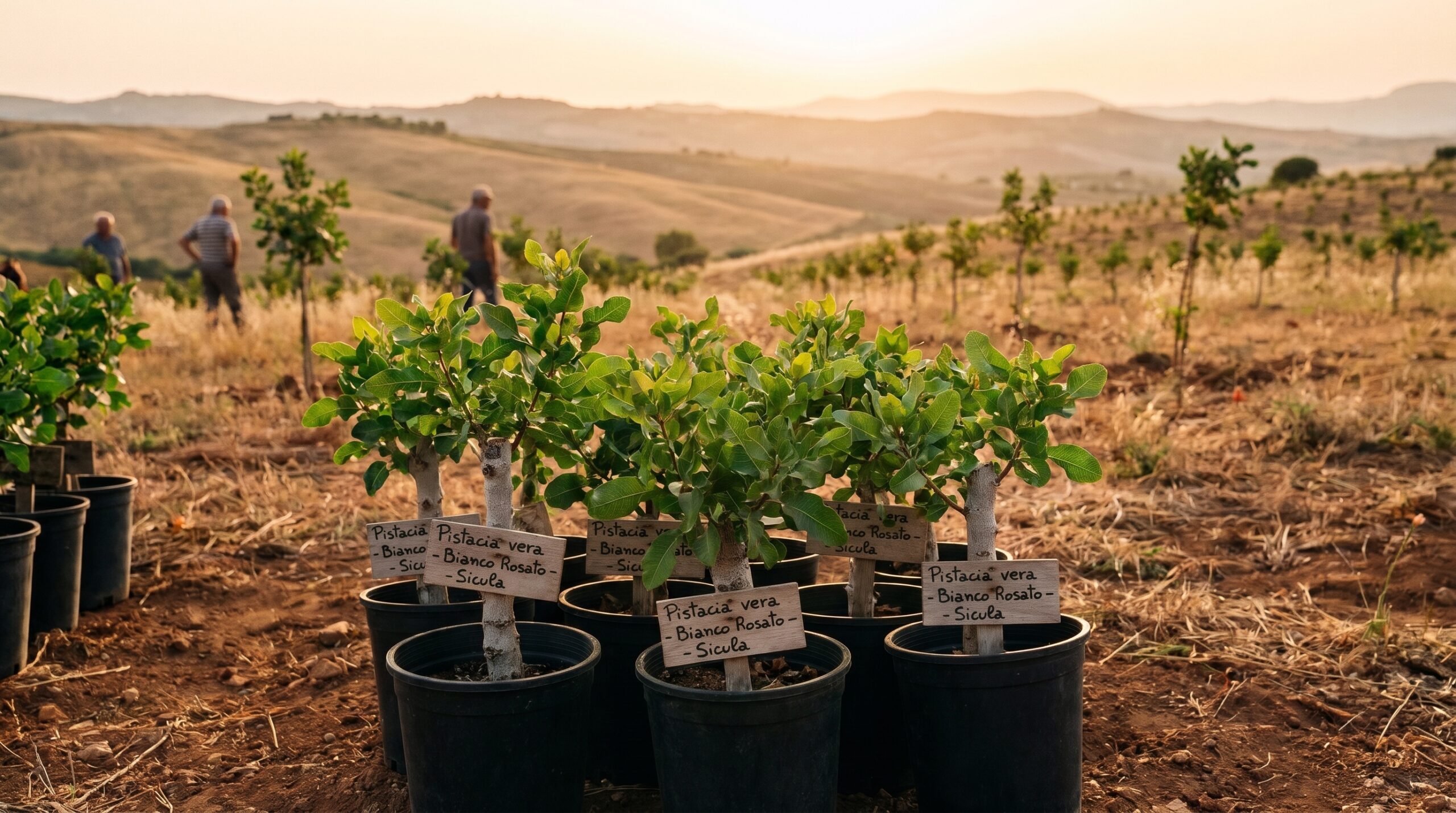
When people think of pistachio in Sicily, they immediately picture the volcanic slopes of Mount Etna and the famous green of Bronte. Yet interest in this nut has spread beyond that area, and more and more growers are looking at new pistachio orchards in the interior and south of the island, where soils, altitudes and water availability are very different from the traditional ones. 🌋
This is where the game is decided. In an established area, farming families have spent generations refining what to plant and how to manage it. Outside it, there is no such room for trial and error. The planting material we choose, meaning the rootstock, the variety and the pollinizers, will shape plant health, crop regularity and profitability for the whole life of the orchard. 🌱
At Agro Vivero del Mediterráneo, we support small and large growers in hot, dry climates with this decision, and we know well the mistakes that come up most often. In this guide, we share the criteria we apply when choosing pistachio planting material for a new farm, what is worth asking the nursery, and how to reduce risk before the first tree goes into the ground. If you need a starting point, take a look at our pistachio plants.
Why Pistachio in Sicily Is No Longer Limited to Bronte 🗺️
The pistachio of Bronte, Adrano and Biancavilla, on the slopes of Etna, is a global benchmark for its colour, aroma and protected designation of origin (PDO). It grows on lava soils, often on terraces and slopes, at altitudes of roughly 400 to 900 m and, in many cases, without irrigation. The traditional plant is a local variety grafted onto terebinth (Pistacia terebinthus), a very hardy rootstock, and production has historically followed a biennial pattern. 🏔️
That model works because everything fits together: climate, soil, variety, rootstock and a very specific management culture. The problem appears when someone tries to transfer it unchanged to another place, because outside Etna many things change at once:
- heavier clay or limestone soils, deeper and with a risk of waterlogging;
- lower altitudes, with milder winters and fewer chilling hours;
- irrigation available, sometimes with mediocre water quality;
- flat plots that allow mechanisation of pruning, spraying and harvesting;
- greater interest in large orchards with more regular production.
That is why it is not enough to copy what is done in Bronte or to import a “package” from another region of the world. The planting material has to be adapted to each farm. 🎯
What Changes in Non-Traditional Areas 🔎
To understand the decisions that follow, it helps to compare the two scenarios:
| Factor | Traditional area (Etna) | Non-traditional areas |
|---|---|---|
| Soil | Volcanic, stony and very free-draining | Clay, limestone or loam, with greater water retention |
| Altitude | Medium to high | Low to medium |
| Irrigation | Limited or none | Common, with variable quality |
| Winter chill | Abundant | Variable, sometimes marginal |
| Ambient humidity | Moderate | Higher in areas near the coast |
| Management | Manual and on terraces | Mechanisable |
Each row of this table affects a different decision. Soil and water guide the choice of rootstock; chill and frost, the choice of variety; and the flowering calendar, the choice of pollinizers. This is the order of priorities we work with.
The Three Decisions That Define Planting Material 🌳
A grafted pistachio plant is the result of three components that must fit together:
- The rootstock: the root system, which provides vigour and tolerance to soil conditions, water and fungal diseases.
- The female variety: the canopy, which produces the nut and sets the flowering and harvest calendar.
- Male pollinizers: essential, because the pistachio is a dioecious species, with separate male and female trees.
A mistake in any of the three is carried through the whole life of the orchard. Let us look at each one separately.
How to Choose a Pistachio Rootstock 🌿
The rootstock is the part you cannot see, and it is the one that shapes the future the most. It determines vigour, tolerance to drought, salinity and soil-borne fungi and, to some extent, to cold. It is also the hardest decision to correct: a variety can be re-grafted, but the wrong rootstock is paid for over many years.
These are the rootstocks most commonly used in the Mediterranean:
| Rootstock | Strengths | Points to watch | Best suited to |
|---|---|---|---|
| Pistacia terebinthus | Very hardy; tolerates cold, drought and calcareous soils; the traditional Sicilian rootstock | Slow growth, later start of production and non-uniform plants | Rainfed conditions, poor or calcareous soils and cold areas |
| Pistacia atlantica (seedling) | Vigorous, with good tolerance to drought and cold; widely used | Variability between plants and susceptibility to Verticillium | Light, well-drained soils with moderate irrigation |
| UCB-1 (clonal hybrid) | Vigour and uniformity; good tolerance to Verticillium and soil-borne fungi; tolerates some salinity | May be more sensitive to intense winter cold | Irrigated orchards, plots with disease risk or slightly saline water |
There is no perfect rootstock, only the most suitable one for each plot. Imagine an irrigated farm in the interior of the island, with clay soil, a tendency towards waterlogging and water with some salt. There, a clonal rootstock tolerant of soil-borne fungi usually gives more peace of mind, provided it comes with good drainage. By contrast, on a rainfed, stony, calcareous plot at medium altitude with cold winters, terebinth or atlantica make more sense.
Before deciding, we recommend analysing the soil and the water. It is a small investment compared with the cost of a poorly planned pistachio orchard. 🧪
Pistachio Varieties for New Orchards in Sicily 🟢
When choosing a variety, there are two paths, and they can also be combined.
Local Sicilian varieties. The best known is Napoletana, also called Bianca, along with other traditional selections. Their great advantage is identity: they are the Sicilian pistachio as it has always been. Their drawbacks are a very marked alternate-bearing pattern and more limited plant availability. In addition, the designation of origin is tied to a specific territory, so planting the same variety in another area does not give the right to use the Bronte name.
International varieties. These are the most widely used in commercial irrigated orchards because they offer nut size, uniformity and well-known performance in many climates. The ones we work with most often in the Mediterranean are these:
| Variety | Chilling requirement | Flowering | When we recommend it |
|---|---|---|---|
| Kerman | High | Late | With sufficient winter chill and when aiming for size and uniformity |
| Larnaka | Medium | Slightly earlier | Milder winters, watching for spring frosts |
| Sirora | Low to medium | Early | Warm areas with few chilling hours and an earlier cycle |
These are general guidelines. Every farm has its own microclimate, which is why we cross-check the data before recommending anything. 📊
One idea we repeat often: avoid a single variety across the whole farm. Combining varieties with staggered flowering and ripening spreads the frost risk, prevents the entire harvest from coinciding in the same week and makes it easier to organise the harvesting and drying of the nuts. On a small farm, even two varieties make a noticeable difference.
Pistachio Pollinizers: The Piece Most Often Forgotten 🌬️
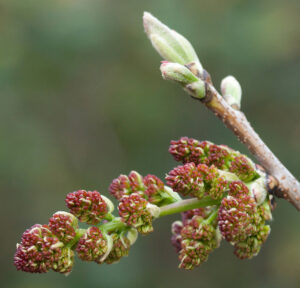
The pistachio is a dioecious species: some trees bear female flowers and others bear male flowers. It is also wind-pollinated, so bees are no substitute for male trees. Without suitable pollinizers, fewer nuts set and the number of empty shells increases.
These are the criteria we follow:
- Ratio: in general, one male for every 8 to 10 females, that is, between 10% and 12.5% of the orchard.
- Flowering synchrony: the pollen must be released when the female flowers are receptive. That is why we choose males matched to each variety; Peters, for example, is a classic reference male for Kerman.
- More than one male: combining two or three extends the pollen period and gives leeway if flowering is out of sync in a given year.
- Placement: we distribute the males across the farm and reinforce them on the side the prevailing spring wind blows from.
Here is a practical example. With a planting spacing of 6 x 5 m, around 333 plants fit per hectare. On a 5-hectare farm, that would be 1,665 plants, of which about 1,480 would be females and about 185 males, if we apply an 8-to-1 ratio.
Remember that a spell of hot, dry wind in the middle of flowering can harm pollination, which is another reason not to depend on a single male. 🌸
Chilling Hours, Frost and Altitude: Matching the Variety to the Climate ❄️
The pistachio needs to accumulate winter chill to break dormancy properly. As a guide, Kerman usually needs between 800 and 1,000 chilling hours, while other varieties get by with less. If these are not reached, budbreak is delayed and uneven, flowering becomes disordered and production falls. At the other extreme, early flowering followed by a frost can ruin a whole year’s harvest. The dormant tree withstands very low temperatures, but budbreak and flowering are far more vulnerable.
This is where altitude weighs heavily: a variety that performs well at 700 m on Etna can behave very differently at 200 m, where winters are milder.
Our recommendations:
- Consult temperature records covering at least ten years from the nearest weather station, for example through a regional agrometeorological network.
- Estimate the chilling hours and the number of frost days after budbreak.
- Avoid hollows and low-lying pockets where cold air pools.
- With marginal chill, prioritise varieties with lower requirements.
- With a risk of spring frost, prioritise late-flowering varieties.
Do not rely on the annual average: it is the extreme years that ruin an orchard. 🌡️
Soil, Water and Salinity: What Determines the Rootstock 💧
The pistachio tolerates calcareous, poor and alkaline soils, and withstands salinity better than many other woody species. But it has a clear limit: it does not tolerate waterlogging. Roots deprived of oxygen open the door to fungi such as Phytophthora and to the death of young plants.
Before choosing the planting material, it is worth measuring:
- useful soil depth and the presence of hard layers;
- texture, pH and active lime;
- soil electrical conductivity;
- water table level and drainage capacity;
- irrigation water quality: conductivity, sodium, chlorides and boron.
With those data, the choice of rootstock stops being a matter of taste. Soil with poor drainage or saline water tips the balance towards more tolerant options; poor, calcareous soil under rainfed conditions tips it towards the hardier ones.
Pistachio irrigation also deserves planning from the start. With water available at the key moments, production is more stable, and regulated deficit irrigation, for example during shell hardening, can save water if applied properly. We help with all of this through our technical advisory services, from orchard design to follow-up during the first years. 🚜
Plant Health: Verticillium, Phytophthora and Botryosphaeria 🍂
Part of choosing planting material is, in fact, a plant-health decision.
- Verticillium dahliae is a soil-borne fungus that persists for years. Some plots come from vegetable crops such as tomato, artichoke or melon, which can leave it in the soil. If the farm has that history, prior testing and the choice of rootstock matter even more.
- Phytophthora is associated with excess moisture in the root zone. It is prevented with good drainage, planting on raised ridges where needed and well-adjusted irrigation.
- Botryosphaeria affects shoots and flower clusters in wet springs, especially in areas near the coast. Planting layouts that allow ventilation and pruning that avoids excess vegetation help.
Above all, the first plant-health barrier is the plant we bring to the farm: a tree that arrives in the field with problems rarely recovers fully.
How to Recognise a Good Nursery and a Good Batch of Plants 🔍
Two plants that look the same can hide enormous differences. This is what we check ourselves and what we recommend demanding:
- Traceability and plant passport or phytosanitary documentation, with rootstock and variety clearly identified in each batch.
- Certified plants where material of that category exists, with no varietal mixing.
- A well-healed graft, with no girdling and no rootstock shoots below the graft union.
- Healthy, well-formed roots in a deep container, with no root spiralling.
- Batch uniformity in size and vigour.
- Prior acclimatisation to field conditions.
- Real advice: a good nursery asks about soil, water, climate and goals before quoting a price.
If a supplier only talks about price and asks nothing about the farm, be wary. Our grafted pistachio plants are produced to these criteria, because we know that everything that comes afterwards depends on them. ✅
Common Mistakes When Choosing Planting Material 🚫
Some mistakes recur with striking regularity:
- Choosing on price. The cheapest plant is rarely the most economical in the long run, because a heterogeneous or poorly grafted batch leads to plant losses and uneven production.
- Copying the Bronte model without its climate or soil.
- Planting a single variety across the whole farm.
- Underestimating pollinizers or choosing males whose flowering does not coincide with that of the females.
- Not analysing the water and discovering salinity when the tree is already planted.
- Planting in poorly drained soils without correcting them first.
- Leaving the purchase to the last moment, which forces you to accept whatever plants are available.
A Five-Step Plan for Deciding on Planting Material 📋
- Analyse soil and water to understand drainage, lime, salinity and irrigation water quality.
- Gather climate data for the area: chilling hours, late frosts and winds.
- Choose the rootstock based on soil, water and disease risk.
- Define varieties, pollinizers and planting spacing, combining flowering and ripening times.
- Reserve the plants well in advance. Grafted plants take months to produce, and the best batches are reserved early. You can do so with our reservation and quotation form.
In areas with no previous references, we also recommend starting with a pilot plot that tests several rootstock and variety combinations before planting the full area. 🧭
Profitability: What to Calculate Before Planting 💶
The pistachio is a long-term crop. The first harvests of commercial interest usually come around the fifth or sixth year, and full production takes longer still. That is why the profitability of a pistachio orchard depends so much on getting things right from the start: a poorly chosen rootstock or variety does not show in the first year, but only once a great deal has already been invested.
Before planting, it is worth calculating:
- the cost of the plants and the installation;
- irrigation, labour and machinery;
- the years without income;
- the effect of alternate bearing;
- post-harvest: hulling, drying and sale of the nuts.
On our page about orchard profitability, we explain how to approach those figures realistically.
Frequently Asked Questions About Pistachio in Sicily ❓
Can pistachio be planted in Sicily outside the Etna area?
Yes, as long as the farm offers winters with enough chill, hot and dry summers, well-drained soils and available water. The key is not the location itself but adjusting the rootstock, variety and pollinizers to its conditions.
What is the best rootstock for pistachio in Sicily?
There is no universal one. Terebinth suits rainfed conditions and poor or calcareous soils; atlantica suits light soils with moderate irrigation; and clonal hybrids such as UCB-1 suit irrigated orchards with disease risk. The soil and water analysis decides.
Can I plant the Bronte varieties in another area?
They can be planted, but their behaviour may vary with the climate, and they do not give the right to the designation of origin, which depends on the territory.
How many male trees do I need?
Between one for every 8 and 10 females, adjusted for flowering time and the prevailing wind.
When does it start producing?
The first harvests of commercial interest arrive around the fifth or sixth year, and full production is reached later.
How far in advance should I reserve the plants?
The sooner the better: grafted plants need months of production, so ideally they should be reserved well before the planting season.
To Finish: Planting Material Is Decided Before Planting 🤝
Choosing the right rootstock, variety and pollinizers is what separates an orchard that starts strongly from one that carries problems for years. Let us remember the essentials: analyse soil and water, know the real chill of the farm, combine varieties and demand healthy, traceable plants.
If you are assessing a farm in Sicily, or in any Mediterranean-climate area, we will be glad to study it with you. You can contact our team to raise your questions or request your quotation for pistachio plants if you already have a clear project. Whether you want to buy pistachio plants for a few hectares or for a large farm, at Agro Vivero del Mediterráneo we help you make sure the first decision is the right one. 🌳
Need a quote?
Tell us about your project and we will send you a proposal with no obligation.
Request a quote