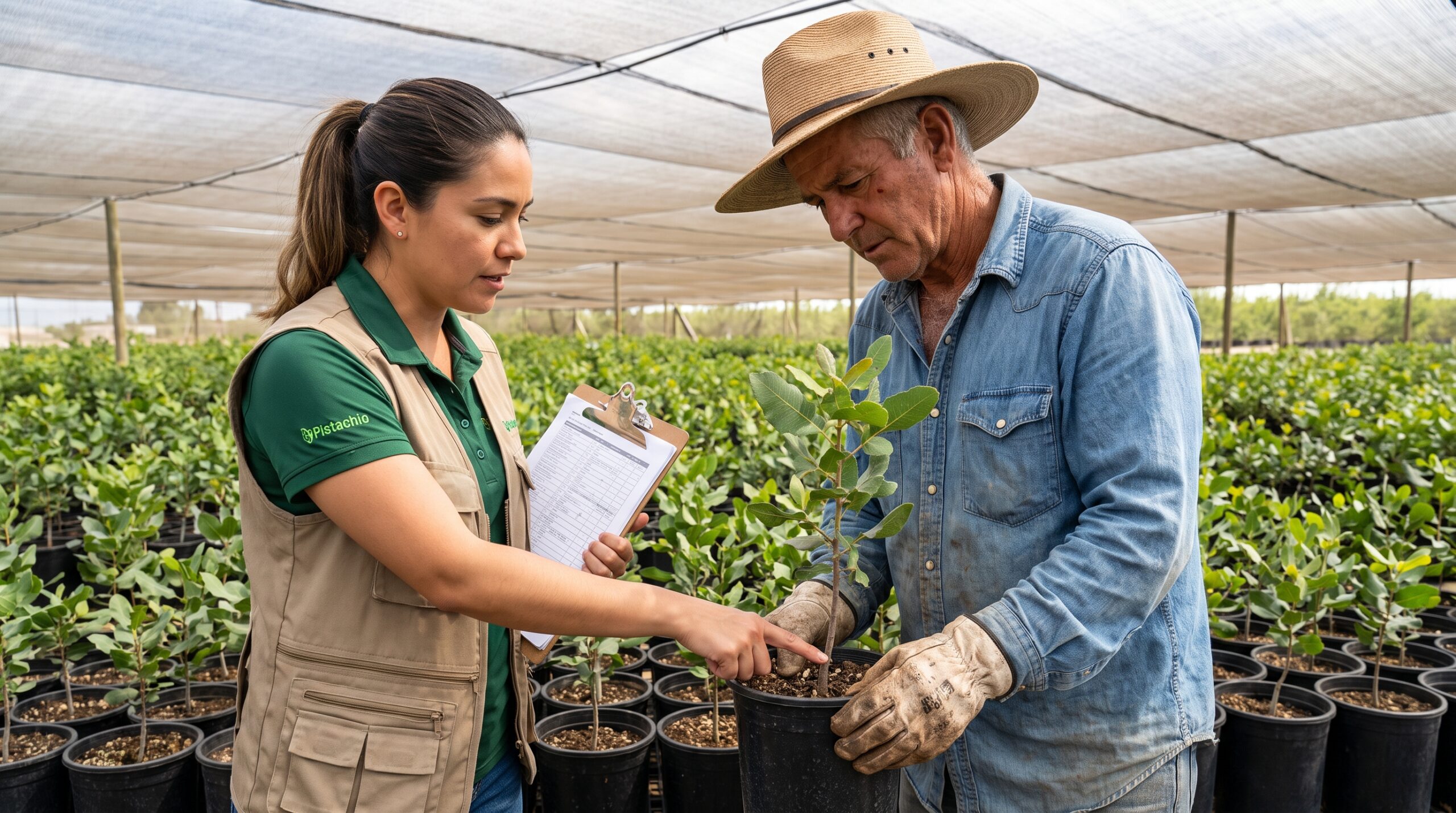
Buying pistachio plants is the decision that most shapes the future of an orchard. A poorly chosen plant does not show its flaws in the first year, or even the second. Problems appear when the tree should start producing and there is no way back: the land is prepared, the irrigation is installed and the investment has been made. 💶
That is why, at Agro Vivero del Mediterráneo, we insist on one idea: before asking for a price, it pays to know what to ask. In our day-to-day work we support both small growers planting a few hectares and large operations planting hundreds. We have seen that growers who ask the nursery the right questions end up with more uniform orchards, fewer replacements and a more orderly start to production.
In this guide we gather the questions we believe should be put to any pistachio nursery before buying, which answers are good signs and which should give you pause. At the end you will find a summary table to take to your meeting or call. 📋
Why the questions matter more than the price per plant 🧠
It is natural to start by comparing prices. But a pistachio plant is not a consumable product that is used and replaced: it is a tree that will stay in the orchard for many years. Differences of a few cents per plant become irrelevant next to the cost of an unsuitable cultivar, a poorly chosen rootstock or a batch with phytosanitary problems.
Consider a 10-hectare orchard. With a spacing of 6 × 5 metres, that means around 3,330 plants. If 8% of them fail or arrive with problems, that is more than 260 trees to replace, each a year or more behind the rest. That difference in growth complicates irrigation, pruning, harvesting and, ultimately, profitability. 📉
If you want a reference on how the whole business case is built, you can read our page on the profitability of a pistachio orchard, which shows why planting material is a key component and not just another cost.
What we need to be clear about before approaching the nursery 🗺️
A good nursery will respond better if you give it information. Before the first conversation, it helps to gather the following site data:
- Location and altitude, to assess winter chill and the risk of spring frost.
- Soil type: texture, depth, pH, active lime and salinity. A prior soil analysis saves surprises. 🧪
- Available water: flow rate, quality and electrical conductivity.
- Surface area and shape of the plot.
- Irrigation system planned or already installed.
- Timeline: when you plan to plant and when the plot will be ready.
- Objective: a family orchard, an expansion of an existing one or a large-scale project.
With this information, the questions that follow become specific, and so do the nursery’s answers. If you are still at the study stage, our team can help you from the very beginning through our advisory services.
Which pistachio cultivars do you recommend for our area, and why? 🌳
This is the first question and the most important one. A serious nursery does not offer a single cultivar for every site. It should justify its proposal according to climate, soil and production goals.
Among the most commonly planted pistachio cultivars are Kerman, with a long track record and well known to the market, and others with earlier budbreak and ripening, such as Sirora or Lost Hills. Selections such as Larnaka, Avdat or Golden Hills are also grown, each with its own characteristics in terms of flowering, ripening and performance in different regions.
What you should ask:
- Why do you recommend this cultivar for my site and not another?
- How many chilling hours does it need, and how many does my area receive? For Kerman, for example, figures of between 800 and 1,000 chilling hours are commonly cited, although these should be confirmed according to the source of the data and the region.
- Are there orchards of this cultivar under conditions similar to mine? Can I visit them?
- What yield and nut size can be expected, and with what ripening calendar?
- Is it advisable to combine cultivars to stagger the harvest?
Be wary if you are promised a cultivar that “suits everything” or if they cannot explain how it fits your climate. If you want to know what we offer, you will find all the information on our pistachio plants page. ✅
Which rootstock are the plants grafted onto, and how does it behave in my soil? 🌿
Pistachio is grown grafted onto a rootstock, and that rootstock determines a large part of the tree’s vigour, soil adaptation and tolerance to certain problems. It is one of the questions least often asked and one of the most influential.
Always ask:
- Which rootstock has been used, and what is the origin of the seed or material?
- How does it respond to calcareous, heavy, shallow or saline soils?
- How does it behave in winter cold and against soil-borne diseases?
- Is it a seedling rootstock or a clonal material? What uniformity does it provide?
The market uses rootstocks from the genus Pistacia, such as Pistacia terebinthus (terebinth), Pistacia atlantica or hybrids such as UCB-1. Each has advantages and limitations, and no single option is best in every case. The key is that the nursery can explain why it recommends one or another for your site, using data rather than generalities. 🔍
How is pollination handled? Which pollinizers are included? 🐝
Pistachio is a dioecious species: there are female trees, which produce the nuts, and male trees, which provide the pollen. Without well-planned pollination, production suffers, however good the female plant may be.
The essential questions are:
- Which pollinizer do you recommend for the female cultivar I am going to plant?
- Does its flowering coincide with that of the main cultivar in my area?
- What male-to-female ratio do you propose? As a guide, it is common to plant one male for every 8 to 12 females, although this depends on the layout and the prevailing wind.
- How are the pollinizers distributed across the plot?
- Do you also supply the male plants, with the same quality and traceability?
A practical tip: ask the nursery for an indicative layout plan showing where the males should go or, at the very least, a clear recommendation. It is much easier to get this right at the design stage than to correct it later. 📐
What is the origin of the plants, and how do you guarantee traceability? 🔗
Traceability is the guarantee that what you buy is what they say it is. In a long-lived crop, buying the wrong cultivar or unidentified material is a mistake that is discovered late and is very costly to correct.
Ask for information on:
- Origin of the plant material: where the buds (scion wood) and rootstock seeds come from.
- Batch identification: is each lot labelled and documented?
- Phytosanitary documentation: plants must be accompanied by the corresponding plant passport or phytosanitary certificate and any other required documentation.
- Certified material: ask whether they have certified plants or which control scheme they come from.
- Possibility of verification: can you visit the nursery and see the process?
A nursery with clear procedures will have no problem answering and showing you its work. If these questions are met with evasiveness, that is a signal worth paying attention to. 🚩
What type of plant exactly are we being sold? 📏
Not all pistachio plants are the same, even if they look it at first glance. Before buying, it helps to be clear about the specific product you will receive:
- Age of the plant and when it was grafted.
- Height and stem diameter, measured above the graft union.
- Graft height and condition of the union.
- Format: container-grown or bare-root, and container volume.
- Type of grafted plants: are they already trained, or are they young plants that will need more time?
- Training status: habit, central leader and branching.
Ask for specifications in writing and, if possible, ask to see a representative sample of the lot. A well-developed plant with a healthy, well-lignified stem establishes better and gets going sooner. The largest plant is not necessarily the best: what matters is plant quality and the balance between shoot and root. 🌱
What is the root system like, and how was it produced in the nursery? 🪴
Roots are the tree’s life insurance. A poor root system can ruin an entire orchard, and it is hard to detect from the outside. Pistachio has a taproot that gives it a great capacity to explore the soil, so nursery handling is particularly delicate.
Ask:
- How was the plant grown, and in what type of container?
- Is there root spiralling or deformation?
- Was the main root respected during production?
- What is the condition of the roots when the plant is removed from the container?
- What recommendations do you give for transplanting and for the first week after planting?
If the nursery allows it, ask to see one or two plants removed from their containers. A good root system, healthy in colour, well distributed and free of coiling, says a lot about the previous work. 🔬
What phytosanitary guarantees do you offer? 🛡️
Pistachio is a hardy crop in many respects, but it is not free of problems. Soil-borne diseases such as Verticillium or Phytophthora, nematodes, wood-rotting fungi or bacteria can arrive with the plant material if no controls are in place.
These are the questions to raise:
- What sanitary control is applied during plant production?
- How are the substrate and irrigation water managed in the nursery?
- Have problems been detected in previous seasons, and how were they resolved?
- What protocols are followed to avoid cross-contamination between batches?
- What happens if a health problem attributable to the material appears after planting?
The aim is not to find a nursery that promises that “nothing ever goes wrong”, but one that clearly explains its prevention system and how it acts. That transparency is the best guarantee. 🧼
When will we receive the plants, and what is the best time to plant? 📅
The plants should arrive on site when the plot is ready, not before. And the planting time directly affects establishment and first-year growth.
Ask about:
- Delivery schedule: specific dates, reservation deadlines and the possibility of staggered deliveries.
- Recommended planting time for your region, taking into account frost, temperature and water availability. If you want to go deeper, you can ask us when to plant pistachios according to your climate.
- Transport: how plants are shipped, under what conditions and who is liable for damage.
- Hardening off: how plants are acclimatised before leaving the nursery.
- Holding on site: what to do if planting is delayed by a few days.
For large projects, it is advisable to book well in advance. Producing grafted plants takes time and cannot be improvised. If you need several thousand plants for a specific date, the ideal is to plan with months to spare. You can start the process through our reservation and quotation form. 🗓️
What spacing and planting density do you propose? 📐
Although planting density depends on the project, a good nursery should guide you and explain the implications of each option for pruning, machinery, irrigation and harvesting.
Some common spacings and their approximate figures:
| Planting spacing | Plants per hectare (approx.) | Comment |
|---|---|---|
| 7 × 6 m | 238 | More space per tree, more convenient for large machinery |
| 7 × 5 m | 286 | Usual balance between space and production |
| 6 × 6 m | 278 | Regular spacing, widely used |
| 6 × 5 m | 333 | Higher density, faster entry into production per unit area |
Ask which spacing they recommend for your cultivar, rootstock and soil, and how it fits your machinery. And do not forget to calculate the quantities to order carefully: in addition to the plants required, it is advisable to set aside a small margin for replacing failures, usually around 3% to 5%, depending on the plot and conditions.
A practical example: for a 3-hectare site with a 6 × 5 metre spacing, we need about 1,000 plants. With a 5% replacement margin, the order would be around 1,050 plants, including both female trees and pollinizers. 🧮
What conditions, lead times and replacement guarantees does the quotation include? 💬
A quotation is not just a price. It is a document that should make clear what you receive, when, and what happens if something does not go as planned.
Check that it states:
- Cultivar, rootstock and characteristics of each batch.
- Number of female plants and pollinizers.
- Price per plant and volume terms.
- Delivery schedule and payment terms.
- Transport and conditions of receipt.
- Warranty and replacement policy for failed plants.
- How claims are handled and within what timeframes.
Ask directly: what happens if a plant fails to establish or arrives with problems? The answer should be clear, in writing and reasonable. A well-defined guarantee protects both parties and shows that the nursery stands behind what it sells. If you prefer, you can contact us and we will resolve all your questions about terms and conditions before you make any decision. 🤝
What technical support do you offer before and after planting? 👩🌾
Many projects fail not because of the plant, but because of a lack of support in the first years. The first year is critical: irrigation, protection, training, weed control and fertilisation all shape the start.
Find out about:
- Do you offer technical advice before planting, in the design of the orchard?
- Is there support during planting and in the first year?
- Can you advise on irrigation, fertilisation and formative pruning?
- Are there farm visits or remote follow-up?
- How do you handle later enquiries?
A nursery that disengages after the sale leaves you alone at the most delicate stage. One that knows pistachio growing from start to finish, on the other hand, will save you costly mistakes. 🧑🔧
What does financial planning include, and how is profitability calculated? 📊
Although a nursery is not a financial consultancy, it should be able to guide you on the economic context of the project: initial investment, establishment costs, years to production and profitability scenarios.
It is worth asking:
- When does a well-managed orchard begin to produce, and when does it reach full production? As a general reference, pistachio takes several years to deliver significant harvests and requires patience at the start.
- What main costs should be anticipated besides the plants?
- Which variables most affect profitability: cultivar, irrigation, market, management?
- Are there simulations or studies we can review?
Bear in mind that no figure is a promise: every site is different. But an experienced nursery will be able to give you indicative ranges and explain what they depend on. You can see how we approach it in our orchard profitability section. 💡
Practical examples: two profiles, two approaches 🔍
Case 1: a small grower with 3 hectares
A grower farming with supplementary irrigation, with a 3-hectare plot of calcareous soil, wants to diversify. The priorities are controlling the investment, avoiding mistakes and receiving technical support. The most important questions are: which rootstock suits the soil, which cultivar fits the available chilling hours, how to solve pollination with few male plants, and what guarantee applies if some trees fail. For this grower, the nursery’s support is as valuable as the plant itself. 🌾
Case 2: a large grower with 100 hectares
An operation planning 100 hectares faces a different scale of concerns: batch uniformity, supply capacity, staggered deliveries, block design by cultivar and documented traceability. It needs schedules fixed well in advance, volume terms and a counterpart who guarantees that the last plant is of the same quality as the first. With around 33,300 plants at stake, a 1% failure rate already means 333 trees to allocate and replace. 🚜
In both cases the questions are the same; what changes is the weight we give to each one.
Common mistakes when buying pistachio plants ⚠️
After speaking with many growers, these are the mistakes that come up most often:
- Deciding on price alone, without comparing quality, rootstock or guarantees.
- Not requesting information in writing and relying on verbal agreements.
- Not analysing soil and water before choosing cultivar and rootstock.
- Neglecting pollination, with too few males or flowering that does not coincide.
- Buying in a hurry, without booking plants far enough in advance.
- Not calculating the replacement margin and falling short in the first season.
- Planting without an irrigation plan and a first-year management plan.
- Not visiting the nursery or reference orchards before deciding.
Avoiding these mistakes does not require great expertise, only asking the right questions at the right time. ✔️
Summary table: key questions and signs of confidence 📋
| Topic | What to ask | Good sign |
|---|---|---|
| Cultivar | Why this cultivar for my site? | They reason based on chilling hours, soil and objective |
| Rootstock | How does it behave in my soil? | They explain advantages and limits with data |
| Pollination | Which males and in what ratio? | Clear placement plan and coinciding flowering |
| Traceability | Where does the material come from? | Identified lots and plant passport |
| Plant type | Height, diameter, format and age? | Specifications in writing |
| Roots | What is the root system like? | They let you see plants removed from the container |
| Plant health | What controls do you apply? | Clear and transparent protocols |
| Timing | When do you deliver and when should we plant? | Specific dates and advice on timing |
| Density | What spacing do you recommend? | They justify it by machinery and cultivar |
| Guarantees | What if a plant fails? | Written replacement policy |
| Support | What support is there after purchase? | Technical support during the first year |
Frequently asked questions about buying pistachio plants ❓
How far in advance should I reserve the plants?
The sooner, the better. Producing grafted plants takes time, and for large projects it is advisable to book many months ahead to secure cultivar, volume and delivery date.
Can I visit the nursery before buying?
You should be able to. Seeing the facilities, the condition of the plants and the working system is one of the best ways to assess a nursery’s quality.
What is the difference between a cheap plant and an expensive one?
Sometimes the difference lies in the rootstock, root development, plant health, traceability or guarantees. Always compare the complete offer, not just the unit price.
How many pollinizers do I need?
It depends on the design and cultivars, but as a guide one male is usually planted for every 8 to 12 females. The best approach is to discuss it with the nursery according to your project.
Is it better to buy container-grown or bare-root plants?
Each format has its advantages and handling requirements. What matters is that the plant is well formed with a healthy root system, and that the planting time suits the chosen format.
What do I do if some plants fail to establish?
It is normal to allow for a small replacement margin. Review the warranty terms in your quotation and apply first-year care rigorously.
Can pistachio be planted with little winter chill?
It depends on the cultivar. Some are more demanding in chilling hours and others adapt better to mild winters. That is why it is essential to ask about specific requirements before choosing.
The next step: taking the questions into the conversation 🚀
Buying pistachio plants is not a routine transaction, but the first step of a long-term investment. If you ask about cultivar, rootstock, pollination, traceability, plant quality, plant health, timing, density, guarantees and support, you will have a very complete picture of who you are dealing with and what you are going to receive.
Remember the essentials:
- Choose the cultivar and rootstock according to your site, not fashion.
- Resolve pollination from the design stage.
- Demand traceability, documentation and guarantees in writing.
- Calculate quantities carefully and book well in advance.
- Look for a nursery that supports you after the sale.
At Agro Vivero del Mediterráneo we have been working with growers of all sizes, and we know that every project is different. If you would like us to review your site together, answer your questions and prepare a tailored proposal, get in touch with us or request your quotation for pistachio plants. You can also learn more about us on our website.
Need a quote?
Tell us about your project and we will send you a proposal with no obligation.
Request a quote