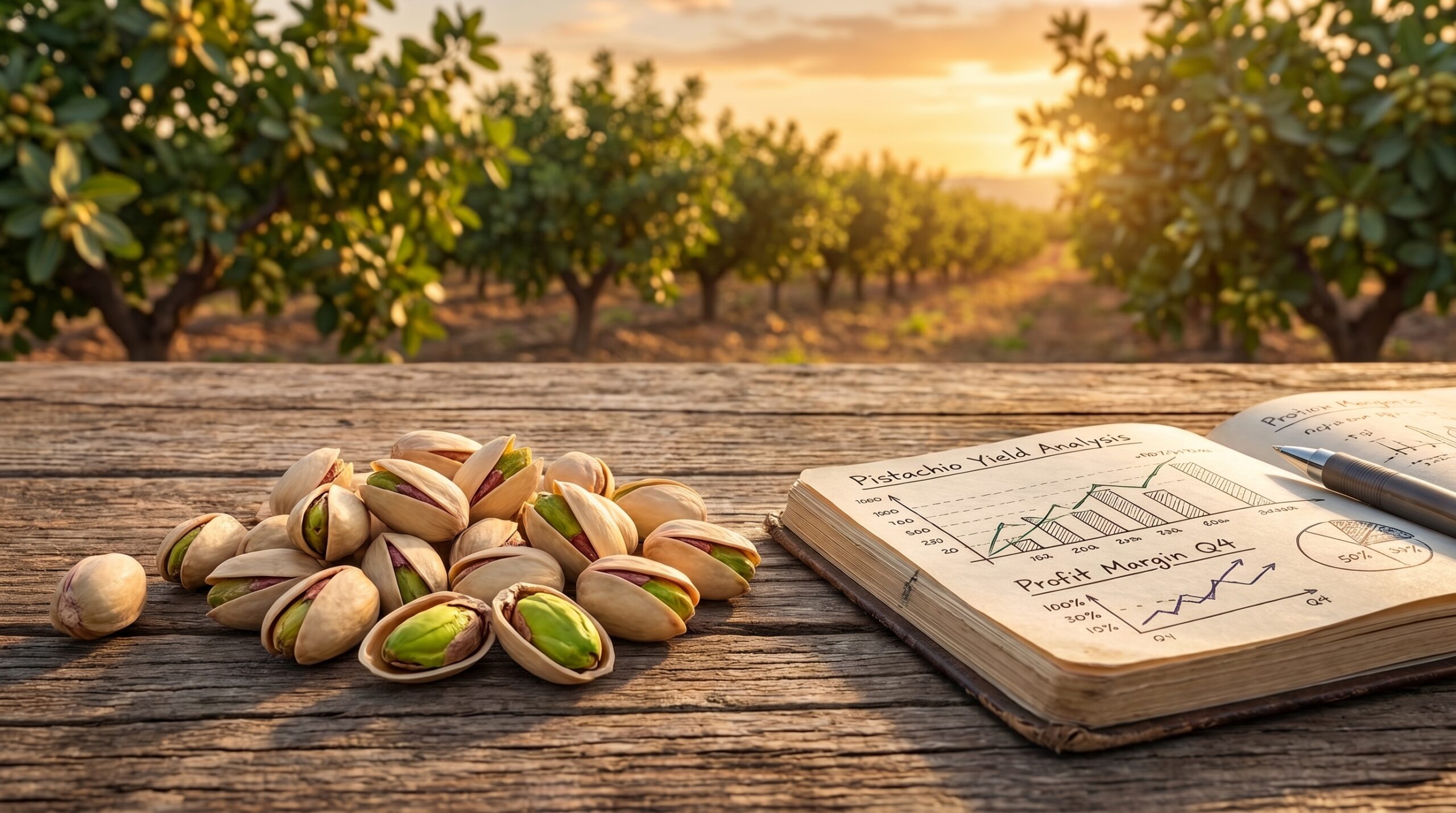
Before planting the first tree, every grower asks the same question: how much money will one hectare generate? 🌱 At Agro Vivero del Mediterráneo, we are asked this every week, both by small landowners who want to convert a few hectares and by large estates looking to diversify. That is why we have prepared this guide with a pistachio profitability calculator per hectare that you can apply to your own farm, step by step and with realistic figures. 📊
This is one of the most interesting agricultural investments today, but also one of the most demanding in terms of patience. It pays to run the numbers rigorously, without miracle promises and with every variable on the table. For a complementary view, you can also visit our page on plantation profitability.
Why You Should Calculate Pistachio Profitability per Hectare Before Planting 🧮
The pistachio is a long-term woody crop. A well-managed plantation can produce for many years, but it takes time to come into production and requires a considerable initial investment. This combination makes it essential to plan with numbers before committing capital.
Calculating pistachio profitability per hectare allows us to:
- know how much money we need to sustain the plantation until it becomes self-financing;
- compare pistachios with other alternatives, such as almonds, olives or cereals;
- decide which planting density, irrigation system and level of mechanisation suit us best;
- detect early on whether a farm, because of its soil, water or climate, is not suited to this crop;
- negotiate with banks, cooperatives or partners using solid data.
A very common mistake is to focus only on the selling price of the nut and forget the years without income, the maintenance costs or the irregularity of harvests. The calculator we propose takes all of this into account. ✅
The Pistachio Profitability Calculator Formula 🔢
You do not need any complex software. A spreadsheet and your farm’s data are enough. The logic is as follows:
Annual net margin = (production per hectare × selling price) − cultivation costs
Return on investment = sum of accumulated net margins − initial investment
The variables we need to know are:
- Initial investment: land preparation, pistachio plants, planting, irrigation and accessories.
- Production per hectare: kilograms of in-shell pistachios we expect to harvest each year.
- Selling price: euros per kilogram we will receive at farm gate.
- Cultivation costs: irrigation, fertilisation, pruning, treatments, harvesting, labour, insurance and management.
- Year production begins: when income actually starts.
These five pieces are enough to build the entire projection. Let us look at how to estimate each one properly. 👇
Step 1: The Initial Investment for a Pistachio Plantation 💶
The cost of planting one hectare of pistachios varies depending on the terrain, density and irrigation system. For an irrigated plantation with drip irrigation, these are indicative figures per hectare:
| Item | Indicative amount |
|---|---|
| Land preparation and soil analysis | €600 |
| Pistachio plants (approx. 285) | €1,800 |
| Planting, holes and labour | €700 |
| Drip irrigation installation | €2,800 |
| Tree shelters, stakes and accessories | €600 |
| Contingencies and other expenses | €500 |
| Approximate total | €7,000 |
These amounts are a reference and may rise or fall depending on each farm. In a non-irrigated (rainfed) plantation, for example, the investment is lower because there is no irrigation system, although the expected production is also lower.
The most important initial investment is not in the table: it is the quality of the plant. A well-grafted plant with a strong root system and guaranteed plant health determines the entire life of the plantation. Discover our pistachio plants and you will see why we insist so much on this point. 🌿
Step 2: Planting Layout and Density 📐
Density determines how many trees fit per hectare and, therefore, how much we invest and how much we can harvest. These are the most common planting layouts:
| Layout | Plants per hectare |
|---|---|
| 7 × 6 m | 238 |
| 7 × 5 m | 285 |
| 6 × 6 m | 277 |
| 6 × 5 m | 333 |
A higher density brings income forward, but requires more careful pruning and may cause competition between trees from a certain age. A lower density makes mechanisation and canopy ventilation easier, at the cost of a somewhat slower start to production.
Moreover, not all plants are the same: the pistachio is a dioecious species, with male and female trees. We need an adequate proportion of pollinators, normally 1 for every 8 to 10 females, and their flowering must coincide with that of the main variety. Combinations such as the Kerman pistachio with the Peter pollinator are well known, but the right choice depends on each climate zone. If you would like us to review your case, write to us through our contact page. 📩
Step 3: Production per Hectare and Year Production Begins 🌳
This is the variable that is hardest to estimate and the one that weighs most on the result. The pistachio does not produce all at once: the plantation gradually gains yield. For a well-managed irrigated plantation, a prudent curve of production per hectare of dried in-shell pistachios would be this:
| Year | Production (kg/ha) |
|---|---|
| 1 to 3 | 0 |
| 4 | 100 |
| 5 | 400 |
| 6 | 800 |
| 7 | 1,300 |
| 8 | 1,800 |
| 9 | 2,200 |
| 10 | 2,600 |
| 11 onwards | 3,000 |
Note that the real year production begins, with income that covers annual expenses, arrives around the fifth or sixth year. Until then, the plantation has to be sustained with our own resources. 🕰️
Alternate Bearing: The Factor We Cannot Forget
The pistachio tends towards alternate bearing: after a very heavy crop, a lighter one usually follows. Good pruning, adjusted irrigation and balanced fertilisation help to soften it, but do not eliminate it entirely. That is why it is wise to work with average yields over several years rather than with the best harvest we have heard of on the neighbouring farm.
Step 4: The Price of In-Shell Pistachios 💰
The pistachio price at farm gate changes from one season to the next. It depends on global production, demand, product quality and the moment at which it is marketed. For a serious projection, we recommend three references:
- Prudent price: €5.50/kg.
- Average price: €6.50/kg.
- Optimistic price: €7.50/kg.
Quality makes the difference: percentage of split nuts, kernel size, colour, moisture and absence of defects directly influence what we are paid. Proper drying and good post-harvest management can improve the price received per kilogram without spending more in the field.
Before fixing the final figures, it is advisable to check current prices with local markets, cooperatives or buyers in your area, because they change quickly.
Step 5: Cultivation Costs of a Pistachio Plantation 🧾
Cultivation costs grow as the trees mature. In a mature irrigated plantation, these are the main items per hectare per year:
| Item | Indicative cost |
|---|---|
| Irrigation (water and energy) | €900 |
| Fertilisation and soil amendments | €600 |
| Pruning and tree management | €450 |
| Plant protection treatments | €400 |
| Harvesting and transport | €700 |
| Labour and maintenance | €450 |
| Insurance, management and miscellaneous | €500 |
| Approximate total | €4,000 |
During the first years expenses are lower, but never zero: between €1,500 and €2,200 per hectare per year, in addition to the initial investment. In large plantations, mechanised harvesting significantly reduces the harvesting cost per kilogram, provided that the planting layout and tree training have been designed with it in mind from the start. 🚜
If you need help organising these items, our services include technical advice to plan the plantation and its management.
Practical Example: The Profitability Calculator Applied to One Irrigated Hectare 📈
Let us put it all together. We start from an average scenario: 285 plants per hectare, irrigated, an initial investment of €7,000, a price of €6.50/kg and the production curve we saw earlier. This is the result year by year:
| Year | Production (kg/ha) | Income | Costs | Annual result | Cumulative (including investment) |
|---|---|---|---|---|---|
| 0 | 0 | €0 | €7,000 | −€7,000 | −€7,000 |
| 1 | 0 | €0 | €1,500 | −€1,500 | −€8,500 |
| 2 | 0 | €0 | €1,800 | −€1,800 | −€10,300 |
| 3 | 0 | €0 | €2,200 | −€2,200 | −€12,500 |
| 4 | 100 | €650 | €2,600 | −€1,950 | −€14,450 |
| 5 | 400 | €2,600 | €3,000 | −€400 | −€14,850 |
| 6 | 800 | €5,200 | €3,300 | €1,900 | −€12,950 |
| 7 | 1,300 | €8,450 | €3,600 | €4,850 | −€8,100 |
| 8 | 1,800 | €11,700 | €3,800 | €7,900 | −€200 |
| 9 | 2,200 | €14,300 | €4,000 | €10,300 | €10,100 |
| 10 | 2,600 | €16,900 | €4,000 | €12,900 | €23,000 |
| 11 | 3,000 | €19,500 | €4,000 | €15,500 | €38,500 |
What this table tells us:
- The greatest financing need occurs between years 4 and 5, with around €14,850 per hectare committed.
- The investment is recovered around year 9.
- From year 11, with the plantation in full production, the net margin is around €15,500 per hectare per year.
- A 10-hectare farm would multiply these figures by ten, which makes planning the financing especially important.
Remember that these figures are indicative. Your actual result will depend on the location, available water, management and the price of each season. 📌
Three Scenarios to Avoid Fooling Ourselves: Prudent, Average and Optimistic 🎯
A good calculator never works with a single result. We always recommend simulating three situations with the plantation in full production:
| Item | Prudent scenario | Average scenario | Optimistic scenario |
|---|---|---|---|
| Production (kg/ha) | 2,000 | 3,000 | 3,800 |
| Price (€/kg) | 5.50 | 6.50 | 7.50 |
| Annual income | €11,000 | €19,500 | €28,500 |
| Annual costs | €3,500 | €4,000 | €4,500 |
| Annual net margin | €7,500 | €15,500 | €24,000 |
The prudent scenario is the one we should look at to know whether the investment is viable even if things go somewhat worse than expected. If the project holds up even in that case, we can move forward with greater peace of mind. The optimistic scenario is possible, but should never be the basis for the decision. ⚖️
Rainfed Plantation versus Irrigated Plantation 💧
One of the most frequent questions is whether it is worth growing pistachios without irrigation. The pistachio is a hardy tree, resistant to drought and poor soils, and for that reason a rainfed plantation makes sense in certain areas. But there are important differences:
- Irrigated plantation: higher production, faster entry into production and more regular harvests, with a higher initial investment and higher water costs.
- Rainfed plantation: lower investment and fewer running costs, although with more modest and more irregular yields, highly dependent on rainfall.
Drip irrigation, even with moderate water allocations, usually greatly improves kernel size, the percentage of split nuts and the regularity of production. In many cases, supplementary irrigation makes the difference between an acceptable plantation and a truly profitable one.
Factors That Most Influence Pistachio Profitability 🔍
Beyond the formula, there are decisions that significantly change the final result:
- Plant quality. A plant with plant health guarantees and a good rootstock avoids losses that are carried over for years. That is why it pays to work with a good pistachio nursery.
- Soil and climate. We need deep, well-drained soils without waterlogging, and an area with sufficiently cold winters and hot summers.
- Pollination. A wrong proportion or choice of pollinators reduces fruit set and, with it, the kilos.
- Irrigation and fertilisation management. Adjusting them to each stage of the crop improves production without driving up costs.
- Formative pruning. It determines when production begins, future mechanisation and canopy health.
- Marketing. Selling through a cooperative, directly to a buyer or under prior agreements changes the final price per kilogram.
- Grants and subsidies. Depending on the country or region, there are grants and subsidies to modernise irrigation or support young farmers. It is worth finding out before investing.
All of these factors can be planned. The sooner we review them, the better the calculator’s result will be. 🤝
Common Mistakes When Calculating Pistachio Profitability ⚠️
In our work with growers, we have seen the same errors repeated. They are worth avoiding:
- Copying production figures from mature plantations without taking the growth years into account.
- Forgetting the costs of the early years, when there is still no income.
- Underestimating the available water: insufficient irrigation reduces yield and quality.
- Not allowing for alternate bearing and projecting the same production every year.
- Setting a price that is too high based on an exceptional season.
- Choosing a plant without guarantees just to save a few euros per unit.
- Not including contingencies or safety margins in the budget.
A prudent calculation is the best defence of our investment. 🛡️
Frequently Asked Questions about Pistachio Profitability per Hectare ❓
How much does it cost to plant one hectare of pistachios?
For an irrigated plantation, a reasonable figure is around €7,000 per hectare, although it varies depending on density, terrain and irrigation system. This is the most common cost of planting one hectare of pistachios in our estimates.
How much does one hectare of pistachios earn?
With the plantation in full production, in an average scenario, we are talking about around €15,500 of annual net margin. In a prudent scenario, around €7,500. This is the answer to the question of how much one hectare of pistachios earns, always with the caveats we have explained.
How many years does it take to make a profit?
In the worked example, the plantation generates a positive annual result from year 6 and recovers the investment around year 9.
Can pistachios be grown without irrigation?
Yes, in suitable areas. It is a valid option with a lower investment, but with lower and more variable yields.
How many plants fit per hectare?
Between 238 and 333, depending on the layout chosen. The most common is 7 × 5 m, with 285 plants.
How can I find out the exact budget for my farm?
The simplest way is to request a pistachio plantation quote tailored to your area. You can do so through our booking and quote form.
The Next Step: Let Us Run the Numbers Together 🚀
We have seen that pistachio profitability per hectare cannot be improvised. It depends on a well-calculated initial investment, a quality plant, a suitable layout, careful management and a healthy dose of patience. With a simple calculator and three realistic scenarios, we can know, before planting, whether the project fits our farm and our goals.
At Agro Vivero del Mediterráneo, we support small and large growers at every stage: from choosing the variety and the plant to launching the plantation. If you would like us to study your case, simply write to us or request your quote. We will run the numbers with you and, above all, keep our feet firmly on the ground. 🌰
Need a quote?
Tell us about your project and we will send you a proposal with no obligation.
Request a quote