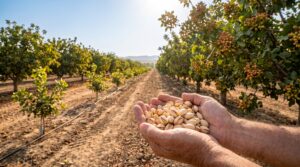
At Agro Vivero del Mediterráneo, we have spent years dedicated to the fascinating world of the pistachio, accumulating experience that allows us to state emphatically that dryland pistachio production is not only viable, but represents an exceptional opportunity for profitable and sustainable agriculture. 🌳💰 In a global context marked by growing concern for the efficient use of water resources and the search for resilient crops, the pistachio tree emerges as a champion.
We understand that the decision to invest in a new agricultural plantation is significant, and therefore, we want to share our vision and knowledge about the profitability of this extraordinary nut when grown in dryland conditions. We firmly believe that the future of agriculture in many regions involves adapting to real water availability, and pistachio is undoubtedly one of the best alternatives.
Pistachio Potential: A Booming Crop with Solid Prospects
Global pistachio consumption has experienced constant and sustained growth over the last decades. This delicious and nutritious nut is no longer just an occasional snack, but a valued ingredient in haute cuisine, confectionery, and the food industry in general. Its nutritional profile, rich in proteins, fiber, vitamins, and antioxidants, positions it as a healthy food demanded by consumers increasingly aware of their diet. 📈
This growing international demand, coupled with a supply that, although expanding, remains limited compared to other nuts, translates into attractive and stable prices for the producer. From our experience at Agro Vivero del Mediterráneo, we have observed how pistachio has consolidated itself as one of the woody crops with the highest profitability per hectare, especially when compared to traditional dryland crops that, on many occasions, offer very tight margins.
The adaptability of the pistachio tree to arid and semi-arid conditions is one of its great assets. Originating from regions with extreme climates, this tree possesses remarkable drought resistance, making it an ideal option for areas where water is a scarce and precious commodity. This characteristic not only reduces dependence on irrigation but also significantly decreases production costs associated with water and energy consumption. 💧☀️
Why Choose Dryland? Advantages and Considerations
Deciding on a dryland pistachio plantation is a bet on sustainability and efficiency. While it is true that yields may be, in absolute terms, lower than those of an intensive irrigated plantation, lower investment and operating costs, along with the growing valuation of sustainable productions, more than compensate for this difference.
Advantages of Dryland Pistachio Cultivation:
-
Lower Initial Investment: The absence of complex irrigation infrastructure (wells, ponds, pumping and distribution systems) significantly reduces the initial outlay. This makes access to this crop more affordable for a larger number of farmers.
-
Reduced Operating Costs: Savings in water and electricity or fuel for pumping are considerable over the life of the plantation. In addition, the lower incidence of certain fungal diseases, favored by humidity, can reduce the need for phytosanitary treatments.
-
Environmental Sustainability: Dryland cultivation aligns perfectly with the principles of environmentally friendly agriculture. It minimizes pressure on aquifers, reduces the water footprint, and promotes rational use of natural resources. At Agro Vivero del Mediterráneo, we actively promote these practices.
-
Nut Quality: Although it may be surprising, on many occasions, pistachios grown in dryland, subjected to certain controlled water stress, can develop even superior organoleptic characteristics, with a more intense and concentrated flavor.
-
Adaptation to Climate Change: The rusticity of the pistachio tree makes it more resilient to climatic variations and periods of prolonged drought, an increasingly important factor in long-term agricultural planning.
Key Considerations for Success in Dryland:
However, the success of a dryland pistachio plantation is not the result of improvisation. It requires careful planning and deep knowledge of crop needs. It is fundamental:
-
Proper Land Selection: Deep, well-drained soils with good moisture retention capacity are needed. Avoid heavy, clayey soils or those with waterlogging problems. Topography also plays a role; gentle slopes with good sun exposure are ideal.
-
Selection of Rootstocks and Varieties: It is crucial to choose vigorous and drought-resistant rootstocks or stocks, such as Pistacia terebinthus (cornicabra) or, preferably, UCB-1, which although initially developed for irrigation, shows excellent adaptability and vigor in well-managed dryland conditions, especially during the first years of establishment where some support irrigation can be crucial. Regarding varieties, Kerman remains the female reference for its quality and size, although others like Larnaka or Sirora are gaining popularity. As pollinators, Peter is the most common for Kerman. At Agro Vivero del Mediterráneo, we offer expert advice to select the plant material best suited to your conditions.
-
Planting Frame: In dryland, wider planting frames (7×7 meters, 8×6 meters, or even larger) tend to be used to reduce competition for water and nutrients between trees. This allows each tree to explore a larger volume of soil.
-
Specific Cultivation Tasks: Practices such as minimum tillage or no-tillage, the use of spontaneous or sown cover crops (properly managed to avoid water competition at critical times), and correct pruning management are essential to conserve soil moisture and optimize tree development.
-
Young Plantation Management: During the first years (2-4), even if it is dryland, it is highly recommended to provide strategic support irrigation, especially during the driest summers. This ensures good rooting and vigorous root system development, key to the plant’s future drought resistance. A tree well established in its early years will be much more productive and resilient in the future.
Profitability Analysis: Breaking Down the Numbers 📊
Talking about profitability implies analyzing both costs and expected income. At Agro Vivero del Mediterráneo, we have carried out numerous studies and accompany our clients in preparing their feasibility plans.
Implementation Costs (Estimate per Hectare in Dryland):
It is important to emphasize that these are indicative costs and can vary significantly depending on the region, farm characteristics, and farmer decisions.
-
-
Soil analysis: 100 € – 300 €
-
Deep subsoiling (if necessary): 300 € – 600 €
-
Tillage and leveling: 200 € – 400 €
-
Basal dressing (according to analysis): 200 € – 500 €
-
Total Preparation: 800 € – 1,800 €
-
-
Plant Acquisition:
-
The price of grafted pistachio plant (see our options at Agro Vivero del Mediterráneo) varies according to format and rootstock. For a 7×6 frame (approximately 238 plants/ha, including males), the cost can range between 8 € and 15 € per plant.
-
Total Plant Acquisition: 1,904 € – 3,570 € (considering 238 plants)
-
-
Planting and Protectors:
-
Others (perimeter fencing if not existing, small initial support irrigations, etc.):
-
Variable: 500 € – 2,000 € (highly dependent on the farm)
-
Estimated Total Implementation Cost per Hectare (Dryland): Between 3,904 € and 8,770 €. If you want a budget more adjusted to your particular case, do not hesitate to use our booking and quote form.
It is crucial to remember that this is a long-term investment. The pistachio tree takes between 5 and 7 years to enter significant production, reaching its full yield between 10 and 15 years. During the first years, expenses will focus on maintenance (training pruning, weed control, preventive phytosanitary treatments if necessary, and possible support irrigations).
Annual Maintenance Costs (Estimate per Hectare in Dryland, Adult Plantation):
-
Weed Control: 150 € – 300 € (mechanical or selective chemical)
-
Phytosanitary Treatments: 100 € – 300 € (lower incidence in dryland, but possible pests like psylla or diseases must be foreseen).
-
Fertilization (if performed, organic or maintenance mineral): 100 € – 250 €
-
Agricultural Insurance: 50 € – 150 €
-
Others (diesel, small repairs): 50 € – 100 €
-
Total Annual Maintenance: 650 € – 1,500 €
Expected Income (Estimate per Hectare in Dryland):
Production in dryland is variable and depends enormously on annual rainfall, soil type, and management.
-
Year 5-7 (Start of production): Modest productions can be expected, between 100 kg and 300 kg of dry and open pistachio per hectare.
-
Year 8-10 (Increasing production): Between 300 kg and 700 kg/ha .
-
Year 10-12 onwards (Full production in well-managed dryland): It is realistic to expect between 600 kg and 1,200 kg/ha . In exceptionally good years and with impeccable management, some dryland plantations can exceed 1,500 kg/ha , but it is more prudent to base calculations on conservative figures. It is important to remember pistachio alternate bearing (harvest alternation), although with good management it can be mitigated.
Pistachio Price:
The price paid to the farmer for conventional pistachio (dry and open) has fluctuated in recent years between 5.00 €/kg and 8.50 €/kg, depending on quality, caliber, variety, and market timing. Organic pistachio usually has an additional premium of 1.50 €/kg to 2.50 €/kg.
Profitability Calculation (Conservative Example in Full Production):
-
Average production in dryland: 800 kg/ha
-
Average price: 6.50 €/kg
-
Annual Gross Income: 800 kg/ha * 6.50 €/kg = 5,200 €/ha
-
Annual Maintenance Costs (average): 1,075 €/ha
-
Annual Gross Profit (before amortization and taxes): 5,200 € – 1,075 € = 4,125 €/ha
If we consider a production of 1,000 kg/ha at a price of 7.00 €/kg:
-
Annual Gross Income: 1,000 kg/ha * 7.00 €/kg = 7,000 €/ha
-
Annual Gross Profit: 7,000 € – 1,075 € = 5,925 €/ha
These numbers demonstrate that, even with conservative estimates for dryland, pistachio profitability is notably higher than that of many traditional crops in these conditions. The initial investment is recovered within a reasonable period once the plantation enters full production, and from there, profits can be very interesting, considering the longevity of the crop (more than 50-60 years). For a more detailed analysis on plantation profitability, you can consult our website.
Sustainability as Added Value 🌍
Beyond direct economic profitability, dryland pistachio cultivation offers intangible benefits that are increasingly valued by society and markets.
-
Efficient Water Use: In a country like Spain, with large areas affected by water stress, betting on crops that minimize water consumption is a strategic and responsible decision.
-
Promotion of Biodiversity: Pistachio plantations, especially if managed with ecological or integrated production criteria, can become reservoirs of biodiversity, hosting auxiliary fauna useful for pest control.
-
Fight against Erosion and Desertification: In marginal or sloping lands, establishing a woody cover like the pistachio tree helps fix the soil, reduce erosion, and combat desertification.
-
Carbon Fixation: As a woody crop, the pistachio tree contributes to capturing atmospheric CO2, helping to mitigate climate change.
-
Rural Development: Pistachio can be a driver of development in rural areas with few agricultural alternatives, generating employment and fixing population.
At Agro Vivero del Mediterráneo, we are committed to an agricultural model that is productive, profitable, and sustainable. Therefore, we not only provide pistachio plant of the highest quality, but we also offer a complete range of technical advisory services to accompany the farmer in all phases of the project, from initial planning to full production, with a special focus on cultivation techniques adapted to dryland.
Challenges and How to Overcome Them
Like any agricultural activity, dryland pistachio cultivation is not without challenges:
-
Climatic Variability: Prolonged droughts or late frosts can affect production. Choosing adapted varieties, resistant rootstocks, and management techniques that conserve soil moisture are key.
-
Pests and Diseases: Although less frequent in dryland, pests such as Pistachio Psylla (Agonoscena pistaciae) or diseases such as Verticillium wilt or Alternaria can appear. Good monitoring and, if necessary, selective and timely treatments are fundamental.
-
Initial Unproductive Period: The first years require investment without income. Good financial planning is vital.
-
Need for Technical Knowledge: Pistachio is a specialized crop. Having expert advice, like the one we offer at Agro Vivero del Mediterráneo, is crucial to avoid costly mistakes.
However, with proper planning, choice of quality plant material, and correct agronomic management, these challenges are perfectly surmountable. Patience and perseverance are important virtues in pistachio cultivation, but long-term rewards are usually very gratifying.
Our Experience at Your Service
At Agro Vivero del Mediterráneo, we are not just plant suppliers; we are farmers and technicians passionate about pistachio. We have seen firsthand the transformative potential of this crop on lands where other options were unfeasible. Our experience allows us to offer:
-
Certified Quality Pistachio Plants: We select the best rootstocks and varieties, guaranteeing healthy, vigorous plant material with high productive potential.
-
Comprehensive Advice: From feasibility study and plantation design to agronomic management, pruning, nutrition, and pest and disease control. Our services are designed to maximize your chances of success.
-
Commitment to Innovation: We are constantly researching and testing new techniques and adaptations to optimize pistachio cultivation, especially in dryland conditions.
-
Long-Term Vision: We understand that a pistachio plantation is a life project. Therefore, we seek to establish long-term relationships of trust and collaboration with our clients.
Dryland pistachio cultivation represents a real opportunity to diversify, to bet on a high value-added crop, and to practice more sustainable and resilient agriculture. It requires dedication, knowledge, and an initial investment, but the fruits, both economic and environmental, can be very significant.
If you are considering entering the world of pistachio, or if you already have a plantation and seek to optimize its management, we invite you to contact us. At Agro Vivero del Mediterráneo, we will be happy to share our experience and help you turn your project into a successful and profitable reality. The future of productive and sustainable dryland undoubtedly tastes like pistachio. 🌿✨
Need a quote?
Tell us about your project and we will send you a proposal with no obligation.
Request a quote