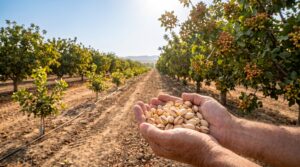
When a grower is considering investing in a pistachio orchard, the question we hear most often is always the same: how much will each tree actually yield, year after year? 🌱 At Agro Vivero del Mediterráneo, we have spent many years supporting growers of all sizes on this journey, and we know that the honest answer is not a single, magic number, but a curve that builds gradually, year by year, until the tree reaches full productive maturity.
In this guide, we want to share a complete picture of real pistachio tree yield by age, from year 1 through year 20, with indicative figures in kilograms per tree and per hectare, for both rain-fed and irrigated orchards. Our goal is that, whether you are considering planting your first pistachio orchard or already have trees in production, you can build a realistic forecast and make informed decisions, without last-minute surprises.
Why Does Tree Age Determine Pistachio Yield? 🌳
The pistachio tree (Pistacia vera) is a long-lived species that grows slowly in its early years. During this initial period, all of the tree’s energy goes into developing a deep root system and a strong woody structure capable of supporting several kilograms of nuts on each branch in the years to come. It is, in a sense, a long-term investment in pistachio production: the foundations are built first, and only later do the harvests arrive.
On top of this, pistachio is a dioecious species, meaning male and female trees are separate. Without adequate pollination, even a healthy, well-trained tree will not produce a harvest. That is why, whenever we talk about yield by age, we are always assuming a well-designed orchard, with the correct ratio of pollinator trees and proper pistachio tree care from the very first year.
The good news is that, once this initial non-bearing period is over, yield follows a fairly predictable upward curve that levels off once the tree reaches full maturity, typically between year 13 and year 15. From that point on, a well-managed pistachio tree can hold this production level for many years, becoming a highly valuable long-term asset for the farm.
Full Table: Pistachio Tree Yield Year by Year (Years 1-20) 📊
To give you a clear overview, we have put together a table showing average yield per tree and per hectare, year by year, for both rain-fed and irrigated orchards. These are indicative figures, based on our own field experience and on technical literature from the sector, calculated using a reference planting density of 238 trees per hectare (a 7×6 metre planting pattern).
| Year | Yield/Tree Rain-fed (kg) | Yield/Tree Irrigated (kg) | Yield/ha Rain-fed (kg/ha) | Yield/ha Irrigated (kg/ha) |
|---|---|---|---|---|
| 1 | 0 | 0 | 0 | 0 |
| 2 | 0 | 0 | 0 | 0 |
| 3 | 0 | 0 | 0 | 0 |
| 4 | 0 | 0 | 0 | 0 |
| 5 | 0 | 0.5 – 1 | 0 | 120 – 240 |
| 6 | 0.3 – 0.8 | 1 – 2 | 70 – 190 | 240 – 480 |
| 7 | 0.8 – 1.5 | 2 – 3.5 | 190 – 360 | 480 – 830 |
| 8 | 1.5 – 2.5 | 3 – 5 | 360 – 600 | 710 – 1,190 |
| 9 | 2 – 3 | 4.5 – 6.5 | 480 – 710 | 1,070 – 1,550 |
| 10 | 2.5 – 3.5 | 5.5 – 8 | 600 – 830 | 1,310 – 1,900 |
| 11 | 3 – 4 | 6.5 – 9 | 710 – 950 | 1,550 – 2,140 |
| 12 | 3.2 – 4.3 | 7.5 – 10 | 760 – 1,020 | 1,790 – 2,380 |
| 13 | 3.5 – 4.5 | 8.5 – 11 | 830 – 1,070 | 2,020 – 2,620 |
| 14 | 3.5 – 5 | 9 – 12 | 830 – 1,190 | 2,140 – 2,860 |
| 15 | 3.5 – 5 | 10 – 13 | 830 – 1,190 | 2,380 – 3,090 |
| 16-20 | 3.5 – 5 | 10.5 – 14.5 | 830 – 1,190 | 2,500 – 3,450 |
Note: these figures represent an average yield, combining an “on” year (heavy crop) and an “off” year (light crop), since pistachio is a naturally alternate-bearing crop. In particularly strong “on” years, and with excellent management, these figures can be exceeded.
As you can see, the curve is not linear: growth is very slow at first, then accelerates markedly between years 8 and 12, and finally levels off into a full-production plateau from year 15 onward. Let’s look at each of these stages in more detail. 👇
Years 1 to 4: The Formative Stage 🌱
During the first four years, no harvest should be expected at all, not even a token one. Yield is simply zero, and that is exactly as it should be. At this stage, all our effort goes into training the tree’s structure through formative pruning, whether in an open-vase or central-leader system, and into ensuring strong establishment through proper irrigation and nutrition.
It is common for growers to become impatient at this stage and wonder if something is wrong. The answer is almost always no: the tree needs this time to build the framework that will, a few years later, carry many kilograms of nuts each season. Rushing into production pruning too early, or pushing the tree too hard, tends to penalise the future productivity of the whole orchard.
Years 5 to 7: Coming Into Bearing 🟢
From year five in irrigated orchards, or year six in rain-fed ones, the first pistachios begin to appear. It is a particularly rewarding moment for any grower: seeing the first tangible results of an investment made years earlier.
In irrigated orchards, yield per tree at this stage usually ranges between 0.5 and 3.5 kg, while in rain-fed orchards the start is somewhat slower, with yields of 0.3 to 1.5 kg per tree around year 6 or 7. At hectare level, this translates into roughly 120 to 830 kg per hectare under irrigation, and 70 to 360 kg per hectare in rain-fed conditions, depending on the exact year within this stage.
It is important not to fixate on these first harvests: they are only the beginning. What matters is that the tree shows it is healthy, well pollinated, and that the production trend is clearly rising year after year.
Years 8 to 12: The Productive Growth Stage 📈
This is, without a doubt, the most exciting stage for any pistachio grower. The tree now has a well-established structure and a root system able to draw on more water and nutrients, so yield jumps significantly from one year to the next.
In irrigated orchards, it is common to see yields of 3 to 10 kg per tree over this period, which in terms of production per hectare means going from just over 700 kg to more than 2,300 kg per hectare in “on” years. In rain-fed orchards, growth is more gradual, moving between 1.5 and 4.3 kg per tree, equivalent to 360 to 1,020 kg per hectare.
This is the stage at which many orchards start to become clearly profitable, and when it is worth reviewing orchard profitability in detail, fine-tuning agronomic management to support this growth without over-stressing the tree.
Full Productive Maturity: From Year 13-15 Onward 🌳
Once a pistachio tree reaches somewhere between 13 and 15 years of age, it enters what we call full bearing or full productive maturity. From this point, yield settles into a plateau that, with correct agronomic management, can be maintained for many years.
In rain-fed orchards, average yield per tree sits between 3.5 and 5 kg, equivalent to 830 to 1,190 kg per hectare. In irrigated orchards, the figures are far more generous: between 10.5 and 14.5 kg per tree, or 2,500 to 3,450 kg per hectare. In particularly good “on” years, with well-managed drip irrigation, it is not unusual to exceed these figures.
It is worth noting that a well-cared-for pistachio tree is an exceptionally long-lived species: some of the world’s oldest producing orchards, still in full bearing, are found in countries such as Iran and the United States. This makes pistachio, when properly planned, an investment that can turn into a productive asset for several generations. 👨🌾👩🌾
Alternate Bearing: Why Yield Rises and Falls Each Year 📉📈
If there is one concept every pistachio grower needs to understand before doing any profitability calculation, it is alternate bearing, sometimes called biennial bearing. Pistachio trees naturally tend to alternate a very heavy harvest, which we call an “on” year, with a lighter one, the “off” year.
This happens for purely physiological reasons: producing a large crop of pistachio kernels consumes a great deal of the tree’s energy and reserves, which makes it harder to form flower buds for the following season. It is, in a way, a natural self-regulating mechanism.
That is why, whenever we quote figures in this article, we are always referring to an average yield, calculated over two consecutive seasons: one on year and one off year. For example, a mature tree that produces 18 kg in its “on” year and 6 kg in its “off” year has a real average yield per tree of 12 kg per year. Careful agronomic management, with balancing pruning and well-adjusted irrigation and nutrition, can soften alternate bearing, although it can never be eliminated entirely, since it is part of the tree’s own nature.
Rain-fed vs. Irrigated: The Factor That Multiplies Yield 💧
If you look back at the table above, you will notice that the gap between rain-fed and irrigated production is enormous, and can amount to close to three times the yield per hectare at full maturity. Although the pistachio tree is well known for its drought tolerance, surviving respectably is one thing, and expressing its full productive potential is quite another.
In rain-fed orchards, we depend entirely on each year’s rainfall, which limits yield and makes it somewhat more irregular. Even so, it remains a perfectly viable option in areas with adequate minimum rainfall, and continues to be a far more profitable crop than other traditional tree crops under the same conditions.
Under irrigation, on the other hand, everything changes. Applying water, especially during kernel fill in the summer months, through a well-designed drip irrigation system with an allowance of around 1,500 to 3,000 cubic metres per hectare per year, allows the tree to express almost all of its genetic potential. The investment in an irrigation system is usually paid back quickly thanks to the substantial increase in production. If you would like to look into the specific investment and return figures, we recommend trying our orchard profitability tool, where you can model your own project.
Other Factors That Determine Your Orchard’s Real Yield
Age and irrigation are, without question, the two most decisive variables, but they are not the only ones. Based on our experience, these are the other factors that make a real difference to the kilograms ultimately harvested:
Rootstock. This is the foundation of the tree, its roots. The UCB-1 rootstock, developed in California, is highly vigorous and favours earlier entry into bearing, although it is more demanding in terms of water. Pistacia terebinthus, widely known for its hardiness, is the most common choice for rain-fed orchards and poorer soils. The right choice depends on soil type, water availability, and the variety to be grafted onto it.
Variety. Not all varieties yield the same amount, or at the same pace. Kerman remains the most widely planted and sought-after variety on the market thanks to its large kernel size, although it does show a marked tendency toward alternate bearing. Larnaka stands out for its good performance under rain-fed conditions and for coming into bearing somewhat earlier. Sirora, of Australian origin, combines early bearing with high yields. The table below summarises their main differences:
| Variety | Entry into Bearing | Alternate-Bearing Tendency | Main Use |
|---|---|---|---|
| Kerman | Medium | High | Snack market, benchmark variety |
| Sirora | Early | Medium | Snack and processing |
| Larnaka | Later | Medium | Processing, high rain-fed yield |
| Aegina | Early | Medium | Processing |
| Mateur | Later | Low | Processing |
You can find all the varieties and rootstocks we offer, in much more detail, in our pistachio plants section.
Pollination. Without suitable pollinator trees, interplanted at the correct ratio (typically 1 male tree for every 8 to 10 female trees), no harvest is possible, no matter how well the trees are cared for. The choice of male variety must always be matched to the female variety, since their flowering periods need to overlap.
Planting pattern. A pattern that is too tight causes trees to compete with one another for light, water and nutrients, reducing individual yield. Wider spacing allows the canopy to develop fully and makes mechanised operations easier.
Agronomic management. Pruning, fertilisation (pistachio trees are particularly demanding in potassium) and pest and disease control make, day by day, the difference between an average orchard and a benchmark one. Having specialised pistachio technical advice from year one is, in our experience, one of the best investments a grower can make. In our services section, you will find all the support you need at every stage of cultivation.
Soil and chilling hours. Pistachio trees prefer deep, loose, well-drained soils; waterlogging is one of their worst enemies, as it encourages root diseases that can affect production for many years. A soil analysis carried out before planting lets us anticipate nutrient deficiencies and correct pH if needed. In addition, each variety needs to accumulate a minimum number of winter chilling hours in order to flower properly; if this requirement is not met, flowering is delayed and uneven, and that season’s harvest suffers noticeably as a result. This is why, before choosing a variety, it is worth studying the climate history of the planting site carefully.
Season-to-season weather. Even once a tree is in full production, one-off factors such as a late frost during flowering, an extreme heatwave during kernel fill, or an unusually wet autumn can cause a given year’s harvest to diverge from the expected average. This is one more reason to always work with realistic yield ranges rather than fixed figures.
How to Estimate the Yield and Profitability of Your Own Orchard 💰
With all this information, you can now make an initial estimate for your own pistachio orchard, but every property is different, and factors such as soil type, local climate, winter chilling hours, or the quality of the planting material can make these figures vary considerably.
That is why, at Agro Vivero del Mediterráneo, we have developed a dedicated orchard profitability tool, where you can enter the specific details of your project (area, location, irrigation type, planting pattern) and get a yield and profitability projection tailored to your own situation, rather than working with generic figures.
Pistachio growing across many of today’s expanding regions, including Spain, where our nursery is based, as well as parts of the wider Mediterranean basin, the Balkans, North Africa and the Middle East, is still relatively young compared with traditional producing countries. This means that much of the newly planted area has not yet reached full productive maturity. In practice, that is good news: it means most of the sector’s growth potential, and your own orchard’s potential, still lies ahead.
Frequently Asked Questions About Pistachio Tree Yield ❓
From what age does a pistachio tree start bearing? A pistachio tree gives its first, token harvest somewhere between year 5 (under irrigation) and year 6 (rain-fed). Yield is not considered commercially significant until around year 8, though, and full maturity is not reached until year 13-15.
How many kilograms of pistachios does a mature tree produce? A mature tree in full production can yield between 3.5 and 5 kg per tree in a rain-fed orchard, and between 10.5 and 14.5 kg per tree under irrigation, as an average taking one “on” year and one “off” year together. In especially good years, with irrigation and good management, these figures can be exceeded by a wide margin.
Why doesn’t my orchard produce the same amount every year? This is entirely normal: it is alternate bearing, a natural feature of pistachio trees, whereby the tree alternates between heavier and lighter crop years. For profitability purposes, what matters is always calculating the average between an on year and an off year.
How long does it take for a pistachio orchard to become profitable? This depends heavily on irrigation type and management, but as a general reference, many well-managed orchards start generating meaningful returns between year 8 and year 12, and reach full profitability from year 13-15 onward, once they enter full production.
Is it better to plant rain-fed or irrigated to maximise yield? If the goal is to maximise production per hectare, irrigation delivers far superior results, potentially producing up to three times the rain-fed yield at full maturity. That said, rain-fed cultivation remains a profitable option in areas with sufficient rainfall and limited water availability.
How many trees are planted per hectare? This depends on the planting pattern chosen, but a common reference, with a 7×6 metre pattern, is around 238 trees per hectare, including both producing and pollinator trees.
What should I do if my tree hasn’t come into bearing on the expected schedule? Before worrying, check three basic points: whether there are enough pollinator trees nearby flowering at the same time, whether the tree has experienced any significant water or nutritional stress in recent years, and whether the chosen variety has a longer-than-average juvenile period. A delay of one or two years compared with the average is not a cause for concern; if the gap is larger, we recommend arranging a technical visit to review your specific orchard.
Common Mistakes That Reduce Orchard Yield ⚠️
Over the years, we have seen a set of mistakes crop up again and again, mistakes that almost always have a bigger impact on the final kilograms than tree age itself. It is worth reviewing them before accepting any yield projection at face value:
- Miscalculating the number of pollinator trees. Planting too few male trees, or positioning them poorly across the plot, is one of the most common reasons for yield falling well below expectations, even in healthy, mature trees.
- Forcing production in the early years. Leaving too heavy a crop load on young trees, instead of prioritising structural training, tends to penalise yield in following seasons.
- Neglecting irrigation at critical times. Water stress during fruit set or kernel fill, even if brief, can sharply reduce that year’s harvest, even in well-designed irrigated orchards.
- Not adjusting fertilisation to each stage. A young tree needs a different fertilisation plan from one in full production; applying the same programme year after year, without review, limits productive potential.
- Overlooking plant health. Pests such as psyllid or diseases such as Verticillium wilt can quietly erode yield over several seasons before the problem becomes visible to the naked eye.
Avoiding these mistakes, more than any single other factor, is usually what separates an average pistachio orchard from a truly profitable one.
Our Advice
If there is one thing we have learned throughout our years working with pistachio, it is that patience and realistic information are a grower’s best tools. Pistachio yield by age follows a well-known and fairly predictable curve: a few formative years with no harvest, a gradual entry into bearing between years 5 and 7, very notable growth between years 8 and 12, and a generous, long-lasting full productive maturity from year 13-15 onward.
Knowing these figures in detail lets you plan your investment more effectively, set realistic expectations and, above all, avoid the overly optimistic projections that sometimes circulate within the sector and that only lead to disappointment. Every property has its own particularities, which is why, at Agro Vivero del Mediterráneo, we offer both the highest-quality planting material and full technical support, tailored to your land, your climate and your goals.
If you are thinking about starting a new pistachio orchard, or expanding one you already have, we invite you to get in touch with us or to request a no-obligation quote directly. We will be delighted to review your project and support you every step of the way, from choosing the right variety through to your first big harvest. 🌳💚
Need a quote?
Tell us about your project and we will send you a proposal with no obligation.
Request a quote