
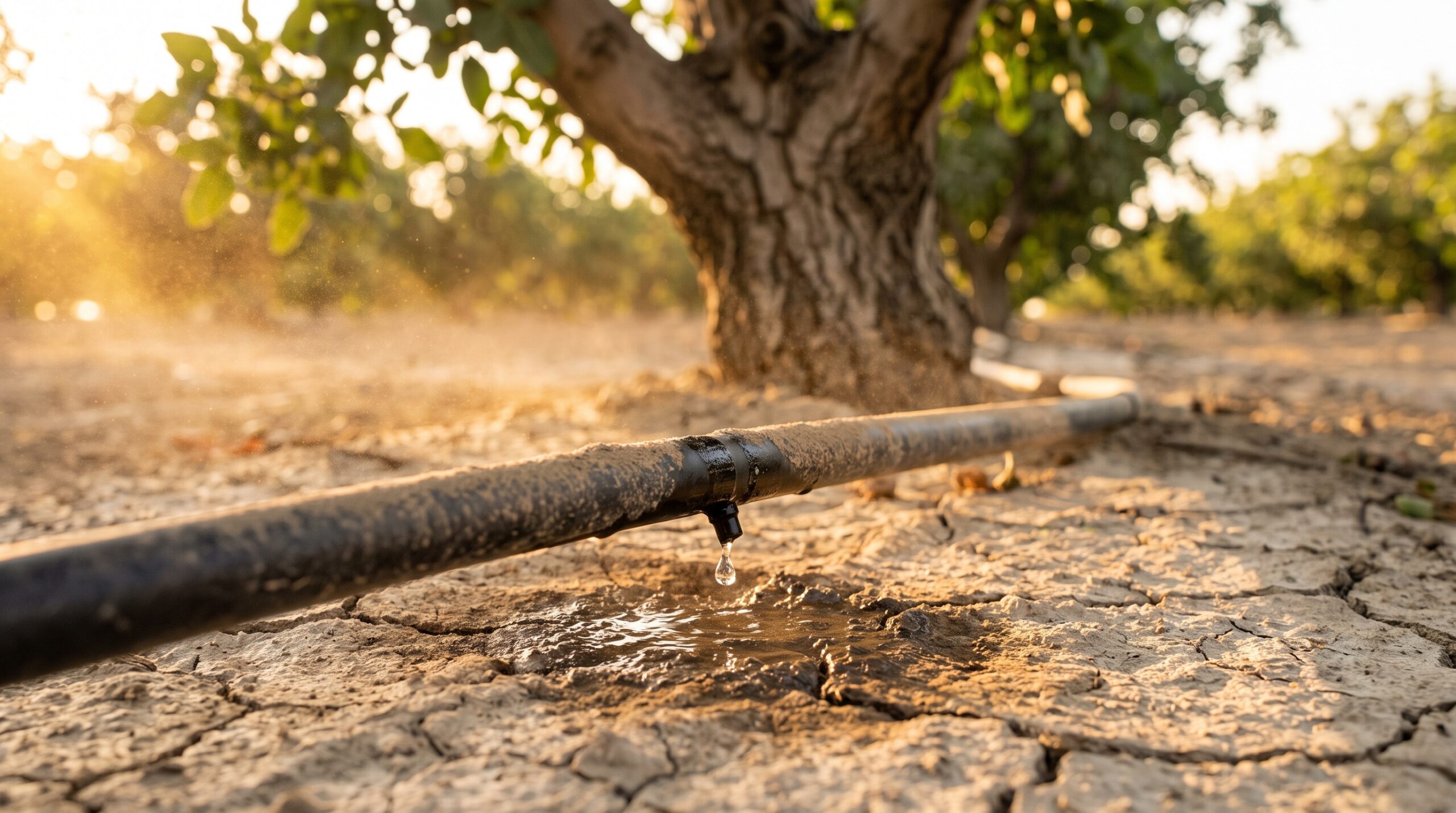
Deficit irrigation in pistachio is one of the most effective tools we have today to produce nuts with less water. 💧 It is not about irrigating by eye or leaving trees without water: it is a technical strategy that cuts irrigation during the stages when the pistachio tree tolerates it best and keeps it at full rate when the crop is being determined.
At Agro Vivero del Mediterráneo we support small and large growers in the design and management of their orchards. This is one of the questions we are asked most often when the irrigation allocation falls short or the cost of pumping the well soars: how much water can be saved without losing yield?
As a rule of thumb, well-planned deficit irrigation can save between 20% and 40% of the water applied over the season. Some trials have gone further, but at a cost in quality. Below we explain where the real margin lies, which crop stages allow it and how to translate it into money. 📊
💧 What Is Regulated Deficit Irrigation and Why It Works in Pistachio Trees
Regulated deficit irrigation (RDI) consists of applying less water than the tree could use through evapotranspiration, but only during the stages of the cycle in which this deficit has little effect on the crop. At all other times, the pistachio tree receives 100% of its needs. It is water management based on agronomic criteria, not a linear reduction.
It should not be confused with sustained deficit irrigation, which reduces a fixed percentage throughout the whole season. Pistachio specialists consider both proportional reductions across the year and regulated deficit irrigation at different stages of nut development. We favour the latter in most cases for a simple reason: it is the one that best protects the crop.
Why does it work? Because the pistachio tree is exceptionally hardy. Research shows that it can be profitable even under rainfed conditions and that it responds well to small water inputs, although its water requirements are high when we aim for high yields. In fact, according to a study by the Technical University of Madrid, around 69% of the pistachio area in Spain is grown under rainfed conditions.
That dual nature, tolerating drought well yet yielding more when irrigated, is what opens the door to water savings in pistachio. There are moments in the cycle when water pays off a lot and others when it pays off very little. Deficit irrigation simply means not wasting the water that pays off little. 🌱
🌧️ Rainfed, Supplemental and Deficit Irrigation: They Are Not the Same Thing
Three concepts are often mixed up and are worth keeping apart. Rainfed pistachio depends only on rainfall and receives no additional water. Supplemental irrigation adds a few rescue irrigations, normally at the most critical moments. Regulated deficit irrigation, by contrast, starts from a complete irrigation plan and deliberately cuts it, stage by stage.
Between the two there is a wide range of possibilities. An orchard with a small water allocation can start with supplemental irrigation and move towards finer deficit management as it secures more water or better data. An orchard with abundant water can cut the part that pays off least and use that volume on other plots. In both cases, drought in pistachio stops being a surprise and becomes a scenario for which we have a plan. 🌦️
📏 How Much Water Does a Mature Pistachio Orchard Need
To know how much we can save, we first need to know how much is being used. In a mature pistachio orchard in full production, pistachio water requirements typically range, as a guide, between 3,500 and 6,000 m³ per hectare per year of irrigation, depending on climate, soil, effective rainfall and planting layout.
As a real-world reference, in one trial whose control treatment was irrigated following the FAO methodology, 596 mm were applied in one year and 505 mm the next. That is equivalent to between 5,050 and 5,960 m³ per hectare.
The calculation starts from reference evapotranspiration (ETo) and the crop coefficient (Kc), which changes throughout the season and with the age of the orchard. It is the basis of the pistachio irrigation schedule and of any deficit strategy: without a well-calculated full-irrigation baseline, we do not know how much we are cutting.
These are the factors that most affect the irrigation allocation of a farm:
- 🌡️ Climate and evapotranspiration of the area.
- 🌳 Age and canopy size.
- 📐 Planting layout and tree density.
- 🪨 Soil type and water-holding capacity.
- 🧂 Water quality and salinity.
- 🌰 Crop load of the year.
🗓️ The Nut Development Stages: When to Cut Irrigation and When Not To
This is the key to everything. Pistachio development is divided into three stages, and tolerance to water stress in pistachio is very different in each one:
| Stage | What happens in the tree | Can we cut? |
|---|---|---|
| Stage I: bloom and shell expansion | The nut reaches its maximum size | No. Full irrigation |
| Stage II: shell hardening | The shell hardens and the kernel grows little | Yes. This is the main window |
| Stage III: kernel filling and shell split | The kernel gains weight and the shell splits open | No. Full irrigation |
| Post-harvest | The tree replenishes its reserves | Yes, with caution |
Research by the University of California indicates that irrigation can be cut by 50% during shell hardening and by 70% to 75% after harvest, whereas deficits should be avoided from bloom until the end of shell expansion and from kernel filling until shell split.
In our growing areas, Stage II falls, as a guide, between mid-May and the end of June or early July, but every season and every region is different. In addition, recent work suggests that Stage II does not coincide exactly with visible shell hardening, and that defining it properly allows yield to be maintained with greater savings. That is why we insist on measuring the tree rather than relying on the calendar alone. 🔍
A word of caution on post-harvest. The pistachio tree loses part of its flower buds in the year before harvest, and that proportion rises under water stress. This means that alternate bearing and irrigation are linked: what we decide this year conditions flowering next year. After a heavy-crop year, we recommend cutting with greater caution.
📊 How Much Can Be Saved with Deficit Irrigation: What the Trials Show
This is what the studies we have reviewed show:
| Trial | Strategy | Water savings | Result |
|---|---|---|---|
| University of California (Goldhamer and Beede) | Cut during Stage II and post-harvest | About 10 inches per season (≈ 250 mm, around 2,500 m³/ha) | No significant yield losses |
| Tunisia, Pistacia atlantica rootstock | Deficit in Stages I and II | 20% | Yield and composition similar to the control |
| Technical University of Madrid, Kerman variety (T1, T2 and T3) | RDI in Stage II based on stem water potential | 37%, 47% and 67% | Quality affected, especially in the most severe treatment |
Let us take them one by one. Multi-year trials in California put the water that can be saved over the season at about 10 inches through strategic irrigation. On a 32.3 ha commercial farm, the deficit programme reduced applied water by 147 mm during the cutback period, that is, around 1,470 m³ per hectare. That study also asked to what extent the water we stop applying translates into lower actual consumption by the tree, which is another reason to measure.
In the Mediterranean, a trial using Pistacia atlantica rootstock saved 20% of irrigation water in Stages I and II while maintaining yield and nut composition similar to the control.
And in the Kerman variety, savings of 37%, 47% and 67% compared with the control were achieved. The restrictions affected crop quality, and the most severe treatment showed fewer split nuts and more blank nuts. The research itself concludes that, given the usual irrigation allocations, RDI is a viable solution for sustainable production.
Our practical reading of these data is as follows:
- ✅ Between 20% and 30%: a prudent strategy, with cuts in Stage II and some post-harvest. This is the starting point we recommend.
- ⚖️ Between 35% and 45%: requires measuring stem water potential and accepting some risk to quality.
- 🚫 Above 50%: compromises shell split and increases blank nuts. We do not advise it except in an emergency.
🧮 Worked Example: How Much We Save in a 50-Hectare Orchard
Let us look at a case with numbers. We start with a 50-hectare orchard that uses 4,000 m³ per hectare per year under full irrigation. Since the cost of water varies widely between farms, we compare two scenarios: $0.12/m³ (irrigation district or water users’ association with low energy costs) and $0.30/m³ (deep well with electric pumping).
| Water saving | m³ saved per hectare | m³ saved on 50 ha | Annual saving at $0.12/m³ | Annual saving at $0.30/m³ |
|---|---|---|---|---|
| 20% | 800 | 40,000 | $4,800 | $12,000 |
| 30% | 1,200 | 60,000 | $7,200 | $18,000 |
| 40% | 1,600 | 80,000 | $9,600 | $24,000 |
With cheap water, the direct saving may look modest: $144 per hectare with a 30% cut. But two effects change the picture. 👇
- Expanding the area with the same allocation. With 200,000 m³ a year we can irrigate 50 hectares at 4,000 m³ per hectare. With a 30% saving, each hectare uses 2,800 m³ and that same allocation stretches to around 71 hectares.
- Withstanding restrictions. When drought cuts the irrigation allocation, a grower who already works with regulated deficit irrigation starts with an advantage, because they know how their trees respond.
And a warning: the goal is never to save at any cost. If by cutting too much we lose 100 kg of pistachios per hectare and sell them at $6/kg (illustrative assumption), that is $600 per hectare, far more than the water saving in the scenario above. That is why what matters is protecting yield. On our page on the profitability of a pistachio orchard we analyse how the cost of water fits into the overall profit-and-loss picture. 💵
🧑🌾 What If We Only Have a Few Hectares: The Small Grower’s Case
Deficit irrigation is also good news for those working with small areas. Let us imagine a 5-hectare farm with the same consumption of 4,000 m³ per hectare. A 30% saving means 6,000 m³ a year: $720 with water at $0.12/m³ and $1,800 with water at $0.30/m³.
The investment required is affordable. A soil moisture probe and occasional use of a pressure chamber are enough to get started, and many growers share the equipment with neighbours or with their cooperative. If the well is your own or you have to pay an irrigation water cost per cubic metre, every well-executed cut shows up in the accounts at the end of the year.
For anyone considering a profitable pistachio orchard from scratch, the message is clear: water management should be built into the business plan from the start, rather than improvised when the first drought arrives.
⚖️ How Deficit Irrigation Affects Yield and Pistachio Quality
Water deficit leaves its mark on the nut, for better and for worse, and it is worth knowing both sides.
What can go wrong. Although the pistachio tree withstands drought, sufficient stress can cause a high percentage of blank nuts, poor shell split and lower yield. These are the two defects that most devalue a pistachio lot.
What can go right. A study by Miguel Hernández University with mild and moderate deficit irrigation produced heavier pistachios, with more polyphenols and greater intensity of the characteristic sensory descriptors, although with fewer commercial-grade pistachios. For its part, in the Tunisian trial the deficit improved volatile compound content and oil yield.
In other words, a well-dosed deficit can produce a nut with more flavour and character. A poorly dosed deficit produces a poorer nut and fewer kilos. The difference lies in the dose, the stage and the monitoring. 🎯
🛠️ How to Apply Deficit Irrigation in Pistachio Step by Step
This is how we approach it when we advise a farm:
- Calculate full irrigation. Using the ETo of the area, the Kc of each month and the shaded ground area, we set the 100% baseline.
- Check soil and water status. We measure moisture at different depths and review irrigation water salinity, because a deficit with saline water concentrates salts in the wetted bulb.
- Identify Stage II. We do not rely on the date alone: we observe nut development and tree behaviour.
- Measure stem water potential. It is measured at midday with a pressure chamber. Values more negative than -14 bar point to stress that reduces growth and yield, and research places the tolerance threshold under deficit irrigation between -15 and -18 bar depending on the stage. In more commonly used units, that is -1.4 MPa and between -1.5 and -1.8 MPa.
- Cut gradually. We reduce the supply little by little, monitoring stem water potential, rather than cutting abruptly. One trial kept stem water potential at around -1.5 MPa during Stage II.
- Restore full irrigation at the end of the stage. The tree should return to its full water supply as soon as possible in Stage III.
- Evaluate the harvest. We record the percentage of split nuts, blank nuts, weight and size, and adjust the strategy for the following season.
Irrigation sensors help a great deal. Combining RDI with plant biosensors is a line of research that improves its efficiency. A well-installed moisture probe and a pressure chamber are a small investment compared with what is at stake. 📡
Drip irrigation in pistachio is the technical foundation of all this. With uniform emitters and well-designed sectors, we can cut exactly what we want, where we want. With uneven irrigation, the deficit is not spread equally and some trees suffer more than others.
🗓️ Indicative Calendar for a Deficit Irrigation Season
To see it all together, we summarise a typical season in a Mediterranean climate. The dates are approximate and must be adjusted to each farm and each year:
| Approximate period | Crop stage | Irrigation strategy |
|---|---|---|
| March and April | Budbreak and bloom | Irrigate according to effective rainfall and soil reserve, without stress |
| April to mid-May | Rapid nut growth | Full irrigation |
| Mid-May to early July | Stage II | Controlled deficit, monitoring stem water potential |
| July and August | Kernel filling and shell split | Full irrigation |
| September and October | Harvest and post-harvest | Reduced post-harvest irrigation, with caution |
Note that full irrigation covers most of the calendar. The cut is concentrated in short windows, and that is where the saving is made. Post-harvest irrigation is maintained but reduced, so that the tree replenishes its reserves without using more water than necessary.
💦 How to Measure Whether Deficit Irrigation Is Working
The best indicator is not the volume we have saved, but water use efficiency, that is, the kilos of pistachios we obtain per cubic metre applied. An illustrative example: an orchard producing 2,000 kg/ha with 4,000 m³/ha achieves 0.5 kg per m³. If it maintains those 2,000 kg with 2,800 m³/ha, it rises to 0.71 kg per m³, which is 43% higher efficiency.
To evaluate each season, we recommend recording, as a minimum:
- 📈 Kilos per hectare and the following year’s yield, to detect effects on alternate bearing.
- 🔓 Percentage of split nuts and blank nuts.
- ⚖️ Weight and size, which determine pistachio quality and price.
- 💧 Volume of water applied per sector and per stage.
- 🌿 Stem water potential on key dates.
After two or three seasons, these data tell us exactly how far we can cut on our own farm.
⚠️ Common Mistakes We See in Orchards
On our farm visits we repeat the same warnings again and again:
- Cutting at the wrong stage. Removing water during kernel filling is the fastest way to generate blank nuts.
- Applying the deficit without measuring. Without a pressure chamber or probes, you are working blind.
- Forgetting the heavy-crop year. A large crop depletes reserves and makes the tree more sensitive to stress.
- Maintaining the cut for too long. The deficit is a window, not a permanent state.
- Not evaluating the results. If we do not record shell split, blank nuts and size, we learn nothing from the season.
- Applying a fixed percentage to the whole farm. Soils, sectors and tree ages are not all the same.
🚫 When We Do Not Recommend Deficit Irrigation
There are situations in which we prefer to irrigate at 100%:
- Young orchards. During the first years the aim is to build the structure of the tree, and there water matters more than savings.
- High-salinity water. Less water means a higher concentration of salts in the root zone.
- Very light, shallow soils. They have little reserve and stress arrives very quickly.
- Trees that are already weakened by disease, root asphyxia or excessive crop load.
- Extreme droughts with minimal irrigation. Here we are not talking about regulated deficit irrigation, but about managing an emergency with other measures.
🌳 The Role of Variety, Rootstock and Orchard Design
Deficit irrigation does not begin the day we open the valve: it begins the day we choose what to plant and how. The variety, the pistachio rootstock and the planting layout influence how much stress the farm can tolerate. The Technical University of Madrid trials studied precisely the influence of the rootstock on the variety under water stress conditions.
That is why, when we prepare a new orchard, we think about water from day one: we choose rootstocks suited to the soil and to salinity, we design the irrigation sectors with future deficit management in mind and we plan the density according to the real water allocation. You can see how we work on the page for our pistachio plants.
And if you already have an orchard up and running, we can help you review irrigation, measure the water status of the trees and define a stage-based strategy through our technical advisory services for pistachio growers. 🤝
❓ Frequently Asked Questions About Deficit Irrigation in Pistachio
How much can be saved with deficit irrigation in pistachio?
With a prudent strategy, between 20% and 30% of annual water. With more demanding strategies, savings of 37% and 47% have been achieved, although with a greater risk to quality.
Is yield lost when applying regulated deficit irrigation?
If the cut is made at the right stage and the water status of the trees is monitored, trials indicate that yield is maintained. If the cut is excessive or comes at the wrong moment, blank nuts increase and shell split decreases.
Is deficit irrigation suitable for young orchards?
We do not recommend it in the first years. It is a technique designed for mature trees in production.
Does it also reduce electricity costs?
Yes, because we pump less water. The energy saving is proportional to the volume we no longer lift and pressurise.
Can it be applied with saline water?
With great caution. A water deficit concentrates salts, so irrigation water salinity must be monitored and leaching maintained when necessary.
✅ Final Thoughts
Deficit irrigation in pistachio is not a fad; it is a proven technique that can save between 20% and 40% of irrigation water if applied at the right stages. Cuts are concentrated in shell hardening and, with caution, in post-harvest. They are avoided during bloom and kernel filling. It is monitored with a pressure chamber and probes, and adjusted every season.
Three ideas are worth remembering. First: saving water only makes sense if we protect yield and quality. Second: the strategy starts with the design of the orchard, not at the valve. Third: every farm has its own water cost, its own soil and its own variety, and therefore the saving must be calculated case by case.
At Agro Vivero del Mediterráneo we would be delighted to help you design your orchard or optimise your existing one. You can contact our team to resolve your questions or ask us directly for a quote through the booking and quotation form. 🌱
Need a quote?
Tell us about your project and we will send you a proposal with no obligation.
Request a quote



