Choosing the right pistachio varieties is the decision that weighs most on the future of an orchard in southeastern Turkey. Gaziantep, Kilis, Şanlıurfa, Mardin and Siirt share a long pistachio-growing tradition, but they do not share the same climate, altitude or soil type. A variety that performs superbly in a warm valley may suffer bloom frosts just a few kilometres away, on a higher slope. Another with high chilling requirements may fall short in an area with mild winters. 🌿
At Agro Vivero del Mediterráneo we work every day with growers who want to establish a pistachio orchard or expand an existing one, from small producers with a few hectares to large estates. That is why we know the right question is not “which is the best variety?” but “which is the best variety for this specific plot?”
In this guide we review, province by province, the technical criteria we apply to pistachio growing in Turkey and in any climate with cold winters and dry summers. 📋
Why does the variety weigh so heavily on the orchard’s results? 🎯
A pistachio tree is a long-term investment. It takes five to seven years to yield its first commercial crops, around ten to twelve to reach full production, and it can then keep producing for a very long time. This means that a mistake in choosing the variety cannot be fixed with good fertilization or a timely treatment: it carries through the entire life of the orchard.
The variety determines, among other things:
- ❄️ The chilling hours it needs to break dormancy and flower normally.
- 🌸 The flowering date and, with it, the frost risk.
- 🗓️ The ripening date and the harvest calendar.
- 🥜 Nut size, shell splitting and nut quality.
- 🔄 The tendency toward alternate bearing, that is, alternating good and poor crops.
- 🐛 The susceptibility to certain pests and diseases.
- 🐝 The male pollinizer it must be paired with.
All of this directly affects orchard profitability. A good variety in the wrong location produces mediocre results, and the reverse is also true. The key is that both fit together. ✅
Climate, altitude and soil: what each province is like 🗺️
Before talking about varieties, it helps to understand the setting. The five provinces share long, dry and very hot summers, but winter cold and frost risk vary considerably from one to the next. This table summarizes their profile with indicative values:
| Province | Approximate altitude | Climate profile | Main challenge |
|---|---|---|---|
| Gaziantep | 700–900 m | Continental, cold winters and dry summers | Late frosts at higher elevations |
| Kilis | 500–700 m | Mediterranean transition, milder winters | Heat and water stress |
| Şanlıurfa | 400–800 m | Semi-arid, very hot summers | Marginal chilling and limited water |
| Mardin | 800–1,000 m | Continental, strong temperature contrasts | Frosts and stony soils |
| Siirt | 700–1,000 m | Cold winters and higher rainfall | Spring frosts and sloping terrain |
And this is what we see in each area:
📍 Gaziantep. It is the historical heart of Turkish pistachio production. Its winters provide enough cold for demanding varieties, and its sloping calcareous soils suit the pistachio tree very well. In the higher areas, budbreak timing must be monitored because of frost risk.
📍 Kilis. With milder winters and very hot summers, accumulated chilling can be limited. Here we prioritize varieties with moderate chilling requirements and pay particular attention to irrigation design.
📍 Şanlıurfa. Heat and water scarcity are the main constraints. In the lower areas chilling can be marginal, and the real availability of water determines the planting layout.
📍 Mardin. Varied terrain, often stony and sloping, with large differences between day and night temperatures. At higher elevations, late-flowering varieties and hardy rootstocks are of interest.
📍 Siirt. A mountain area with cold winters, more rainfall and a pistachio identity of its own. Chilling is rarely the problem; spring frosts are.
These values are indicative, because within a single province the microclimate changes from one valley to the next. That is why we recommend measuring the plot’s chilling hours and recording the dates of the last frosts over several years before deciding. 🌡️
Traditional pistachio varieties of southeastern Turkey 🥜
For generations, growers in the region have selected and propagated the varieties best suited to their land. Among the best known are Kırmızı, Uzun, Siirt, Halebi and Ohadi, the latter of Iranian origin but widespread in the area. This is how we summarize them in general terms:
| Variety | Typical traits | Approximate fit |
|---|---|---|
| Kırmızı | Early ripening and good adaptation to traditional orchards | Gaziantep and early-harvest areas |
| Uzun | Elongated pistachio of good size; may show alternate bearing | Gaziantep and plots with sufficient winter chilling |
| Siirt | Large nut size, good yield and good shell splitting | Siirt, Mardin and inland areas |
| Halebi | Early ripening and smaller nut size | Warm areas such as Kilis |
| Ohadi | Productive and early-cycle | Warm, low-lying areas such as Şanlıurfa |
Local varieties have clear advantages 👍:
- They have been adapted to the region’s climate and soil for generations.
- The local market knows and values them.
- There is a great deal of management experience among neighbouring producers.
And they also have some limitations ⚠️:
- Many older orchards are heterogeneous, with trees of uneven performance.
- Some varieties show very marked alternate bearing.
- Not all of them adapt equally well to the intensive, mechanized systems of modern orchards.
These traits are general and vary with management, rootstock and area. That is why they should be checked against trials from local research centres, such as the Gaziantep Pistachio Research Institute, and against the actual results of producers in the district.
International varieties: does it make sense to introduce them? 🌍
The leading international varieties, such as Kerman, Sirora, Larnaka, Lost Hills and Golden Hills, underpin a large share of modern orchards worldwide. We know them well because we work in central and southern Spain, with cold winters, dry summers and calcareous soils, a setting very similar to much of southeastern Turkey. ☀️
- Kerman: the world benchmark for nut size, quality and shell splitting. It is demanding in terms of chilling, so it suits cold plots in Gaziantep, Mardin or Siirt better than low-lying areas of Kilis or Şanlıurfa. Its classic partner is the Peters male.
- Lost Hills and Golden Hills: they tend to flower and ripen earlier than Kerman and adapt better to somewhat milder winters, although their earlier flowering calls for close frost monitoring.
- Sirora and Larnaka: interesting options for mild-winter climates and earlier cycles, provided irrigation water is available.
Introducing a new variety is no minor matter. Each country’s phytosanitary and variety registration regulations must be met, and it must be ensured that the pistachio plants arrive in full health and with full traceability. Our recommendation is always to start with a pilot plot before planting on a large scale. 🧪
Chilling hours and flowering: the criterion that avoids the most mistakes ❄️
The pistachio tree needs a period of winter cold to wake up normally. We measure it in chilling hours, that is, the hours with temperatures below 7.2 °C during dormancy.
If the variety does not receive the chilling it needs, well-known problems appear:
- Late and irregular budbreak.
- Staggered flowering that does not coincide with that of the male.
- Poorer fruit set and lower yields.
At the opposite extreme are varieties that wake up too early. They suffer bloom frosts, which can ruin an entire crop in a single night. 🥶
To avoid both problems, we always follow these steps:
- Record the plot’s chilling hours over several years, using an on-site or nearby weather station.
- Compare that data with the requirements of each variety.
- Review the dates of the last spring frosts.
- Analyse the topography: in valley bottoms cold air accumulates and frosts are more intense.
Two plots just a few kilometres apart may require different varieties. This is one of the reasons why our technical advice and services always start in the field, not in the catalogue. 📍
The pollinizer: half of the equation 🐝
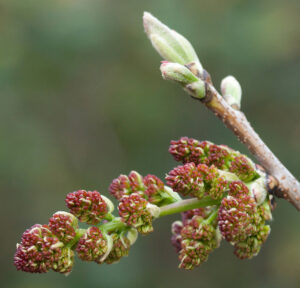
The pistachio is a dioecious species: there are male and female trees, and only the females produce pistachios. Pollen travels on the wind, so without suitable males there is no crop, however good the female variety.
We take three factors into account:
- Flowering overlap. The male must flower at the same time as the female. With Kerman, for instance, Peters is used, and in traditional orchards local males with a similar cycle are used.
- Ratio and distribution. As a rough guide, one male for every eight to ten females, positioned so that the prevailing wind carries pollen across the whole plot.
- Pollen quantity and quality. We choose vigorous males with abundant pollen.
When the female varieties have different cycles, we usually combine more than one pollinizer to cover the whole flowering window. A good male pollinizer is one of the cheapest and most profitable investments in the whole orchard. 🌬️
Rootstocks: the roots count too 🌱
The variety is grafted onto a rootstock, which determines vigour, soil adaptation and resistance to certain diseases. In the region, seed-grown Pistacia vera, Pistacia atlantica and Pistacia terebinthus have traditionally been used. In more modern orchards, hybrids such as UCB-1 are also used.
- Pistacia atlantica: hardy, adapted to calcareous, dry and cold soils.
- Pistacia terebinthus: highly cold-resistant, although slower-growing.
- UCB-1: vigorous and with good tolerance to Verticillium, although somewhat less tolerant of intense cold.
We choose the rootstock according to the soil, irrigation, cold and health status of the plot. A poorly chosen rootstock can cancel out the benefits of a good variety. 🔧
Rainfed or irrigated, and planting spacing 💧
Much of the region’s traditional orchards are rainfed, with wide planting spacings of around 8 x 8 or 10 x 10 metres, that is, roughly 100 to 150 trees per hectare. Under irrigation, the planting spacing is tighter, and typically between 250 and 330 trees per hectare are planted, with more regular yields and faster entry into production.
Our criterion is simple:
- With reliable water available, we opt for productive, high-quality varieties such as Kerman, and for more intensive spacings.
- With limited water or no irrigation, we choose hardy varieties, drought-adapted rootstocks and wider spacings.
Before deciding on the spacing, it is worth calculating how much water we will actually have in dry years, not in good ones. 🚰
Ripening calendar: spreading the harvest is also part of choosing well 🗓️
The pistachio harvest is concentrated between late summer and early autumn, and it is a race against the clock: freshly harvested pistachios must be hulled and dried quickly to avoid staining and loss of quality. If all the varieties ripen in the same week, the harvest gets bottlenecked: labour, trailers and processing capacity run short.
That is why we like to combine earlier- and later-ripening varieties within the same estate. This spreads the workload, makes better use of machinery and reduces the risk that a storm or heat spike affects the entire production at once. That said, it is best not to overdo it: two or three female varieties are usually enough. 🚜
Nut quality: what the market and the industry value 💶
The variety directly influences the price obtained. Buyers value:
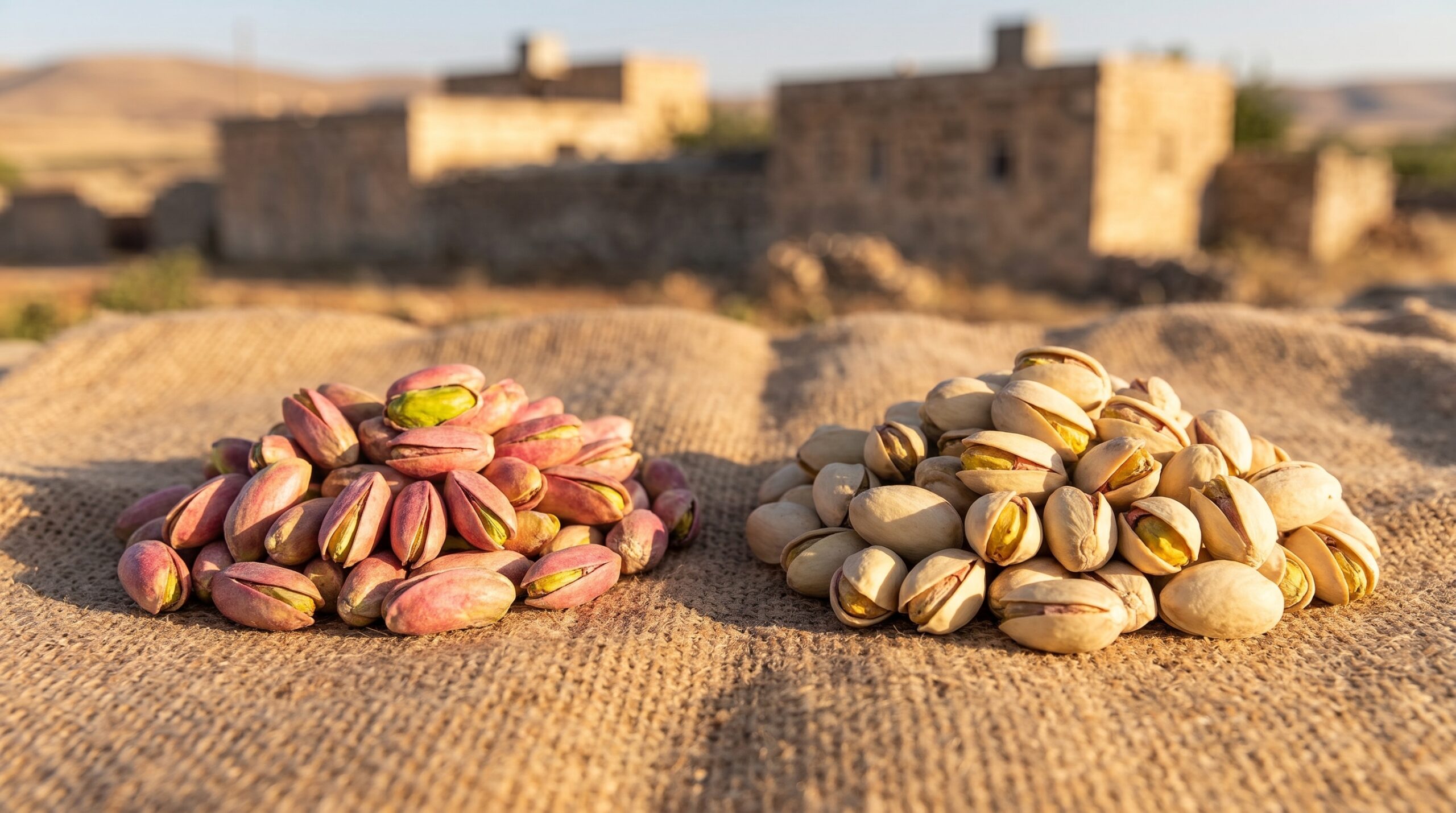
- 📏 Large, uniform nut size.
- 🔓 A high percentage of split shells.
- 🟢 Deep green kernels with a pronounced flavour.
- ✨ Few empty shells and no staining.
In provinces such as Gaziantep and Siirt, pistachios also enjoy a recognition of origin that is highly valued by the industry and consumers. Choosing varieties that perform well in the area and following proper management and drying practices is the best way to take advantage of that prestige.
Small or large grower: how the choice changes 👨🌾
We do not decide in the same way for a two-hectare family plot as for an estate of hundreds of hectares.
Small growers. With small areas and largely manual harvesting, we prioritize reliable varieties, staggered ripening that lets work proceed without rushing, and quality plants, because every tree counts. It is often a good idea to rely on well-known local varieties and set aside a small share to trial an international variety.
Large growers. With large areas and mechanization, we look for uniformity, ripening concentrated by block, precision irrigation and spacings designed around the machinery. Here it makes a lot of sense to diversify by sector: each block with its own variety, rootstock and pollinizer.
In both cases the rule is the same: decide with data from the plot, not by intuition. 📊
Varieties and climate change: thinking about the coming years 🌦️
A pistachio orchard is planted today but will live in the climate of twenty or thirty years from now. So, in addition to looking at historical data, it is worth paying attention to trends: slightly milder winters with fewer chilling hours, earlier flowering, increasingly unpredictable late frosts and drier summers.
What does this imply for variety choice?
- Avoid betting everything on a variety with high chilling requirements in areas that are already marginal.
- Diversify between early- and late-flowering varieties to spread the frost risk.
- Prioritize hardy rootstocks that are well adapted to drought.
- Design the irrigation system with sufficient margin.
Thinking about the future does not mean giving up traditional varieties, but combining them with sound judgement. 🌱
Which varieties we recommend for each province 🧭
With all of the above, this is our general guidance. We stress that there is no single recipe: each plot requires its own study.
Pistachios in Gaziantep 🌳
- Traditional base with Kırmızı and Uzun.
- Kerman in plots with sufficient chilling and good frost protection.
- At higher elevations, late-flowering varieties and monitoring of cold-air drainage.
Pistachios in Kilis ☀️
- Halebi and Ohadi as the traditional base.
- Larnaka and Sirora as options to trial in a pilot plot.
- Well-designed irrigation and control of heat stress.
Pistachios in Şanlıurfa 💧
- Ohadi and Halebi in warm areas.
- Lost Hills or Golden Hills in irrigated plots, watching for occasional frosts.
- Avoid Kerman at low elevations with little accumulated chilling.
Pistachios in Mardin ⛰️
- Siirt and Uzun at mid elevations.
- Kerman where chilling is guaranteed and there is no risk of late frost.
- Late-flowering males and hardy rootstocks.
Pistachios in Siirt 🏔️
- The Siirt variety as the base.
- Kerman in plots sheltered from frost.
- Special attention to flowering date and slope orientation.
These guidelines are a starting point, not a substitute for studying the plot. If you would like to assess it with a technical team, you can contact our team and we will review your case. 🤝
Alternate bearing and plant health: two factors that also depend on the variety 🐛
Alternate bearing affects almost all pistachio trees, but not to the same degree. Proper pruning, irrigation and fertilization management softens it, and the choice of variety also has an influence.
In terms of plant health, we mainly monitor:
- Verticillium and Phytophthora, soil-borne fungi that make it necessary to choose the rootstock carefully and take care of drainage.
- Pistachio psylla (Agonoscena pistaciae), which weakens shoots.
- Pistachio seed wasp (Eurytoma plotnikovi), which attacks the developing pistachio.
- Foliar and panicle diseases, favoured by spring humidity.
A certified, healthy plant is the first step in prevention. 🛡️
Common mistakes when choosing pistachio varieties ⚠️
When someone comes to choose pistachio varieties, these are the mistakes we see most often:
- Deciding by trend or by plant price, without analysing the plot.
- Ignoring chilling hours and the dates of frosts.
- Planting without thinking about the pollinizer and flowering overlap.
- Not analysing the soil or the quality of the irrigation water.
- Copying the neighbour’s orchard without taking into account that their microclimate may be very different.
- Mixing too many varieties, which complicates the harvest because of uneven ripening.
- Buying plants without guarantees of health status and origin.
Avoiding them costs little at the start and saves a lot of money later. 💰
How to decide, step by step ✅
- Analyse the soil and water of the plot.
- Measure the chilling hours and review the frost history.
- Define whether you will plant rainfed or irrigated, and with what spacing.
- Select two or three female varieties with staggered ripening.
- Choose the male pollinizers according to flowering.
- Select the most suitable rootstock.
- Start with a pilot plot if you are introducing a new variety.
- Calculate the investment and timelines with a realistic financial plan.
Frequently asked questions about pistachio varieties ❓
Which pistachio variety is best for Gaziantep? There is no single answer. Traditional varieties such as Kırmızı and Uzun perform well, and Kerman can fit in plots with sufficient chilling and no risk of late frost.
Can Kerman be planted in Kilis or Şanlıurfa? In low-lying, warm areas it is risky, as it may not receive the chilling it needs. We recommend doing so, at most, in a pilot plot and after measuring chilling hours.
How many varieties should be planted? Few. Two or three female varieties with staggered ripening, plus the necessary males, are usually enough to spread the harvest without complicating management.
Which rootstock should be used? It depends on the soil, the cold and the health status of the plot. Pistacia atlantica and Pistacia terebinthus are hardy options, and UCB-1 offers vigour and tolerance to Verticillium.
Is irrigation essential? Production is possible under rainfed conditions, but irrigation evens out yields and improves nut size and quality.
When does a pistachio orchard start producing? The first commercial crops appear between five and seven years, and full production is reached a few years later.
The next step 🤝
Choosing pistachio varieties for Gaziantep, Kilis, Şanlıurfa, Mardin and Siirt means examining the plot closely: chilling hours, frost risk, water, soil, rootstock and pollinizers. Traditional varieties bring adaptation and local experience, international varieties bring nut size and productivity, and the ideal combination depends on each area. 🌱
The essentials to remember:
- The variety must fit the chilling and frost risk of the plot.
- The male pollinizer is as important as the female variety.
- A pilot plot reduces risk when introducing new varieties.
- A healthy, certified plant is the foundation of a long-lasting orchard.
At Agro Vivero del Mediterráneo we will be glad to help you design your orchard, whether you are starting from scratch or want to expand the one you already have. You can request your quote and we will advise you on varieties, rootstocks and pollinizers for your plot. 🥜
Need a quote?
Tell us about your project and we will send you a proposal with no obligation.
Request a quote