
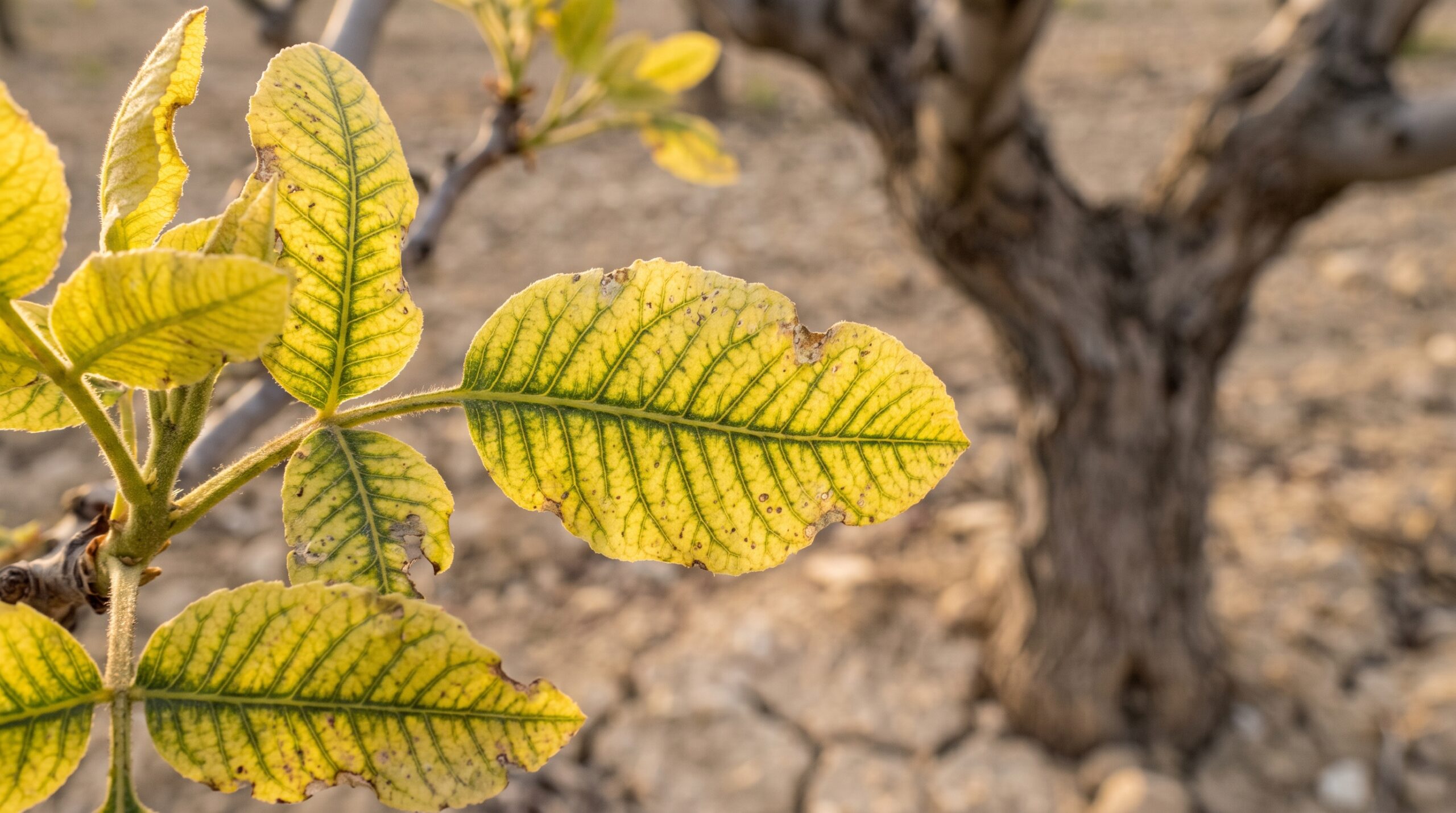
It is late spring and you are walking through your orchard. The new shoots have lost their deep green: the young leaves show a pale yellow, with the veins still green, and growth seems to have stalled. In most cases, behind that picture lies iron deficiency in pistachio, a problem we see often at Agro Vivero del Mediterráneo when we visit both rainfed and irrigated orchards.
The good news is that iron chlorosis in pistachio can be corrected and, above all, prevented. The bad news is that, if ignored, it saps tree vigour, reduces yield and puts the return on your investment at risk. In this guide we explain why it appears, how to confirm it, which solutions really work and how to design an orchard so that it does not become a constant headache. 🌳
🌿 What Is Iron Deficiency in Pistachio and Why Does It Occur
One important point needs clarifying: the soil almost always does contain iron, and plenty of it. What fails is that the tree cannot absorb or make use of it. That is why we speak of iron chlorosis and not simply of a lack of iron in the soil.
Iron is involved in chlorophyll formation and in numerous reactions of the plant’s metabolism. Without it, the leaf does not produce enough green pigment and loses photosynthetic capacity. The result is fewer sugars, less growth, fewer reserves for next year’s flowering and, ultimately, fewer nuts on the tree. 🥜
Pistachio is a hardy species that tolerates calcareous and alkaline soils reasonably well, better than many other trees. But tolerating is not the same as being immune. When several factors coincide (high active lime, irrigation water with bicarbonates, excess moisture, cold and compacted soils), iron deficiency appears even in well-managed orchards.
It is especially damaging in the early years of the tree’s life, when it needs to grow strongly to come into production as soon as possible. Moreover, if the underlying cause remains, chlorosis will return every spring.
🔍 Symptoms of Iron Deficiency: How to Recognize Yellow Leaves in Pistachio
Iron moves very little within the plant. That is why the first symptoms appear on the young leaves of the current season’s shoots, while older leaves stay green for longer. It is the most reliable clue for telling this deficiency apart from others.
This is how it usually develops:
- Initial stage: young leaves lighten between the veins, which remain green and form a fine network. 🟢
- Moderate stage: yellowing becomes general, the leaf blade turns almost whitish, and the size of leaves and shoots decreases.
- Severe stage: scorching appears on margins and tips, followed by premature leaf drop and dieback of twigs in the most affected areas.
It is also worth looking at how it is distributed across the orchard. If the affected trees form patches, or coincide with low-lying areas, heavier soil or spots where water accumulates, we are almost certainly dealing with a soil and management problem, not a problem with the tree itself. And if the condition worsens after heavy rain or copious irrigation in spring, root asphyxia is usually the main cause.
A practical note: mild chlorosis after a cold, wet spring may fade on its own when temperatures rise. Even so, it has left its mark on vigour, and it is worth finding out why it happened.
🧪 Causes of Iron Chlorosis in a Pistachio Orchard
There is rarely a single cause. These are the factors we most often find in the field:
- High active lime. This is the finest and most reactive fraction of calcium carbonate in the soil. The more there is, the more iron remains locked in forms the root cannot use.
- High soil pH. With values above 7.5-8, iron loses solubility and is less available.
- Bicarbonates in irrigation water. Water with 250-300 mg/L of bicarbonates or more buffers the pH around the root and aggravates the problem season after season. It is a widely underestimated cause.
- Excess water and lack of oxygen. Asphyxiated roots do not absorb iron well, even when there is plenty in the soil. It is the main trigger of chlorosis.
- Compacted, cold soils. They slow root development and root activity, especially in wet springs.
- Nutritional imbalances. Excess phosphorus or metals such as manganese, zinc or copper compete with iron for uptake.
- Damaged roots. Soil-borne fungi, nematodes, injuries from field operations or poor drainage reduce the tree’s absorption capacity.
- Rootstock poorly suited to the terrain. This decision is made before planting and shapes many years of the orchard’s life.
When several of these factors add up, the effect is multiplied. That is why a good diagnosis always starts with one question: what has changed in the orchard? More irrigation, heavy rain, a different fertilizer programme? 🤔
📋 How to Confirm the Diagnosis Before Applying Anything
Yellowing does not always mean iron deficiency. Before spending money, it is worth ruling out other deficiencies:
| Deficiency | Leaves where it appears | Typical appearance |
|---|---|---|
| Iron | Young | Yellow between green veins, fine network |
| Manganese | Young and mid-age | Mottled chlorosis, with less pronounced green veins |
| Zinc | Young | Small, narrow leaves, rosetted shoots |
| Magnesium | Old | Yellowing between veins starting from the leaf margin |
| Nitrogen | Old | Uniform yellowing across the whole leaf |
To confirm it, we recommend relying on data:
- Soil analysis: pH, total and active lime, organic matter, texture and electrical conductivity.
- Irrigation water analysis: pH, bicarbonates and conductivity.
- Leaf analysis: sampling in mid-summer on leaves from the current season’s shoots. Be careful, because total leaf iron can be misleading: a chlorotic leaf may hold iron trapped in inactive forms. It must be interpreted with technical judgement.
- SPAD meter: it estimates chlorophyll content quickly and without damaging the leaf. It is very useful for comparing healthy and affected trees, and for monitoring the progress of a treatment.
A practical tip: mark the affected trees on a map. That map almost always tells a story about the soil, the drainage or the position of the emitters. 🗺️
🌱 How to Prevent Iron Chlorosis from the Orchard Design Stage
The most cost-effective approach is to avoid the problem before planting. Three decisions make the difference:
1. Study the soil and choose the site well. We recommend digging soil pits to check depth, texture, the presence of compacted layers and drainage, in addition to carrying out a soil analysis. A deep, well-drained soil is worth more than any later correction.
2. Prepare the land. Subsoiling to break up plough pans, levelling to avoid waterlogged areas and, where needed, a drainage design will save a great deal of trouble in the following years.
3. Choose the right rootstock. Pistachio rootstocks, of the genus Pistacia, behave differently with regard to calcareous soils, salinity, cold and soil-borne diseases. That choice shapes the tree’s performance throughout its life, which is why we advise each grower according to the soil, water and climate of their land. If you are evaluating your project, we invite you to learn about our pistachio plants. ✅
A quality plant, with a healthy and well-formed root system, withstands the stress of the early years better, which is precisely when chlorosis does the most damage. And a good initial choice translates into much lower spending on corrective products over the whole life of the orchard.
💧 Pistachio Irrigation: The Best Ally and, Sometimes, the Origin of Chlorosis
Counterintuitive as it may seem, many cases of chlorosis are due to too much water, not too little. Pistachio withstands drought well, but not wet feet. Prolonged waterlogging, even if it lasts only a few days in spring, is enough to leave the roots without oxygen and trigger chlorosis.
These are our recommendations:
- Adjust pistachio irrigation to the tree’s real needs at each stage. Frequent, heavy irrigation on heavy soils is a recipe for trouble.
- Distribute the emitters so as not to saturate the same area every time.
- Avoid heavy irrigation in spring, when the soil is cold and the roots are barely active.
- Analyse the water. If it carries high levels of bicarbonates, consider acidification of the water with authorized acids, always with professional advice and pH monitoring so as not to damage the system or the roots.
- Keep drains in good condition and check infiltration after heavy rain. 🌧️
🧴 How to Correct Iron Deficiency with Iron Chelates
When the problem is already established, the most common and effective solution in calcareous soils is iron chelates: molecules that keep iron protected and available to the root. But not all of them suit all soils, and this is where a lot of money is lost.
| Chelate | Approximate stability | Recommended use |
|---|---|---|
| Fe-EDTA | Up to pH 6.0-6.5 | Acidic or neutral soils; of little use in calcareous soils |
| Fe-DTPA | Up to pH 7.0-7.5 | Neutral or slightly alkaline soils |
| Fe-EDDHA | Up to pH 9 | Calcareous and alkaline soils; the reference option |
In calcareous soils, Fe-EDDHA is the most reliable. One detail makes the difference: it is not enough for the product to have EDDHA in its name. What guarantees its effectiveness is the percentage of iron chelated by the ortho-ortho isomer, which must appear on the label. A cheap product with little ortho-ortho iron can be a wasted expense.
How to apply it:
- Fertigation or localized application in the wetted bulb, close to the active roots.
- Indicative doses with a product containing around 6% iron: between 10 and 30 g per tree in young orchards and between 50 and 150 g per tree per year in mature trees. These are general references; the exact dose depends on the product, the severity of the symptoms and the soil, and should be validated with a technician.
- Split the applications: several small applications are better than a single large one, starting at the beginning of bud break.
- Check compatibility before mixing with other fertilizers.
And an honest warning: the chelate corrects the symptom, but does not eliminate the cause. If there is waterlogging or water with a high bicarbonate content, the problem will return every year.
🍃 Foliar Treatments: When They Work and When They Do Not
Foliar fertilization with iron (iron sulfate or foliar chelates) gives a quick response, which makes it tempting. But it has clear limits: as iron hardly moves within the plant, only the parts that are wetted turn green again, and any new leaves that sprout afterwards will again come out chlorotic. It is a supporting solution, not a fundamental one.
- Apply during the cool hours of the day, avoiding heat and intense sun so as not to scorch the leaves.
- Always follow the dose on the label and test first on a few trees.
- Repeat if necessary, at intervals of 10 to 15 days, while the shoots are growing.
- Combine it with soil correction, never replace it. 🍃
🌾 Improving the Soil So the Roots Work Better
In the long term, the best treatment is a soil with good structure. Pistachio nutrition does not depend only on what we apply, but on what the root is able to absorb:
- Organic matter: well-matured compost improves structure, aeration and biological activity, and favours the availability of micronutrients.
- Cover crops in the alleys: they improve infiltration and reduce compaction, provided they are managed so that they do not compete for water in summer.
- Balanced fertilization: pistachio fertilization should be based on analyses, avoiding excess phosphorus. Ammoniacal forms and acid-reacting fertilizers help to slightly acidify the root zone.
- Careful tillage: do not run heavy machinery over wet soil. 🚜
📅 Indicative Calendar for Managing Chlorosis
| Time | What we do |
|---|---|
| Winter | Soil and water analysis, drainage checks and organic matter application |
| Start of bud break | First chelate application in orchards with a history of chlorosis; shoot monitoring |
| Spring | Split applications of Fe-EDDHA and irrigation control after rain |
| Mid-summer | Leaf analysis and SPAD readings; evaluation of results |
| Autumn | Season review and planning of improvements |
Dates vary by region and by year, so they should be adapted to the climate of each orchard. 🗓️
👨🌾 Small Grower or Large Operation: How We Adapt the Strategy
If you have a small plot, it is usual to have a single soil type and a single water source. Diagnosis is simple, trees can be monitored one by one and doses can be adjusted almost tree by tree. Here the priority is not to overspend: a good analysis and a suitable chelate avoid useless treatments.
In large orchards there are usually several soil types, different irrigation sectors and a great deal of area to monitor. What works best is to zone the orchard: divide it into homogeneous units according to soil, pH and tree behaviour, and define a fertigation programme for each sector. Measuring with SPAD and keeping year-by-year records shows which sectors are improving and which need structural action, such as drainage or changes to irrigation.
In both cases we offer support tailored to each project. You can see how we work on our services page. 🤝
🧭 A Practical Example: From Yellow Leaves to the Solution
Imagine a young three-year-old orchard, on a clay-loam soil with drip irrigation. After a rainy April, patches of trees with yellowish young leaves appear, right in the lower part of the farm.
- The soil analysis shows a pH of 8.2 and high active lime.
- The soil pit reveals a compacted layer at around 40 cm, where water stagnates.
- The irrigation water has moderate bicarbonate levels.
The response would be to apply Fe-EDDHA in split doses, space out the irrigations in that sector and schedule subsoiling to break up the compaction. Within a few weeks, the new shoots come out green. The chelate put out the fire, but correcting the compaction prevented it from coming back. 🔥➡️🌱
⚠️ Common Mistakes We Should Avoid
- Applying iron without a diagnosis. You may be treating a manganese or zinc deficiency.
- Choosing an unsuitable chelate. Fe-EDTA in a calcareous soil quickly loses effectiveness.
- Ignoring the irrigation water. Water loaded with bicarbonates cancels out a good part of the effort.
- Overirrigating. More water is not more care; it is often the origin of the problem.
- Waiting too long. Once there is defoliation and twig dieback, recovery is slow.
- Confusing re-greening with a solution. A foliar treatment that “paints” the leaves green does not resolve the cause.
💶 The Cost of Not Acting: Impact on Production and Profitability
A chlorotic tree grows less, forms less productive wood and arrives weaker at the years of heaviest crop load. In young orchards, it also delays the start of production, which is the key moment for beginning to recover the investment.
Correcting in time usually costs a fraction of what is lost by not doing so. When we study a project with a grower, we include variables such as soil and water in the economic analysis. If you would like to see how this is approached, visit our page on orchard profitability. 📈
❓ Frequently Asked Questions About Iron Deficiency in Pistachio
How long does it take for a pistachio tree to green up after applying a chelate?
It depends on the severity and the timing, but a response is usually seen in the new shoots after several weeks. Leaves that are already yellow do not always fully recover their colour.
Can pistachio be planted in calcareous soils?
Yes, it is one of the species best adapted to them. The key is good drainage, adjusted irrigation and a suitable rootstock.
Is foliar treatment or soil application better?
Soil treatment with Fe-EDDHA acts on the underlying cause in calcareous soils. Foliar treatment serves as quick support, but its effect is temporary.
Does chlorosis go away on its own?
Mild, transient chlorosis linked to a cold spring may subside. If the cause is structural, it will return every year.
How often should soil and water be analysed?
Before planting and, afterwards, every few years or whenever something important changes in management. Leaf analysis is usually repeated every year to monitor nutrition.
🤝 The Next Step
Iron deficiency in pistachio is not a death sentence: it is a sign that the tree, the soil or the water needs adjustments. If we had to sum it up in a few ideas:
- Symptoms appear first on the young leaves.
- The diagnosis must be confirmed with analyses before applying anything.
- In calcareous soils, Fe-EDDHA with ortho-ortho iron is the most reliable option.
- Without correcting the cause (irrigation, drainage, soil), the problem returns.
- The best prevention is decided before planting: site, land preparation and rootstock.
As specialists in pistachio cultivation, we support growers of all sizes with close, practical technical advice. If you would like us to review your case, contact our team and we will help you correct iron chlorosis on your farm. And if you are planning a new orchard, you can request a quote for pistachio plants with no obligation. 🌱
Need a quote?
Tell us about your project and we will send you a proposal with no obligation.
Request a quote



