


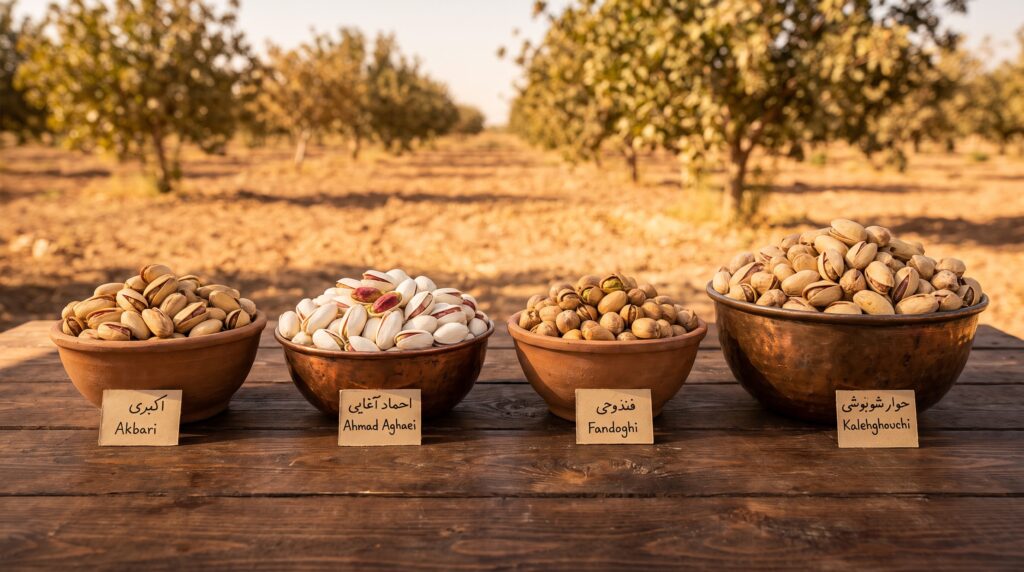
When a grower asks us which pistachio varieties are worth planting, we almost always end up talking about Iran 🇮🇷. It is no coincidence: it is home to one of the world’s great centres of diversity for this species, with millions of trees in production and centuries of practical, orchard-level selection. Four names come up again and again in any serious conversation on the subject: Akbari, Ahmad Aghaei, Fandoghi and Kalehghouchi.
At Agro Vivero del Mediterráneo we closely follow what is happening in the leading producing regions, because understanding how these varieties perform helps us better advise those who want to start a pistachio orchard or expand an existing one. In this article we explain what characterises each of them, what trials from Iranian research centres say and, above all, what lessons we can apply to growing conditions outside Iran 🌳.
Why Iran Is the Reference for Understanding Pistachio Varieties 🌍
Iran is one of the world’s largest pistachio producers and also one of the species’ centres of origin and diversity. It is estimated to have more than 80 million trees and around 17 main varieties. However, the commercial reality is far more concentrated: five varieties (Ohadi, Ahmad Aghaei, Fandoghi, Akbari and Kalehghouchi) account for more than 95% of the cultivated area.
That concentration is highly valuable information for us. It means that, after generations of growers trying, discarding and replanting, the market has filtered which Iranian pistachio varieties perform best in terms of yield, nut quality and commercial acceptance.
That said, these data should be read with care 🧠:
- Most of the trials have been carried out in Kerman Province, in areas such as Rafsanjan or Anar, under a very specific arid continental climate.
- Results change depending on the rootstock, irrigation, tree age and orchard management.
- A variety that excels in one environment may disappoint in another.
That is why, rather than simply copying a list, we want you to understand the reasoning behind each trait and how it translates to your orchard.
How to Choose Pistachio Varieties: The Criteria That Really Matter 🎯
Before comparing names, it is worth settling what yardstick we use. When we help growers choose pistachio varieties, we always review the same points:
- Yield per hectare and consistency between seasons.
- Nut size and overall nut appearance: shape, colour and size.
- Natural shell splitting, which affects commercial value.
- Blank nuts, which reduce the truly usable yield.
- Alternate bearing, that is, the tendency to alternate heavy crops with light ones.
- Nut shelf life, linked to oil composition.
- Rootstock compatibility: the rootstock onto which the variety is grafted.
- Phenology and chilling hours: flowering, ripening and winter chill requirements.
- Available pollinizers with matching flowering.
No single variety wins in every category. That is the first lesson we learned and the one we repeat the most: choosing is about balance. Large, eye-catching nuts are of little use if the tree has pronounced alternate bearing, and a highly productive variety can lose value if nut size is modest.
We must also consider the purpose of the orchard. Producing for a cooperative or an industrial buyer is not the same as seeking a premium nut for direct sales or the gourmet channel. Nor is a farm of a few hectares, where every tree counts, the same as a large estate that prioritises mechanisation and harvest scheduling 🚜.
Ahmad Aghaei: The Most Productive Variety in the Kerman Trials 🥇
Ahmad Aghaei is probably the Iranian variety we see cited most often when profitability is discussed. In a six-season study carried out in orchards in Anar and Rafsanjan, it achieved the highest average yield (1,758.7 kg/ha) and the highest net profit per hectare of the four commercial varieties analysed. Akbari came second.
Other studies reinforce that picture 📈:
- It showed the greatest vegetative growth and the best affinity with tissue-culture rootstocks in compatibility trials.
- In studies on harvest timing, it stood out for quality compared with other varieties, with an optimal window between mid and late September in Rafsanjan.
- It stood out for its percentage of natural shell splitting at maturity.
However, it is not all advantages ⚠️. A high level of alternate bearing has been reported in Ahmad Aghaei, which calls for careful management of pruning, fertilisation and irrigation to cushion the lower-crop years. And its excellent performance in Kerman does not guarantee the same result in a different climate.
Our take: Ahmad Aghaei is a benchmark when the goal is yield and profitability, but it requires a grower who pays close attention to cropping consistency.
Akbari: Nut Size, Quality and Good Nut Shelf Life 🏅
Akbari is the variety that many growers associate with a large, elongated pistachio with a striking appearance. In comparative trials it ranks among those with the largest nut size, at around 21.9 nuts per ounce (28.3 g): the lower that figure, the larger the nut.
Its other strength is oil quality. In a study of the fatty acid composition of five commercial Iranian varieties, Akbari obtained the best quality index (an oleic-to-linoleic acid ratio of 3.66), ahead of Kalehghouchi (2.94), Ahmad Aghaei (2.60) and Ohadi (2.40). In practice, a higher ratio is associated with greater oxidative stability and, therefore, better nut shelf life 📦.
In terms of yield, Akbari came second after Ahmad Aghaei in the Kerman study mentioned earlier, which makes it one of the most balanced options. That said, there is one detail that should not go unnoticed: in trials with tissue-culture rootstocks, Akbari showed the lowest compatibility of the varieties tested. Rootstock choice is therefore especially important 🔧.
Our take: Akbari suits growers who are after quality and shelf life, for example for sales channels where nut size and presentation influence the price.
Fandoghi: The Round-Nut Pistachio and Its Different Types 🔵
The name Fandoghi comes from the Persian word for “hazelnut” and describes the round nut of this group of varieties. Several types have been described in Iran, such as Fandoghi 48 or Fandoghi riz, and in practice they are discussed alongside Ohadi, the other major round-nut variety.
This is what the trials show 🔍:
- Fandoghi 48 stands out for its large nut size (around 19.8 nuts per ounce) and for having one of the lowest percentages of blank nuts among the varieties compared.
- Fandoghi riz gave the highest yield per tree in one comparative trial, with 12,870 g fresh weight and 4,054 g dry weight.
- Ohadi showed the lowest year-to-year yield variability in the Kerman study, although it ranked behind Ahmad Aghaei and Akbari in profitability.
- Some types, such as Fandoghi zodras, show high alternate bearing.
All of this shows why it makes sense to talk about specific types and clones rather than just generic names: two “Fandoghi” trees can behave very differently.
Our take: the Fandoghi group may appeal to growers who prioritise a round nut and more stable production, provided the plant material is properly identified.
Kalehghouchi: An Eye-Catching Nut with Points to Watch 🐏
Kalehghouchi takes its name from a Persian expression meaning “ram’s head”, referring to the shape of the nut. It is a variety widely known for its size and its presence on the Iranian market. In growth trials carried out in the Saman area, it was among the varieties with the greatest canopy development, together with Ahmad Aghaei.
However, the data also call for caution 🧐:
- In one comparative trial it showed one of the highest percentages of blank nuts (34.5%), within a range across varieties of 4.9% to 39.1%.
- In the Kerman profitability study it ranked last of the four commercial varieties analysed.
- Its oil quality index (2.94) places it in an intermediate position.
- Together with Ahmad Aghaei, it shows more cracking of the outer hull at maturity than other varieties.
That said, it remains a well-regarded variety, and its performance depends heavily on the location, the rootstock and pollination, since poor pollination, among other factors, increases the percentage of blank nuts 🐝.
Our take: Kalehghouchi can be interesting for its nut size and vigour, but we advise confirming its performance locally before committing to it on a large scale.
Comparison Table of the Four Iranian Pistachio Varieties 📊
We summarise the above in a table. These are trends observed in specific trials, not promises for every farm:
| Variety | Profitability ranking (Kerman) | Oil quality (oleic/linoleic) | Key strength | Point to watch |
|---|---|---|---|---|
| Ahmad Aghaei | 1st (1,758.7 kg/ha) | 2.60 | Yield, vigour and shell splitting | High alternate bearing |
| Akbari | 2nd | 3.66 | Nut size and shelf life | Lower compatibility with tissue-culture rootstocks |
| Fandoghi / Ohadi | Ohadi: 3rd | Ohadi: 2.40 | Fandoghi 48: large nut size and few blank nuts | High alternate bearing in some types |
| Kalehghouchi | 4th | 2.94 | Size and vigour | High percentage of blank nuts (34.5%) |
If one thing emerges from the table, it is that there is no perfect variety: each offers advantages and demands different care. The best choice is the one that best fits your farm, your climate and your market 🧩.
And Beyond Iran? What We Should Consider Before Applying These Data 🌐
This is where things get practical. Iranian varieties have proven their worth in their home environment, but transferring a choice from Iran to an orchard elsewhere requires nuance. These are the points we always review with each grower:
1. Available plant material. In Spain, where our nursery is based, a large share of pistachio orchards have been established with varieties such as Kerman (whose name refers to the Iranian region of Kerman) and Sirora, accompanied by suitable pollinizers. Moreover, importing plant material from third countries is subject to very strict phytosanitary controls in the European Union and in most other markets, so it is not something a grower should improvise. If you would like to know which pistachio plants we have available and which we recommend for your area, you can check on our website.
2. Climate and chilling hours. In Mediterranean climates and other regions with mild winters, a variety with high winter chill requirements may flower irregularly, and very early flowering may be exposed to late frosts. That is why we analyse each farm’s climate history before recommending anything 🌡️.
3. Soil and water. The pistachio tree tolerates drought and poor soils well, but it needs good drainage and does not tolerate waterlogging. Irrigation water quality and salinity also influence each variety’s response 💧.
4. The rootstock. As we saw with Akbari and Ahmad Aghaei, compatibility between variety and rootstock varies greatly. The rootstock determines vigour, nutrient uptake and soil adaptation, so it is chosen together with the variety, not afterwards 🌱.
5. The market we will sell to. The nut that fetches the best price in one market may not do so in another. Nut size, colour, shell splitting and shelf life determine the price, and it pays to know them before planting 🛒.
In short, the lessons from Iran are an excellent compass, but the final decision must be based on data from your own plot. That is what our technical advice service is for: we study the farm with you and define the best combination of variety, rootstock and pollinizers 🤝.
Pollination and Alternate Bearing: Two Factors That Shape Any Variety 🐝
The pistachio is a dioecious species: there are female trees, which produce the nuts, and male trees, which supply the pollen. Without well-chosen pollinizers, even the best variety yields little and with many blank nuts.
These are the keys we apply in a pistachio orchard:
- Indicative ratio: one male for every eight to ten females, adjusted to the orchard layout.
- Flowering overlap: pollen must be available when the female variety’s flowers are receptive.
- Prevailing wind: the species is wind-pollinated, so the position of the males matters.
- Female variety: each one has its own calendar, so it is not enough to copy a recipe from another farm.
Alternate bearing, for its part, is the tendency of a tree to alternate years of heavy crops with years of light ones. It is a trait closely linked to the variety, but management can soften it: proper pruning, balanced fertilisation, well-scheduled irrigation during nut filling and timely harvesting all help the tree avoid exhausting its reserves 🌿.
That is why, when deciding between Akbari, Ahmad Aghaei, Fandoghi or Kalehghouchi, we do not only ask which one yields the most: we ask which one we will be able to pollinate well and manage consistently on that particular farm.
Common Mistakes When Choosing Pistachio Varieties ❌
Throughout our work with growers we have seen the same stumbling blocks repeated:
- Choosing by name alone. A famous name does not guarantee that the specific clone or plant material will perform the same on your farm.
- Looking only at yield. Without nut size, shell splitting and shelf life, the final price may fall short.
- Ignoring pollination. Planting females without planning the males is one of the costliest mistakes.
- Leaving the rootstock for last. Variety and rootstock form a combination and must be decided together.
- Planting a single variety across the whole farm. Staggering varieties with different calendars spreads the harvest workload and reduces risk.
- Extrapolating results from another area without verifying them. What works in Kerman may need adjusting to the climate of your region.
Avoiding these mistakes from the outset saves years of correction and improves orchard profitability ✅.
Which Variety Suits Each Type of Grower? 🧑🌾
There is no single answer, but there are criteria that help us guide each case.
Small-scale growers 🌱. When the area is small, every tree weighs heavily on the bottom line. We tend to prioritise consistent production, a nut size and presentation that allow a better selling price, and management that can be handled with little labour. A variety with pronounced alternate bearing demands more attention, so it should be assessed realistically.
Large-scale growers 🚜. On large estates, mechanisation, harvest scheduling and the ability to absorb lower-crop years carry the most weight. Here it is often a good idea to combine varieties with staggered ripening, spreading the workload and the risk, and to work with a very carefully planned pollination layout.
Growers expanding an existing orchard 🔄. Before adding hectares, we analyse which varieties and rootstocks you already have, how they have performed, and which gaps in the calendar or in pollination need to be filled.
Whatever your case, the decision should also rest on numbers. On our page about orchard profitability you can see how production, costs and selling price influence the final result, and check whether the chosen variety fits your goals 📊.
From Tree to Market: How Variety Influences Harvest and Drying 🧺
Choosing a variety does not end in the field. Each one ripens at a different time and behaves differently at harvest and post-harvest. Trials in Rafsanjan found that harvest timing affects nut quality, and that between mid and late September the best balance was achieved for the varieties studied, under those conditions.
These are the points we recommend paying attention to from harvest onwards 🧺:
- Harvest at the right time: picking too early or too late reduces quality and can increase losses.
- Hull promptly: as a general guideline, the outer hull should be removed within the first hours after harvest.
- Dry properly: correct drying, down to a moisture content of around 5%, protects quality and avoids storage problems.
- Grade by size and splitting: the more uniform the lot, the better it sells.
A variety with very good shelf life, such as Akbari in the fatty acid study, offers more room to store and market the nuts under the best conditions. And one with high natural shell splitting, such as Ahmad Aghaei, makes the final product easier to present ✨.
Our Four-Step Decision Path for Choosing a Variety 🧭
So that none of the above stays theoretical, this is how we work when someone asks us for help choosing pistachio varieties:
- Farm assessment: climate, soil, water, slope, aspect and frost risk.
- Commercial objective: who we will sell to, with what nut size and presentation, and what price we expect.
- Selecting the whole set: variety, rootstock and pollinizers are chosen together, with compatible flowering periods.
- Management and harvest plan: pruning, irrigation, fertilisation and harvest calendar adapted to the chosen variety.
This method works just as well for a two-hectare farm as for a large estate, and it allows us to explain the reasoning behind every decision with data 🧮.
What the Iranian Trials Teach Us: Five Key Ideas 💡
- Productivity is not everything. The variety with the most kilos per hectare is not always the one with the best shelf life or the largest nut size.
- Consistency is worth money. A somewhat less productive but stable variety can be easier to manage and to market.
- The rootstock changes the result. The same variety can perform better or worse depending on the rootstock it grows on.
- Blank nuts subtract value. A high percentage reduces useful yield, even if the tree carries a heavy crop.
- Context rules. Kerman is not your region, and any data point must be checked against the real conditions of your farm.
Frequently Asked Questions About Iranian Pistachio Varieties ❓
Which is the most productive pistachio variety in Iran?
In the Kerman study discussed above, Ahmad Aghaei achieved the highest average yield and the greatest profit per hectare, followed by Akbari. Even so, the result varies with the area, the rootstock and management.
Which variety has the best nut shelf life?
According to the fatty-acid-based index, Akbari scored highest, which points to greater stability against oxidation. Ohadi ranked last of the five compared.
Can Iranian varieties such as Akbari or Ahmad Aghaei be planted outside Iran?
It depends on the legal availability of the plant material and on its adaptation to your climate. The introduction of plants from third countries is regulated, so the most prudent step is to consult us before making any decision.
Are Fandoghi and Ohadi the same variety?
Not exactly. Both are associated with a round nut, but trials treat them as different materials, and within Fandoghi there are several types with different behaviours.
How many pollinizers does a pistachio orchard need?
As a reference, one male for every eight to ten females, provided its flowering coincides with that of the female variety and the males are well distributed according to the prevailing wind.
Why is alternate bearing so important when choosing a variety?
Because it determines income stability. A variety with pronounced alternate bearing can swing between very good years and weak ones, which affects planning for costs, labour and sales.
What is natural shell splitting and why does it matter?
It is the nut’s ability to open spontaneously as it ripens. A high percentage of split nuts improves presentation and commercial value, and Ahmad Aghaei stood out in this respect.
How can I request a quote for pistachio plants?
You can fill in our reservation and quote form and we will help you define which varieties, how many plants and which pollinizers you need.
To Wrap Up: Your Next Step for Your Orchard 🌱
Akbari, Ahmad Aghaei, Fandoghi and Kalehghouchi teach us that there is no absolute winner in pistachio. Ahmad Aghaei stands out for its yield and profitability, Akbari for its nut size and shelf life, the Fandoghi group for its round nut and, in some types, its consistency, and Kalehghouchi for its size and vigour, although with more blank nuts to watch.
The point is not to copy the most famous variety, but to choose the one that best fits your climate, soil, water, market and way of working. And to do so taking the rootstock, pollination and management into account from day one.
At Agro Vivero del Mediterráneo we support both small-scale growers and large-scale growers at every stage: from selecting the plant to designing and managing the orchard. If you are thinking of starting or expanding, get in touch with our team and tell us about your project, or request your quote for pistachio plants directly. We would be delighted to help you plant with sound judgement 🌳💚.