


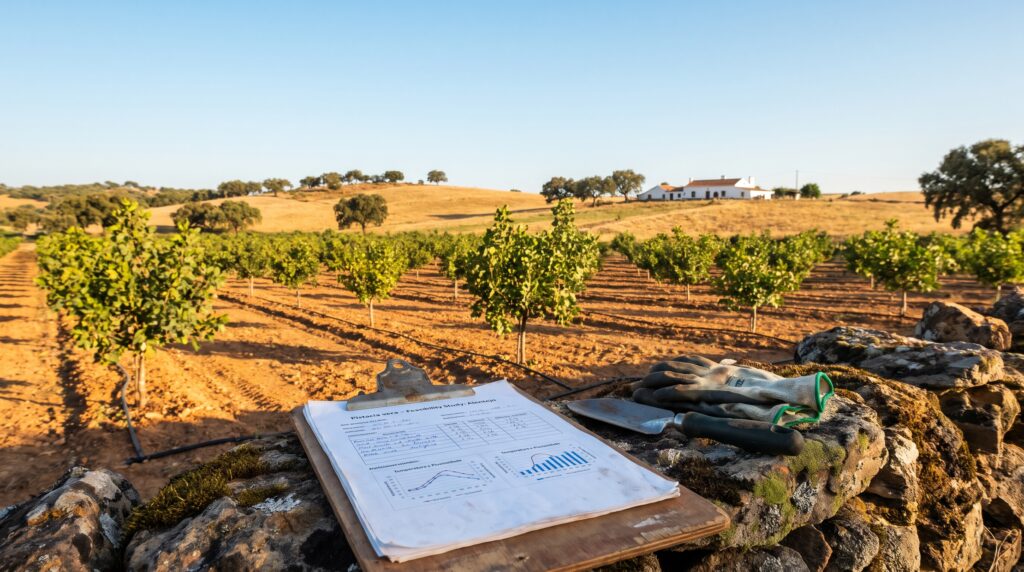
Almonds have transformed the agricultural landscape of the Alentejo in just a few years, and now other nuts are starting to attract the interest of Portuguese farmers. Pistachio is one of them. 🌳 The question we hear again and again is simple: is growing pistachios in Portugal profitable, or is it too risky a bet?
Our answer is clear: yes, it can be profitable, but not on just any farm and not with just any approach. Pistachio profitability in Portugal depends on three factors that must be analysed before buying a single plant: the climate of the area, the water available and the scale of the plantation.
At Agro Vivero del Mediterráneo we are specialists in pistachio growing, and we support both small-scale growers and large-scale investors who want to start a plantation or expand an existing one. In this article we review, from a technical standpoint, which Portuguese regions offer the best conditions, what the crop requires and how to work out whether a pistachio plantation can succeed. 🔎
🇵🇹 Pistachios in Portugal: current situation and why interest is growing
Pistachio is still a young crop in Portugal. There are specific projects, but the area planted remains small compared with almonds. Even so, the almond boom has left something very valuable behind: growers with experience in localised irrigation, suitable machinery and a culture of investing in tree-crop plantations.
Several Portuguese technical sources consider pistachio highly recommended for irrigated land in the interior, in regions with a continental climate such as Trás-os-Montes, the Beiras and the Alentejo. And that is no coincidence: the vast Alqueva irrigation scheme, covering some 120,000 hectares, has opened the door to new crops, pistachio among those considered. 💧
There are also practical examples. An agricultural company in Trás-os-Montes committed in 2017 to 29 hectares of organically grown pistachios. Meanwhile, in Escalhão, in the municipality of Figueira de Castelo Rodrigo, a technical visit was organised to an 8-hectare holding still in the installation phase, so that future growers could see at first hand how a plantation is set up.
On top of this comes the market. The European Union consumes considerably more pistachios than it produces, and a large share of the nuts that reach our tables are imported from other continents. This external dependence explains the interest in expanding production in southern Europe. 🌍
With these facts, technical feasibility is clear. The real question is economic feasibility, and that depends on the specific conditions of each farm.
🌡️ Climate: the first thing we must check before growing pistachios in Portugal
The pistachio is a hardy tree, but it is very demanding in one specific respect: it needs a cold winter and a long, hot, dry summer. These are the conditions we always review before recommending a plantation:
- ❄️ Chill hours: depending on the variety, between 600 and 1,000 hours below 7 °C. Without them, bud break is irregular and the harvest suffers.
- ☀️ Hot, dry summers: the nut needs heat to fill and ripen properly. High ambient humidity favours fungal diseases.
- 🥶 Spring frosts: the tree tolerates cold well while dormant, but a late frost after bud break can damage flowers and tender shoots.
- 🌧️ Rain at harvest: it complicates harvesting and drying and can affect quality.
In Portugal, the interior meets these requirements better than the coast. The Atlantic influence brings humidity and milder summers, exactly the opposite of what pistachios need. That is why we recommend checking the data from the nearest IPMA weather stations (Portuguese Institute for Sea and Atmosphere) and, if possible, installing your own temperature logger for a full winter. 📈
A detail that is often overlooked is topography. Two farms only a few kilometres apart can have very different frost risk: at the bottom of a valley cold air pools, whereas a well-ventilated slope escapes more easily. Choosing the right plot can be worth more than any corrective measure later on.
🧱 Well-drained soils: the one condition that admits no exceptions
Pistachio tolerates poor, calcareous, stony and even somewhat saline soils. That makes it an interesting option for land where other crops do not work. But there is one condition that admits no exceptions: drainage.
Waterlogged soils cause root asphyxiation and favour fungi such as Phytophthora or Verticillium, which can ruin an entire plantation. Before planting, we look for the following:
- At least one metre of useful depth, with no compacted layers.
- Loam, sandy loam or clay loam texture with good infiltration.
- Neutral or slightly alkaline pH.
- Gentle slope that allows work with machinery and prevents erosion.
In inland Portugal, schist and granite soils are common, and shallow in some areas, alongside the so-called barros of the Baixo Alentejo, which are heavier, more clayey and prone to waterlogging. A soil pit and a soil analysis before planting cost little and spare you a great deal of trouble. 🔍
💧 Water: irrigation, rainfed cultivation and the key to pistachio profitability
A good part of pistachio profitability in Portugal is decided here. Pistachio withstands drought better than many other crops, but it produces profitably when it receives water at critical moments.
Irrigated pistachios. With regulated deficit irrigation, a mature plantation typically needs between 2,000 and 4,000 m³ per hectare per year, depending on climate, soil and irrigation strategy. It is not about irrigating a lot, but about irrigating well: reserving water for nut filling and moderating it in the phases when the tree tolerates some stress.
Rainfed pistachios. This is possible in areas with around 400 mm of well-distributed annual rainfall and deep soils, but production is lower and more irregular. The same Portuguese sources indicate that, to set up a young farmer, the minimum profitable size under irrigation is around five hectares, and that under rainfed conditions at least 2.5 times more land is needed.
Where can water come from in Portugal? Mainly from three sources:
- Irrigation networks such as Alqueva and other public irrigation schemes.
- Own abstraction, such as wells and boreholes, which requires the corresponding water-use permit from the APA (Portuguese Environment Agency).
- Storage reservoirs that capture rainwater or runoff.
Recent droughts have made availability more variable. Before deciding, check the security of supply, the water tariff and water quality, especially salinity. 📋
🌦️ Climate change: an opportunity or a threat for pistachios?
Many growers ask us whether a warming climate works for or against pistachios. The answer is nuanced.
On the plus side, pistachio withstands intense heat very well and, with deficit irrigation, uses less water than other tree crops. In areas suffering ever more heatwaves, it is a tree that keeps performing where other crops struggle. 🌞
On the downside, milder winters reduce the chill hours accumulated, a problem that can affect the southernmost or lowest-lying areas. In addition, irregular rainfall and prolonged droughts put pressure on water availability, and extreme events, such as an out-of-season frost or heavy rain during harvest, can damage the production of a given year.
That is why we recommend looking not only at the average of recent years, but also at the extremes. Good planning includes varieties whose chill requirements suit the area, water storage that provides a buffer in the driest summers, and constant weather monitoring during bud break and harvest.
🗺️ Regions of Portugal for growing pistachios: where it fits best
There is no single answer valid for the whole country. These are the areas that, in terms of climate, water and farm structure, we find most promising, and those we advise against.
📍 Pistachios in the Alentejo: the leading candidate
The Alentejo offers very clear advantages. Farms are large and flat, which makes mechanisation easier. Summers are hot and dry. Alqueva provides a water source with professional management. And growers are already accustomed to intensive olive groves and irrigated almonds.
In most of the Alentejo interior, chill hours are usually sufficient, although this should be verified in the southernmost areas. The main risks are late frosts in low-lying hollows, poorly drained barros soils and the rising cost of water in dry years.
One advantage is the proximity to Extremadura (Spain), where there is an established nut-processing industry that can be contacted for post-harvest handling. 🚜
📍 Beira Interior and Beira Baixa: continental climate and watch out for frosts
Areas such as Castelo Branco, Idanha-a-Nova or Figueira de Castelo Rodrigo have a more marked continental climate: cold winters with plenty of chill hours and hot summers. The Escalhão technical visit mentioned earlier shows that there is already real interest in this area.
The main risk is spring frost, which increases with altitude. As a prudent rule, we advise against plots above about 600 or 700 metres. Schist and granite soils usually drain well, but depth must be checked. Land ownership is more fragmented than in the Alentejo, so it is worth looking for blocks of sufficient size.
📍 Pistachios in Trás-os-Montes and the Upper Douro: potential, with caution
The so-called Terra Quente of Trás-os-Montes, with valleys such as the Vilariça, and the Upper Douro (Douro Superior) combine very hot summers with cold winters. It is an environment with a tradition of nut growing, above all almonds and chestnuts, and with pistachio plantations already established, such as the 29-hectare one mentioned earlier. 🏔️
Pistachio flowers later than almond, and that partially protects it from the frosts that have hit almond growers in Trás-os-Montes. But it is not immune, and choosing the site remains decisive. Another challenge is the prevalence of smallholdings: many plots are small and fragmented, which raises the cost of field operations and limits scale. In this area, consolidating adjoining farms or partnering with other growers can make the difference.
📍 Ribatejo: occasional opportunities
The fertile floodplains of the Tagus tend to have high humidity and high water tables, the opposite of what pistachios need. However, some sandy, well-drained terraces in the Médio Tejo may be suitable. We are talking about very specific plots that require a prior soil study.
⚠️ Areas where we do not recommend planting pistachios
- Northern and central coast (Minho, Douro Litoral, Beira Litoral): humidity, autumn rain and mild summers.
- Coastal Algarve: winters too mild to accumulate chill, and scarce water.
- Terra Fria of Trás-os-Montes and high-altitude areas: excessive cold and frequent late frosts.
- Azores and Madeira: humid, oceanic climate.
📊 Comparison of regions for planting pistachios in Portugal
| Area | Climate and chill | Water | Typical farm size | Assessment |
|---|---|---|---|---|
| Alentejo (Alqueva and irrigated areas) | Hot, dry summers, sufficient chill | Good in public irrigation schemes | Large | Very interesting |
| Beira Interior and Beira Baixa | Continental, plentiful chill, frost risk | Irrigation schemes and own abstraction | Medium | Interesting with careful plot selection |
| Trás-os-Montes (Terra Quente) and Upper Douro | Hot summers and cold winters | Variable | Small and fragmented | Interesting with caution |
| Ribatejo | Wetter, waterlogging risk | Good | Medium | Specific plots only |
| Coast and coastal Algarve | Humid or mild winters | Scarce in the south | Variable | Not recommended |
💶 Is a pistachio plantation profitable in Portugal? Let’s talk numbers
Pistachio is a long-term crop. It comes into production gradually, and the plantation reaches full maturity after around ten years. This demands investment capacity and patience, which should be clear from the outset.
These are the indicative figures we work with for an irrigated pistachio plantation:
- Establishment costs: between €8,000 and €14,000 per hectare, excluding land. They include the plants, the irrigation system, soil preparation and installation work.
- Annual costs with a mature plantation: around €4,500 per hectare, covering water, energy, fertilisation, treatments, pruning and harvesting.
- Yield from a mature irrigated plantation: between 1,800 and 3,200 kg per hectare of in-shell pistachios, depending on climate, variety and management.
- Density: between 280 and 400 trees per hectare, depending on the planting layout.
With those figures, an illustrative example for one mature hectare would be as follows:
| Scenario | Yield (kg/ha) | Price (€/kg) | Revenue (€/ha) | Costs (€/ha) | Margin (€/ha) |
|---|---|---|---|---|---|
| Prudent | 1,800 | 5.0 | 9,000 | 4,500 | 4,500 |
| Medium | 2,500 | 6.0 | 15,000 | 4,500 | 10,500 |
| Optimistic | 3,200 | 7.0 | 22,400 | 4,500 | 17,900 |
This is an example, not a promise. Pistachio prices have fluctuated widely in recent years, which is why we always advise working with prudent scenarios. Return on investment is usually planned over the medium to long term, and in the prudent scenario it can approach twelve years. In the other two scenarios it is shortened considerably. 📉
Some ideas that improve the margin per hectare:
- Choose the plot carefully: it is the decision that weighs most in the result.
- Install efficient, automated irrigation.
- Size the farm properly to make the most of machinery.
- Plan post-harvest handling from the first year.
If you would like to go deeper, you can consult our information on the profitability of a pistachio plantation and apply the figures to your specific case. 🧮
🧑🌾 Small-scale and large-scale growers: how to approach scale
Pistachio is not a crop exclusive to large farms, but scale shapes the strategy.
If you are a small-scale grower, the most sensible approach is to start with an area you can manage with your own resources, make use of the irrigation you already have and team up with other growers to share machinery and post-harvest facilities. A small plantation, well chosen and well managed, can be a solid complement to other production. 🌾
If you are a large-scale grower or investor, scale allows you to mechanise almost everything, negotiate inputs better and consider your own hulling and drying facility. In return, risk becomes concentrated: the larger the investment, the more important it is to verify the climate, the water and the variety before taking the step. A prudent option is to plant in phases, so that the first hectares serve as a trial before expanding.
In both cases the rule is the same: plant only where the numbers and the conditions of the farm support it.
🌱 Varieties, pollinators and pistachio plants for Portugal
The choice of variety depends above all on the chill hours of the area and on the ripening date. These are the most common:
- Kerman: the world-reference female variety, with very good quality, but one that needs many chill hours.
- Sirora: earlier ripening and lower chill requirements, useful in milder areas.
- Lost Hills and Golden Hills: more recent varieties, with early ripening and high productivity.
- Larnaka: a variety of Cypriot origin, with low chill requirements and early ripening.
Pistachio is a dioecious species: there are male trees and female trees, and the wind carries the pollen from one to the other. For this reason, pollinators must be distributed throughout the plantation, at roughly one male for every eight to ten females, and positioned taking the prevailing wind into account. Their flowering period must coincide with that of the chosen female variety.
The rootstock must also be chosen according to soil, cold and salinity. It is not a minor decision, because it determines vigour, the onset of production and resistance to soil-borne diseases.
And one piece of advice beyond doubt: always buy nursery plants with quality and plant-health guarantees. A mistake here is paid for throughout the life of the plantation. You can find out about our pistachio plants and ask us for guidance on the most suitable variety and rootstock combination for your area. 🌱
📋 Permits, grants and labour: what to prepare in Portugal
A plantation does not begin with the plant, but with the paperwork. These are the points to review, always with the support of a local technician:
- Planning and land protection: consult the Municipal Master Plan (PDM) and any restrictions arising from the National Agricultural Reserve (RAN) and the National Ecological Reserve (REN).
- Water: a water-use permit if you abstract your own water, or a contract with the body managing the irrigation scheme.
- Regional agriculture directorate: the DRAP of the relevant region is the usual contact for technical and administrative questions.
- Agricultural investment grants: support schemes exist within the framework of the EU Common Agricultural Policy in Portugal, with calls that change over time. The conditions in force must be checked before planning.
As for labour, pistachio is a highly mechanised crop. According to the Portuguese sources mentioned above, a single full-time worker can look after about 50 hectares, with occasional support for pruning, weed control along the row, irrigation and fertigation. This is an important advantage in a context where finding agricultural workers is increasingly difficult.
If you need support with design, installation or follow-up, you can see all our services for pistachio growing. 🤝
🚜 Post-harvest handling and marketing of pistachios: let’s not leave it until the end
Many projects fail because they do not consider what happens after the nuts are picked. Pistachios are harvested with a trunk shaker at the end of summer, and after harvest they must be hulled, dried and stored within a short time, normally in less than 24 hours, to avoid staining and quality problems.
It rarely makes sense for a small farm to set up its own hulling and drying facility. For this reason, the most common alternatives are:
- Grower organisations: in Portugal, the creation of companies formed by growers that provide technical assistance and collect, hull and market their members’ pistachios has been proposed.
- Nearby processing industries: especially useful in areas bordering Spain.
- Cooperatives and purchase contracts: prior agreements that give the grower security.
Our advice is to secure the destination of the harvest before planting. A plantation without a clear post-harvest route loses profitability even if it yields a lot. 📦
❌ Common mistakes when planting pistachios in Portugal
In our work with growers we almost always see the same failings:
- Planting without checking chill hours or the risk of spring frosts.
- Choosing poorly drained land simply because it is cheap.
- Underestimating water needs or relying on a water entitlement that is not guaranteed.
- Calculating profitability with record prices instead of prudent scenarios.
- Planting an area too small to amortise machinery and labour.
- Failing to plan post-harvest handling and marketing.
- Buying plants without guarantees of quality, variety or plant health.
Avoiding them does not guarantee success, but it drastically reduces the risk of getting wrong the decisions that are hardest to correct.
❓ Frequently asked questions about pistachios in Portugal
How many years does a pistachio plantation take to become profitable?
The first harvests appear around the fourth or fifth year, but sustained profits come when the plantation approaches full production, at around ten years.
Can pistachios be grown rainfed in Portugal?
Yes, in areas with around 400 mm of well-distributed rainfall and deep soils. Production is lower and more variable, so more land is needed to achieve the same profitability as under irrigation.
How many hectares are needed?
There is no magic figure. Portuguese technical sources speak of around five hectares under irrigation as a minimum for a young farmer. The larger the area, the better machinery and labour are used.
How much does it cost to plant one hectare of pistachios?
Indicatively, between €8,000 and €14,000 per hectare, excluding land. The final figure depends on density, the irrigation system and soil preparation.
How does it differ from almond?
Pistachio flowers later, tolerates drought and salinity better and is usually longer-lived, but takes longer to reach full production and requires a sound post-harvest plan.
Which is better: the Alentejo, Beira Interior or Trás-os-Montes?
It depends on each farm. The Alentejo offers more scale and water, while the Beiras and Trás-os-Montes require careful plot selection because of frost and fragmentation.
🤝 The next step
Growing pistachios profitably in Portugal is possible, provided the project is based on data and not on enthusiasm. The interior of the country, and in particular the irrigated Alentejo, the Beiras and the Terra Quente of Trás-os-Montes, offers very interesting conditions. But you must watch the cold, frosts, drainage, water and post-harvest handling.
If you are considering a plantation, the most sensible step is to begin with a study of your farm. At Agro Vivero del Mediterráneo we will be delighted to help you see whether pistachio is a good fit and with which varieties. You can write to us through our contact page or request a quotation directly from our reservation and quotation form. The sooner the project is well defined, the sooner the plantation starts to grow. 🌿