


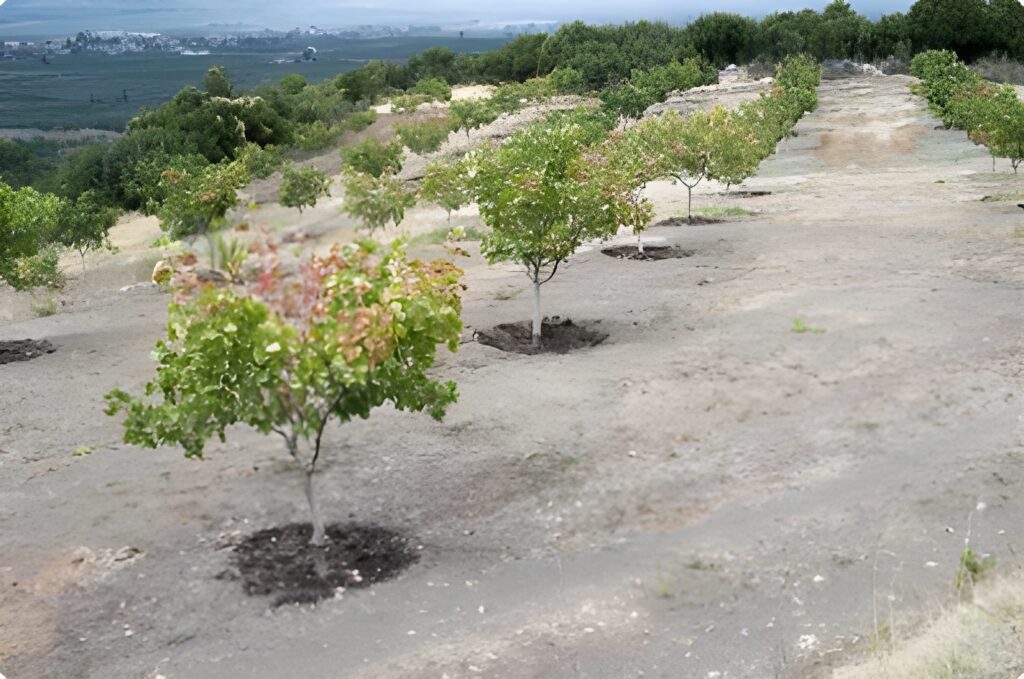
Hello to all pistachio enthusiasts! 👋
We are the team at Agro Vivero del Mediterráneo, and we have spent years dedicated body and soul to the fascinating world of the pistachio. We have seen this sector grow, we have learned from each plantation and, above all, we have helped many farmers convert their lands, even those considered “difficult”, into thriving pistachio farms. Today we want to share our experience with you on a crucial topic: how to adapt pistachio cultivation to poor soils.
We know that land choice is fundamental, but the reality is that we do not always have the ideal soil available. Fortunately, the pistachio tree (Pistacia Vera) is an extraordinarily rustic and adaptable tree. Its ability to thrive where others fail is one of its great advantages. However, “rustic” does not mean “invincible”. To ensure the success and profitability of a plantation in suboptimal conditions, it is necessary to apply technical knowledge and specific strategies. Let’s get to it! 💪
Understanding What “Poor Soils” Are for Pistachio
Before starting, let’s define what we mean by “poor soil” in the context of pistachio. It’s not just about lack of nutrients. A soil can be considered poor or limiting for various reasons:
-
Extreme Texture: Very sandy soils (low water and nutrient retention) or very clayey (drainage problems, compaction, difficulty for roots).
-
Shallow Depth: A bedrock layer close to the surface limits the development of the pistachio’s powerful root system.
-
Low Organic Matter Content: Organic matter is vital for soil structure, water retention, and biological activity. Soils < 1% can be considered poor in this aspect.
-
Extreme pH: Pistachio prefers slightly alkaline pH (7.0 – 8.0), but very acidic (< 6.0) or excessively alkaline (> 8.5) values can block the absorption of essential nutrients.
-
Salinity Problems or Excess Active Lime: Although pistachio shows some tolerance, high levels can negatively affect its development and production.
-
Poor Structure and Compaction: Hinders water infiltration, aeration, and root growth.
-
Scarcity of Essential Nutrients: Deficiencies in Nitrogen (N), Phosphorus (P), Potassium (K) or micronutrients such as Zinc (Zn), Iron (Fe) or Boron (B).
Identifying which of these limitations our land presents is the indispensable first step.
The Natural Resilience of the Pistachio Tree: A Key Advantage
As we mentioned, the pistachio tree has a remarkable capacity for adaptation. Its root system is taproot and deep, capable of exploring large volumes of soil in search of water and nutrients, which gives it drought resistance superior to many other trees. In addition, it shows relatively good tolerance to calcareous soils and some salinity, common conditions in many areas where its cultivation is viable.
However, relying solely on this natural resilience can lead to mediocre production or even plantation failure, especially in very limiting soils. This is where our technical intervention becomes crucial. 🧑🌾
Key Strategies for Adapting Cultivation to Poor Soils
At Agro Vivero del Mediterráneo, we have developed and perfected a series of strategies that allow establishing and managing successful pistachio plantations even in unfavorable soil conditions. These are our main recommendations:
1. Exhaustive Soil Analysis: The Cornerstone 📊
We will not tire of repeating it: analyzing the soil is not an expense, it is a fundamental investment! Before even thinking about planting, we need a detailed map of our land’s characteristics. A complete analysis should include:
-
Texture: Percentage of sand, silt, and clay.
-
pH: Acidity or alkalinity level.
-
Electrical Conductivity (EC): Salinity indicator.
-
Organic Matter (%): OM level in the soil.
-
Main Nutrients: Total Nitrogen, Assimilable Phosphorus (P) (Olsen or Bray), Exchangeable Potassium (K).
-
Secondary Nutrients: Calcium (Ca), Magnesium (Mg), Sulfur (S).
-
Micronutrients: Iron (Fe), Manganese (Mn), Zinc (Zn), Copper (Cu), Boron (B).
-
Active Lime (%): Important in calcareous soils to foresee iron chlorosis problems.
-
Cation Exchange Capacity (CEC): Indicates the soil’s capacity to retain nutrients.
This analysis will tell us exactly what we are facing and will guide all subsequent decisions, from rootstock choice to fertilization plan. At Agro Vivero del Mediterráneo we offer advice to interpret these analyses and design the best strategy for your farm.
2. Selection of the Appropriate Rootstock: The Most Critical Decision 🌱
Choosing the rootstock or stock is undoubtedly the most important decision when establishing a pistachio plantation, and even more so in poor soils. The rootstock is the base on which our productive variety (Kerman, Larnaka, Sirora, etc.) will grow and is responsible for interacting directly with the soil and absorbing water and nutrients.
Not all rootstocks behave the same under adverse conditions. The most used are:
-
Pistacia terebinthus (Cornicabra): Very rustic, resistant to drought and cold, adapts well to poor and stony soils, but is sensitive to Verticillium and has slower growth. Traditionally used in dryland.
-
Pistacia atlantica: Also very rustic and tolerant to drought and lime, but sensitive to Verticillium and late frosts. Vigorous.
-
Pistacia integerrima: Very vigorous and productive, resistant to Verticillium and nematodes, but more demanding in water and sensitive to cold and waterlogging. It is the basis of modern hybrids.
-
UCB-1 Hybrids (P. atlantica x P. integerrima): It is the star rootstock currently and the one we work with most in our pistachio plants. Combines great vigor, high productivity, resistance to Verticillium, nematodes, and some tolerance to salinity. Adapts well to a wide range of soils, although requires irrigation to express its full potential. Its vigor helps explore limiting soils better.
How to choose? Based on soil analysis:
-
Very calcareous soils: P. terebinthus or UCB-1 usually work well.
-
Soils with Verticillium risk: UCB-1 or P. integerrima are the mandatory choice.
-
Saline soils: UCB-1 shows better behavior than P. terebinthus.
-
Shallow or stony soils (dryland): P. terebinthus can be a valid traditional option, although UCB-1 with proper management also adapts.
-
Clayey soils with poor drainage: Caution! All rootstocks are sensitive to waterlogging. Improving drainage is a priority. UCB-1 may suffer more in these conditions if irrigation is not managed well.
At Agro Vivero del Mediterráneo, we advise you in detail on which pistachio plant (variety/rootstock combination) is most suitable for your specific conditions.
3. Deep Land Preparation: Breaking Physical Barriers 🚜
In poor soils, especially those compacted or with hardened layers (petrocalcic horizons not very deep), good preparation work is essential. We recommend:
-
Deep Subsoiling: Perform cross passes with a subsoiler at a depth of 60-80 cm or even more if possible. This breaks compaction, improves water infiltration, favors aeration, and facilitates deep root growth. It is fundamental to do it with dry soil (atempéro) to achieve effective breakage.
-
Stone Removal (if necessary): In very stony soils, removing larger stones in the planting line can facilitate subsequent tasks.
These tasks must be done before planting and are a long-term investment in soil health and tree development.
4. Organic and Mineral Amendments: Improving the Base 🌿
Incorporating organic matter is one of the best strategies to improve poor soils, whether sandy or clayey.
-
Well-composted manure, plant compost, etc.: Provide slow-release nutrients, improve structure (creating stable aggregates), increase water retention capacity in sandy soils and improve drainage in clayey ones, and stimulate beneficial microbial activity. We recommend generous applications (20,000 – 40,000 kg/ha ) incorporated superficially before planting or located in the planting line.
-
pH Correction:
-
Acidic soils (< 6.5): Limestone amendments (calcium carbonate, dolomite) to raise pH and provide Calcium and Magnesium. The amount will depend on initial pH and soil texture (indicated in analysis).
-
Very alkaline soils (> 8.5): Acidifying amendments such as elemental sulfur or iron sulfate. These are slower and sometimes costly processes. Choosing a tolerant rootstock is key here.
-
-
Agricultural Gypsum (Calcium Sulfate): Useful in sodic soils (high in Sodium) or to improve clay soil structure by providing Calcium without significantly raising pH.
These amendments must always be based on soil analysis results. Do not apply blindly!
5. Plantation Design and Specific Planting Techniques
-
Planting Frame: In poor soils, especially in dryland or with deficit irrigation, it may be convenient to opt for slightly wider planting frames (e.g., 7×6 m or even 7×7 m) to reduce competition for water and nutrients between trees.
-
Planting Holes: Make sufficiently large holes (e.g., 40x40x40 cm or more) and ensure walls are not polished (pot effect), especially in clayey soils. A small amount of well-decomposed organic matter mixed with hole soil can be added.
-
Planting Depth: Crucial! Never bury the graft point. It must always remain about 10-15 cm above final ground level to avoid collar diseases. Plant at same depth plant came in pot or slightly above.
-
Initial Irrigation: Good irrigation right after planting is fundamental to settle soil around roots and eliminate air pockets.
6. Intelligent Irrigation Management: Every Drop Counts 💧
Even in dryland, pistachio appreciates support irrigation, especially during first years and in critical periods. In poor soils, water management is even more delicate:
-
Sandy Soils: Require more frequent but shorter duration irrigations, as water percolates quickly. Drip irrigation is ideal.
-
Clayey Soils: Require more spaced but longer duration irrigations, ensuring good infiltration without causing waterlogging. Vital to monitor drainage.
-
Irrigation System: Drip irrigation is most efficient. We recommend installing double drip line per row from first years and using pressure-compensating and anti-drain drippers to ensure uniform distribution, especially on sloping terrain.
-
Monitoring: Use of soil moisture sensors (tensiometers, capacitive probes) highly recommended in poor soils to adjust irrigation doses and frequencies to real tree needs and soil retention capacity. Avoid both water stress and excess water.
-
Water Quality: Also analyze irrigation water, especially if salinity suspected (high EC) or specific problems (e.g., excess Boron).
Precise irrigation management not only saves water, but maximizes nutrient absorption efficiency and avoids sanitary problems. Our advisory services include designing adapted irrigation plans.
7. Personalized and Efficient Fertilization: Feeding with Precision 🧪
Poor soils, by definition, usually have nutritional deficiencies. Fertilization plan based on soil analysis and complemented with periodic foliar analyses (once trees in production) is essential.
-
Based on Analysis: Apply only nutrients really missing and in appropriate amounts. Avoid generic recipes.
-
Fractionation: In sandy soils with low retention capacity, better to fractionate nutrient contributions (especially Nitrogen) throughout crop cycle, coinciding with moments of greatest tree demand. Fertigation (applying fertilizers dissolved in irrigation water) is ideal technique for this.
-
Key Nutrients in Poor Soils:
-
Phosphorus (P): Important for root development and flowering/fruit set. Availability can be blocked at extreme pH.
-
Potassium (K): Crucial for kernel filling and general tree resistance. Sandy soils usually poor in K.
-
Zinc (Zn) and Iron (Fe): Micronutrients whose deficiency common in calcareous and alkaline soils, causing chlorosis (leaf yellowing). Foliar or soil applications of chelates may be necessary.
-
Boron (B): Essential for flowering and fruit set. Sandy or very calcareous soils can be deficient. Careful with excesses, toxic in high concentrations!
-
Organic Fertilization: Complementing mineral fertilization with periodic organic contributions helps maintain fertility and improve soil structure long term.
-
Biostimulants and Microorganisms: Use of amino acids, seaweed extracts, humic/fulvic acids or inoculation with mycorrhizae and beneficial bacteria can help trees overcome stress situations, improve nutrient absorption and general soil health.
Balanced nutrition key to obtaining good harvests and keeping trees healthy and resistant, especially in limiting conditions. Plantation profitability depends largely on it.
8. Cover Crop Management and Mulching: Protecting and Enriching Soil
Keeping soil covered very beneficial practice, especially in poor soils:
-
Cover Crops: Sow adapted species (legumes, grasses, crucifers) between tree rows. Help prevent erosion, improve water infiltration, increase organic matter when mowed and incorporated, can fix atmospheric Nitrogen (legumes) and compete with weeds. Choose low water consumption species in dry areas.
-
Mulching: Apply layer of organic material (straw, shredded pruning remains) or inorganic (weed control fabric) over planting line. Reduces water evaporation, controls weeds, moderates soil temperature and, if organic, provides organic matter upon decomposition.
These practices contribute to creating more living, structured and resilient soil long term.
9. Addressing Specific Problems
-
Iron Chlorosis (in calcareous soils): Choice of tolerant rootstock (UCB-1), applications of iron chelates (Fe-EDDHA) to soil via irrigation or foliar sprays. Localized acidification in dripper zone.
-
Salinity: Choice of tolerant rootstock (UCB-1), careful irrigation management to maintain moisture and avoid salt concentration in wet bulb, leaching irrigations (if good quality water available and drainage allows), use of calcium amendments (gypsum) if problem due to Sodium.
-
Persistent Compaction: Periodic subsoiling (careful not to damage surface roots), use of cover crops with deep roots (e.g. Forage radish).
-
Poor Drainage (in clayey soils): Prevention is key! Deep subsoiling, organic matter contribution. If problem severe, could consider making ridges or raised beds for planting (although complicates management) or even installing underground drainage (costly). Exquisite irrigation management fundamental.
Long-Term Vision: Living Soil is Productive Soil
Adapting pistachio cultivation to poor soils not one-day task. Requires long-term commitment to continuous soil improvement. Constant monitoring (soil analysis every 3-4 years, annual foliar analyses in production), adjustment of management practices, promotion of soil biodiversity… all contributes to transforming initially limiting soil into increasingly fertile and conducive medium for our pistachio trees.
At Agro Vivero del Mediterráneo firmly believe almost any soil, with knowledge and appropriate techniques, can host viable and profitable pistachio plantation. Our team of experts at your disposal to accompany you at every step, from initial land evaluation to adult plantation management. Offer highest quality pistachio plants grafted on most suitable rootstocks and comprehensive advisory service.
Don’t let “poor” soil discourage you. With correct strategy, pistachio can pleasantly surprise you. 🌱📈
Thinking of starting your plantation or need help improving existing one in difficult conditions? Do not hesitate to contact us or request personalized quote through our form. We are here to help you cultivate your success!
Until next time and happy farming! 💚