


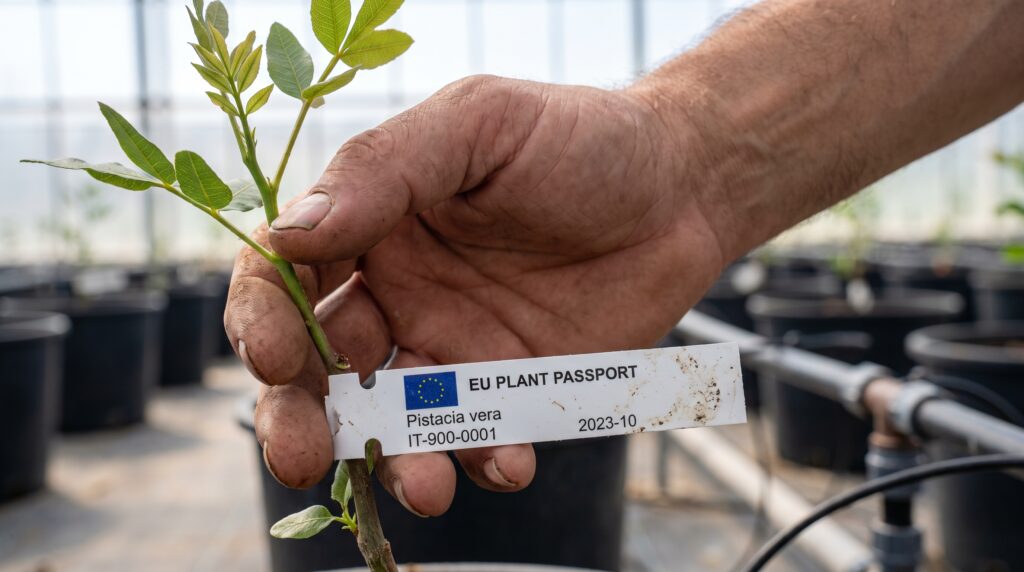
When a grower decides to establish a pistachio orchard, the first conversations are almost always about the land, irrigation, planting spacing or the choice of variety. These are fundamental decisions, but there is a small piece of paper, almost always attached to a pallet or a bundle of plants, that says a great deal about the plant health of what we are about to plant: the plant passport. 🌱
At Agro Vivero del Mediterráneo we see this every day. When we prepare an order of pistachio plants, the documentation travelling with them is as important as the plants themselves. That is why we have prepared this guide, aimed at small-scale growers planting their first hectares as well as large-scale growers who want to expand an operation with every guarantee.
We will explain what a plant passport is, when it is mandatory for pistachio plants, what information it contains, how to interpret it, who issues it and what we should check when we receive the planting material. We will also look at its relationship with the bacterium Xylella fastidiosa, which affects Pistacia vera, and answer the most common questions. 🔎
What Is a Plant Passport and Why It Matters in a Pistachio Orchard 🛂
A plant passport is an official label that accompanies certain plants when they are moved within the European Union. Its purpose is to certify that those plants meet the plant health requirements set by the regulations and, above all, to allow us to trace where each plant comes from if a problem ever appears.
It should not be confused with a delivery note or an invoice. It is not a commercial document. It is an official mark, with a format and content defined by European legislation, which can only be issued by a registered professional operator authorised to do so.
In a pistachio orchard it is particularly important for three reasons:
- 🌳 It is a long-term investment. If the starting plant carries a pest or a disease, the problem will stay with us through many production cycles.
- 🔍 It allows us to know the origin of the plants. If an incident arises, we will know which batch, which nursery and which producer are involved.
- 🛡️ It protects the whole sector. Good traceability helps contain problems before they reach neighbouring orchards.
In other words, the plant passport is the documentary guarantee that the plant arriving at our plot has been produced, inspected and marketed within a controlled system. And in a crop with a long productive life, that is an insurance that costs very little and can save a great deal. That is why, when a grower asks us for a quote, the first thing we explain is what documentation will accompany their plants.
Regulatory Framework: What the European Union and Spain Say 📜
The plant passport sits within the European plant health regime, whose cornerstone is Regulation (EU) 2016/2031 on protective measures against pests of plants. That regulation significantly broadened the use of the passport, which came to be required for most plants intended for planting.
Around that regulation there are other rules worth knowing:
- Implementing Regulation (EU) 2019/2072. Lays down uniform conditions for implementation and lists in its annexes which plants require a passport to move within the Union and which require one to move through protected zones.
- Implementing Regulation (EU) 2017/2313. Defines the format and specifications of the plant passport.
- Regulation (EU) 2017/625. Governs official controls.
- Implementing Regulation (EU) 2020/1201. Sets measures against Xylella fastidiosa, a bacterium that directly affects us, as we will see later.
- Royal Decree 1054/2021 of 30 November. In Spain it creates the Register of Professional Operators of Plants (ROPVEG) and regulates the measures to be met by operators authorised to issue plant passports.
In Spain, the Ministry of Agriculture, Fisheries and Food coordinates the system, but registrations, authorisations and inspections are managed by the autonomous communities (regional governments). So, for any specific procedure, we always recommend consulting the plant health service of the region or country where the company or farm is located.
This article is for informational purposes and does not replace legal advice or the guidance of the competent authority. Our aim is for growers to enter the conversation with their supplier and with the authorities knowing what to ask. 🤝
Is a Plant Passport Mandatory for Pistachio Plants? ✅
As a general rule, yes. European regulations require plants intended for planting, that is, those that are to remain planted, to be planted or to be replanted, to be accompanied by their plant passport when moved within the European Union. Seeds follow a different regime.
This applies fully to pistachio plants, whatever their presentation: bare-root, in containers or in any other nursery format. It also applies to the replacement of failed plants, because a plant that replaces one that has not established is, from a plant health standpoint, a plant for planting like any other.
Is there any exception? The European regulation provides an exemption for plants intended for sale to final users, provided the sale is not made by distance contract and does not involve movements in protected zones. Think of a private individual buying a tree for their garden.
A professional agricultural orchard is a very different scenario. In our experience, anyone acquiring plants for a commercial operation should always require the mandatory plant passport, and if in any doubt about their specific case, they should ask the plant health service of their region or national authority.
There is a detail that many growers are unaware of: purchases made online or by telephone are not exempt. If we buy plants at a distance, the plant passport is still required.
What Information a Plant Passport Contains 🧾
The plant passport has a standardised format, so that any grower, technician or inspector can read it the same way in any EU country. At the top appear the words “Plant Passport”, followed by four sections identified by a letter.
| Letter | What it indicates | How to interpret it |
|---|---|---|
| A | Botanical name of the species | In our case, Pistacia vera must appear |
| B | Country code of the producer and registration number of the professional operator | Identifies the nursery issuing the passport. For Spanish operators it begins with “ES” |
| C | Traceability code | Links the batch of plants to the nursery’s records |
| D | Country code of origin or production | Indicates where the material comes from |
The traceability code may be a combination of letters and numbers chosen by the operator and may be supplemented by a QR code or other data carriers. It is, without doubt, the most useful element when an incident needs to be investigated, because it connects the plant in our plot with its history.
In addition to the standard model, there is a specific model for protected zones, marked “PZ”, and also models that are combined with the label of the plant reproductive material. If we receive a passport in a format we do not recognise, it is best to ask the nursery before planting.
How to Read a Plant Passport Step by Step 🔎
Interpreting a passport does not require being a technician. It is enough to follow a logical order:
- We check the heading. It must read “Plant Passport” and not be some other type of commercial label.
- We verify the botanical name. In an order of pistachio plants, Pistacia vera must appear.
- We review the registration number. Section B identifies the operator. If it does not match the nursery that sold us the plants, it should be clarified.
- We note the traceability code. It is the key to connecting each batch of plants with its history.
- We check the country of origin. Section D must match what we were told when buying.
- We cross-check with the delivery note. The traceability code and quantities must be consistent with the delivery documentation.
A practical example: if we receive 1,200 plants on three pallets, each with its own label, the ideal is to photograph the three passports on the day of delivery and keep them together with the delivery note. It takes a minute and can settle a question several years later.
Who Issues the Plant Passport: the Professional Operators Register and Authorised Operators 🏢
Not just any company can issue plant passports. To do so, the professional operator must complete a fairly demanding administrative process:
- 📝 Register in the official register of professional operators (in Spain, ROPVEG) of the region where it has its registered office and, if it has facilities in other regions, in each of them. Each operator has a single registration number, which begins with “ES” for Spanish operators and is the number shown in section B of the passport.
- 📋 Obtain authorisation to issue passports, for which it must submit an effective plan of measures, prove the necessary training, identify the critical points in the production and movement of plants, and detail the staff, equipment and facilities involved.
- 👀 Examine the plants before issuing the passport. The operator must carry out thorough checks to verify that plant health requirements are met, and its staff must be trained to do so.
- 🗂️ Maintain a traceability system and keep records for a minimum of three years.
- 🧑🔬 Undergo inspections by the competent authority, which verifies the content and format of the passports and the operator’s knowledge.
As a nursery, for us this system is not an inconvenient formality but part of product quality. A well-produced pistachio plant deserves documentation to match.
And the grower? As a general rule, anyone who acquires plants solely to plant them on their own farm does not need to issue passports. What does matter is to receive and keep them, because the obligation to keep records for three years also applies to the recipient of the material, provided they are not a final user.
Plant Passport, Xylella fastidiosa and Pistachio Plants 🦠
There is a specific reason why the plant passport is especially relevant for the pistachio sector: Pistacia vera appears in the lists of host plants and specified plants for Xylella fastidiosa in Implementing Regulation (EU) 2020/1201, as amended by Implementing Regulation (EU) 2021/1688.
Xylella fastidiosa is a bacterium with a very wide host range and is considered a priority Union quarantine pest. Outbreaks have been declared in several EU countries, including Spain, and there is official monitoring, with surveys and contingency plans.
What does this mean for anyone buying pistachio plants?
- 🌿 Host plants intended for planting must travel within the Union accompanied by their plant passport, subject to the conditions set out in the relevant chapter of Implementing Regulation (EU) 2020/1201.
- 🗺️ There are demarcated areas, zones where the bacterium has been detected, from which the movement of host plants is subject to restrictions unless the measures laid down by the regulations are met.
- 🌍 Plants from countries outside the European Union are subject to additional requirements and official border controls.
- 📌 If we receive plants that should carry a passport and they do not, it is no minor matter: it is advisable to stop planting and report it to the nursery and, where appropriate, to the authorities.
Our advice here is simple. If the plant comes from a nursery that works with traceability, can show us its documentation and explains clearly the origin of the material, we greatly reduce the risk of introducing plant health problems into our farm. Our pistachio plants are produced with that approach.
Plant Passport, Phytosanitary Certificate and Other Documents: Differences 📑
When we buy plants, several documents appear. They do not all serve the same purpose and it is common to confuse them. This table helps to clarify:
| Document | When it is used | What it certifies |
|---|---|---|
| Plant passport | Movement of plants within the European Union | That the plants meet plant health requirements, and it allows their traceability |
| Phytosanitary certificate | Import from countries outside the European Union | That the plants have been inspected by the plant protection authority of the exporting country |
| Label or document for the plant material | Marketing of nursery plants | Identity and category of the plant material, depending on the type of material |
| Delivery note or invoice | Any sale | Quantities, prices and commercial data, but not the plant health status |
The practical point is clear: a delivery note or an invoice never replaces a plant passport. If a supplier tells us the invoice is enough, we should be wary.
Nor does the plant passport in itself guarantee genetic quality or varietal identity. Its function is plant health and traceability. That is why, in addition to the passport, we always recommend asking for clear information on the variety, the rootstock and the characteristics of the material.
What to Check When Receiving Pistachio Plants 📦
The moment of delivery is the best time to detect any anomaly. This is the checklist we recommend to our customers, both to those planting a few hectares and to those receiving several thousand plants:
- ✔️ That each batch or pallet carries its plant passport in a visible place.
- ✔️ That the botanical name is Pistacia vera.
- ✔️ That the registration number in section B corresponds to the nursery shown on the invoice.
- ✔️ That the traceability code matches the one on the delivery note or documentation.
- ✔️ That the country of origin is the one indicated to us.
- ✔️ That the plants arrive in good condition: no wilting, no conspicuous necrosis and a healthy root system.
- ✔️ That we photograph the labels and file them with the rest of the plant documentation.
- ✔️ That we record which plot each batch is planted in.
This last point is the one our customers appreciate most as time goes by. Knowing which batch of plants is in which plot turns a potential incident into a contained, manageable problem.
Common Mistakes When Buying Pistachio Plants Without Documentation 🚫
Over time we have seen situations that repeat themselves and that can easily be avoided:
- Buying on price alone. A slightly cheaper plant without clear documentation can turn out extremely expensive if it carries a plant health problem.
- Accepting the invoice as the only document. As we have seen, it does not replace the passport.
- Throwing away the labels on planting day. The label is part of our records and we should keep it, or at least a photograph of it.
- Mixing batches on the farm without recording it. If we later need to trace an origin, it will be impossible.
- Forgetting replacement plants. Plants added later also need their passport.
- Thinking that, if there are only a few plants, it is not needed. The regulations do not distinguish between small and large operations when it comes to professional planting.
None of these mistakes is serious if caught in time. The difficulty is discovering them when the plants are already in the ground, the plot is ready and the planting schedule is tight. That is why we insist on checking the documentation on the day of delivery rather than leaving it for later. A call to the nursery at that moment usually settles almost any doubt.
A Practical Example: A 10-Hectare Orchard 🧮
To see how useful traceability is, let us imagine a 10-hectare farm with a planting spacing of 6 x 5 metres. This means approximately 333 plants per hectare, that is, around 3,330 plants in total. This is an indicative example, since actual spacing depends on the terrain, the variety and the management system.
Let us suppose the grower receives the material in three deliveries, each with its own passport and traceability code, and plants each delivery in a different plot. They record the date, plot and batch in their farm logbook.
Eighteen months later, plants showing symptoms they cannot identify appear in one of the plots. Thanks to the documentation, they can tell the technician and the authorities exactly which batch it is, which nursery produced it and when it was received. Without that information, they would have to investigate the entire farm.
That is the difference between improvising and working with method. And it also connects directly with profitability: an orchard that starts out healthy and well documented avoids unexpected costs. If we want to look at the figures in more depth, we can consult our analysis of pistachio orchard profitability. 📈
Importing Pistachio Plants from Outside the European Union 🌍
Some growers, attracted by lower prices or by specific varieties, consider importing pistachio plants from countries outside the Union. It is legally possible, but much more complex.
In that case, the plants must be accompanied by a phytosanitary certificate issued by the official authority of the exporting country and undergo official controls at the point of entry into the Union. Since Pistacia vera is included among the host plants of Xylella fastidiosa, the requirements and checks are even stricter.
Our recommendation is that, before considering an import, the grower weighs plant health, lead times, the risk of rejection at the border and the difficulty of making a claim if something goes wrong. Buying from an EU-based nursery with full traceability usually simplifies the whole process.
How We Work at Agro Vivero del Mediterráneo to Offer Plants with Guarantees 🌳
For us, documentation is part of the product. We work so that every order of pistachio plants arrives with its documentation in order, with the material identified and with clear information on its origin.
But we do not simply deliver plants. We support the grower before, during and after planting:
- 🧭 Technical advice to choose varieties, rootstocks and planting spacings suited to each farm.
- 🌱 Planting planning, from the delivery schedule to the reception of the material.
- 📚 Clear information on the documentation that must accompany the plants.
- 🤝 Follow-up support to resolve any questions that arise during the first years of the orchard.
All of this is part of our services for growers, designed both for those taking their first steps with pistachios and for those managing large areas. The pistachio is a long-cycle tree nut crop, and every decision we make at the start shapes what will happen throughout the life of the orchard.
When a grower asks us about documentation, we prefer to explain in detail what they will receive and why. An informed customer demands more, compares better and makes safer decisions, and that benefits the whole chain, from the nursery to the harvest.
Frequently Asked Questions About the Plant Passport for Pistachio Plants ❓
What is a plant passport in a nutshell?
It is an official label that accompanies plants moving within the European Union and certifies that they meet plant health requirements, as well as allowing their origin to be traced.
Who should demand it, the nursery or the grower?
It is issued by the nursery, or by any authorised professional operator, but the grower should demand it and check it when receiving the plants. It is their first documentary guarantee.
Can I plant if the plants arrive without a passport?
Our recommendation is not to. The prudent course is to contact the supplier, request the documentation and, if it is not resolved, consult the plant health authority of the region or country.
Is a passport needed if I buy the plants online?
Yes. The exemption for final users does not apply to sales made by distance contract.
How long must it be kept?
A minimum of three years. That obligation applies to the operator who issues it and also to the one who receives the plants, provided they are not a final user.
Does the passport guarantee that the variety is correct?
No. Its function is plant health and traceability. Varietal identity and the category of the material are checked through the label and documentation of the plant material, which is why it is advisable to buy from a trustworthy pistachio nursery.
Does the passport change depending on the region?
The format is defined by European regulations, so it is the same throughout the Union. What may vary are the registration and authorisation procedures, which are managed by each region.
The Next Step: Let’s Plant with Confidence 🚀
Let us review the key ideas. The plant passport is an official label, mandatory as a general rule for plants for planting moving within the Union. It contains the botanical name, the operator’s registration number, the traceability code and the country of origin. It must be issued by a registered and authorised professional operator. And in the case of pistachio, the relationship between Pistacia vera and Xylella fastidiosa makes traceability even more important.
For growers, the rule is simple: demand the passport, check it, photograph it and file it. It is a minimal gesture that protects an investment that will last a long time and will spare us quite a few future headaches.
If you are considering buying pistachio plants for a new orchard or to expand your existing one, our team can help you resolve questions about varieties, timing and documentation. You can contact us to present your case, or directly request a no-obligation quote for pistachio plants. We would be delighted to accompany you in a project that, well planned, can bring many rewards. 🌰