


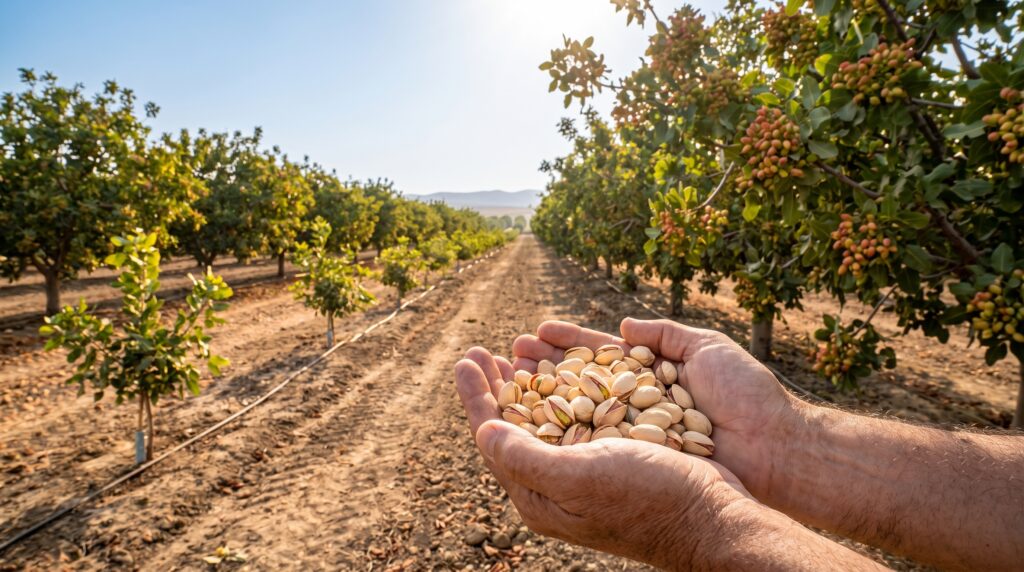
Before planting the first row, almost all the growers who come to us ask the same question: how much money will I need to put in, for how many years, and when will it start coming back to me? 💶 That question is answered by the cash flow of one hectare of pistachios year by year. It is the tool we use every day at Agro Vivero del Mediterráneo to support growers who want to establish a pistachio plantation or expand an existing one.
The pistachio is a high-value nut crop, but it is also a long-term investment. During the first few years there are only costs. Then the first harvests arrive and, once the plantation matures, revenue clearly exceeds costs. Seeing this with real numbers avoids surprises, makes it possible to plan financing and helps you decide with confidence.
In this article we break down, using indicative figures, how one hectare of drip-irrigated pistachios performs from year 0 to year 15. We explain where each item comes from, what happens if the price rises or falls, and which mistakes are best avoided. 🌳
What Is the Cash Flow of One Hectare of Pistachios and Why Does It Matter? 🌱
Cash flow is the difference between the money coming in and the money going out each year. In an annual crop, this balance is usually positive from the very first season. In a pistachio plantation, things work differently: the tree needs time to come into production, so the balance is negative for several years and then turns positive.
That is why we talk about three key moments:
- Initial investment: the outlay in year 0, when we prepare the land, install the irrigation system and plant.
- Peak funding requirement: the point at which the cumulative amount invested is at its highest. It is the number most worth knowing in advance.
- Investment payback: the year in which cumulative cash flow turns positive.
Many projects fail not because the crop is unprofitable, but because the grower had not anticipated how much money would be needed until the first harvest. A well-built cash flow projection is the best protection against that mistake. 🛡️
If you would like a broader analysis, you can consult our page on the profitability of a pistachio plantation, where we expand on these concepts.
Starting Assumptions: The Figures We Have Used 📋
Every cash flow projection depends on the assumptions behind it. We have chosen a prudent scenario, designed for a drip-irrigated pistachio plantation in an area with a suitable climate, using well-adapted varieties such as Kerman with Sirora as the pollinator. These are the bases of the calculation:
| Item | Assumption |
|---|---|
| Area | 1 hectare |
| Planting layout | 7 x 5 metres |
| Plants per hectare | 285 (including pollinators) |
| Irrigation system | Drip irrigation |
| Selling price | €5 per kg of in-shell pistachios |
| Yield at maturity | 3,500 kg per hectare |
| Analysis period | 15 years |
It is worth clarifying what the model does not include: it does not count the purchase or rental of the land, financing interest, taxes or possible grants. Nor does it reflect price variation between seasons. Every farm has its own particularities, so these figures are a reference for understanding how the crop behaves, not a promise of results. 📌
Year 0: The Initial Investment for One Hectare of Pistachios 🚜
Year 0 is the heaviest for cash. This is where the cost of planting one hectare of pistachios is concentrated, and it is worth being clear about it from the start:
| Item | Indicative amount |
|---|---|
| Land preparation and subsoiling | €600 |
| Pistachio plants (285 units) | €2,850 |
| Drip irrigation system and irrigation head unit | €3,500 |
| Planting, stakes and tree guards | €900 |
| Analyses, project design and other expenses | €500 |
| Total | €8,350 |
Two of these items deserve special attention. The first is the quality of the pistachio plants. It is the decision that most affects the next thirty years of the plantation, and saving money here is usually very expensive. On our pistachio plants page we explain how we approach selection and nursery production.
The second is the irrigation system. A properly sized irrigation head unit and a well-designed drip network reduce water and energy consumption throughout the life of the plantation. 💧
In a real project these figures vary with soil type, slope, distance to the water source or the number of plants, but the order of magnitude is the one shown.
Years 1 to 3: The Establishment Phase and the First Negative Figures 🌿
During these years the tree grows but does not yet produce. Costs are moderate, but there is no revenue. The main tasks are:
- irrigation adjusted to the development of the plant;
- formative pruning to give the tree its structure;
- weed control;
- fertilisation adapted to the needs of each season;
- pest and disease monitoring and replacement of failed plants.
Our annual cost estimates for this phase are:
- Year 1: €1,500
- Year 2: €1,700
- Year 3: €2,000
Cumulative cash flow at the end of year 3 reaches –€13,550 per hectare, adding the initial investment and the first three years of maintenance. 📉
The most important thing at this stage is not to neglect the tree in order to save money. Well-executed formative pruning and regular irrigation shorten the time to the first harvest. Poor tree training can delay it by a year or more, and that delay costs money.
Years 4 to 6: The First Harvest and the Turning Point 🌳
Between the fourth and sixth years the first harvest arrives. We should not expect large volumes: the tree begins producing only modestly and gains yield with each season.
We have modelled this phase as follows:
| Year | Yield (kg/ha) | Revenue | Costs | Annual cash flow |
|---|---|---|---|---|
| 4 | 0 | €0 | €2,400 | –€2,400 |
| 5 | 300 | €1,500 | €2,900 | –€1,400 |
| 6 | 800 | €4,000 | €3,500 | +€500 |
Year 6 marks an important psychological and financial shift: for the first time, annual cash flow is positive, although the cumulative balance is still negative.
This is also the point at which the peak funding requirement occurs. At the end of year 5, the cumulative balance reaches –€17,350 per hectare. If you have planned your cash position well, that number should not alarm you, because it is the lowest point before the curve starts to rise. If you had not anticipated it, it can become a serious problem. ⚠️
Years 7 to 10: The Plantation Accelerates 📈
From year 7 onwards, yield grows rapidly and revenue moves away from costs. Our model forecasts:
- Year 7: 1,500 kg per hectare, €7,500 in revenue
- Year 8: 2,200 kg, €11,000 in revenue
- Year 9: 2,800 kg, €14,000 in revenue
- Year 10: 3,200 kg, €16,000 in revenue
Costs also rise, because there is more crop to harvest, more pruning to carry out and more fertiliser to apply. They go from €4,000 in year 7 to €5,000 in year 10. Even so, the margin grows strongly:
- Year 7: +€3,500
- Year 8: +€6,600
- Year 9: +€9,300
- Year 10: +€11,000
In year 9, cumulative cash flow turns positive (+€2,550). This is the moment when we can say the initial investment has been recovered. From here on, every year that passes is, in practice, accumulated profit. 🎉
From Year 11 Onwards: Steady-State Production 🌾
When the plantation reaches productive maturity, it enters what we call steady-state production. In our model, this means around 3,500 kg per hectare per year, around €17,500 in revenue and around €5,000 in costs. The annual margin comes to around €12,500 per hectare.
Maintaining that level depends on three things:
- irrigation and fertilisation that are consistent with the crop load;
- annual pruning that maintains the balance between wood and crop;
- pest and disease monitoring that prevents losses.
With these assumptions, the 15-year cumulative total would be around €76,050 per hectare. This figure illustrates the logic of the crop well: the difficult part is the early years, and the most profitable part comes later. ⏳
Summary Table: Cash Flow of One Hectare of Pistachios Year by Year 📊
This is the complete table using the assumptions above. Amounts are in euros per hectare:
| Year | Yield (kg) | Revenue | Costs and investment | Annual cash flow | Cumulative cash flow |
|---|---|---|---|---|---|
| 0 | 0 | 0 | 8,350 | –8,350 | –8,350 |
| 1 | 0 | 0 | 1,500 | –1,500 | –9,850 |
| 2 | 0 | 0 | 1,700 | –1,700 | –11,550 |
| 3 | 0 | 0 | 2,000 | –2,000 | –13,550 |
| 4 | 0 | 0 | 2,400 | –2,400 | –15,950 |
| 5 | 300 | 1,500 | 2,900 | –1,400 | –17,350 |
| 6 | 800 | 4,000 | 3,500 | +500 | –16,850 |
| 7 | 1,500 | 7,500 | 4,000 | +3,500 | –13,350 |
| 8 | 2,200 | 11,000 | 4,400 | +6,600 | –6,750 |
| 9 | 2,800 | 14,000 | 4,700 | +9,300 | +2,550 |
| 10 | 3,200 | 16,000 | 5,000 | +11,000 | +13,550 |
| 11 | 3,500 | 17,500 | 5,000 | +12,500 | +26,050 |
From year 11 onwards, annual cash flow remains at around €12,500 in our steady-state scenario, so that over 15 years the cumulative total reaches around €76,050.
Break-Even Point: When Do We Recover the Investment? ⏱️
The break-even point is the moment when cumulative cash flow stops being negative. In our model it arrives in year 9, and from then on the plantation generates net profit on top of the amount invested.
It is worth distinguishing two ideas that are sometimes confused:
- Positive annual cash flow: this occurs in year 6. It means the plantation already covers its own costs each season.
- Investment payback: this occurs in year 9. It means we have already recovered everything invested since the beginning.
With these assumptions, the internal rate of return over 15 years exceeds 15%, a figure that explains why so many growers see pistachios as an alternative to other tree crops. Even so, this is a theoretical calculation: every plantation will have its own figures, and our advice is always to run the numbers with the real data from your farm. 🧮
Maintenance Costs at Full Production 🔧
A common question is where the €5,000 of annual costs goes once the plantation is mature. This is the indicative breakdown:
| Item | Approximate annual amount |
|---|---|
| Irrigation water and energy | €1,100 |
| Fertilisation | €900 |
| Plant protection treatments | €500 |
| Pruning | €500 |
| Weed control and soil tillage | €300 |
| Mechanised harvesting (contracted or own equipment) | €900 |
| Drying and hulling | €300 |
| Insurance, irrigation maintenance and management | €500 |
| Total | €5,000 |
Maintenance costs vary by region, energy prices, water availability and whether harvesting is done with your own machinery or contracted out. On small farms, contracting the harvest is usually the better option; on large farms, it is worth evaluating investment in your own or shared machinery. 🚜
Sensitivity Analysis: How Price and Yield Affect the Numbers 🎯
Cash flow depends on two variables that we do not fully control: the price of in-shell pistachios and the yield of each season. That is why a sensitivity analysis is useful, that is, seeing what happens if the scenario changes.
Effect of price (with 3,500 kg per hectare and €5,000 in costs):
| Price (€/kg) | Revenue | Annual margin |
|---|---|---|
| 4.0 | €14,000 | €9,000 |
| 5.0 | €17,500 | €12,500 |
| 6.0 | €21,000 | €16,000 |
| 7.0 | €24,500 | €19,500 |
Effect of yield (at a price of €5/kg):
| Yield (kg/ha) | Revenue | Annual margin |
|---|---|---|
| 2,500 | €12,500 | €7,500 |
| 3,000 | €15,000 | €10,000 |
| 3,500 | €17,500 | €12,500 |
| 4,000 | €20,000 | €15,000 |
As can be seen, even at a price of €4 per kg, the margin at maturity remains clearly positive. Nut prices have fluctuated between seasons, which is why we recommend always evaluating a prudent scenario and an optimistic one before making a decision. 📈
Alternate Bearing and Its Effect on Cash Flow 🔄
The pistachio has a natural tendency towards alternate bearing: years of heavy crops followed by years of lighter production. It is not a defect, it is a biological characteristic of the tree, although it can be moderated.
In practice, the real cash flow of a pistachio plantation will not be a straight line like the one in our table. There will be seasons above the average and others below. To manage it well we recommend:
- Setting aside liquidity in good years to cover the leaner ones.
- Taking care of pruning and fertilisation, which help balance production between seasons.
- Ensuring good pollination, with well-positioned male trees whose flowering period coincides.
- Monitoring irrigation during nut filling.
A plantation managed with care greatly reduces the swing of alternate bearing. And if the farm is large, splitting the area into blocks with slightly different management helps stabilise revenue. 🌤️
Irrigated Pistachios or Rain-Fed Pistachios: How Does Cash Flow Change? 💧
Everything above refers to irrigated pistachios. It is the option that delivers higher and more consistent yields, and the one that responds best to supplementary irrigation when the climate is demanding.
Rain-fed pistachios also exist and make sense in areas with sufficient rainfall and deep soils. The general comparison is as follows:
| Aspect | Irrigated | Rain-fed |
|---|---|---|
| Initial investment | Higher (includes irrigation) | Lower |
| Time to production | Faster | Slower |
| Yield at maturity | Higher and more consistent | Lower and more variable |
| Annual costs | Higher | Lower |
| Climate risk | Lower | Higher |
In rain-fed systems the initial investment is lower, but so are the yields and their consistency. That is why, in each case, it is advisable to calculate the cash flow with the real data of the farm: there is no universal answer. If you have doubts about which option suits your land better, our team can guide you through our technical advisory services. 🤝
Mistakes That Sink Cash Flow (and How to Avoid Them) 🚫
After supporting growers on many plantations, we have seen that profitability problems tend to repeat themselves. These are the most common:
- Underestimating the investment: budgeting only for the purchase of plants and forgetting irrigation, soil preparation or the costs of the first few years.
- Not anticipating the peak funding requirement: running out of liquidity just before the plantation starts to produce.
- Choosing plants without guarantees: poor-quality plant material compromises yield throughout the life of the plantation.
- Choosing the wrong planting layout: too high a density complicates mechanisation and plant health; too low wastes land.
- Neglecting pollination: without enough well-chosen pollinators, the harvest suffers.
- Delaying formative pruning: a poorly trained tree takes longer to produce and is harder to manage.
- Ignoring soil and water analysis: salinity or poor drainage can ruin a project that looked perfect on paper.
- Not measuring: without keeping accounts by plot, it is impossible to know what works and what does not.
Almost all of these mistakes can be avoided with a good preliminary study. That is why our advice is to invest time in planning before planting. 🔍
How to Improve the Cash Flow of Our Pistachio Plantation ✅
Once the plantation is up and running, there are several levers we can pull to improve the numbers:
- Adjust irrigation using data: soil moisture probes and phase-based scheduling reduce water use without lowering the harvest.
- Fine-tune fertilisation with leaf analysis: applying what the tree needs, no more and no less, saves costs and improves quality.
- Mechanise pruning and harvesting when the scale justifies it.
- Sell well: compare offers, consider delivery to cooperatives or processors, and look into direct sales of processed product.
- Diversify the work calendar so as not to depend on a single season.
- Seek synergies with other growers: sharing machinery, drying facilities or marketing reduces the unit cost.
- Keep rigorous financial control of every plot and every season.
Each of these measures may seem small on its own, but together they make a noticeable difference to the final result. 📊
Small and Large Growers: How Does Cash Flow Change? 👨🌾
Performance per hectare is similar, but the strategy is not.
If you have a small area (one to five hectares), pistachios can be an excellent way to supplement income. The most important thing is to control harvesting costs well and look for collaboration arrangements, because owning your own machinery rarely pays off. It is also advisable to plant in phases, so as not to concentrate the whole investment in a single year.
If you have a large area, the focus is on scale: negotiating the supply of plants and materials, planning an efficient irrigation project, sizing the machinery and staggering plantings to spread the risks of alternate bearing and cash flow. Planning in blocks means that while one plot is in the establishment phase, another is already generating revenue.
In both cases, the exercise is the same: start from a realistic cash flow projection and adapt it to your situation. We can help you build it from the specific data of your farm. 🌟
Frequently Asked Questions About the Cash Flow of One Hectare of Pistachios ❓
How much does it cost to plant one hectare of pistachios?
In our model, the year-0 investment is around €8,350 per hectare. It varies with the terrain, the irrigation system and the number of plants.
How long does a pistachio plantation take to become profitable?
The first harvest arrives around year 5. Annual cash flow is positive from year 6 and the investment is recovered around year 9.
How many kilos of pistachios does a mature hectare produce?
With irrigation and good management, we work with around 3,500 kg per hectare in steady-state production, although each season can vary.
What price for in-shell pistachios should be used in the calculations?
We recommend a prudent price, such as €5 per kg, and testing it against a lower and a higher scenario.
Can the initial investment be reduced?
Yes, by adjusting the irrigation design, planting in phases or looking for grants. What we do not advise is saving on the quality of the plants.
Does this calculation work for any farm?
It is a reference, not a closed quote. For your case, it is advisable to carry out a study with real data on soil, water, climate and area.
To Wrap Up: What We Should Remember ✨
The cash flow of one hectare of pistachios follows a very clear pattern. There is an initial investment in year 0, several years of costs without revenue and a peak funding requirement around year 5. Then the first harvest arrives, annual cash flow turns positive around year 6 and the investment is recovered around year 9. Once the plantation enters steady-state production, the annual margin can approach €12,500 per hectare in our prudent scenario.
The keys to achieving those numbers are well known: quality plants, a well-designed irrigation system, timely pruning and fertilisation, good pollination and orderly financial management. With these, the pistachio can become a stable and profitable crop in the long term, for a small grower and a large-scale operation alike. 🌱
At Agro Vivero del Mediterráneo we have been supporting growers at every step, from choosing the plants to setting up the plantation. If you would like us to calculate the cash flow of your farm, you can contact us or request your personalised quote directly. We will be delighted to help you take the first step. 🤝