
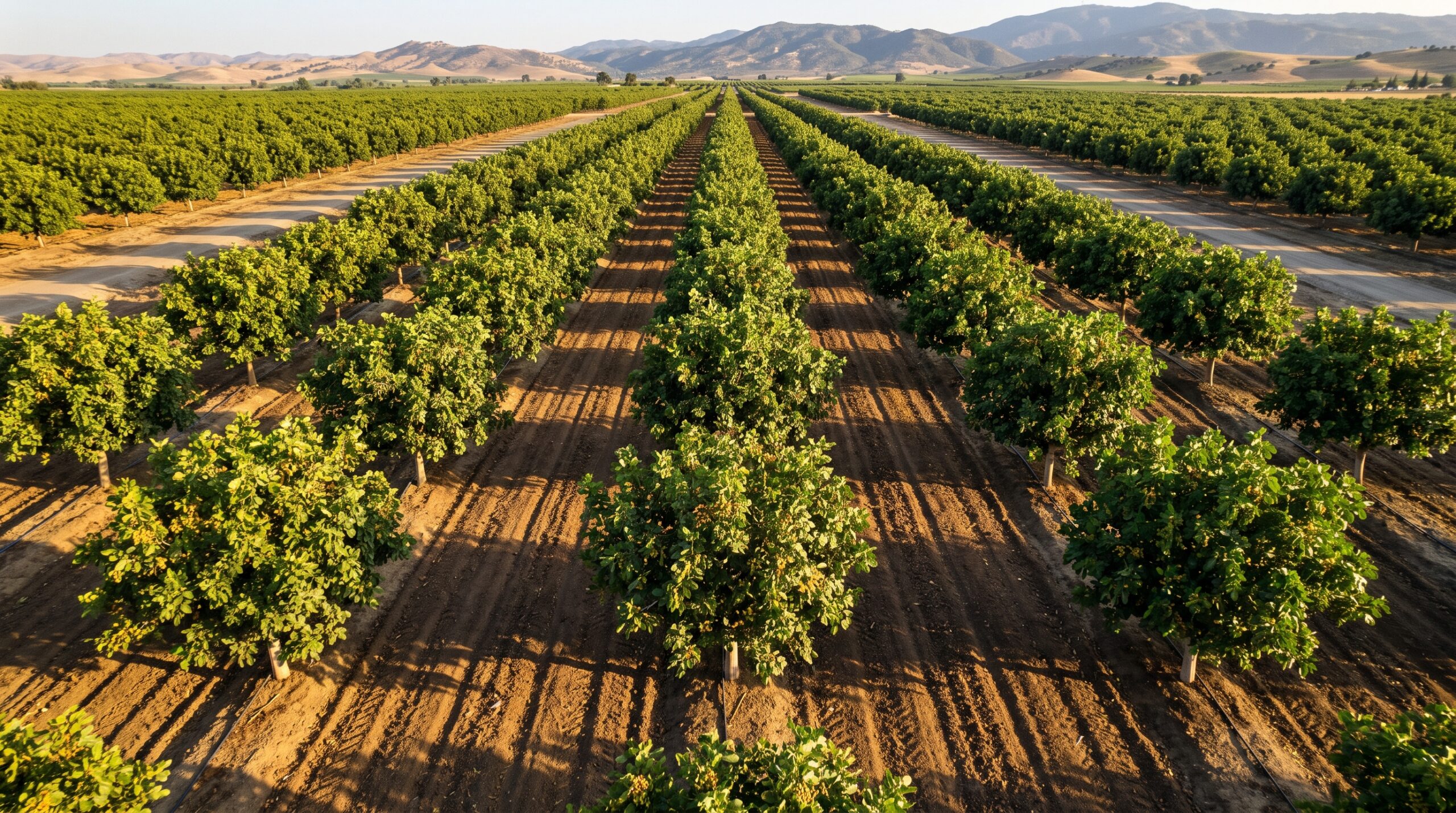
How Many Pistachio Trees Fit in One Hectare in 2026? 🌳 A Complete Guide to Planting Density
When someone starts planning a pistachio orchard, one of the first questions we hear every day at Agro Vivero del Mediterráneo is exactly this: how many pistachio trees fit in one hectare? It sounds like a simple question, but the answer has far more depth than it appears at first glance, because much of the orchard’s future profitability depends on it.
There is no single figure that applies to every situation. Planting density depends on the spacing pattern chosen, the soil type, whether the orchard is rainfed or irrigated, the machinery available, and each grower’s production goals. In this article we’ll explain, with real data and practical examples, how to calculate the number of trees per hectare that best suits each project 🌱.
As pistachio cultivation specialists, we have spent years guiding both smallholders and large-scale growers through the entire process: from feasibility studies to planting and subsequent orchard management. That’s why, before giving a specific figure, we prefer to walk through the reasoning behind it, since making this decision without the right information can shape the orchard’s results for many years to come.
Why Is It So Important to Calculate Planting Density Correctly?
Planting density — that is, the number of pistachio trees placed per hectare — has a direct influence on several key aspects:
- Total production per hectare in the medium and long term.
- The initial investment cost in planting stock.
- How easily maintenance and harvesting operations can be mechanized.
- Air circulation and the overall health of the orchard.
- Efficient use of irrigation water.
- The orchard’s overall profitability.
A spacing pattern that is too tight can create competition between trees for light, water, and nutrients, reducing each tree’s individual yield. Conversely, a density that’s too low wastes available land and delays the return on investment. Finding the right balance is, in fact, one of the most important technical decisions in the entire project 📊.
Before going further, it’s worth remembering that the pistachio tree is dioecious — meaning there are separate male and female plants — and this also directly affects the density calculation, as we’ll see further on.
Factors That Determine How Many Pistachio Trees Fit in One Hectare
There isn’t just one variable to consider. Based on our experience, these are the factors that most influence the final density of a pistachio orchard:
1. The chosen planting pattern
The planting pattern refers to the distance between trees within the same row and the distance between rows. The greater that distance, the fewer trees fit per hectare, but each tree has more room to develop.
2. The irrigation system
In an irrigated orchard, a controlled water supply allows for somewhat tighter spacing, since the tree doesn’t rely solely on natural soil moisture. In rainfed orchards, by contrast, more space between trees is usually needed so each one has access to sufficient water reserves.
3. Soil type
Deep, well-drained soil with good structure allows for broader root development, which favors wider spacing and more vigorous trees. In poor or shallow soils, tree behavior can differ significantly.
4. Available machinery
If the orchard will be mechanized — both for maintenance work and for harvesting with a trunk shaker — sufficient access lanes must be left for machinery to pass through. This directly determines the minimum width between rows.
5. The proportion of pollinator trees
As mentioned earlier, pistachio orchards need male trees to pollinate the females, which are the ones that produce the nuts. This proportion is also part of the overall tree-per-hectare calculation, even though not every tree yields a direct harvest.
6. The grower’s production objectives
Designing an orchard to maximize medium-term production is not the same as planning one focused on minimizing initial costs. Each approach may call for a different spacing pattern.
If you’d like to explore the available varieties and their characteristics in more depth, our pistachio plants page explains in detail the options we work with and which one best suits each type of land and climate.
Most Common Planting Patterns in Pistachio Cultivation
Below is a reference table showing the most widely used planting patterns and the approximate number of trees per hectare each one produces. These are reference figures; the final spacing should always be confirmed after a technical assessment of the land 🧭.
| Planting Pattern (m) | Area per Tree (m²) | Approximate Trees per Hectare |
|---|---|---|
| 6 x 6 | 36 | 277 |
| 6 x 5 | 30 | 333 |
| 6 x 4 | 24 | 416 |
| 7 x 5 | 35 | 285 |
| 7 x 4 | 28 | 357 |
| 5 x 4 | 20 | 500 |
| 5 x 3 | 15 | 666 |
As you can see, the range is wide: from just under 300 trees per hectare in more open patterns to close to 700 trees per hectare in more intensive ones. Generally speaking, rainfed orchards on lower-quality soils tend to use wider spacing, such as 7 x 5 or 6 x 6, while irrigated orchards under good agronomic management typically use tighter patterns, such as 6 x 4 or 5 x 4.
Based on our experience working with growers across a wide range of regions, the most balanced pattern for most irrigated projects tends to fall around 400 trees per hectare, since it allows for good canopy development without sacrificing efficient use of the land.
Practical Example: Calculating Trees per Hectare
Let’s walk through a real example, the same way we would explain it to any grower who contacts us for advice 📞.
Suppose a grower has a 10-hectare irrigated plot and decides to use a 6 x 4 meter planting pattern.
Step 1: Calculate the area occupied by each tree. 6 m x 4 m = 24 m² per tree.
Step 2: Divide the total area of one hectare (10,000 m²) by the area occupied by each tree. 10,000 m² / 24 m² = 416.6 trees per hectare, which in practice is rounded down to 416 trees.
Step 3: Multiply by the total number of hectares. 416 trees x 10 hectares = 4,160 trees in total.
Of those 4,160 trees, a portion must be allocated to male pollinators, as explained in the next section, so the final number of productive (female) trees will be somewhat lower than the total calculated.
This is exactly the kind of calculation we carry out with each client when they request a quote, since it allows us to determine the exact quantity of planting stock required and plan the project’s initial costs with precision.
The Ratio of Male to Female Trees: A Variable You Can’t Afford to Overlook
One of the most common mistakes we see among growers new to this crop is failing to properly account for the proportion of male plants needed to ensure good pollination.
Pistachio trees flower before their leaves emerge and rely on wind to carry pollen from the male flowers to the female ones. That’s why it’s essential to have a well-distributed network of pollinators throughout the orchard, not just around the edges of the plot.
As a general guideline:
- It’s recommended to allocate between 8% and 10% of total trees to male pollinators.
- Males should be spread evenly across the entire area rather than concentrated in one spot.
- The prevailing wind direction in the area should be factored into pollinator placement.
- Male varieties should be chosen so their flowering period matches that of the selected female variety.
Continuing with the example above, of the 4,160 trees calculated for the 10 hectares, roughly 332 to 416 should be male pollinators, with the remainder serving as productive female trees. This figure is critical for calculating both the initial investment and expected yield, and it’s one of the points we always review in detail as part of our technical advisory service.
Planting Density: Rainfed vs. Irrigated Orchards
Water availability is probably the factor with the greatest influence on the final planting pattern. Here’s a clearer side-by-side comparison:
| Aspect | Rainfed | Irrigated |
|---|---|---|
| Typical pattern | Wider (6×6, 7×5, 7×6) | Tighter (6×4, 5×4) |
| Approximate trees per hectare | 200 – 300 | 350 – 500 |
| Competition for water | High if spacing is tight | Controlled through irrigation |
| Entry into production | Slower | Faster |
| Potential yield per hectare | More moderate | Higher |
| Initial investment in planting stock | Lower | Higher |
In rainfed orchards, each tree needs more surface area to develop a root system capable of capturing sufficient soil moisture, particularly in lower-rainfall regions. In irrigated orchards, by contrast, since water supply is controlled, it’s possible to work with more intensive spacing without placing excessive stress on the trees 💧.
Many growers ask us whether it’s worth converting a rainfed orchard to irrigation, or designing the project from the outset with drip irrigation. On our profitability page we go into detail about how this decision affects economic results over the medium and long term.
Benefits of Choosing the Right Planting Density
Getting the number of trees per hectare right isn’t just a technical matter — it has a direct impact on the project’s profitability. Here are some of the benefits of getting it right from the start:
🌿 Better use of sunlight across the entire canopy.
💧 More efficient use of irrigation water, avoiding unnecessary competition between plants.
🚜 Easier mechanization of pruning, treatments, and harvesting.
🐝 Better pollination thanks to a balanced distribution of male and female trees.
📈 Optimized initial investment in planting stock, avoiding unnecessary expense.
🌳 Healthier trees, with lower incidence of fungal disease due to improved air circulation.
💰 A better balance between establishment cost and expected medium-term yield.
Common Mistakes When Calculating Planting Density
Based on our experience advising projects of every size, here are the mistakes we most often see growers make when starting out in pistachio cultivation without proper technical guidance:
Not accounting for future canopy growth. The pistachio tree grows slowly but, over the years, develops a wide canopy. A spacing pattern that looks right in the early years can prove too tight once the trees reach full maturity.
Forgetting the space machinery needs. Designing an orchard without considering the passage of a trunk shaker or treatment equipment can lead to costly changes down the line.
Miscalculating the pollinator ratio. As explained above, poor distribution or an insufficient percentage of male trees directly reduces the whole orchard’s production, no matter how well the spacing pattern is chosen.
Copying another orchard’s spacing without analyzing local conditions. Every plot has different soil, climate, and water availability. What works in one area isn’t necessarily the best option elsewhere.
Failing to plan the initial investment with real figures. The number of trees per hectare directly determines the budget required for planting stock, so it’s essential to calculate it precisely before getting started.
For these reasons, we always recommend carrying out a preliminary assessment before settling on a final planting pattern. We put our accumulated experience working with a wide variety of soil types and climates at the disposal of every grower we work with.
Frequently Asked Questions About Pistachio Planting Density
How many pistachio trees should be planted per hectare on average? Generally speaking, most irrigated orchards fall between 350 and 450 trees per hectare, although this figure can vary depending on the pattern chosen and the specific conditions of each plot.
Is a tighter or wider spacing pattern better? There’s no single answer. Tighter spacing increases density and, as a result, potential yield per hectare, but it also raises the initial investment and requires more careful management. Wider spacing lowers initial costs and makes mechanization easier, although total yield per hectare may be somewhat lower.
How many male trees do I need for every 100 female trees? As a general guideline, it’s recommended to allocate between 8% and 10% of the total orchard, which works out to roughly 8 to 10 male trees for every 100 female trees, always distributed evenly across the plot.
Can planting density be increased over time? It is possible to plan an orchard with a higher initial density than the intended final one, with the idea of gradually removing alternating trees as the canopies develop, although this strategy requires very precise technical monitoring to avoid harming overall production.
Does the pistachio variety affect the planting pattern? Yes. Some varieties develop wider, more vigorous canopies than others, so the optimal spacing pattern can vary slightly depending on the variety chosen. This is one of the aspects we review with each grower before finalizing the project.
How long does it take for a pistachio orchard to come into production? The pistachio tree develops slowly. It typically begins producing significant yields from the fifth or sixth year onward, reaching full production considerably later, which is why initial planning is so critical to the project’s long-term outcome.
Our Advice Before Deciding on a Planting Pattern
Calculating how many pistachio trees fit in one hectare shouldn’t be based on a reference table alone. Every plot is different, and factors such as soil type, water availability, orientation, local climate, and the grower’s objectives all need to be assessed together before making a decision that will shape the orchard for many years to come 🌰.
At Agro Vivero del Mediterráneo, we work hand in hand with growers of every size to design the planting pattern best suited to each project, calculate the exact number of plants required — including the correct proportion of pollinators — and plan an investment tailored to the realities of each operation.
If you’re considering starting a pistachio orchard or expanding an existing one, we invite you to get in touch with us or request your budget and reservation quote with no obligation. We’ll assess your plot and specific conditions and help you define the planting pattern that best balances investment, production, and long-term profitability.
Need a quote?
Tell us about your project and we will send you a proposal with no obligation.
Request a quote



