When we plan a pistachio orchard, almost every conversation starts with the same question: which female variety should we plant? And the other half of the equation, the male, rarely gets the same amount of attention. Yet the Randy pistachio is one of the decisions that most influences the harvest of the Golden Hills and Lost Hills varieties. 🌱
Randy is an early-flowering male pollinator, selected specifically to accompany those two female varieties. In this article we explain what it is, where it comes from, how it differs from Peters, how many trees you need and how to lay them out in the orchard. We write from the experience we have at Agro Vivero del Mediterráneo, where we work with growers who are just starting out as well as those expanding their planted area.
Whether you are planting a few hectares or managing a large-scale operation, what follows will help you decide with confidence. And if you would rather discuss your case with our team, you can write to us through our contact page. 📩
🌿 What the Randy pistachio is and why it matters so much
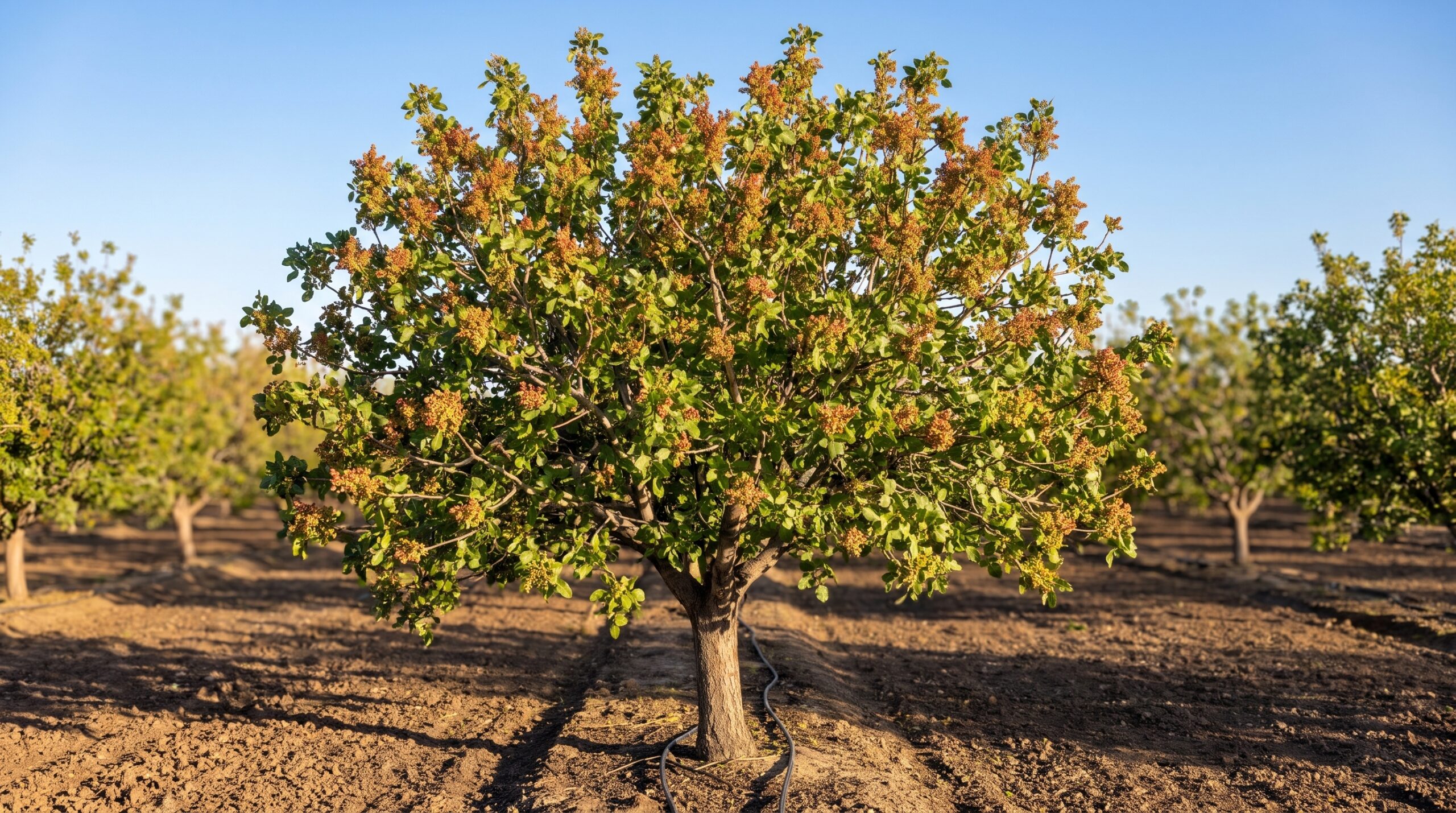
The Randy pistachio (Pistacia vera) is a male tree. It does not produce nuts for sale, but it performs an essential function: releasing the pollen that fertilises the flowers of the female trees. Put differently, without a good pollinator, even the best orchard of female trees only gets halfway.
It is an early-flowering male with three features that make it special:
- 🌼 Early flowering, synchronised with Golden Hills and Lost Hills.
- 🌬️ Abundant pollen production, with high viability and good durability.
- 🌳 Precocity, as it usually starts flowering as early as the third or fourth year after planting.
It is a protected variety, something worth remembering when buying plants: it is always preferable to buy from a nursery that guarantees the origin and varietal identity. If you would like to see what we offer, you can visit our pistachio plants page.
🌸 Why a pistachio tree needs a male: the dioecious species
To understand the value of Randy, we need to start from a basic biological feature: the pistachio is a dioecious species. There are male trees and female trees, each on a separate plant. Males produce pollen; females produce the pistachios. Neither can do the other’s job.
Moreover, pollination is anemophilous, that is, it depends on the wind. Pistachio flowers have no showy petals or nectar, so bees hardly play a role. The pollen travels through the air and has to coincide with the moment when the female flower is receptive.
This brings us to the concept that matters most in this article: flowering synchrony. If the male flowers before or after the female, the pollen arrives when the flower cannot receive it, and the usual problems appear:
- Poor fruit set and clusters with few nuts.
- A higher percentage of empty pistachios.
- Irregular harvests from one season to the next.
- Loss of profitability in an orchard that has already required a significant investment and several years of waiting.
That is why choosing the pollinator is not a minor detail: it is a structural part of the project. 🧩
🔄 How pollination works, step by step
To appreciate the role of the male, it helps to walk through the whole process, from winter to fruit set:
- Winter dormancy. During winter, the tree accumulates chill hours and the buds remain dormant. When the accumulated chill is sufficient, bud break and flowering are more uniform.
- Bud swell. At the end of winter, the male’s buds swell and the inflorescences open.
- Pollen release. The anthers open and the pollen is released into the air. From that moment on, everything depends on the wind.
- Reception by the female. The female flower remains receptive for a limited period. If viable pollen reaches it within that window, fertilisation takes place.
- Fruit set. Fertilised flowers begin to develop the nut. Those that have not been fertilised drop or give rise to empty pistachios.
Each link depends on the one before, and Randy acts at the third: it is the tree that has to supply abundant, viable pollen just when the females need it. ⏱️
🔬 Origin of Randy: how this pollinator came about
Randy comes from the breeding and evaluation work of the University of California. In 1997, a replicated trial was established near Lost Hills, in Kern County (California), and Randy flowered for the first time in 2000. From then on, its performance was observed alongside the female varieties that were under evaluation.
The selection criteria were very clear:
- High pollen viability.
- Durable pollen, which keeps its ability to fertilise for longer.
- High pollen production.
- Early flowering that coincides with Golden Hills and Lost Hills.
There is also an especially interesting underlying reason. Those who selected it anticipated that seasons with few chill hours would become more and more frequent because of global warming. In those winters, Peters, the traditional male, flowers too late and does not properly cover the start of flowering. Randy was born, in large part, to solve that problem. 🌡️
This track record of field evaluation matters. Before recommending a male, it should be seen performing in real orchards, year after year and in different climates, not just during a favourable season. That is how we can check whether it truly delivers when conditions get difficult.
🌳 Golden Hills and Lost Hills: the females that need Randy
Golden Hills and Lost Hills are two female varieties obtained in the same breeding programme and considered sisters because of their parentage. They were developed as alternatives to Kerman, the dominant variety for many years, and share several advantages:
- Earlier flowering and ripening than Kerman. According to its release description, Golden Hills flowers 1 to 2 weeks earlier and possibly has lower chilling requirements.
- Staggered harvest. Lost Hills ripens about 10–12 days before Golden Hills, which makes it possible to spread harvesting and processing work more evenly.
- Manageable growth habit. Golden Hills tends to grow upright and requires less training and pruning than Kerman, which reduces costs.
- Consistency. Lost Hills shows a lower tendency towards alternate bearing, that is, alternating high and low yields.
To have everything at a glance, here is the comparison between the three female varieties and their usual male:
| Variety | Flowering | Ripening | Usual male |
|---|---|---|---|
| Kerman | Reference | Reference | Peters |
| Golden Hills | 1 to 2 weeks earlier than Kerman | Earlier than Kerman | Randy |
| Lost Hills | Very similar to Golden Hills | About 10–12 days earlier than Golden Hills | Randy |
This is where Randy comes in. As both varieties flower earlier than Kerman, the usual male, Peters, arrives too late and is not an effective pollinator for them. Randy was selected to solve this: its flowering coincides with that of both females and provides adequate overlap throughout the period in which the flowers are receptive. 🌸
📅 Randy versus Peters: flowering makes the difference
Peters has long been the standard male for Kerman. It works well in that context, but it flowers later. According to the variety description, Randy flowers 2 to 4 weeks earlier than Peters. That difference, which on paper looks like just a figure, decides in the field whether pollen is available when the female flowers open.
Randy can also cover the early part of Kerman’s flowering in years when it is prolonged by winters with little chill. But the roles should not be confused: for Golden Hills and Lost Hills, Randy is the male designed for the job; for Kerman, the reference male remains a different one. Here is how the best-known males compare:
| Male | What sets it apart | Usual use |
|---|---|---|
| Peters | Late flowering; historical standard | Kerman |
| Randy | Early flowering, 2 to 4 weeks earlier than Peters | Golden Hills and Lost Hills; support at the start of Kerman flowering |
| Tejon | Very early flowering, 6 to 10 days earlier than Randy | Very early varieties, such as Gumdrop |
| Famoso | Released in 2016 | Male suggested for Kerman |
A practical note: Randy and Peters do not compete; they complement each other. Some evaluation programmes recommend using both males in Golden Hills and Lost Hills orchards to widen the available pollen window. 🤝
🧬 Characteristics of Randy in the orchard
When we design an orchard with Randy, we take these characteristics into account:
- Precocity. It usually flowers in the third or fourth year, so pollen is already available when the females begin to come into production.
- Large buds. Male buds are larger than female buds, and Randy’s are noticeably larger than Peters’. This helps identify it in winter.
- Viable and durable pollen. It increases the amount of effective pollen available at any given time and gives a margin when the weather does not cooperate.
- Abundant flowering. Many inflorescences and a heavy pollen load per tree.
One piece of advice we always repeat: keep an orchard map showing the exact position of each male. It sounds obvious, but it avoids confusion during replacements, pruning and maintenance work throughout the whole life of the orchard. 🗺️
📐 How many Randy pistachios to plant and how to distribute them
There is no magic number, but there are reliable guidelines. As a general rule, an orchard allocates between 1 male per 8 females and 1 per 10, that is, between 9% and 11% of the trees.
A classic layout consists of planting a male every third tree in every third row. This gives us 1 male per 8 females (11.1% of the total) and ensures that every female has a male nearby. Let us see how this translates into numbers with a planting spacing of 7 × 5 metres, which gives about 285 trees per hectare:
| Area | Total trees | Males (≈ 11.1%) | Females |
|---|---|---|---|
| 2 ha | 570 | 63 | 507 |
| 10 ha | 2,850 | 317 | 2,533 |
| 50 ha | 14,250 | 1,583 | 12,667 |
These figures are indicative. The final distribution depends on several factors:
- Prevailing wind. It is advisable to reinforce the presence of males on the side the wind comes from.
- Topography. Hollows, slopes and air corridors change how pollen moves.
- Planting spacing and density. The greater the distance between trees, the more important it is not to leave females far from a male.
- Combination of males. If you use Randy together with another male, the total percentage stays the same and is shared between the two.
If you need help drawing up the layout of your plot, you can find out about the advisory services we offer. 📐
🧭 Small plot or large operation: how to approach the choice of male
If you are a small-scale grower. On plots of just a few hectares every tree counts, and the temptation to cut back on males in order to plant more females is strong. But that is exactly where the numbers work out worst. It is best to prioritise good distribution, with males close to all the females, and to make sure the material is the right one from day one. Replacing a wrongly identified male means losing years.
If you manage a large-scale operation. Logistics and planning carry more weight here: blocks by variety, an orderly distribution of males and, where appropriate, combining Randy with another pollinator. In addition, working with Golden Hills and Lost Hills, which ripen at different times, lets you organise labour, machinery and processing better during harvest.
In both cases the starting point is the same: a clear plan before ordering the plants. And since grafted plants require planning, it is advisable to reserve them in good time. 📋
🌍 Why these varieties are attracting more and more interest
When we talk to growers, three reasons come up again and again when they assess Golden Hills and Lost Hills:
- A wider harvest window. Working with varieties that ripen earlier than Kerman helps spread harvesting and avoids concentrating all the work into a few days. The processing industry also benefits from a longer reception period.
- Less training and pruning work. A more upright habit simplifies management and reduces labour hours.
- Better fit with mild winters. Their early flowering and lower chilling requirements are attractive in a context of changing temperatures.
All this potential depends on the flowers of the females being pollinated on time. And that is where a well-chosen male makes the difference between an orchard that delivers what was planned and one that falls short. 🌞
🗓️ Pollination calendar: what happens and when
Exact dates vary by area and season, but the general calendar of an orchard with Randy, Golden Hills and Lost Hills looks like this:
| Period | What happens | What we need to watch |
|---|---|---|
| Winter | Chill accumulation and bud dormancy | Chill hours and minimum temperatures |
| End of winter | Bud swell; male buds stand out by size | Identification of males and bud condition |
| Late March and April | Flowering of Randy, Golden Hills and Lost Hills; then Peters and Kerman | Frost, rain, humidity and wind |
| Spring | Fruit set and nut growth | Fruit set percentage and plant health |
| Summer | Kernel fill and ripening | Irrigation and nutrition |
| Late summer | Staggered harvest: Lost Hills first, then Golden Hills | Harvest and processing logistics |
What matters about this table is that Randy’s flowering takes place in the earliest part of spring. That is why following the buds from the end of winter is so useful: they tell us when the decisive moment is approaching and allow us to anticipate any weather incident. 🌤️
☀️ Randy in a Mediterranean climate: mild winters and frost risk
In Mediterranean-type environments, mild winters are becoming increasingly common. This is exactly the scenario Randy was designed for: seasons with few chill hours in which a late male arrives out of step.
However, flowering early has a downside we do not want to hide: late spring frosts can damage the earliest flowers. That is why we recommend:
- Reviewing the frost history of the area before planting.
- Avoiding valley floors where cold air collects.
- Considering combining Randy with a slightly later-flowering male, so that if a frost damages the first flowers, pollen is still available.
- Bearing in mind that rain and humidity during flowering make pollen dispersal difficult.
A good design does not rely on a single bet. It rests on the right variety, the right location and a certain safety margin. ❄️
✅ Checklist before ordering the plants
If you are about to decide on your orchard, go through these steps in order. Nearly every grower asks us about them, and answering them beforehand saves problems later:
- Define the area and the planting spacing. This gives the total number of trees.
- Analyse the climate of the plot. Chill hours, risk of late frosts and prevailing wind.
- Choose the females. Golden Hills, Lost Hills or a combination of both, depending on the harvest calendar you want.
- Calculate the males. Between 9% and 11% of the trees, and decide whether to combine Randy with another pollinator.
- Draw the layout. With the position of each male and each female variety.
- Verify the origin of the material. Demand guarantees on the varietal identity of each plant.
- Book in good time. Quality plants are planned well in advance.
With these seven points settled, the project has a solid foundation. The rest is fine-tuning. 🧱
🧪 What Randy cannot solve on its own
Let us be clear: a good pollinator is a necessary condition, but not a sufficient one. Randy guarantees that pollen is available when needed, but it does not make up for other factors that also determine production:
- Appropriate irrigation and nutrition for each stage of the crop.
- The choice of rootstock and its suitability to the soil of the plot.
- Correct formative pruning during the first years.
- Pest and disease control.
- Soil quality, drainage and the climate of the area.
Pollination is just one piece of the whole. That is why, when we advise on a project, we approach it holistically and not only from the variety. In other words: Randy opens the door to a good harvest, but the rest of the management is what lets you walk through it. 🧠
⚠️ Common mistakes when choosing the pollinator
These are the failures we see most often when someone consults us about an orchard that is not pollinating as expected:
- Choosing the male based on price or availability instead of its flowering time.
- Using Peters as the only male with Golden Hills or Lost Hills, when it flowers too late for them.
- Reducing the number of males to gain space for females.
- Concentrating all the males in one corner of the plot.
- Not identifying the males and mistaking them for females when replacing missing trees.
- Ignoring the prevailing wind when distributing the trees.
- Buying plants without varietal guarantees, something that is only discovered when the trees flower.
All of them are avoidable with good initial planning. 🔎
💶 Randy and orchard profitability
Pollination has a direct influence on fruit set, on the percentage of empty pistachios and on the regularity of harvests. An illustrative example helps to see it.
Imagine a 10-hectare orchard producing 2,500 kg per hectare, that is, 25,000 kg in total. If poor pollination causes a 4% loss, we are talking about 1,000 kg that will never reach the hopper. And that loss repeats season after season until the problem is corrected.
Let us move to a smaller scale. On a 2-hectare plot with the same productivity, total production would be 5,000 kg, and a 4% loss would mean 200 kg. It may seem little, but that shortfall comes out of a project with a tighter margin, where every kilo counts.
Against that, males occupy between 9% and 11% of the land and do not produce nuts, but they are what makes production from the rest possible. It is an investment, not an expense. If you would like to go deeper into the numbers for your project, we recommend reviewing our information on the profitability of a pistachio orchard. 📈
❓ Frequently asked questions about the Randy pistachio
Is Randy suitable as a pollinator for Kerman? It can cover the first part of Kerman’s flowering in winters with little chill. However, the reference male for that variety remains another one, such as Peters. Randy is intended mainly for Golden Hills and Lost Hills.
Can I use only Randy with Golden Hills and Lost Hills? Randy provides adequate pollination for both. Even so, many specialists advise combining it with Peters to widen the pollen window and have a safety margin.
When does a newly planted Randy start to flower? It is a precocious male: it usually flowers in the third or fourth year after planting.
Does the Randy pistachio produce pistachios? No. It is a male tree and its function is to produce pollen, not nuts for sale.
How is Randy propagated? Like the rest of the pistachio varieties, by grafting onto a rootstock. That is why it is so important to buy from a nursery that guarantees the identity of the plant.
What happens in years with few chill hours? That is when the difference between a late male and an early one is most noticeable. Randy was selected precisely for these cases.
Can I replace Randy with another male if I cannot find it? What matters is that flowering coincides with that of the females. Before replacing it, that overlap must be checked. We do not recommend improvising: it is best to consult us and find the right combination for your area.
What do I do if I have planted too few males? Males can be added in gaps and missing trees replaced, although recovering the lost time takes years. That is why we insist on planning well from the start.
Where can I get plants and advice? You can browse our pistachio plants or talk to our team through the contact page. 🌿
🤝 The next step
If there is one idea we would like you to remember, it is this: an orchard of Golden Hills or Lost Hills is not complete without its pollinator. The Randy pistachio was selected to flower on time, produce abundant, durable pollen, and cover those mild-winter seasons in which Peters arrives late.
It is also worth bearing in mind that:
- The pistachio is a dioecious species and depends on the wind for pollination.
- Flowering synchrony between male and female is the key.
- The usual practice is to allocate between 9% and 11% of the trees to males.
- Layout, wind and frost matter as much as the variety.
- Combining Randy with another male provides a safety margin.
At Agro Vivero del Mediterráneo we are here to help your orchard get off to a good start from the very first tree. Tell us about your project through our reservation and quotation form and we will work with you to design the combination of females and males that best suits your plot. 🌳
Need a quote?
Tell us about your project and we will send you a proposal with no obligation.
Request a quote