


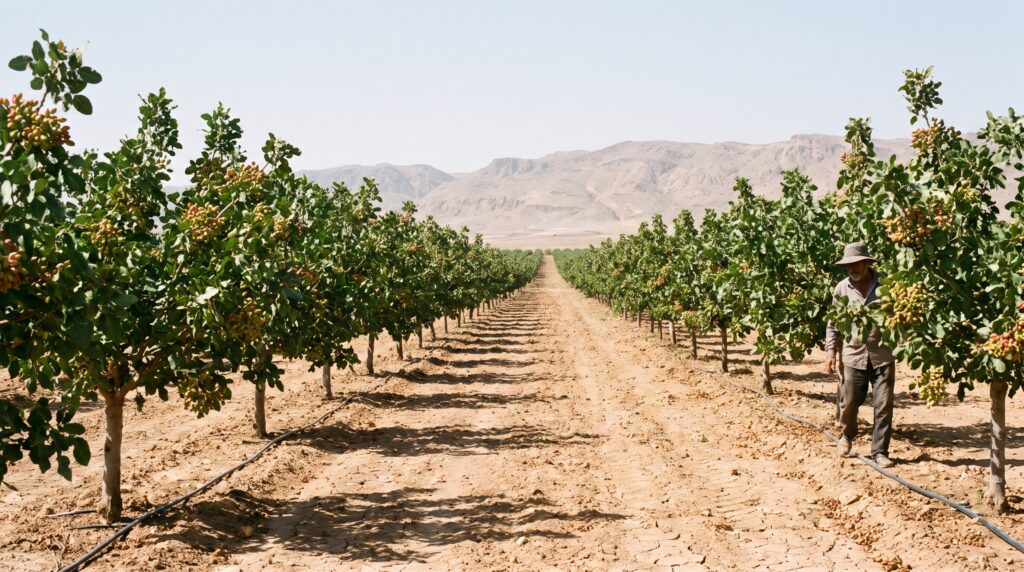
🌍 We receive more and more enquiries from farmers and investors in North Africa who want to know whether pistachio cultivation in Algeria can be a real alternative to cereals, olive groves or other rainfed crops. The question is a fair one: Algeria is a huge country with very different climates, and not all of its territory is suited to growing a nut that demands so much winter chill and summer heat.
In this article we analyse, with technical rigour and without easy promises, which areas fit the continental Mediterranean climate that the pistachio tree needs, which risks deserve attention and how we plan a commercial orchard so that it is profitable. We do so drawing on the experience of Agro Vivero del Mediterráneo, where we work every day with plants, farms and pistachio projects of all sizes. 🌳
✅ Short Answer: Is Algeria’s Climate Suitable for Pistachios?
Yes, but not across the whole country. Algeria’s climate is suitable for commercial pistachio orchards in a specific inland strip: mid-altitude areas with cool or cold winters, long dry summers and available irrigation water. Outside that strip, the project demands far more caution.
This is how we summarise our assessment:
- 🟢 High potential: the High Plateaus and inland valleys with cold winters and hot, dry summers.
- 🟡 Conditional potential: transition zones towards the Saharan Atlas and the edge of the desert, where accumulated chill, late spring frosts and water quality must be checked.
- 🔴 Not recommended: the very humid coastal strip and land with winters that are too mild or with poor drainage.
The key is not the name of the province but the data for each farm: chilling hours, spring minimum temperatures, rainfall, available water and soil.
🌟 Why Pistachios Are Attracting Growing Interest in Algeria
There are agronomic and economic reasons behind this interest. The pistachio tree is long-lived, with a productive life that can exceed fifty years, and it is one of the trees that makes the best use of water in dry climates. In addition, the nut enjoys steady international demand and fetches a far higher price per kilogram than traditional field crops.
In many North African markets, a significant share of nut consumption is covered by imports, which opens up room for local production. That said, this should be verified in each case against the planned sales channel. 📦
🌾 For anyone currently growing cereals or pasture in semi-arid areas, pistachio is a way to diversify, as long as it is understood to be a long-term investment and not a crop that delivers immediate results.
🌱 Climate Requirements of the Pistachio: What a Tree Needs to Produce
Before looking at the map of Algeria, it is worth being clear about what the pistachio tree (Pistacia vera) requires. It is a hardy tree, but a very specific one: it comes from arid areas of Central Asia and the Middle East and performs best when we manage to reproduce that environment.
| Factor | What we look for | Why it matters |
|---|---|---|
| ❄️ Winter chill | Between 600 and 1,000 hours below 7 °C, depending on the variety | Uniform bud break and flowering |
| ☀️ Summer | Long, hot and dry, with typical maximum temperatures above 35 °C | Good kernel filling and nut ripening |
| 🥶 Dormant tree | Tolerates down to about -15 °C | Winter hardiness |
| 🌸 Spring | No frosts below -1 °C during bud break and flowering | Avoids losing the crop |
| 💧 Rainfall | From about 300 mm per year, with supplementary irrigation | Determines whether rainfed cultivation is possible |
| 🌬️ Humidity | Low during summer | Fewer fungal diseases |
| 🧱 Soil | Deep, well-drained, with neutral to alkaline pH | Prevents root asphyxia |
These figures are indicative and each variety has its own nuances, but they serve as an initial filter to determine whether a farm deserves a more detailed study. 🔎
❄️ Chilling Hours: The Factor That Most Conditions Pistachio Cultivation in Algeria
If we had to choose a single piece of data to assess a farm, we would choose chilling hours. The pistachio tree needs to accumulate a minimum number of hours below 7 °C during winter in order to break dormancy properly. When chill is insufficient, bud break becomes staggered, flowering becomes uneven and production suffers.
This explains why coastal areas, with their mild winters, are not the most suitable, whereas the inland highlands offer a much more interesting profile.
📌 Practical example. Let us imagine a farm at an altitude of 1,000 metres on the High Plateaus, with around 1,100 chilling hours. There we could work with Kerman, the most widely planted variety, at a reasonable level of risk. On a lower plot with around 500 accumulated hours, we would have to rule out Kerman, consider varieties with lower chilling requirements and, if the data do not support it, accept that the project is not viable.
Our advice is to request the historical temperature records from the nearest weather station and, if the project is a significant one, install a data logger on the plot itself for one full winter before committing to the investment. 🌡️
☀️ Heat and Dry Air: Where Inland Algeria Has the Advantage
Pistachio is a demanding summer crop. It needs plenty of accumulated heat for the kernel to fill and for the shell to split naturally. On this point, inland Algeria has a head start: long summers, abundant sunshine and low relative humidity, conditions very similar to those of the best producing areas of the Mediterranean.
Low humidity is also a great health ally. In humid environments, diseases such as Septoria leaf spot, Alternaria late blight or fungi of the genus Botryosphaeria spread quickly and force more frequent treatments. In arid and semi-arid areas, that pressure is considerably lower. 🍃
⚠️ That said, heat does not mean that any location will do. At the edge of the Sahara, with summers well above 45 °C and hot winds during flowering, we must keep a close eye on pollination and water stress.
🗺️ Algeria’s Climate Applied to Pistachios: Four Main Environments
To assess the country’s potential, we divide Algeria into four main environments. This table summarises how we evaluate them for commercial pistachio orchards:
| Zone | Climate | Our assessment |
|---|---|---|
| Coast and Tell | Humid Mediterranean, mild winters and higher rainfall | 🟠 Medium-low: little chill and more fungal pressure |
| High Plateaus | Semi-arid continental, cold winters and dry summers | 🟢 High: the profile closest to that of established producing areas |
| Saharan Atlas and foothills | Arid, cool winters and wide temperature swings | 🟡 Medium-high if water is available and frost is controlled |
| Northern edge of the Sahara | Desert, mild winters and extreme summers | 🟠 Medium-low: depends on accumulated chill and water |
These are general assessments. Within each zone there are microclimates, and a difference of 100 metres in altitude or the aspect of a slope can completely change the outcome. 📍
🌊 Coast and Tell: Why It Is Not Our First Choice
Algeria’s Mediterranean strip has more rainfall and humidity than the interior, which favours other crops but not pistachio. Mild winters tend to deliver few chilling hours, and spring and summer humidity increases the risk of fungal diseases.
We are not saying it is impossible: at elevated points of the Tell, with good ventilation and well-drained soils, there may be interesting microclimates. But as a general rule, we recommend reserving the best coastal land for other crops and looking for pistachio sites in the interior. 🌊
🏔️ High Plateaus: The Area With the Most Potential for Commercial Orchards
In our view, the High Plateaus offer the most favourable combination: altitudes that are usually between 800 and 1,300 metres, winters with real cold, hot and dry summers, frequently calcareous soils and a long tradition of extensive farming. It is an environment very comparable to that of other continental Mediterranean producing areas.
There is also a sign we like very much: Pistacia atlantica, known locally as betoum, a wild relative of the pistachio tree, grows naturally in these regions. The fact that the genus is adapted to this environment is a good agroclimatic indicator, and this species can also be an excellent rootstock, as we will see later. 🌳
There are two main challenges:
- 🥶 Late spring frosts, which are more frequent at higher altitudes.
- 💧 Irrigation water, with aquifers that must be managed very carefully.
With a well-chosen plot and a suitable variety, this is the zone where we see the greatest future for pistachio cultivation in Algeria.
🏜️ Saharan Atlas and Desert Edge: Potential With Conditions
South of the High Plateaus, the climate becomes more arid and the temperature swings between day and night increase. This is usually positive for nut quality, but it requires more prior analysis.
At the edge of the desert, with milder winters, accumulated chill may fall below what some varieties need. This is where varieties with lower chilling requirements, such as Sirora or Larnaka, come into play, provided the temperature data confirm it. On the other hand, it is common to have access to water from deep aquifers, which we must analyse carefully for salt content.
📝 In short: in these areas, viability is not decided by the map but by three analyses: accumulated chill, water and soil.
🥶 Late Frosts: The Risk That Endangers the Most Projects
A dormant pistachio tree withstands very low temperatures, but a frost during bud break or flowering can ruin that year’s crop. Temperatures below -1 °C or -2 °C, once the tree has woken up, damage buds and flowers.
To reduce that risk in Algeria, we recommend:
- 📍 Avoiding hollows and valley floors, where cold air collects.
- 🌸 Choosing late-flowering varieties, such as Kerman, in the areas with the greatest risk.
- ⛰️ Preferring slopes with good air movement and favourable aspects.
- 🔥 In large projects, considering protection systems such as wind machines, heaters or sprinkler irrigation.
- 📊 Installing temperature sensors so that we can react in time.
The aim is not to eliminate the risk but to reduce it to a level that is acceptable within the economic plan.
🧭 Two Farms, Two Decisions: A Comparative Example
To understand how we apply all of this, let us compare two hypothetical farms:
| Data | Farm A (High Plateaus) | Farm B (desert edge) |
|---|---|---|
| Altitude | 1,050 m | 250 m |
| Chilling hours | 1,100 | 450 |
| Annual rainfall | 320 mm | 90 mm |
| Late frost risk | Medium | Low |
| Irrigation water | Well water at 1.8 dS/m | Well water at 4.5 dS/m |
| Decision | Viable with Kerman and drip irrigation | Not recommended without further studies |
On Farm A, chill and water allow for a solid project, with the usual precautions against frost. On Farm B, the lack of chill and the salinity of the water limit viability: even though the heat is ideal, the tree would not complete its cycle properly. 🧐
The lesson is simple: within the same country there can be a clear “yes” and an equally clear “no”.
💧 Irrigation Water: Quantity, Quality and Availability
After chill, water is the second major factor. The pistachio tree withstands dryness better than almost any other tree, but a commercial orchard with regular production needs irrigation. In areas with less than 300 mm per year, we do not recommend planning rainfed pistachio cultivation.
As a general reference, a mature orchard with well-managed irrigation typically uses between 3,000 and 5,000 m³ per hectare per year, depending on climate, soil and age. This is an indicative figure. What matters is having that volume guaranteed every season, and not only in rainy years.
Quality also counts. Pistachio is one of the most salt-tolerant trees, but it is not immune. As a prudent criterion, we prefer water with an electrical conductivity below 3 dS/m, and we always analyse the salinity of the irrigation water before designing the project. 🧪
Pistachio irrigation should be planned using drip systems and with regulated deficit irrigation at the appropriate stages, which makes it possible to optimise water consumption without sacrificing production. And before investing, it is advisable to verify water use rights and the sustainability of the aquifer. 💧
🧱 Soil and Drainage: The Foundation of the Orchard
The pistachio tree adapts to a wide range of soils, including the calcareous soils that are so common in inland Algeria, and it tolerates neutral or alkaline pH well, between 7 and 8.5. What it does not forgive is waterlogging.
Before planting, we check:
- 🔍 A useful soil depth of at least one metre, with no hard layers that limit root growth.
- 🚰 Effective drainage that prevents root asphyxia.
- 🧂 Soil salinity and the presence of sodium.
- 🦠 The history of the plot, especially the presence of Verticillium after crops such as cotton, tomato or potato.
It is better to rule out a plot with poor drainage than to try to correct it afterwards.
🌿 Varieties and Rootstocks for Pistachio Cultivation in Algeria
Choosing the right pistachio varieties and rootstock is just as important as the climate. The pistachio plant we select determines production throughout the entire productive life of the orchard.
| Variety | Chill required | Flowering | When we recommend it |
|---|---|---|---|
| Kerman | High | Late | High Plateaus with sufficient chill and frost risk |
| Sirora | Medium-low | Early | Warmer areas with moderate chill |
| Larnaka | Medium-low | Early | Areas with milder winters and good heat adaptation |
As for rootstock, Pistacia atlantica is a logical option for Algeria: it is adapted to drought and calcareous soils, and plants grafted onto it usually show good vigour. That said, it is susceptible to Verticillium, so the history of the plot is key. Other options, such as UCB-1-type hybrids, provide greater uniformity and tolerance to some pathogens, and we assess them according to each project.
One last piece of advice: quality planting material, with a good root system and phytosanitary guarantees, is the smallest investment and, at the same time, one of those that contributes most to the profitability of the entire project. 🌱
🌬️ Pollination: Without Males There Is No Harvest
The pistachio is a dioecious species, with separate male and female trees, and it is wind-pollinated. In a commercial orchard we include one male for every eight to ten females, with a flowering period that coincides with that of the main variety. In addition, we position the pollinators taking into account the prevailing wind during flowering.
In climates with mild winters, a mismatch between male and female flowering is one of the most common failures. That is why choosing the right pollinators, such as Peter for Kerman, is just as important as choosing the right variety. 🌼
🐛 Plant Health in Arid and Semi-Arid Climates
A dry climate helps, but it does not eliminate problems. In Algeria we must watch for, among others, pistachio psylla, the pistachio seed wasp (Megastigmus pistaciae), Verticillium wilt and diseases of shoots and leaves in wet years.
To avoid surprises, we recommend planting material with phytosanitary guarantees, regular monitoring and an integrated management plan. In addition, it is advisable to verify the phytosanitary and customs requirements currently in force for importing plants into the country before setting the planting calendar. 📄
🌡️ Climate Change and Uncertainty: Planning With a Margin
There is one factor we cannot ignore: how the climate is evolving. In many parts of the Mediterranean, winters are becoming milder and summers hotter, which reduces chilling hours and increases water requirements. In addition, extreme events such as heatwaves or out-of-season frosts are becoming more frequent.
That is why, when designing an orchard in Algeria, we do not look only at the average of recent years: we apply a safety margin on chilling hours, we choose varieties with a degree of flexibility and we calculate water needs using more demanding scenarios. An orchard is designed to produce for many years, and the climate it will face in fifteen or twenty years matters as much as today’s. 🔮
🌳 Management in the First Years: How an Orchard Is Built
A good orchard is decided in the first years of the tree’s life. These are the points we take most care over:
- 🌱 Planting: during dormancy, with well-prepared soil and immediate irrigation.
- ✂️ Formative pruning: to create a balanced structure that is easy to mechanise.
- 🧴 Fertilisation: adjusted to soil and leaf analyses, with attention to nitrogen, potassium and micronutrients such as zinc.
- 🌾 Weed control: to avoid competition for water and nutrients.
- 🔄 Alternate bearing: the pistachio tree tends to alternate between years of heavy and light crops, and well-planned pruning and irrigation help to smooth it out.
💶 Profitability: Let’s Do the Numbers Before Planting
Pistachio is a long-term crop. With good management, the first harvests arrive around the fourth or fifth year and full commercial production from the eighth or tenth. In a mature orchard with well-managed irrigation, as an indicative figure, we are talking about between 2,000 and 3,000 kg of in-shell nuts per hectare, a figure that each project must validate.
To calculate the profitability of a pistachio orchard in Algeria, several elements must be taken into account:
- 🌱 The cost of the plants and of the planting layout, for example 6 x 5 m or 7 x 5 m, which means between 285 and 333 trees per hectare.
- 💧 The irrigation installation, the well or reservoir, and energy.
- 👷 Labour, mechanisation and pruning.
- 🏭 Hulling, drying and storage after harvest: without nearby infrastructure, part of the value is lost.
- 📈 The price and sales channel for the nuts, whether local or export.
One important point: pistachios must be processed within a few hours of harvest to preserve their quality, so logistics analysis is part of the economic study. 💰
📋 How We Evaluate a Plot of Land in Algeria Step by Step
When a farmer asks us to assess a farm, we always follow the same order:
- 🌡️ We gather climate data: chilling hours, spring minimums, summer maximums and rainfall.
- 🧪 We analyse the soil and water using samples taken at several points.
- 📍 We study the topography and the frost risk of the plot.
- 🌿 We select varieties, rootstock and pollinators.
- 📐 We design the planting layout and the irrigation system.
- 💶 We prepare a realistic economic feasibility study.
This is the work we do as part of our technical advisory services: we help to decide with data and not with hunches, both for those planning a few hectares and for those developing a large estate. 🤝
⚠️ Common Mistakes When Planting Pistachios in New Areas
- ❌ Planting without measuring the real chilling hours of the plot.
- ❌ Choosing a variety because it is fashionable and not because of its adaptation to the climate.
- ❌ Underestimating the risk of late frosts on low-lying land.
- ❌ Accepting irrigation water as good without analysing it.
- ❌ Forgetting the pollinators or positioning them badly.
- ❌ Not planning hulling and drying.
- ❌ Calculating profitability using only the years of full production.
Avoiding these seven mistakes already accounts for a large part of the road towards a healthy and productive orchard.
❓ Frequently Asked Questions About Pistachio Cultivation in Algeria
Can pistachios be grown in arid areas or in the desert? They can be grown in arid areas, but not at just any point in the desert. Sufficient winter chill, good-quality water and control of extreme temperatures are required.
How many chilling hours does the pistachio tree need? It depends on the variety: from around 600 hours for the earliest ones to nearly 1,000 for Kerman.
Do pistachios work under rainfed conditions in Algeria? Only in areas with sufficient rainfall and deep soils. In most of the High Plateaus, where precipitation is scarce, we recommend irrigation.
How long does an orchard take to start producing? The first harvests arrive around the fourth or fifth year and full production around the eighth or tenth.
Is it profitable for a small farmer? Yes, as long as the project is adapted to their scale. With a few hectares, it is possible to work with an efficient design, properly sized irrigation and, where possible, collaboration with other producers to share machinery and the hulling and drying process.
🚀 The Next Step: Let’s Study Your Farm Together
Algeria’s climate makes it possible to plan pistachio orchards in the interior of the country, especially on the High Plateaus and in mid-altitude areas, provided that three conditions are met: sufficient winter chill, a controlled frost risk and irrigation water in adequate quantity and quality. The coast and the desert edge demand much more caution, and in every case the decision must be based on the data for the plot.
If you own a farm in Algeria or are considering an investment, at Agro Vivero del Mediterráneo we can help you analyse it rigorously. You can contact our team to resolve your questions or request a no-obligation quotation for pistachio plants. 🌳
Let us start this project with our feet on the ground and the data on the table. 🤝