


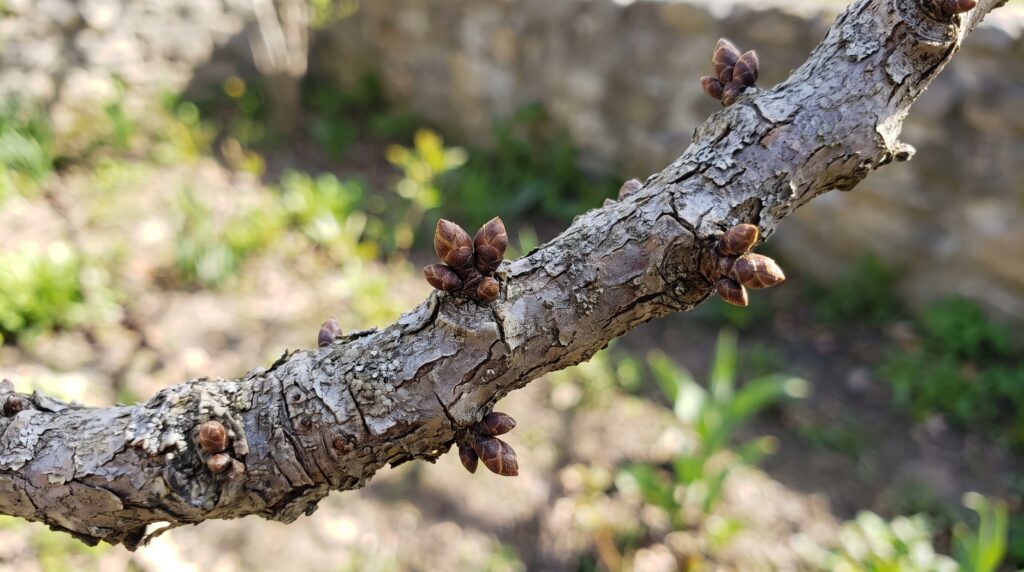
April arrives, the trees around you are already covered in green, and your pistachio tree is not budding in spring. The branches are still bare, the buds seem to be asleep, and the worry begins. It is a question we receive often at Agro Vivero del Mediterráneo, both from growers who have just planted their first orchard and from farmers with many hectares in production. 🌱
The good news is that a pistachio tree without leaves in spring is not always a dead tree. Sometimes it is simply a tree running late. Other times there is a real problem with the roots, the climate, plant health or management, and it is worth detecting it early. In this guide we explain how to tell the cases apart, which causes are the most common, and which solutions we apply in the pistachio orchards we support.
When Should a Pistachio Tree Bud, and When Should You Worry?
Before giving up on a tree, you need to know what is normal. The pistachio is a relatively late-budding tree. In the main Mediterranean-climate producing regions, pistachio bud break usually starts between late March and mid-April, and it is delayed if the winter has been cold or the spring cool. 🗓️
Several factors change the calendar:
- The variety: not all varieties wake up at the same time. Male trees usually break bud ahead of female trees so that pollination is synchronised.
- The area: in inland areas with colder winters, bud break comes later than in areas close to the coast.
- The age of the tree: young, newly planted trees take longer to wake up than mature trees with an established root system.
- The particular spring: in a cool year, bud break can be delayed by two or three weeks compared with a warm one.
As a practical rule, if it is mid-April and neighbouring trees of the same variety and age have broken bud while yours looks the same as it did in January, it is time to investigate. If it is still early April and the whole plot is progressing evenly, the most likely answer is simply to wait. ⏳
First Step: Check Whether the Pistachio Tree Is Still Alive
Before looking for causes, you need to know whether the tree is alive. It is a simple check that we always carry out in the field before recommending anything. 🔍
The cambium test
- With a clean knife, gently scrape the bark of a branch or the trunk in a small area.
- If a green, moist tissue appears underneath, the tree is alive in that area.
- If the tissue is brown, dry or brittle, that part is dead.
- Repeat the test at different heights, from the thin branches down to the base of the trunk, and also below the graft union.
What the result tells us
- Green cambium throughout the tree: it is still alive and is simply delayed or stressed.
- Green cambium in the trunk and brown in the branches: it has suffered damage in the aerial part (frost, drought, disease) and may resprout from below.
- Brown cambium throughout the trunk, even at the base: the tree has probably died.
It is also worth observing the buds. A healthy bud is firm, swollen and slightly shiny. If the inside is green when you cut it with a knife, it is alive. If it is black, soft or completely dry, it has died and will not break.
This orchard diagnostic test saves you from hasty decisions, such as uprooting a tree that can still recover. 👍
Lack of Chilling Hours and Winter Dormancy
One of the most frequent causes of irregular or delayed bud break is that the tree has not accumulated enough pistachio chilling hours. It is a species that needs to go through a period of cold during winter in order to exit winter dormancy properly. ❄️
When the winter is too mild, the tree does not complete this requirement and symptoms appear such as:
- very staggered bud break, with some buds waking up and others not;
- bud break delayed by several weeks;
- small, underdeveloped leaves or stunted clusters;
- desynchronised flowering between male and female trees, with the resulting pollination problem.
The chilling requirement varies by variety. Some need more accumulated hours below about 7 °C, while others adapt better to areas with moderate winters. That is why the choice of variety and the synchronisation of male and female trees are key decisions that must be made before planting, according to the area.
What can be done
- Check the climate data for your region and compare the accumulated chilling hours with those your variety requires.
- In new orchards, choose varieties adapted to the area. You can explore our range of pistachio plants and ask us for advice.
- Keep the tree in good general condition, because a balanced pistachio tree tolerates irregular winters better.
- Avoid late pruning and late nitrogen fertilisation that stimulate tender shoots when it is not yet the right time.
There is no miracle solution once the winter has passed, but observation over the following years allows us to correct management and prevent the problem from recurring.
Late Frosts: When Spring Deceives
Another common cause is late frosts. If the tree broke bud normally and an April frost burned the shoots, what we see afterwards is a pistachio tree with blackened or dry leaves, or one that looks as if it never budded at all. 🥶
The pistachio is a hardy tree and withstands winter cold well while dormant. Its weak point is spring, when the tissues are tender and a drop in temperature below 0 °C can damage shoots, flowers and even young branches.
How to recognise frost damage
- Blackened, wilted tender shoots, often on a date that coincides with a cold night.
- Damage concentrated in the low areas of the plot, where cold air accumulates.
- Young trees with a dry upper part and a living base.
What to do
- Wait for the tree to react. Many trees bud again from secondary buds after a few weeks.
- Carry out a cleaning prune, removing only what is clearly dry, once it is evident how far the damage extends.
- Reinforce irrigation and fertilisation in a balanced way to help recovery.
- For the future, consider orientation, cold-air drainage and the choice of slightly later-budding varieties in areas at risk.
The location of the plot matters a great deal here. That is why, before planting, at Agro Vivero del Mediterráneo we analyse the microclimate and topography of the land. You can find out everything we do in our services section.
Root Asphyxia and Excess Water
If we had to choose a single problem that kills young pistachio trees in the field, it would be root asphyxia. The pistachio tolerates drought very well, but it is very sensitive to waterlogging. In a saturated soil, the roots run out of oxygen, rot, and the tree cannot wake up in spring. 💧
Typical situations
- Clayey, compacted soils with poor drainage.
- A particularly rainy winter, with plots that have held water for weeks.
- Planting holes that act like “pots”, with loose soil inside and compacted soil around them, where water is retained.
- Excessive or overly frequent irrigation of young trees.
- Buds that do not wake up, or that break and quickly wilt.
- Yellowish, weak leaves.
- Dark, soft roots with a bad smell when you uncover the root collar slightly.
- Check the drainage of the plot and improve water evacuation with ditches, ridges or subsoiling.
- Immediately reduce the irrigation frequency in the affected areas.
- Uncover the root collar of the tree so that it aerates and dries, preventing it from being buried or surrounded by moisture.
- In new orchards, plan the spacing, ridges and drainage carefully before planting.
Pistachio irrigation must be precise: little and well distributed is better than a lot and often. It is a very rewarding crop when managed with sound judgement.
Diseases That Prevent Bud Break
When we rule out climatic and management causes, we have to look at plant health. Three problems appear frequently in enquiries about pistachio trees that do not bud. 🦠
Verticillium in pistachio trees
This is a vascular disease caused by a soil-borne fungus that blocks the circulation of sap. Symptoms include sudden wilting of branches, dry leaves that remain attached to the tree, and a dark colour inside the wood when a cut is made. It is seen more often in plots where susceptible crops such as tomato, potato or cotton were previously grown. It is important to know the history of the plot before planting.
This is an oomycete that attacks roots and the root collar and is favoured by excess moisture. It causes rots and, in young trees, can prevent bud break or cause death in a short time. It often goes hand in hand with root asphyxia, so managing water is the best prevention.
This is a fungus that causes branch dieback, cankers and drying of shoots. It enters through pruning wounds or mechanical damage and shows up as dry branches, sunken bark and dark lesions. It appears more frequently in weakened trees.
How we act
- Remove and take out of the field the affected wood, cutting below the damaged area until reaching healthy tissue.
- Disinfect tools between trees.
- Prune at suitable times and in suitable weather conditions, avoiding rainy days.
- Protect wounds and look after nutrition to strengthen the tree’s defences.
- If a soil-borne disease is suspected, obtain technical advice before replanting in the same spot.
If you suspect that any of these diseases is affecting your orchard, you can contact our team and we will help you assess the case.
Transplant Stress and Plant Quality
In newly established orchards, many cases of failure to bud are due to transplant stress. A young tree needs time to develop roots and adapt to its final site. If there were problems in the first year, it is common for bud break the following spring to be weak or late. 🌿
Factors involved
- Planting depth: a tree planted too deep or too high suffers.
- Damaged or coiled roots: if the plant came out of its container with spiralled roots, it will take longer to establish.
- Insufficient or excessive initial irrigation: balance is key during the first season.
- Planting date: planting in the heat or with very cold soil makes rooting difficult.
- Plant quality: a weak, poorly hardened plant with little root development starts at a disadvantage.
That is why the choice of nursery makes an enormous difference. At Agro Vivero del Mediterráneo we look after every stage of plant production so that trees reach the field with a balanced, well-formed root system. The whole process is described on our homepage and in the section dedicated to plants.
What to do if the tree is young and does not bud
- Check the cambium to confirm that it is still alive.
- Carefully examine the root collar and root zone, without damaging the tree.
- Maintain moderate, steady irrigation, without waterlogging.
- Protect the trunk from the sun and from rodents.
- Wait a few more weeks before deciding: young trees can break bud well into May.
Grafting and Rootstock Problems
The pistachio is grown grafted onto a rootstock that provides the roots, while the productive variety is grafted on top. When something fails at that union, the tree may fail to bud above the graft point even though the rootstock is still alive. 🌳
How to detect the problem
- The rootstock buds, but the grafted variety does not. It is easy to see, because suckers and shoots with different leaves appear below the graft.
- Poor healing at the union, with cracks or sunken areas.
- Loss of the graft after a knock, strong wind or frost.
What to do
- If the rootstock is alive and the graft is lost, it can be regrafted in the next suitable season.
- Choose carefully which suckers to keep, in order to reshape the tree with the right variety.
- Prevent rootstock suckers from dominating and exhausting the tree.
Pistachio grafting is a technique that requires practice and time. If you need help regrafting or replacing failed plants, ask us about our technical services.
Nutritional Deficiencies and Unbalanced Fertilisation
A poorly nourished tree has less capacity to reactivate its buds in spring. Deficiencies of zinc, boron or potassium, or poorly managed excess nitrogen, can cause weak bud break, small leaves and short growth. 🧪
Common signs
- Small, rosetted leaves with very short internodes, typical of zinc deficiency.
- Shoots that dry out at the tip, associated with boron deficits.
- General yellowing due to lack of nitrogen or root uptake problems.
How to correct it
- Carry out a soil analysis and, if possible, a leaf analysis to find out what is lacking and what is in excess.
- Adjust pistachio fertilisation to the age of the tree and the condition of the soil, without overdoing it.
- Apply foliar micronutrients at the right time if the analysis recommends them.
- Correct the pH when necessary, because in highly alkaline soils some nutrients become locked up.
Over-fertilisation also does harm. A young tree does not need large quantities, but a regular, adjusted supply. It is advisable to avoid highly saline fertilisers close to the root collar of newly planted trees.
Drought, Water Stress and Water Quality
Although the pistachio withstands drought better than other species, a young tree without deep roots suffers if it runs out of water during the preceding summer and autumn. It reaches winter weakened and, in spring, has no reserves to break bud vigorously. ☀️
What to watch for
- Young trees with no supplementary irrigation during long hot periods.
- Irrigation with poor-quality water containing excess salts, which gradually damages the roots.
- Very stony or shallow soils where water is lost quickly.
- Schedule supplementary irrigation in the first years, even in orchards intended to be rainfed.
- Check the conductivity of the irrigation water and adjust management if salts are present.
- Apply mulches or covers that reduce evaporation around the trunk.
Rainfed pistachio planting is feasible in many areas, but it requires a prior study of the soil, the rainfall and the variety. The first years are the most delicate.
Pruning, Previous Crop Load and Alternate Bearing
Sometimes the lack of bud break has an explanation in the tree’s own cycle. The pistachio has a tendency towards alternate bearing: after a year of very high production, the tree depletes its reserves and the following year it buds less, with short, weak shoots. 🌰
How it shows up
- Mature trees that produced heavily the previous year and now show weak bud break.
- Fewer flower buds and less vegetative growth.
- An alternating pattern of good and poor years in the same plot.
How to soften it
- Adjust pistachio pruning to balance productive wood and new wood.
- Maintain fertilisation and irrigation that allow reserves to be replenished after harvest.
- Avoid severe pruning out of season, which triggers disordered shoots or weakens the tree.
Poorly executed pruning can also be the origin of the problem: cuts that are too large, unprotected wounds or pruning on wet days favour the entry of fungi such as Botryosphaeria.
Herbicides, Rodents and Mechanical Damage
There are less obvious causes that we nevertheless see frequently when visiting plots. 🚜
- Herbicides: a product applied when the tree is young, or with drift near the trunk, can damage tissues and shallow roots, and the effect becomes apparent when spring arrives.
- Rodents: voles and field rats gnaw the bark and roots of young trees, especially in winter. A ring of gnawed bark around the trunk can be fatal.
- Machinery: knocks to the trunk from a brush cutter or tractor open wounds that become entry points for disease.
- Rabbits and wildlife: browsing of shoots, especially in new orchards.
- Protect the trunk with tree guards or mesh.
- Apply herbicides carefully and away from the trunk.
- Control rodent populations through ground cover management and appropriate control measures.
- Train the operators who work near young trees.
Summary: Symptoms, Probable Cause and Solution
So that you can consult it quickly, here is a table with the most frequent cases. 📋
| Symptom | Probable cause | What to do |
|---|---|---|
| The whole plot breaks bud late and unevenly | Few chilling hours or cool spring | Wait, review the variety and local climate |
| Black shoots after a cold night | Late frost | Wait for regrowth, prune only what is dry, review the site |
| Dead buds and soft roots | Root asphyxia or Phytophthora | Improve drainage, reduce irrigation, aerate the root collar |
| Dry branches with dark wood inside | Verticillium or Botryosphaeria | Prune back to healthy tissue, disinfect, technical advice |
| Young tree that does not get going | Transplant stress | Check cambium, moderate irrigation, patience |
| Rootstock buds, variety does not | Graft failure | Select suckers or regraft |
| Small, rosetted leaves | Zinc or other nutrient deficiency | Leaf analysis and specific correction |
| Weak bud break after a heavy crop | Alternate bearing | Adjust pruning, irrigation and fertilisation |
| Gnawed bark at the base | Rodents | Guards and control |
Step-by-Step Action Plan
If your pistachio tree has not budded, this is the sequence we usually recommend: ✅
- Wait a reasonable time. Confirm that we are within normal bud break dates and compare with other trees in the plot.
- Do the cambium test. Check whether there is green tissue in the branches, trunk and base.
- Observe the surroundings. Review whether there were frosts, waterlogging, changes in irrigation or recent treatments.
- Examine the roots and root collar. Carefully uncover the collar area to see its condition.
- Analyse the soil and water. A basic analysis clarifies a great deal.
- Apply the appropriate correction. Drainage, irrigation, nutrition or plant health, depending on the cause.
- Keep a record of what happens. Note dates, symptoms and actions to make better decisions next year.
- Ask for help if in doubt. A timely diagnosis can save trees and prevent the problem from spreading.
In the most complex cases, a technician with in-depth knowledge of the crop avoids costly mistakes. At Agro Vivero del Mediterráneo we offer technical advice to farmers of all sizes, from those with a few hectares to large estates.
When to Give Up on a Tree and How to Replace It
There are cases in which the tree does not recover. We will know this if the cambium is dry throughout the trunk, even at the base, and there is no shoot below the graft or on the rootstock. In that case, it is advisable to: 🪓
- Remove the dead tree to avoid disease foci.
- Investigate the cause before replacing it, especially if several trees in the same area are affected.
- Correct the underlying problem (drainage, soil, irrigation) before planting again.
- Replace with healthy, well-formed plants in the next suitable planting window.
Replacing failed plants is normal in any new orchard. What matters is that the percentages stay low and that every failure teaches something. If you want to know how failed plants and management affect the final figures, see our analysis of orchard profitability.
How to Prevent the Problem from Day One
The best solution is to prevent it from appearing. Many of the enquiries we receive about pistachio trees that do not bud could have been avoided with good planning. 🧭
- Study the soil: texture, depth, drainage, pH and salinity.
- Analyse the history of the plot to rule out soil-borne diseases.
- Choose varieties and rootstocks adapted to the climate and to the chilling hours of the area.
- Plan the proportion and placement of male trees to ensure pollination.
- Design the irrigation system and drainage.
During planting
- Plant at the right time and at the right depth.
- Prepare the planting hole properly, without creating areas where water accumulates.
- Protect the trunk from the start.
- Irrigate in a balanced way during the first weeks.
During the first years
- Monitor plant health, nutrition and weeds.
- Carry out gentle, well-executed formative pruning.
- Check bud break every spring and note any irregularity.
A grower with a few hectares can monitor tree by tree and act quickly. On a large estate, the key is to divide the orchard into sectors, sample, and detect problem areas before the problem spreads. In both cases, prior planning makes the difference between a profitable pistachio orchard and one full of surprises.
Frequently Asked Questions About Pistachio Trees That Do Not Bud
How long should I wait before worrying?
If it is early April and the whole plot is progressing evenly, it is advisable to wait. If by mid-April there are trees of the same variety and age that have broken bud and yours has not, it is time to run a diagnosis.
Can a pistachio tree bud late and recover?
Yes. Young trees in particular can break bud in May. As long as the cambium is green, there is hope.
Should I prune a pistachio tree that does not bud?
Not drastically. Wait to see how far the damage extends and then remove only what is clearly dry, with clean tools and in dry conditions.
Does adding more fertiliser help it bud?
No. Excess fertiliser does not solve a root or plant health problem and can aggravate stress. It is better to run an analysis and correct what is actually lacking.
What happens if the rootstock buds and the variety does not?
There is a graft failure. Suckers can be selected to reshape the tree, or regrafting can be considered at the appropriate time.
Is it more frequent in young orchards?
Yes, because they have a developing root system and are more sensitive to excess water, frost and transplant stress.
How much does it cost to replace trees?
It depends on the number of plants, the variety and the work required. To calculate it, you can request a quotation through our reservation and quotation form.
The Next Step
A pistachio tree that does not bud in spring has neither a single cause nor a single solution. It may be a simple delay due to a mild winter, frost damage, a root problem caused by excess water, a disease, a graft failure, a nutritional deficiency, or the result of a very demanding crop. What matters is not to act in haste, to check the condition of the tree with the cambium test, and to rule out the causes one by one. 🌰
The key points to remember are these:
- Normal bud break comes between late March and mid-April, with variations according to area and variety.
- Green cambium means the tree is still alive.
- Excess water and poor drainage kill more young pistachio trees than drought.
- The quality of the plant and the graft conditions the start of the orchard.
- A good analysis of soil, water and leaves avoids blind decisions.
- Prevention starts before planting, with a good choice of plot, variety and irrigation system.
At Agro Vivero del Mediterráneo we support small and large growers at every stage, from the choice of plants to the follow-up of the orchard. If you have trees that are not budding, want to review your plot, or are thinking of starting or expanding a pistachio orchard, we will be delighted to help. Write to us through our contact page or request your quotation directly. We work so that your orchard gets off to a strong start and yields quality nuts for many years. 🤝