


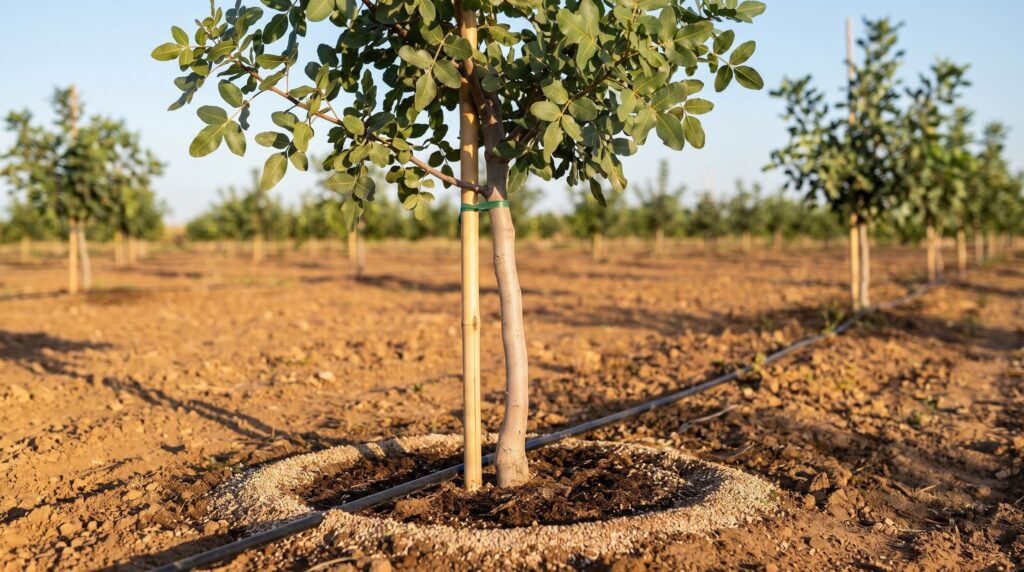
When a grower asks us what fertiliser a young pistachio tree needs, there is almost always a deeper question behind it: how to get the trees off to a strong start without overspending or putting the orchard at risk. 🌱 It is a very good question, because fertilisation during the first three or four years shapes the vigour, the structure and, to a large extent, the future nut yield.
From our nursery, where we grow pistachio plants with what will happen later in the field in mind, we see the same successes and the same mistakes every season when it comes to choosing fertiliser for a young pistachio tree. That is why we have prepared this practical guide, in which we explain which nutrients the tree needs, in what approximate quantities, when to apply them and how to spot that something is going wrong. 📋
One important point up front: there is no single recipe that suits every orchard, but there are principles that work in the vast majority of them. With these, both the grower starting with one hectare and the operation planting dozens of hectares can make sound decisions. 💪
Why fertilising a young pistachio tree is different 🌳
The pistachio is a hardy tree that tolerates poor, calcareous and moderately saline soils. This hardiness leads many people to think that it hardly needs any fertiliser, which is not entirely true. In the first years the goal is not to produce, but to build a tree: a deep root system, a firm trunk and a well-formed branch structure.
A mature pistachio tree has to balance growth with nut production, and its fertilisation is calculated from what the harvest removes. In a young tree, by contrast, vegetative growth is the absolute protagonist, which is why nitrogen carries so much weight. 🌿
In addition, there are three particularities we should always keep in mind:
- Young roots are sensitive to salts: an excess of concentrated fertiliser next to the root ball can burn them.
- During the first year the tree devotes much of its energy to rooting, so it makes use of only small amounts of nutrients.
- Forced, tender and late growth is more vulnerable to frost, pests and diseases.
For all these reasons, we advocate moderate, steady and well-spread fertilisation, tied to irrigation and adjusted each year to the real development of the trees.
Before fertilising: soil and water analysis 🔬
The best pistachio fertilisation decision is made before planting. A soil analysis costs little compared with the total investment in the orchard and avoids fertilising blindly. We recommend taking representative samples at two depths (0 to 30 cm and 30 to 60 cm) and, if there are clearly different zones, analysing them separately.
A good soil analysis should include:
- pH and active lime: the pistachio tolerates high pH well, but active lime affects the availability of iron and zinc.
- Electrical conductivity, which tells us about salinity.
- Texture: in sandy soils nutrients are leached sooner and require more frequent, smaller applications.
- Organic matter, a key indicator of fertility and water retention.
- Available phosphorus (Olsen method) and available potassium.
- Calcium, magnesium and micronutrients: iron, zinc, manganese and boron.
We must not forget the irrigation water. An analysis measuring conductivity, chlorides, sodium and boron tells us whether fertilisation could add to an existing salinity problem. Boron, which the pistachio needs in minimal amounts, becomes toxic above certain thresholds and sometimes arrives naturally with the water.
From the second or third year we add leaf analysis, which is taken in midsummer and compares the composition of the leaves with reference values. It is the best tool for fine-tuning fertilisation once the trees are growing. If you need support interpreting the results, our technical advisory services can help. 🧑🔬
Basal fertilisation and organic matter: the best start 🧪
Basal fertilisation is carried out before planting, incorporated into the soil during land preparation. It is the opportunity to correct deficiencies that would later be slow or expensive to fix.
Organic matter. In soils with less than 1% organic matter, which is common in arid areas, we apply mature compost or well-cured manure at indicative rates of 10 to 20 tonnes per hectare. These improve structure, water retention and soil life. We never use fresh manure: it can burn roots and carry weed seeds.
Basal phosphorus and potassium. These are low-mobility nutrients, so if the analysis shows low levels, the ideal time to incorporate them is before planting, in the volume of soil where the roots will develop. If levels are normal or high, we can save on this item.
Drainage and structure. In compacted soils, soils with crusting or soils with poor drainage, the priority is not fertilising but improving structure. The pistachio tolerates waterlogging very badly, and no fertiliser can make up for roots without oxygen. 💧
Fertilising at planting: what to do and what to avoid 🕳️
On planting day the priority is for the plant to root, not to feed. That is why we follow a few simple guidelines:
- Prepare a wide planting hole or planting line, with loose soil and no compacted walls.
- Mix the backfill soil with a little mature compost, not exceeding 10% of the volume.
- Avoid soluble mineral fertilisers inside the hole, because they concentrate salts next to the roots.
- Irrigate abundantly immediately after planting to settle the soil and eliminate air pockets.
- Keep the area close to the tree free of weeds from day one.
Plant quality is the other decisive factor. A well-formed nursery plant with a balanced, healthy root system gets going sooner and makes better use of every kilo of fertiliser. No fertilisation plan can compensate for a poor plant, which is why we take such care over this point in our nursery. 🌱
What fertiliser a young pistachio tree needs according to soil type 🏜️
Soil determines both the type of fertiliser and the frequency of applications:
- Sandy soils. Nitrates are leached quickly, so it is best to apply small, frequent doses, preferably through fertigation, and to reinforce organic matter. We monitor potassium and magnesium.
- Clay and calcareous soils. They retain nutrients well, but phosphorus and iron become poorly available. Ammonium sulphate, iron chelates and, above all, good drainage work well.
- Poor, stony soils. They have little organic matter and low water reserves. We rely on compost, supplementary irrigation and gentle but steady fertilisation.
- Saline soils. The pistachio tolerates them better than many other species, but fertiliser adds salts. We choose sources with a low salt index, avoid chlorides and spread the doses well.
In every case, the soil analysis shows the way. Two neighbouring orchards can require very different fertilisation.
Nitrogen, phosphorus and potassium: what the young pistachio tree needs 🌾
Nitrogen (N). This is the leading nutrient in fertilising young pistachio orchards. It drives the growth of shoots and leaves and, with it, how quickly the tree reaches its size. But it is a double-edged sword: an excess produces tender shoots, delays hardening-off, increases the risk of cold damage and favours pests and diseases. That is why nitrogen for pistachio trees is always applied in split doses and stopped in time.
Phosphorus (P). Demand is low, but it plays a part in rooting and in the use of energy. In calcareous soils phosphorus is poorly available, so a supply through fertigation (for example, monoammonium phosphate) can be useful during the first year after planting. If the analysis shows sufficient levels, there is no need to insist.
Potassium (K). It becomes more important as the tree approaches production, because it influences the quality and size of the nut. In young trees it is enough to maintain an adequate level. In clay soils that fix potassium, or in soils with low levels, moderate applications from the second or third year avoid surprises. We prefer sources such as potassium sulphate or potassium nitrate over chloride, so as not to add salts to still-delicate roots.
Calcium, magnesium and sulphur. In calcareous soils calcium is abundant. Magnesium can be scarce in sandy soils or soils very rich in potassium, and sulphur is supplied indirectly with ammonium sulphate or potassium sulphate. They are rarely limiting, but they should be monitored in the analysis.
As a starting point, ratios close to 3-1-2 (N-P2O5-K2O) usually work well in the early years, always subject to the analysis results.
Micronutrients: zinc, iron and boron 🔍
Although they are needed in tiny amounts, a shortage can hold back a young pistachio tree as much as a lack of nitrogen.
- Zinc. Zinc deficiency is one of the best-known in pistachio growing: it causes small, narrow leaves, short internodes and rosetted shoots. It is corrected with foliar treatments of zinc sulphate or zinc chelate in spring, while the leaves are growing.
- Iron. In soils with a lot of active lime, iron chlorosis appears: yellow young leaves with green veins. It is prevented through a good choice of rootstock and site, and corrected with EDDHA-type iron chelates, the most stable in high-pH soils.
- Boron. It is involved in flowering and shoot development, but its margin is narrow: a shortage causes die-back of terminal buds and an excess causes scorching along the leaf margins. We apply it only when the analysis justifies it.
- Manganese and copper. Their deficiencies are less frequent and are treated by foliar application when the analysis detects them.
A good starting base helps: a well-formed plant with a balanced root system explores the soil better and makes better use of the available nutrients. 🌱
Indicative fertiliser rates per tree by age 📊
We stress that the following figures are indicative. They are based on an orchard with about 300 trees per hectare and drip irrigation, and must be adjusted to the soil, the water, the rootstock and the real development of the trees.
| Orchard age | Nitrogen (kg N/ha) | Nitrogen per tree (g N) | Phosphorus and potassium |
|---|---|---|---|
| First year | 10-20 | 35-65 | Only if the analysis shows a deficiency |
| Second year | 20-35 | 65-115 | If needed: 10-20 kg P2O5 and 15-30 kg K2O/ha |
| Third year | 35-50 | 115-165 | If needed: 10-20 kg P2O5 and 20-40 kg K2O/ha |
| Fourth year | 50-70 | 165-235 | If needed: 10-20 kg P2O5 and 30-50 kg K2O/ha |
To understand the numbers better, here is a practical example: a 2-hectare plot with 600 trees in their third year. With an average rate of 40 kg of nitrogen per hectare, we need 80 kg of nitrogen per year. If we use a fertiliser with 27% nitrogen, we are talking about around 300 kg of product, spread over six or seven applications if there is fertigation and over three or four if the fertiliser is solid. That is, a fertiliser rate of about 500 g of commercial product per tree per year, which is never applied all at once. 🧮
For the first year, the calculation is similar: with 15 kg of nitrogen per hectare and 300 trees, that works out at about 50 g of nitrogen per tree, or around 185 g of calcium ammonium nitrate, which we split into three applications of about 60 g during spring and early summer.
These quantities increase slowly because the tree does too. If the trees show excellent vigour and a dark green colour, we can stay at the lower end of the range; if growth is short and pale, and irrigation and drainage are correct, we increase with caution.
Fertilisation calendar for the young pistachio tree 📅
The pistachio breaks bud in spring and concentrates its vegetative growth until the beginning of summer. The fertilisation calendar must follow that curve.
| Season | What we do |
|---|---|
| Autumn-winter, before planting | Analysis, basal fertilisation, organic matter and, if needed, phosphorus and potassium |
| March-April | First nitrogen applications; foliar zinc if there are symptoms |
| May-June | Most of the nitrogen, in small, frequent doses |
| July | Last nitrogen application in vigorous trees; leaf sampling |
| August-September | No nitrogen; adjusted irrigation to encourage hardening-off |
| October-November | If appropriate, phosphorus and potassium; organic matter applications |
In the first year after planting we wait until the plant has rooted and budded: the first fertiliser application comes about three or four weeks after planting, when new shoots appear. Before that, well-managed irrigation is more important than any fertiliser.
Why do we cut nitrogen in summer? Because a shoot that is still growing in September goes into winter unripened and can suffer cold damage. In areas with cold winters or a risk of early frosts, this rule is especially important. ❄️
Fertigation or solid fertiliser: which option to choose 💧
Pistachio fertigation. With drip irrigation, applying the fertiliser dissolved in the water is the most efficient option in young orchards: the dose arrives right at the root zone, is spread in small amounts over the weeks and saves labour. It is our recommendation whenever there is an irrigation head with an injection system. The most common fertilisers are calcium nitrate, potassium nitrate, ammonium nitrate and liquid nitrogen solutions, along with monoammonium phosphate as a phosphorus source.
Solid fertiliser. This is a valid alternative on plots without an injection head. It is spread in a band under the canopy projection, about 30 cm from the trunk, and irrigated immediately afterwards. We usually recommend three or four applications between March and July with calcium ammonium nitrate (27% nitrogen) or ammonium sulphate (21% nitrogen), the latter very useful in high-pH soils. Urea, by contrast, loses nitrogen through volatilisation in calcareous soils if it is not incorporated with the irrigation water.
Slow-release fertilisers. They can be interesting in sandy soils or on hard-to-access plots, because they reduce leaching losses and the number of passes. In return, their cost per unit of nitrogen is higher.
Organic fertilisation. Compost, vermicompost or pelletised manure are the basis on organic farms. They release nutrients slowly, improve the soil and combine very well with mineral fertilisation in conventional orchards. However, it is important to know their nutrient content and salt content so as not to overapply. 🌍
How to apply fertiliser correctly 👨🌾
Beyond the product chosen, the way it is applied makes the difference:
- On moist soil, irrigating before and after when the fertiliser is solid.
- Away from the trunk: never right against it, and always in the zone where the active roots reach.
- In several small applications rather than a few large ones.
- With the area around the tree free of weeds, which compete for nitrogen and water.
- With spreaders and injectors calibrated, so that the actual dose matches the planned one.
- Recording dates, products and quantities in the field record book.
One last recommendation: after each application, we observe the tree’s response for two or three weeks before deciding on the next one. If there is good growth and colour, we keep the dose; if not, we first review irrigation, drainage and the analysis before increasing the fertiliser.
Warning signs: nutritional deficiencies and excesses 👀
Observing the trees every week is the best diagnostic tool. These are the signs we see most often:
| Symptom | Possible cause | What we do |
|---|---|---|
| Pale leaves across the whole tree and short shoots | Lack of nitrogen or roots with irrigation problems | Check irrigation and drainage; adjust nitrogen |
| Yellow young leaves with green veins | Iron chlorosis | EDDHA iron chelate and irrigation review |
| Small, narrow leaves, rosetted shoots | Zinc deficiency | Foliar zinc treatment in spring |
| Die-back of shoot tips | Boron problem, frost or disease | Leaf and water analysis |
| Scorched leaf margins | Salinity, excess fertiliser or boron | Check conductivity and rates |
| Very tender, dark green growth in autumn | Excess nitrogen or late applications | Reduce the rate and stop nitrogen earlier |
The same symptom can have several causes, which is why diagnosis must combine observation, leaf analysis and an irrigation review. When in doubt, we prefer to analyse before correcting.
Fertilisation mistakes we see most often ⚠️
These are the fertilisation mistakes that recur most in young orchards and that we can easily avoid:
- Over-fertilising in the first year so that the tree grows sooner. All this achieves is burnt roots and wasted product.
- Applying fertiliser without irrigation or on dry soil, with the risk of salinising the root zone.
- Placing fertiliser against the trunk or in contact with the roots in the planting hole.
- Continuing to apply nitrogen in August or September, when the tree should be preparing for winter.
- Copying the neighbour’s rate or that of a mature orchard, when needs are very different.
- Forgetting soil and water analyses, and fertilising the same way year after year.
- Mistaking an irrigation problem for a lack of fertiliser. Waterlogged roots turn leaves yellow, and more fertiliser only makes the situation worse.
- Neglecting weeds, which take part of the nitrogen and water meant for the tree.
Fertilisation in small plots and large orchards 🚜
Smallholders. On a small plot, simplicity is a virtue: one soil analysis, basal fertilisation with organic matter, three or four applications of solid fertiliser from March to July and a foliar zinc treatment if needed. With that routine and good irrigation, very well-formed trees are achieved.
Large orchards. On large operations, automated fertigation, division into sectors by soil and age, annual leaf analysis per plot and data recording gain weight. Small efficiency improvements translate into very significant savings when multiplied across many hectares.
The cost of fertilisation in the first years is only a moderate part of the investment, but it directly influences the time the trees take to come into production. To see how these items fit into the overall picture, see our analysis of the profitability of pistachio orchards. 💶
Frequently asked questions about fertilising young pistachio trees ❓
When do we start fertilising after planting? Once the trees have budded, normally three or four weeks after planting. Before that, the priority is irrigation.
Is organic fertiliser enough? In soils with good fertility and trees that are growing well, it may be enough. In poor soils it usually needs to be supplemented with mineral inputs, especially nitrogen.
Which NPK fertiliser is the most suitable? It depends on the analysis, but in the early years we look for formulas rich in nitrogen, with little phosphorus and a moderate amount of potassium.
Can a pistachio tree be fertilised under rainfed conditions? Yes, with great caution: without irrigation the response is smaller and the risk of burning roots is greater. We prefer small applications during rainy periods.
How much fertiliser does each tree need? Between about 35 and about 235 g of pure nitrogen per year, depending on age, as the rate table shows.
Is the same fertiliser used for other woody crops suitable? The principles are similar, but the pistachio has its own particularities, especially with zinc, boron and nitrogen management, so the plan should be adapted.
How long does this formation-stage fertilisation last? Until the orchard comes into production, which usually happens around the fourth or fifth year. From then on, fertilisation is calculated according to the harvest and leaf analysis.
To finish: the next step ✅
A young pistachio tree does not need large amounts of fertiliser, but the right fertiliser, at the right time and well spread. The essentials come down to a few ideas: we analyse soil and water before planting, we apply basal organic matter, we give moderate nitrogen from bud break until the start of summer, we watch zinc, iron and boron, and we observe the trees closely all year round.
At Agro Vivero del Mediterráneo we support growers who want to plant pistachios with technical rigour, from the choice of plant to the management of the first years. Anyone who wishes to review an analysis, design a fertilisation plan or resolve any question can write to us through our contact page. And anyone who is ready to get started can reserve their plants and request a quotation using our reservation and quotation form. We will be glad to support the orchard from day one. 🤝