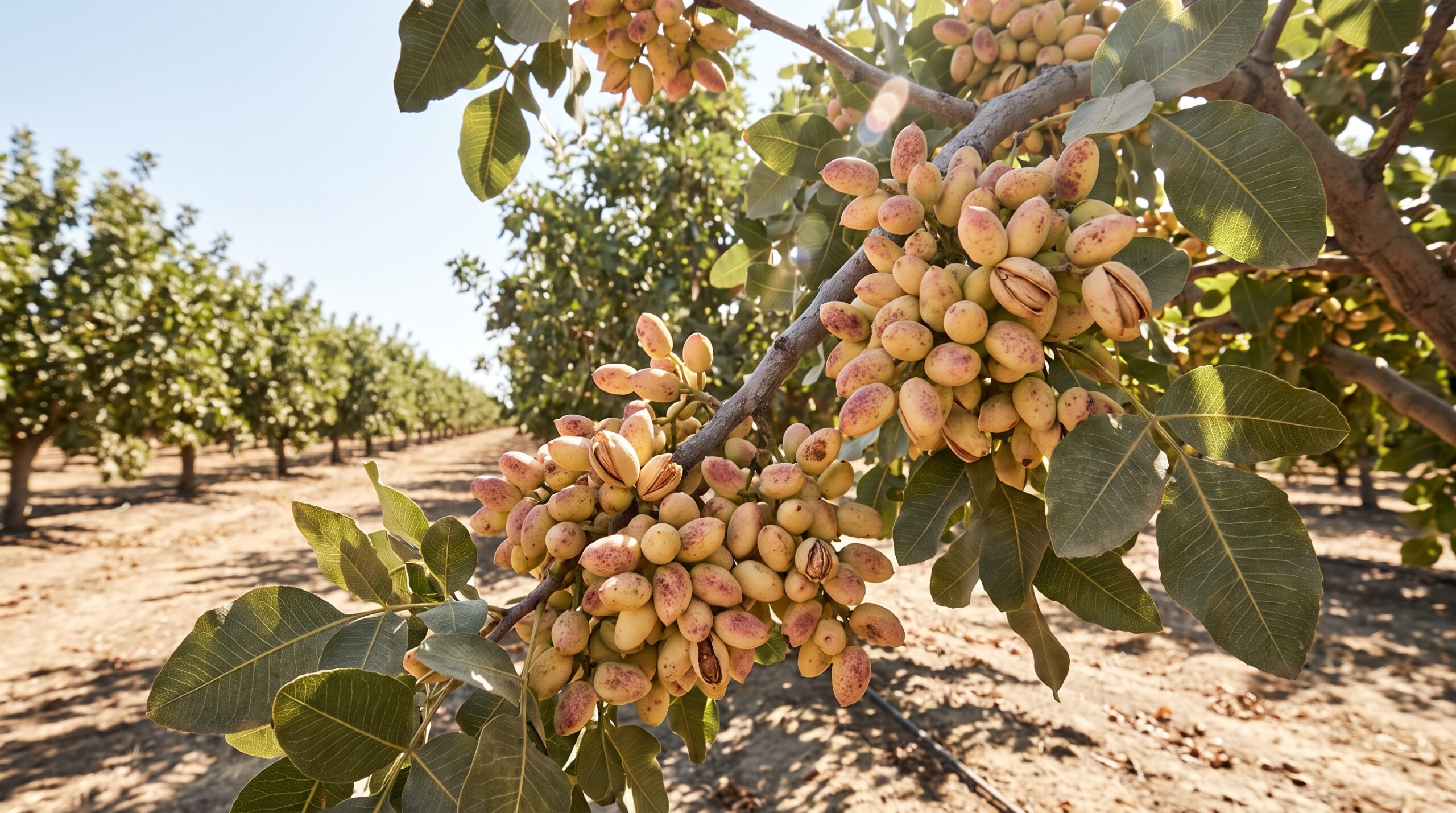
When we talk to growers who want to plant pistachios, the same question always comes up sooner or later: which variety should I choose? Whenever someone asks us about the latest developments in California, one name keeps appearing: Lost Hills. 🌰
The Lost Hills pistachio is an early-maturing female variety, bred by the University of California, Davis and released in 2005. It was created to offer an alternative to Kerman, which for most of the history of California pistachio production was virtually the only option. Since then it has generated debate, trials and plenty of curiosity among pistachio growers worldwide.
In this article we explain what Lost Hills is, what it really offers, where it falls short, and whether it makes sense to consider varieties of this kind for a pistachio orchard in Mediterranean-climate regions. We base this on the data from university trials and on the experience of our technical team at Agro Vivero del Mediterráneo, with no hype and no miracle promises. 🤝
What Is the Lost Hills Pistachio and Where Does It Come From? 🌱
Lost Hills is a female pistachio variety (Pistacia vera), meaning it produces the nut. It comes from the University of California, Davis breeding programme, launched in 1990 with industry support and led by the breeder Dan Parfitt together with other specialists in pomology and agricultural extension.
Three related materials came out of that programme in 2005:
- Golden Hills: a female variety, sister line to Lost Hills.
- Lost Hills: a female variety, with the same genetic origin as the previous one.
- Randy: an early-flowering male, selected to pollinate both.
Lost Hills and Golden Hills are related, but they are not the same. They behave similarly in some respects, such as early flowering and early maturity, and differently in others: vigour, growth habit, ease of budding and nut quality.
It is a protected variety. California growers can only obtain it from nurseries licensed by the University of California. This detail matters: a protected variety cannot be freely propagated, and the origin of the plant material conditions any planting decision.
Why Lost Hills Arrived in California: The Context of a Single-Variety Crop 🇺🇸
To understand why people talk about a revolution, we have to look at the starting point. For most of the modern history of pistachios in California, orchards were planted almost exclusively with Kerman. It was a well-known, productive variety with excellent nut quality, but it had three structural problems:
- Concentrated harvest. With a single variety, all orchards ripen at roughly the same time, and hulling and drying facilities become overloaded within a few days.
- Marked alternate bearing. Kerman tends to alternate good and poor crops.
- Vulnerability. Relying on a single genetic material is risky if a pest or disease appears that affects it especially.
The University of California specialists set out the aim clearly: they were looking for varieties with yield and quality comparable to Kerman, but with different ripening times, fewer nut defects and better growing characteristics. Lost Hills and Golden Hills were the first serious answer to that need.
For the grower, this is not just a matter of timing. Harvesting earlier or later changes how machinery, labour, drying and end-of-season irrigation are organized. That is why an early-maturing pistachio variety has more impact than it might seem at first glance. ⏱️
Characteristics of the Lost Hills Pistachio: What the Trials Show 📋
Data from the University of California trials give us a fairly reliable profile. We summarize the most relevant points in a table:
| Characteristic | Lost Hills | Kerman (benchmark) |
|---|---|---|
| Type | Female variety | Female variety |
| Year of release | 2005 | In use since the 1960s |
| Flowering | Earlier | Later |
| Maturity | 1 to 2 weeks earlier | Late |
| Tendency to alternate bearing | Lower | Marked |
| Loss of nuts and shells | Around 3% | Below 0.5% |
| Main pollinator | Randy | UC Westside and others |
In addition, the trials show that Lost Hills has vigorous trunk growth. Its habit and pruning requirements are closer to Kerman than to Golden Hills, which makes it easier to manage for growers already familiar with the classic variety.
It is worth remembering that these data come from California conditions, with a continental climate, very hot summers and tightly controlled irrigation. They are an excellent guide, but we cannot simply transfer them to every growing region. We explain this in more detail below. 🌍
Early Maturity: The Real Advantages at Harvest ⏱️
The star feature of Lost Hills is that it is harvested earlier. In trials in Kern and Madera counties, the two Californian counties where much of the crop is concentrated, the harvest of Lost Hills and Golden Hills came one to two weeks ahead of Kerman. In the University of California trials, Lost Hills and Golden Hills were harvested in early September.
What does this mean in practice?
- The processing window is extended. If not all orchards ripen at once, hulling and drying plants can spread their workload better.
- Harvest risk is reduced. Finishing earlier lowers exposure to rain or adverse end-of-season conditions.
- Machinery is organized more efficiently. A grower with several plots can stagger harvesting and make better use of equipment.
- End-of-cycle irrigation management improves. An earlier harvest leaves more room for post-harvest orchard management.
There is one important caveat: early maturity requires fine-tuning the harvest timing. California specialists insist that with these varieties it is even more important to harvest on time, because nut quality can suffer if the operation is delayed. An early variety leaves no room for improvisation. 🔧
Yield and Consistency: Less Alternate Bearing with Lost Hills? 📈
Alternate bearing is one of the biggest headaches in pistachio growing. A heavy crop depletes the tree’s reserves, and the following year production falls. If this cycle is very pronounced, financial planning for the farm becomes much more complicated.
According to University of California trials, Lost Hills seems to have less tendency toward alternate bearing than Kerman, which translates into more consistent production from one year to the next. For the grower, consistency is worth almost as much as quantity: it allows income to be forecast, negotiations to go better, and workforce and machinery to be sized properly.
As for yield levels, variety trials in Kern indicate that Lost Hills and Golden Hills exceeded 10,000 pounds per acre in 2019, that is, just over 11,000 kg/ha. In some trials, Golden Hills yielded slightly more than Lost Hills, so Lost Hills is not the highest-yielding variety in the family. Its strength lies in the balance between yield, consistency and timing.
A warning we always give: these figures come from well-controlled trials in a specific area. In a commercial orchard, the result depends on soil, water, climate, management and tree age. If you want to run realistic numbers for your project, we recommend consulting our page on the profitability of a pistachio orchard. 💶
The Weak Points You Should Know About ⚠️
A variety with only advantages would not exist. Lost Hills has limitations that every grower should understand before making a decision.
1. Loss of nuts and shells. In the trials, Lost Hills has shown around 3% loss of shells and nuts, compared with less than 0.5% for Kerman and Golden Hills. It sounds small, but in a large orchard it means production that never reaches the warehouse.
2. Lower adoption. For years, Golden Hills accounted for more than 80% of new California plantings, while Lost Hills remained at a considerably more modest figure. This means less commercial field data and less accumulated experience than with its sister variety.
3. Slightly lower yield in some trials. As we saw earlier, Golden Hills has yielded somewhat more in several tests.
4. Dependence on a specific pollinator. It works very well with Randy, but the ratio and flowering synchrony must be respected. We go into detail in the next section.
5. Protected variety. It can only be obtained from authorized nurseries, which affects its availability and price in each country.
This is the balance we give our customers: Lost Hills is a good variety, but not a universal solution. It must be assessed with data and with a cool head. 🧠
Lost Hills Pollination: Randy and Tejon 🐝
The pistachio is a dioecious species: there are female trees, which produce the nut, and male trees, which supply the pollen. That is why pistachio pollination is one of the most important decisions when designing an orchard. If the males fail, the best female variety in the world will not deliver a good crop.
For Lost Hills and Golden Hills, the University of California developed the male Randy, which flowers early over an extended period and is considered a reliable pollinator for both. In the variety trials, a combination of pollinators was used in which Randy provided around 80% and Tejon around 20%. This mix aims to cover the flowering window better and ensure nut set even if the year brings irregular temperatures.
Some key points on pollination:
- Flowering synchrony between females and males is essential. If the dates do not coincide, nut set suffers.
- With early-flowering varieties, spring frosts matter more, because the flowers open earlier and may be left exposed.
- The ratio and distribution of males in the plot must be designed with technical judgement.
- Male plant material must also come with guarantees of origin.
Our team always stresses that pollination is not improvised or solved by planting males at random. If you need help designing your plot, you can find out about our advisory services. 🌿
Rootstocks, Training and Pruning of Lost Hills ✂️
When we talk about varieties, we often forget that the tree is two plants in one: the variety that produces the nut and the rootstock that provides roots, vigour and soil tolerance. In California, Lost Hills and Golden Hills have been evaluated on the UCB-1 and PG1 rootstocks, among others.
There are several practical aspects to managing this variety:
- Budding. Specialists note that Golden Hills is harder to bud than Kerman or Lost Hills. On this point, Lost Hills has the advantage.
- Growth. Both Lost Hills and Golden Hills thicken their trunks faster than Kerman, which helps build sturdy trees in the early years.
- Pruning. Pruning Lost Hills is more like pruning Kerman than Golden Hills, which makes the transition easier for those who already have experience with the classic variety.
- Training. For both varieties, we recommend not tipping late, because training is carried out through early, well-planned interventions.
Training in the first few years determines the performance of the orchard over its whole life. A poorly trained tree is harder to prune, harder to harvest and yields less. That is why in young orchards it pays to invest time and technical judgement rather than simply copying what is done in other regions. 🌳
Lost Hills vs Golden Hills and Kerman: A Practical Comparison ⚖️
To help you place Lost Hills among its main benchmarks, here is a comparison of the aspects that weigh most in the decision:
| Aspect | Lost Hills | Golden Hills | Kerman |
|---|---|---|---|
| Maturity | Early | Early | Later |
| Flowering | Early | Early | Later |
| Alternate bearing | Lower tendency | Lower tendency | Marked |
| Growth | Vigorous | Vigorous, more upright habit | Slower |
| Ease of budding | Good | More difficult | Good |
| Pruning | Similar to Kerman | More specific | Well known |
| Loss of nuts and shells | Around 3% | Below 0.5% | Below 0.5% |
| Adoption in California | Limited | Very high | Historic |
The reading is simple. Golden Hills has been the great commercial winner, Lost Hills has occupied a smaller niche, and Kerman remains the historical benchmark. This takes nothing away from Lost Hills, but it does require us to be honest: what has revolutionized California is the arrival of the early-maturing varieties from the University of California, and Lost Hills is part of that change alongside Golden Hills.
California specialists also point out that Lost Hills may be an interesting option in situations where it is not possible to meet the crop’s full water demand, an issue of growing concern in water-scarce regions. It is a valuable clue, although it should be validated in each context. 💧
Does Lost Hills Make Sense for Pistachio Growing in Mediterranean Climates? 🌍
This is the question we are asked most often, and the honest answer is: it depends. A Mediterranean climate is not the climate of Kern County, and California data cannot simply be copied and pasted.
These are the factors we analyse with each grower:
Chilling hours. Pistachios need to accumulate chilling hours in winter to break bud and flower properly. Early-flowering varieties may have different requirements, and in mild-winter regions this is decisive.
Frost risk. Early flowering exposes the blossom to late frosts. On plots at risk, this can outweigh any advantage in maturity.
Harvest calendar and machinery. If we have limited equipment or a single harvester, an early variety can help stagger the work. If the orchard is small, it may not add much.
Availability and legality. Because it is a protected variety, the status and access to plant material in each country must be checked.
Market and destination of the nut. The buyer, the size grade, the percentage of split nuts and the final quality matter as much as the calendar.
In our case, we work with the plant material that best suits the conditions of our growing areas. If you would like to know what we offer, you can visit our pistachio plants page, where we explain the available options. And if you already have a plot in mind, we like to study it carefully before recommending anything: soil, water, climate, slope and production targets. 📍
What we do find valuable about Lost Hills is the lesson it offers. Diversifying varieties, spreading harvest timing and reducing alternate bearing are ideas that any grower, small or large, can apply to their farm, whether or not they plant this particular variety.
How to Choose a Pistachio Variety: The Criteria We Recommend 🧭
Beyond Lost Hills, choosing a pistachio variety requires a method. These are the criteria we review with our customers:
- Local climate: chilling hours, frosts and summer temperatures.
- Water availability: quantity, quality and irrigation regime.
- Soil: texture, depth, salinity and drainage.
- Orchard size: a small farm does not need the same as a large operation.
- Equipment and labour: the real capacity to harvest in a short time.
- Commercial destination: who buys and what they require.
- Suitable pollinators: synchrony with the chosen female variety.
- Investment horizon: timescales and expected return.
A good variety decision is not made by fashion. It is made by comparing data, talking to technicians who know the area and looking at the long term. A mistake at this stage is paid for throughout the life of the orchard. ✅
Frequently Asked Questions About the Lost Hills Pistachio 🙋
What is the difference between Lost Hills and Golden Hills?
They are sister varieties with the same genetic origin. Both are early and are pollinated by Randy. Golden Hills has had much wider adoption and lower loss of nuts and shells, while Lost Hills has pruning requirements closer to Kerman.
When is the Lost Hills pistachio harvested?
It is harvested one to two weeks before Kerman. In the California trials in Kern and Madera, this means early September.
What pollinator does Lost Hills need?
The recommended male is Randy, which flowers early. In the trials it was combined with Tejon in a ratio of approximately 80% and 20%.
Does Lost Hills have alternate bearing?
It seems to have less tendency than Kerman, so production is more consistent, although no variety is completely free of this phenomenon.
Can Lost Hills be planted outside California?
It depends on the region, the climate and the legal availability of the plant material. The most sensible approach is to study each case with a technician before deciding.
Is Lost Hills better than Kerman?
There is no universal answer. Lost Hills offers early harvest and less alternate bearing; Kerman offers a wealth of accumulated knowledge and a highly proven nut quality. The best variety is the one that fits your plot and your project.
To Finish: What We Should Remember 🌰
The Lost Hills pistachio is an early-maturing female variety, created by the University of California and released in 2005 together with Golden Hills and the pollinator Randy. Its main contribution is to bring the harvest forward, spread the workload and reduce alternate bearing compared with Kerman. In return, it has a higher loss of nuts and shells, more limited adoption than Golden Hills and the particularities of being a protected variety.
More than a revolution on its own, Lost Hills is part of a deeper change: pistachio growing stopped depending on a single variety. That is the idea we are most keen to pass on to those thinking about starting or expanding an orchard.
If you are assessing your project, at Agro Vivero del Mediterráneo we can help you choose a variety, design the pollination and calculate the investment with real data. You can contact us, find out more on our website or request a quote for pistachio plants directly. We will be glad to study your plot. 🤝
Need a quote?
Tell us about your project and we will send you a proposal with no obligation.
Request a quote