


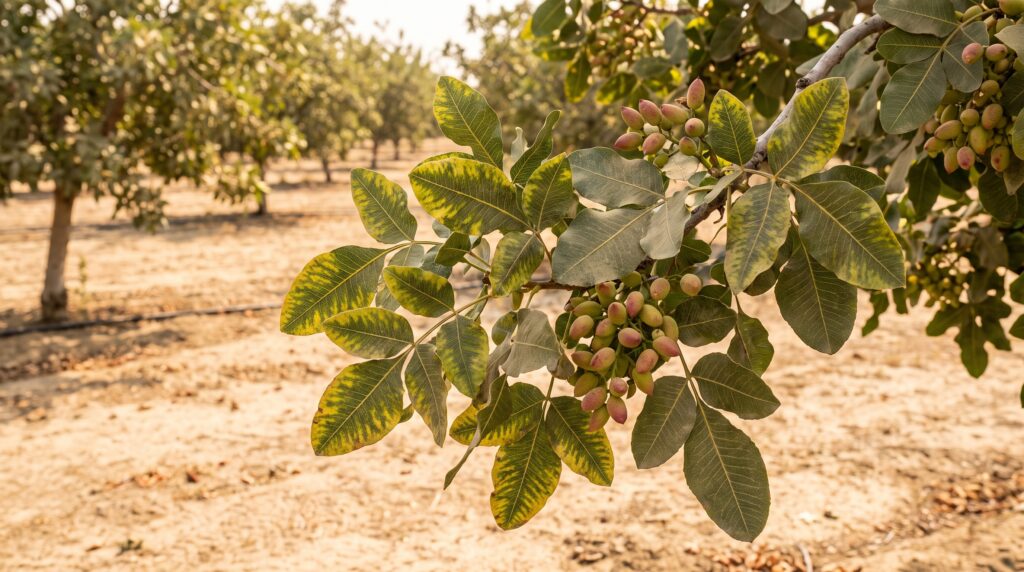
🌳 When we walk through an orchard and see yellow leaves on pistachio trees, the first thing we do is resist the urge to apply any product. Yellowing is a symptom, not a disease. Behind pale leaves there may be a simple seasonal change, but also a nutrient deficiency, a water problem, a soil-borne fungus or soil that is not performing as it should.
At Agro Vivero del Mediterráneo, we have spent many years working alongside growers who are planting their first plot and others who are expanding large-scale operations. We have seen the same symptom with completely different causes, which is why we insist on one principle: diagnose first, act second.
In this guide, we explain in clear language and with practical examples how to interpret yellowing in pistachio trees, which causes are the most common and what you can do in each case. If you are looking for an overview of the investment and management side, we also recommend reading our page on the profitability of a pistachio orchard, because a healthy orchard is the foundation of any financial return. 📈
Why Do Pistachio Leaves Turn Yellow?
A green leaf is green because of chlorophyll, the pigment that captures light and produces the sugars that feed the tree. When a nutrient needed for chlorophyll production is lacking, when the roots cannot absorb it or when something damages the vascular system, the leaf loses its colour. This process is called chlorosis.
The pistachio is a hardy tree, drought-resistant and tolerant of calcareous soils and moderate salinity. But that hardiness does not mean it forgives every management mistake. Its greatest enemy is excess water in the soil, and many of the cases of yellowing we review are directly related to irrigation and drainage.
The causes fall into five groups:
- 🍂 Physiological and seasonal causes: autumn, crop load or temporary stress.
- 🧪 Nutrient deficiencies: nitrogen, iron, magnesium, zinc, potassium, manganese or boron.
- 💧 Water problems: excess, shortage or poor water quality.
- 🍄 Diseases: soil-borne and foliar fungi.
- 🐛 Pests: sap-sucking insects and mites.
Before We Worry: Natural Autumn Yellowing 🍁
The pistachio is a deciduous tree. Between October and November, depending on the region, the leaves turn from green to golden yellow and then fall. This is a normal process, and even a beautiful one, which occurs uniformly across the whole orchard and in all trees at the same time.
How to tell it apart from a real problem:
- It appears at the expected time of year, once temperatures have dropped.
- It affects the entire plot evenly.
- Leaves yellow from the tip towards the petiole and drop cleanly.
- Trees leaf out normally in spring.
If yellowing appears in midsummer, in patches or on isolated trees, we are no longer talking about autumn. That is when it is time to investigate.
How to Read the Symptom: Where Does the Yellowing Appear?
This is the question that helps us most when narrowing down a diagnosis. Observe carefully:
Old leaves or young leaves. Nutrients that are mobile within the plant, such as nitrogen, magnesium and potassium, are moved from old leaves to new shoots when there is a deficiency. That is why their symptoms appear first on the oldest leaves. Nutrients with low mobility, such as iron, zinc, manganese and boron, produce symptoms on young leaves and terminal shoots.
Uniform yellowing or interveinal yellowing. When the whole leaf blade lightens evenly, we think of nitrogen. When the veins remain green and the tissue between them yellows, we think of iron, magnesium or manganese.
Whole tree or a single branch. If the problem is concentrated on one side of the tree or on a single branch, we suspect a vascular disease. If it affects the whole tree, we usually think of soil, water or nutrition.
Specific areas of the plot. If yellowing appears in low-lying areas, next to an irrigation channel or where water pools, we point to drainage. If it appears in a strip, it may be due to a variation in the soil or a fault in the irrigation system.
Nitrogen Deficiency in Pistachio Trees: The Most Common Yellowing 🌿
Nitrogen is the driver of vegetative growth. When it is lacking, the older leaves turn pale green and then uniformly yellow, shoots grow poorly and trees look stunted.
Nitrogen deficiency in pistachio trees typically appears in young orchards with little fertilisation, in sandy soils with heavy leaching losses, or in plots where ground cover competes with the tree. It is worth remembering that the pistachio has alternate bearing, and in heavy crop years demand increases.
What we do:
- Review the fertilisation history and the rate applied.
- Carry out a leaf analysis to confirm the diagnosis.
- Adjust the nitrogen supply by splitting it into several applications throughout the cycle, preferably through drip irrigation (fertigation).
- Avoid excess, because a tree that is pushed too hard with nitrogen is more susceptible to certain diseases and ripens later.
An important point: nitrogen is never applied blindly. A young orchard has very different needs from a mature one in full production, and adapting the pistachio fertilisation programme to each stage is one of the keys to good management.
Iron Chlorosis in Pistachio Trees: When Iron Does Not Reach the Plant 🔩
Iron chlorosis in pistachio trees is the typical picture in calcareous soils with a high pH. Symptoms appear on young leaves: the blade turns light yellow while the veins keep a more intense green, forming a net-like pattern. In severe cases, the leaves turn almost white and the margins become necrotic.
Curiously, the soil often contains plenty of iron. The problem is that, with a pH above 8.3 and a high level of active lime, the iron becomes locked up and the plant cannot absorb it. Over-irrigation and waterlogged soils aggravate the problem because they make it harder for the roots to respire.
How we act:
- We confirm the diagnosis with soil and leaf analysis. An apparently normal total iron content in the leaf does not rule out chlorosis, because part of the iron may be inactive.
- We assess the active lime content and the soil pH.
- We check the quality of the irrigation water, particularly bicarbonates.
- We apply iron chelates suited to the soil pH, always following technical rates.
- We improve drainage and avoid waterlogging.
And a recommendation for those who have not yet planted: in soils with high lime content, the choice of rootstock and site preparation make all the difference. On our pistachio plants page, we explain the plant material we work with and how we help choose the most suitable option for each soil.
Magnesium and Manganese Deficiency: Interveinal Yellowing 🍃
Magnesium deficiency appears mainly on mature and old leaves. The tissue between the veins lightens, while a green band remains close to them. It is common in sandy or acidic soils, or in soils with excess potassium or calcium, which compete with magnesium for uptake.
Manganese deficiency, by contrast, shows up on young leaves and resembles iron chlorosis, although it is usually milder. It is more frequent in calcareous, strongly alkaline soils.
To tell them apart reliably, the best tool is leaf analysis. We encourage you to carry it out every year in mid-summer, when leaf nutrient levels stabilise, and to repeat it annually to track how the orchard evolves.
Zinc Deficiency in Pistachio Trees: Small Leaves and Rosetted Shoots 🌱
Zinc deficiency is one of the best-known micronutrient deficiencies in pistachio. The symptoms are highly characteristic:
- Small, narrow and distorted leaves.
- Short shoots with very close internodes (rosette appearance).
- Interveinal yellowing on young leaves.
- Reduced vigour and lower yields.
It occurs in calcareous soils, soils low in organic matter or soils with excess phosphorus. It can usually be corrected with foliar applications at the right time and a balanced fertilisation programme. The key is to detect it early: if left to progress, the tree loses yield considerably.
Potassium and Boron: Two Delicate Nutrients ⚖️
Potassium is essential for kernel filling and the quality of the nut. Its deficiency shows on the older leaves, with marginal scorching and yellowing, especially in heavy crop years. It is common when yields are high and potassium supply has not kept pace.
Boron deserves special attention because there is a narrow margin between deficiency and toxicity. A shortage causes distorted shoots and problems with flowering and fruit set. An excess, frequent in waters with a high boron content, causes leaf-tip scorching and marginal yellowing. For this reason, we never recommend applying boron without first analysing the soil, the water and the leaf.
Quick Summary: Symptoms and Likely Causes Table 📋
| Symptom | Where it appears | Likely cause |
|---|---|---|
| Uniform pale yellow | Old leaves | Nitrogen deficiency |
| Interveinal yellowing, green veins | Young leaves | Iron chlorosis or manganese deficiency |
| Interveinal yellowing with a green band | Mature and old leaves | Magnesium deficiency |
| Small leaves and rosetted shoots | Young leaves | Zinc deficiency |
| Scorched, yellow margins | Old leaves | Potassium deficiency or excess boron or salts |
| Yellowing with wilting on one side of the tree | Specific branches | Verticillium or another vascular fungus |
| Yellow leaves, weak tree, in wet areas | Whole tree | Root asphyxia or Phytophthora |
| Sticky leaves with sooty mould | Leaves and shoots | Sap-sucking pests |
This table is a guide for orientation, not a definitive diagnosis. Several causes can coexist in the same orchard, which is why we always recommend confirming with laboratory analysis.
Root Asphyxia and Over-Irrigation in Pistachio Trees 💧
If we had to point to the number one cause of widespread yellowing in young orchards, it would be this. The pistachio tolerates drought well, but it does not tolerate waterlogged soils. Roots need oxygen, and when the soil stays saturated with water for days, root asphyxia develops, leading to yellow leaves, leaf drop and general weakening.
Over-irrigation in pistachio trees is more common than we imagine. Many growers who come from other, more water-demanding crops apply irrigation as if the pistachio were an intensively irrigated fruit tree. The result: permanently wet soils, weak roots and a tree more exposed to fungi.
Signs that the problem is water:
- Yellowing appears in low-lying areas or in heavy soil.
- The soil stays moist at a depth of 30 to 40 centimetres for days.
- Fine roots look dark or smell bad.
- There is a poor response to fertiliser applications.
How we correct it:
- Review the drip irrigation schedule and reduce the frequency or volume.
- Check with a soil pit how water is distributed through the soil profile.
- Improve drainage with tillage, ridges or drainage systems where necessary.
- Avoid irrigating at times when the tree’s water demand is lower.
When we advise on a new orchard, soil study and irrigation design go hand in hand from the very start. This is one of the lines of work you can see on our services page. 🛠️
Phytophthora in Pistachio Trees: When the Fungus Attacks the Root 🍄
Phytophthora is a soil-borne pathogen (more precisely, an oomycete) that thrives in conditions of excess moisture. It attacks the crown and roots, causes rot and weakens the tree. From the outside, we see yellow leaves, reduced growth, premature leaf drop and, in advanced cases, tree death.
Characteristic signs:
- Dark lesions at the base of the trunk, sometimes with exudates.
- Bark that peels away and brown wood at the crown.
- Progressive yellowing of the whole canopy.
- Higher incidence in plots with poor drainage and frequent irrigation.
Here, prevention is far more effective than cure. It is advisable to choose the site carefully, avoid planting too deep, avoid wetting the trunk with irrigation, maintain good drainage and, of course, start with healthy, high-quality plants. If you suspect this problem, it is best to confirm the diagnosis with a laboratory analysis before applying any treatment.
Verticillium in Pistachio Trees: Yellowing That Advances Along a Branch 🔍
Verticillium in pistachio trees is one of the most feared diseases. It is a vascular fungus that lives in the soil, enters through the roots and blocks the vessels through which sap flows. The affected tree shows a very typical picture: yellowing, wilting and drying of leaves on one part of the canopy or on a single branch, while the rest appears healthy.
What sets it apart from nutritional yellowing:
- It usually affects one sector of the tree, not the whole canopy.
- Leaves dry out and often remain attached to the branch.
- When the wood is cut, dark streaks may be visible inside.
- It does not improve even when we apply fertiliser or correct irrigation.
There is no simple curative treatment, so the strategy is based on prevention: knowing the history of the plot, avoiding planting after susceptible crops such as cotton, tomato or potato, and choosing rootstocks with good tolerance. If the plot has a history of this fungus, consult us before planting. This is a case where a good initial decision avoids problems throughout the life of the orchard.
Other Diseases That Cause Leaf Spots and Yellowing 🔬
In addition to soil-borne fungi, there are foliar diseases that can cause spots, yellowing and defoliation:
- Septoria: causes rounded spots that turn yellow and lead to premature leaf drop, especially in humid summers and autumns.
- Alternaria: causes dark spots on leaves and fruit, more frequent in areas with high humidity.
- Botryosphaeria: affects shoots, flowers and leaves, and can be very damaging in rainy springs.
The key is prevention: canopy aeration through good pruning, preventive treatment programmes during risk periods and frequent monitoring. In dry climates, these diseases tend to be less limiting, but one wet year can change everything.
Pests That Can Cause Leaf Yellowing 🐞
Not everything comes down to nutrition and fungi. Some sap-sucking insects weaken leaves and leave them discoloured:
- Pistachio psyllid: causes weakening through sap extraction and produces honeydew, on which the fungus known as sooty mould grows.
- Mites: cause stippling and discolouration of the leaf blade in hot, dry periods.
- Aphids: cause curling and yellowing of tender shoots.
When we see sticky, shiny leaves or a black powdery coating, we need to examine the underside of the leaves with a hand lens and look for the insects. In this part of crop management, regular monitoring and intervention thresholds are essential so that we act only when necessary.
Soil Salinity and Irrigation Water Quality 🧂
The pistachio tolerates soil salinity well, much better than most crops. But tolerating is not the same as thriving without consequences. With brackish water or salt accumulation, scorching appears along leaf margins, along with marginal yellowing and reduced growth.
What we should check:
- Electrical conductivity of the water and the soil.
- Chloride, sodium and boron content.
- Salt distribution in the soil profile after irrigation.
- The possibility of leaching irrigations when the situation requires it.
A water analysis before planting is a small investment that can prevent major problems. And if your orchard is already established, repeating it periodically helps detect changes, especially in wells whose quality varies over the years.
The Plant Factor: Rootstock, Nursery Quality and Root Condition 🌳
Although it is rarely discussed, the quality of the starting plant has a major influence on the appearance of yellow leaves. A plant with a deformed root system, poorly trained in the nursery or with health problems will carry its weakness into the field. And the rootstock chosen determines its adaptation to lime, salinity, waterlogging and certain fungi.
That is why, before planting, it is worth asking:
- Which rootstock is the most suitable for my soil type?
- Does my plot have a history of root diseases?
- Does the plant material come from a nursery with phytosanitary control?
- Is the plant’s root system well formed?
This is an essential part of our work at the nursery and one of the reasons many growers consult us before making a decision. You can learn more about us at Agro Vivero del Mediterráneo.
Practical Guide: How to Diagnose Yellow Leaves Step by Step 🧭
We propose a simple method, the same one we follow during our orchard visits:
Step 1. Observe the pattern. Determine whether the yellowing affects young or old leaves, the whole tree or one branch, one area of the plot or all of it.
Step 2. Review irrigation. Check how much water arrives, how often and how the soil drains. A soil pit will tell us more than a thousand assumptions.
Step 3. Dig and look at the roots. Healthy, white and firm roots indicate good condition. Dark, soft or foul-smelling roots point to asphyxia or fungi.
Step 4. Inspect the trunk and branches. Look for lesions, exudates or dark streaks when cutting the wood.
Step 5. Check the underside of the leaves. Rule out pests, honeydew or mites.
Step 6. Take samples. Soil analysis, water analysis and leaf analysis are the three pillars of an objective diagnosis.
Step 7. Act with judgement. Correct the real cause and not just the symptom. Applying iron to a tree suffering from root asphyxia, for example, is money wasted.
The Mistakes We Make Most Often 🚫
Throughout our work, we have identified mistakes that are repeated again and again:
- Fertilising without prior analysis, by eye or out of habit.
- Giving more water when leaves turn yellow, aggravating an asphyxia that was already present.
- Mistaking autumn yellowing for a serious problem, or the other way round.
- Applying plant protection products without first identifying the pest or disease.
- Ignoring the quality of the irrigation water.
- Planting without a prior soil study.
Avoiding these mistakes saves money and, above all, time. In a long-term crop like pistachio, every year lost in tree development shows up later in the harvest.
Prevention: How to Avoid Yellow Leaves from Day One ✅
The best solution is not having to apply one. These are our recommendations for a healthy pistachio orchard from the very beginning:
- Study the land before planting: texture, depth, pH, active lime, salinity and drainage.
- Analyse the irrigation water and plan the installation accordingly.
- Choose the plant material carefully, with a rootstock adapted to the conditions of the plot.
- Plant correctly, without burying the crown and with good soil preparation.
- Schedule irrigation on technical criteria, without excess.
- Fertilise according to analysis, adapting the programme to each stage of the crop.
- Carry out annual monitoring with leaf analysis and regular plot inspections.
- Monitor pests and diseases regularly.
With this routine, the vast majority of yellowing episodes are detected in time or never even appear.
Frequently Asked Questions About Yellow Leaves in Pistachio Trees ❓
Is it normal for pistachio leaves to turn yellow?
Yes, in autumn, when the tree prepares for winter dormancy. If it happens in spring or summer, it is not normal and should be investigated.
What is the most common cause of yellowing in pistachio trees?
In our experience, water management and drainage. After that, nutrient deficiencies linked to soil pH, such as iron chlorosis.
Can I solve yellowing with fertiliser alone?
Only if the cause is nutritional. If the origin is excess water, a disease or a pest, fertiliser will not solve anything.
When should leaf analysis be carried out?
In mid-summer, when leaf composition is most stable and comparable between years.
Is a young orchard more vulnerable?
Yes. Young trees have a poorly developed root system and react sooner to excess moisture and deficiencies.
Do trees recover their colour?
If the cause is corrected in time, most cases of nutrient deficiency or water stress recover at the next flush of growth. If the problem is an advanced vascular disease, the prognosis is more difficult.
When to Seek Professional Help 🤝
There are situations in which it is better not to improvise: when yellowing affects many trees, when it advances quickly, when it coexists with branch dieback, or when you have already tried a solution without results. In these cases, a professional on-site diagnosis saves costs and avoids repeated mistakes.
If you have questions about your orchard, you can write to us through our contact page. And if you are planning a new orchard and want to get it right from the start, you can also request your plant reservation and quotation with no obligation. We will assist you with the closeness of those who know the crop first-hand.
To Finish: Observe, Diagnose and Act 🌟
Yellow leaves in pistachio trees are not a death sentence, but they are a signal that deserves attention. We have seen that they can be due to a natural process, a lack of nitrogen, iron, magnesium or zinc, over-irrigation, root asphyxia, fungi such as Phytophthora or Verticillium, pests or salinity problems.
What works best is always the same: observe the symptom pattern carefully, rely on soil, water and leaf analysis, correct the real cause and, above all, prevent problems from the design stage of the orchard. A good choice of rootstock, well-planned irrigation and annual monitoring make the difference between an orchard that gives problems and one that produces consistently.
If you would like an expert opinion on your plot, or if you are thinking of starting or expanding a pistachio orchard, we are here. Write to us and we will study it together. 🌰