


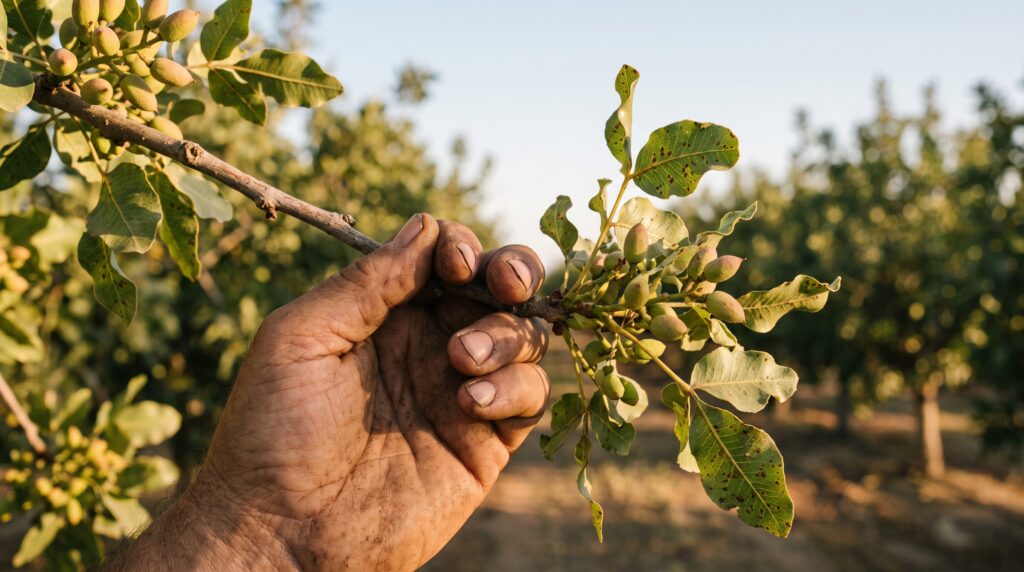
When a pistachio orchard flowers normally and the harvest still falls short, the first thing we should check is tree nutrition. Among all the possible causes, boron deficiency in pistachio is one of the quietest: it does not always leave obvious symptoms on the leaves, yet it can reduce effective flowering, nut set and, with them, the kilograms that actually reach the harvest trailer. 🌰
At Agro Vivero del Mediterráneo we work with growers planting their first hectares as well as with large estates expanding their area, and boron is a topic that comes up again and again in the questions we receive. That is why we have put together this practical guide.
We will look at what boron does inside the tree, how to recognize the symptoms, how to confirm them with a leaf analysis and, above all, how to correct and prevent boron deficiency in pistachio trees without overdosing. ✅
🔬 What boron is and why it matters so much in pistachio cultivation
Boron is a micronutrient: the tree needs it in very small amounts, but it cannot replace it with any other element. It is measured in parts per million (ppm), that is, milligrams per kilogram of leaf dry matter, and that modest figure makes the difference between a productive flowering and one that stays half-finished.
In pistachio cultivation we tend to focus our efforts on nitrogen, potassium and irrigation, which is logical, because these are the elements that weigh most on vigour and crop size. But pistachio nutrition is a whole system, and micronutrients work like the hinges of a large door: you do not see them and they weigh almost nothing, but if they fail, the door will not close. 🚪
These are the functions of boron in the pistachio tree that interest us most:
- 🧱 Cell wall structure: gives firmness and flexibility to young tissues, such as shoots and growing leaves.
- 🌱 Meristem growth: without enough boron, the growing points of shoots and roots suffer.
- 🌸 Pollen germination and pollen tube growth: essential for the flower to be fertilized.
- 🍬 Sugar transport: helps move energy to flowers, nuts and developing tissues.
- 🧬 Cell membrane function: helps cells regulate what enters and leaves them.
Boron in pistachio also has a particular feature that makes it especially delicate, and we will come back to it later.
🌸 Boron in pistachio flowering, pollination and nut set
The pistachio is a dioecious species: there are male trees and female trees, and the pollen travels on the wind. This dependence means that any factor affecting pistachio flowering has direct consequences for the harvest. And boron is one of them.
During flowering, the tree goes through a short window in which it needs boron to be available quickly: the pollen has to germinate, the pollen tube has to grow down to the ovule, and the fertilized flower has to set. If boron is scarce at that moment, some inflorescences may die or produce aborted nuts.
In practice, what we see in the field are clusters with few nuts, blank pistachios, shells without a properly formed kernel and a heavier than normal nut drop during spring, the so-called June drop. A failure in pistachio pollination caused by a lack of boron is often mistaken for a shortage of pollen, cold weather during flowering or alternate bearing.
The trickiest thing is that a mild deficiency may show nothing unusual on the leaves. The tree looks healthy, flushes normally and flowers, but nut set does not respond as it should. Very often the first warning is a yield below expectations, and that is when it is worth looking at boron.
🍃 Symptoms of boron deficiency in pistachio: what to look for
The symptoms of boron deficiency depend on how severe the problem is. With a mild deficiency, the only sign may be the yield; with a severe one, the tree shows it in its shoots and leaves. This table summarizes what we usually find:
| Organ | What we observe |
|---|---|
| 🍃 Young leaves | Distorted leaves: wrinkled, thickened and leathery, with wavy margins and tips curled upwards. They usually stay green. |
| 🌿 Shoots | Short growth, shortened internodes and, in severe cases, dieback of the terminal shoots. |
| 🌸 Inflorescences | Clusters that dry out or set very few nuts. |
| 🌰 Nuts | Blank pistachios, abortions and, in mild deficiencies, internal gumming. |
| 📉 Yield | Harvests below potential, sometimes with no visible symptoms at all. |
One detail that often misleads: affected leaves do not turn yellow, as happens with other deficiencies. They become distorted and thickened, but keep a somewhat dull green. Anyone expecting to see chlorosis may overlook the problem.
To organize our thinking, we usually talk about three levels:
- 🟢 Mild deficiency: no clear symptoms on the leaves. Nut set and yield lower than they should be.
- 🟡 Moderate deficiency: abortion of inflorescences, heavy nut drop and some distorted leaves on the youngest shoots.
- 🔴 Severe deficiency: thickened and distorted leaves, shoot dieback and a clear loss of yield.
In young orchards, shoot dieback is particularly damaging, because it delays the formation of the tree’s framework and, with it, the start of production. That is why we recommend checking boron from the very first years, and not only when the orchard is already carrying a crop.
Another useful clue is the pattern of occurrence. If the symptoms are concentrated in specific parts of the plot, linked to a soil type, a slope or an irrigation sector, a soil-related factor is very likely behind them. If they appear at random, other causes should be suspected.
🧭 Why boron is so delicate in the pistachio tree
In pistachio, boron is an immobile element within the tree. Once it reaches a tissue, it is hardly redistributed to other organs through the phloem. This has four practical consequences:
- 🌱 Symptoms appear in new tissues, because they are the ones that depend on the boron arriving at that moment.
- 🏦 The tree’s reserves do not act as a buffer: it cannot draw on boron stored in old leaves to carry flowering through.
- 🔄 It needs a continuous supply from the soil during bud break and flowering.
- 🍃 A foliar application only protects the treated tissue, not the tissue that forms afterwards.
In other species boron moves more easily within the plant, so what works in other crops should not be extrapolated to pistachio.
There is a second nuance. The pistachio tree has a high boron demand and, at the same time, a notable tolerance of excess. But that does not mean we can apply it by eye: when irrigation water or soil already supply boron, the step from deficiency to excess can be quicker than it seems. That is why we measure before acting.
🌍 Most common causes of boron deficiency in pistachio trees
Soil boron moves with water and is taken up through it. Any factor that reduces its presence or makes it harder for it to reach the root can cause the deficiency. These are the causes we see most often:
- 🏜️ Sandy or light-textured soils: they hold little boron, and rain or irrigation washes it away easily.
- 🧱 Calcareous soils and high soil pH: calcareous soils with a high pH are widespread in many pistachio-growing regions, including much of the Mediterranean basin, and in them boron is held more tightly and the root takes it up less well.
- ☀️ Dry springs: if the soil is dry during bud break and flowering, uptake drops even when there is boron in the profile.
- 🍂 Low organic matter: an important part of soil boron is bound to it, so poor soils have less reserve.
- 💧 Irrigation water low in boron: if irrigation supplies none, everything depends on the soil reserve and the fertilization programme.
- 🌿 Fast growth and high demand: vigorous young orchards, with intensive irrigation and nitrogen fertilization, need more boron than the soil delivers.
- 🪨 Restricted roots: compaction, waterlogging or poor land preparation reduce the volume of soil the tree explores.
Usually several causes coincide. A plot with calcareous, light, low-organic-matter soil plus a dry spring is almost an invitation to deficiency. Understanding the origin is as important as correcting the symptom. 🔍
🧑🌾 A common scenario in the field
A scenario we come across often, which we describe here as an illustrative example, is a young orchard on calcareous, light-textured soil, with drip irrigation and a good nitrogen and potassium programme. The trees grow vigorously and flowering looks fine, but nut set is uneven and dry terminal shoots appear in some rows.
The July leaf analysis shows a boron level below the critical threshold, while the irrigation water supplies hardly any boron. With that diagnosis, the plan involves a uniform soil correction, a foliar boost before the next flowering and a new leaf analysis the following summer. What matters in cases like this is that the problem was not the amount of fertilizer, but a micronutrient that nobody had measured. 📋
🧪 Leaf, soil and irrigation water analysis: how to diagnose accurately
We do not recommend correcting blindly. A well-made diagnosis combines three tools:
- 🍃 Leaf analysis: this is the reference tool. It is taken in midsummer, in July or August, when levels are most stable, from fully developed leaves from the middle third of the current season’s shoots. A representative sample must be collected from each plot, keeping problem areas separate from healthy ones.
- 🌍 Soil analysis: hot-water-extractable boron should be measured, along with pH, texture, organic matter and active lime. It tells us what reserve there is and why it may not be available.
- 💧 Irrigation water analysis: irrigation water analysis shows whether the water supplies boron and at what concentration. It is essential before applying any product.
To interpret the leaf analysis result, these are the indicative ranges we use, based on the reference research on pistachio:
| Leaf boron | Interpretation | What we usually do |
|---|---|---|
| Less than 60 ppm | 🔴 Severe deficiency | Urgent correction and review of causes |
| 60 to 90 ppm | 🟠 Deficiency | Planned correction; risk to flowering and nut set |
| 90 to 150 ppm | 🟡 Borderline | Monitor and reinforce the fertilization programme |
| 150 to 250 ppm | 🟢 Optimal level | Maintain and repeat the analysis every year |
| 250 to 700 ppm | 🔵 High, but tolerable | Do not apply boron and monitor the water |
| More than 700 ppm | ⚠️ Excess | Review the source and avoid inputs; scorching may appear at around 1,000 ppm |
These values are indicative: the variety, the rootstock, the age of the orchard and the soil type refine the interpretation. In addition, a single analysis is a snapshot. Ideally, it should be repeated every year, in the same plots and at the same time, to see the trend and check that the corrections are working.
🔎 How to tell boron deficiency apart from other problems
Distorted leaves and dry shoots can have several origins. Before applying boron, other causes should be ruled out:
| Possible cause | Clue to tell it apart |
|---|---|
| 🧴 Herbicide drift | Distortion after nearby treatments, affecting many trees at once depending on wind direction |
| 🔩 Zinc deficiency | Small, narrow leaves, very short internodes and rosetted shoots |
| 🟤 Copper deficiency | Symptoms similar to those of zinc, with tip dieback and reduced growth; only analysis can clarify |
| ❄️ Late frosts | Shoots and flowers damaged suddenly after one particular night, especially in low-lying areas |
| 💧 Water stress or salinity | Leaf margin scorching and weak growth linked to irrigation and water quality |
Sometimes, in addition, several deficiencies overlap. That is why we insist so much: without analysis, it is easy to get the symptom right and the solution wrong.
🛠️ How to correct boron deficiency in pistachio
The good news is that correcting boron deficiency is relatively simple when the diagnosis is right. The less good news is that leaves that are already distorted do not recover: the benefit shows in new growth and in the next flowering.
We do not give universal doses, because they depend on the result of the leaf analysis, the soil, the water, the age of the trees and the irrigation system. What we can explain are the correction routes and when each one is appropriate:
| Route | When it is suitable | Advantages | Precautions |
|---|---|---|---|
| 🌍 To the soil | Moderate and severe deficiencies | Longer-lasting and safer effect | Uniform distribution; risk of toxicity if concentrated |
| 💧 Fertigation | Orchards with localized irrigation | Fine adjustment and split doses | Do not overdose the wetted bulb |
| 🍃 Foliar | Mild deficiencies or occasional support | Fast response in treated tissue | Only protects what is sprayed; does not replace soil application |
1. Soil application of boron. This is the most robust route when the deficiency is moderate or severe. It is carried out with boron fertilizers, such as boric acid, borax or octaborates, spread uniformly and carried into the root zone by irrigation or rain. Uniformity is key: applications concentrated in a strip or at a single point can cause toxicity. If the distribution is correct, the effect can last several seasons, always checked by analysis.
2. Fertigation. With drip irrigation we can supply boron in small, split doses during spring and summer. It is a very practical option, but it calls for care: localized irrigation concentrates water and roots in a small bulb, and it is easy to overdo it there.
3. Foliar boron application. Because of boron’s immobility, foliar boron application only benefits the tissue that receives the product at that moment. It is useful as a complement in mild deficiencies or when we need to act quickly before flowering and during bud break, but it does not replace soil correction when the deficiency is serious. It is best to avoid the hottest hours of the day and poorly compatible tank mixes.
4. Follow-up. After correcting, we test again in July or August. If the leaf level rises into the optimal range and the following flowering sets better, the programme is working. If not, we review the underlying cause: pH, irrigation, organic matter or roots.
⚠️ Beware of excess: boron toxicity
The pistachio tree tolerates boron levels that would damage other crops, but it is not invulnerable. Boron toxicity shows mainly as necrosis on the leaf margins and, in extreme cases, as leaf loss and lower yield.
The most common causes are irrigation water rich in boron or excessive, poorly distributed applications. That is why, before fertilizing with boron, we always repeat the same rule: test the soil, test the water and check the leaf level. More is not better. 🚫
🌱 Prevention: from the plant to fertilization
The best boron deficiency is the one that never occurs. These are the measures we recommend for new orchards and orchards in production:
- 🧪 Test before planting: soil and irrigation water give us very valuable information before making fertilization and land preparation decisions.
- 🌿 Start with a good plant: healthy pistachio plants with a well-developed root system explore the soil better and take up micronutrients better.
- 💧 Look after moisture in spring: preventing the soil from drying out during bud break and flowering improves boron uptake.
- 🍂 Maintain organic matter: it favours boron retention, improves structure and makes life easier for the roots.
- 📅 Annual analysis calendar: a leaf analysis every summer makes it possible to correct before it shows in the harvest.
- 📝 Keep records: noting the date, plot, symptoms and results of each analysis helps to detect trends from one season to the next and to make decisions based on data.
Small and large orchards. In small plots, a well-executed sampling and a simple pistachio fertilization plan are usually enough. On large areas, the most effective approach is to divide the orchard into sectors according to soil type, rootstock, age and irrigation, and to apply inputs differently in each sector. In both cases, orchard management benefits greatly from ongoing technical advice, which is why we include it among our services.
📅 Indicative calendar to monitor boron throughout the year
To make sure boron does not slip past us, it helps to work with a simple calendar. It is indicative, and we adapt it to each region, each irrigation system and each orchard:
| Moment | What we do |
|---|---|
| ❄️ Late winter | We review the previous summer’s analysis, plan inputs and test soil and water if there is no recent data |
| 🌱 Bud swell and pre-flowering | If there is a history of deficiency, we consider a foliar boost and check the irrigation system |
| 🌸 Flowering and nut set | We prevent the soil from drying out and watch for any symptoms in the inflorescences |
| 🌿 Bud break and late spring | We supply boron through fertigation, where appropriate, in small, split doses |
| ☀️ July and August | We take the samples for leaf analysis |
| 🍂 Autumn | We interpret results, decide on soil corrections and adjust next year’s programme |
💶 What is at stake: boron deficiency and orchard profitability
Let us look at a practical example, with assumed figures to illustrate the order of magnitude. Imagine a 25-hectare orchard with a potential of 2,000 kg per hectare of in-shell pistachios. If an undetected boron deficiency reduces nut set and yield by 10%, the loss is 200 kg per hectare, that is, 5,000 kg in total.
With an assumed price of USD 6 per kilogram, we are talking about USD 30,000 not earned in a single season. And that amount can repeat year after year for as long as the cause remains uncorrected.
Compared with that figure, the cost of a leaf analysis and a correction programme is usually much lower. That is why we regard nutrition as a pillar of orchard profitability, not an optional expense. If you would like to go deeper into how the economic viability of a project is built, you can consult our information on the profitability of a pistachio orchard. 📈
❓ Frequently asked questions about boron deficiency in pistachio
When should we do the leaf analysis to detect boron deficiency?
We recommend doing it in July or August, on fully developed leaves from the current season’s shoots, and repeating it every summer in the same plots.
Is a single foliar application enough to solve the problem?
It depends on the severity. In mild deficiencies it can serve as support, but because boron does not move within the tree, in moderate or severe deficiencies the soil must also be corrected.
Do distorted leaves return to normal?
No. Leaves that are already distorted stay that way. The improvement shows in the new shoots and in the flowering and nut set of the following season.
Can boron deficiency occur in young orchards?
Yes, and it is especially important to detect it early, because shoot dieback delays tree formation.
Can pistachio suffer from boron excess?
Yes. Although it tolerates high levels, excess causes scorching on leaf margins and can reduce the harvest. That is why we always test the irrigation water before applying.
Is boron deficiency confused with alternate bearing?
They can look alike, because in both cases the harvest falls. Alternate bearing is the pistachio tree’s natural tendency to alternate between years of heavy and light production. Boron deficiency, on the other hand, comes with dried inflorescences, blank pistachios or distorted leaves, and is confirmed by analysis. They can coexist, so boron should be ruled out before attributing everything to alternate bearing.
How often should we repeat the analysis after correcting?
We recommend repeating it the summer after the correction and, if everything is within range, keeping an annual analysis as a routine check.
🤝 The next step
Boron deficiency is a silent problem, but a manageable one. If we remember the essentials, the plan is simple:
- 🌸 Boron is key to flowering, pollination and nut set.
- 🍃 Symptoms appear in young tissues and, in mild deficiencies, may go unnoticed.
- 🧪 Leaf, soil and water analysis prevent blind corrections.
- 🛠️ How to correct boron deficiency depends on the diagnosis: soil application, fertigation or foliar application.
- ⚠️ Excess is also harmful: more is not better.
At Agro Vivero del Mediterráneo we keep pistachio cultivation at the heart of everything we do, from the plant to orchard management. If you suspect your trees may have a boron problem, or if you are planning a new orchard and want to get it right from the start, contact us and we will look into it together. And if your project is already clear, you can request your quote and plant reservation in just a few minutes. 🌳