


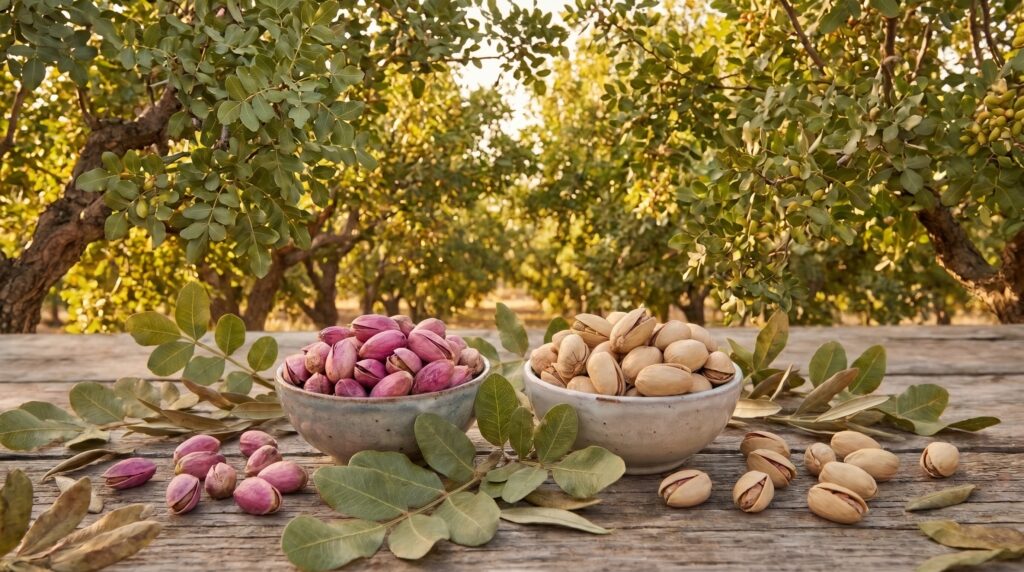
Choosing between the Aegina pistachio and the Kerman pistachio is one of the most important decisions for anyone planning a new orchard in Greece 🇬🇷. We are not simply comparing two names, but two ways of understanding the crop: one rooted in tradition, in a designation of origin and in the poor soils of the Aegean; the other based on productivity, nut size and the international market.
At Agro Vivero del Mediterráneo we support small-scale growers and large-scale growers alike in this decision, and the question is always similar: which is the best pistachio variety for my plot? The honest answer is that it depends on the climate, the chill hours, the water available, the soil and how we plan to sell the crop.
In this article we compare both varieties using technical criteria and practical examples so that you can decide on the basis of data rather than trends. If you would like to see the planting material as you read, take a look at our pistachio plants 🌱.
Why This Choice Shapes the Entire Orchard 🌳
A pistachio tree takes several years to come into production and does not reach full productive maturity until the initial investment is already well advanced. That is why a mistake in variety cannot be corrected in a single season: it carries through the whole life of the orchard.
The variety determines, among other things:
- The number of chill hours the tree needs to break dormancy and flower regularly ❄️.
- The flowering calendar and, with it, the risk of spring frost.
- Water demand and the ability to produce under limited irrigation 💧.
- Nut size, shell split and the price the market pays.
- The choice of male pollinator and rootstock.
For this reason we advise carrying out this analysis before reserving plants, not the other way round. The sooner the variety is defined, the easier it is to plan the planting spacing, the irrigation system and the work calendar.
What Is the Aegina Pistachio? Origin, Character and Protected Designation of Origin 🏛️
The Aegina pistachio is Greece’s benchmark tree nut. Its cultivation took root on the island of Aegina in the mid-19th century and has since spread to other areas of mainland and island Greece. It holds a Protected Designation of Origin (PDO) recognised by the European Union since 1996, which protects the name and requires compliance with a product specification.
It is a variety closely associated with a particular way of growing: trees of balanced habit, on stony, calcareous soils, often on terraces and with minimal irrigation or simply rainfed. We are talking about a medium-sized nut with an intense, aromatic flavour that Greek consumers greatly appreciate and that is sold mainly in-shell, roasted and salted.
What we like most about Aegina:
- Hardiness: tolerates poor, dry soils with some salinity.
- Identity: the name “Aegina” opens commercial doors and sets the product apart.
- Flavour: an intense profile, highly valued in direct sales and the gourmet market.
What to keep in mind:
- Average yields tend to be lower than those of Kerman, especially in rainfed pistachio production.
- Nut size is somewhat smaller.
- The market is smaller and closely tied to local consumption.
- To sell under the designation, you must respect the delimited area and the product specification. Outside that scope, the variety can be planted but cannot be marketed under the PDO.
What Is the Kerman Pistachio? The World’s Benchmark Variety 🌍
The Kerman pistachio is the most widely planted variety in the world. It originates from Iran, reached its greatest development in California and is now the basis of many new orchards across the Mediterranean basin, including Spain. Its reputation rests on a large nut size, a high rate of natural shell split and a very attractive green kernel.
It is a demanding variety to manage, but it responds with high yields when it receives enough winter chill, adequate irrigation and a sound plant health programme. In our work with pistachio orchards we find that its great strength is commercial predictability: industry and distributors know it and buy it without difficulty.
What we like most about Kerman:
- Nut size and shell split: large nuts and a high percentage of naturally open shells.
- Broad market: buyers accustomed to its quality.
- Response to irrigation: very high yield potential under irrigation.
- Technical information: well-established protocols for irrigation, pruning and fertilisation.
What to keep in mind:
- High chilling requirements, around 800–1,000 chill hours depending on the technical reference consulted.
- Marked alternate bearing: a tendency to alternate high-yielding years with low-yielding ones.
- Susceptibility to fungal diseases in humid conditions.
- Reliance on irrigation to express its full potential.
Aegina Pistachio vs Kerman: Comparison Table 📊
To see the differences at a glance, we summarise the criteria that weigh most heavily in the decision. These are indicative values: every plot and every season will alter them.
| Criterion | Aegina pistachio | Kerman pistachio |
|---|---|---|
| Origin | Greece (island of Aegina) | Iran, developed in California |
| Recognition | PDO since 1996 | Commercial variety, no PDO |
| Nut size | Medium | Large |
| Flavour profile | Intense and aromatic | Balanced and highly recognisable |
| Chilling requirement | Moderate | High |
| Suitability for rainfed conditions | High | Low |
| Response to irrigation | Good | Excellent |
| Indicative yield, mature irrigated orchard | 1,500–2,500 kg/ha | 2,000–3,500 kg/ha |
| Main market | Local, gourmet and PDO | Industry and international distribution |
| Ideal profile | Poor soils, limited water, differentiated sales | Sufficient water and chill, volume production |
No single criterion in the table works in isolation. What matters is to weigh them against the reality of each farm, starting with climate and water, the two factors that are hardest to correct once the orchard is planted.
Greek Climate and Chill Hours: Which Variety Suits Your Area ❄️
The Mediterranean climate of Greece varies greatly with altitude, proximity to the sea and the aspect of the plot. On the inland plains of Thessaly or Boeotia, winters are colder and more chill hours accumulate. In the southern Peloponnese, along the coast and on the islands, winters are milder.
That difference is decisive. The pistachio tree needs to accumulate winter chill to come out of dormancy properly. If it does not, bud break is delayed and uneven, flowering is prolonged and pollination loses effectiveness. With Kerman, which requires around 800–1,000 chill hours, this risk increases in milder areas.
Our general guidance is as follows:
- Cold winters and good chill accumulation: Kerman performs very well, and its late flowering helps avoid spring frosts.
- Coastal and island areas with mild winters: Aegina is the safer choice.
- Intermediate areas: study the data before deciding and consider other varieties with lower chilling requirements.
Nor should we forget frost. In spring, cold air settles in hollows and valley floors, and a late frost during flowering or fruit set can ruin a large part of the crop. That is why, besides the variety, the exact position of the plot matters: a ventilated slope is usually safer than a frost hollow, even if both are in the same district. The late flowering of Kerman helps, but it does not remove the risk.
A practical tip 🌡️: ask for a historical temperature series from the nearest weather station, covering at least ten years, and calculate the chill hours for each winter. Do not rely on a single year, because winters are becoming increasingly irregular. Our technical advisory service can help you interpret those data.
Soil, Water and Irrigation: Two Ways of Approaching the Orchard 💧
The pistachio tree is grateful for calcareous, stony, well-drained soils. What it does not forgive is waterlogging: the roots suffocate and the door opens to diseases such as Phytophthora. Before planting, we recommend digging soil pits and carrying out a soil analysis to check effective depth, texture, pH and salinity. If the water is slightly brackish, its electrical conductivity becomes a key piece of data.
This is where our two varieties differ most:
- Aegina has adapted over generations to shallow soils, terraces and scarce water. It allows rainfed pistachio production or supplementary irrigation, accepting more modest but stable yields.
- Kerman gives its best on deeper soils with regular irrigation. With regulated deficit irrigation, in mature orchards we typically talk about indicative water allowances of 2,000 to 4,000 m³ per hectare per year.
It is important not to confuse tolerating drought with producing in drought. A tree without water survives, but the one that receives the right amount of water at critical moments (fruit set, shell hardening and kernel fill) is the one that delivers a crop. That is why, even with Aegina, supplementary irrigation often makes the difference between a token orchard and a profitable one 💰.
Yield and Profitability: What to Expect from Each Variety 💶
Both varieties follow a similar calendar: the first nuts appear around the fourth or fifth year, commercial production begins between the sixth and eighth year, and full production is reached after twelve years. And as in any pistachio orchard, alternate bearing alternates good seasons with poor ones.
To illustrate with a practical example, imagine a 10-hectare farm with a planting spacing of 6 × 5 m, which means about 333 plants per hectare and 3,330 trees in total, of which approximately 10% will be male pollinators. With indicative values at maturity, the result would be:
| Scenario | kg/ha of dry in-shell pistachios | Production on 10 hectares |
|---|---|---|
| Aegina, rainfed | 800 | 8,000 kg |
| Aegina, with supplementary irrigation | 2,000 | 20,000 kg |
| Kerman, irrigated | 2,500 | 25,000 kg |
These are reference figures, not promises: they depend on the soil, management, water and the season. But they show something clear: the difference between rainfed and irrigated production matters more than the difference between varieties.
Moreover, producing more does not always mean earning more. Irrigation, energy, labour and harvesting costs must be deducted. A kilo of Aegina with the designation and sold directly can fetch a better price than one of Kerman sold in bulk and, conversely, the volume of Kerman may offset a lower unit price. That is why we insist on calculating it with the real numbers of each farm. You can start with our analysis of the profitability of a pistachio orchard 📈.
It is also worth separating the establishment investment (plants, land preparation, irrigation installation, wildlife protection and fencing) from annual operating costs. In a pistachio orchard in Greece, as anywhere else, a good part of the investment is recovered late, which is why it is so important to plant well in the first year and with quality plant material.
Nut Quality and Market: Nut Size, Shell Split and Flavour 🥜
When pistachios reach the buyer, they are valued mainly on four factors: nut size, shell split, kernel colour and flavour.
- Nut size and split: Kerman is the benchmark. A large nut size and a high natural split rate make processing easier and improve in-shell presentation.
- Flavour: Aegina plays a different card, with an intense, aromatic profile highly appreciated by those who buy in-shell, roasted and salted.
- Colour: both can offer an attractive green kernel if harvesting and drying are done properly.
Here the process matters as much as the variety. A pistachio that is hulled late or dried poorly loses colour and carries a higher risk of mould and aflatoxins. That is why we recommend having it settled, before the first harvest, where and how the nuts will be hulled and dried within a few hours ⏱️.
As for the market, Aegina allows a differentiation strategy: a local product with identity, suited to direct sales, gastronomic tourism and the gourmet channel. Kerman allows a volume strategy: cooperatives, industry and export. If you want to sell on a large scale, the nut size and uniformity of Kerman tend to weigh more. If you are looking for a premium price in a niche, the origin and story of Aegina are your best argument.
Pollination: The Detail That Decides the Crop 🌬️
The pistachio is a dioecious species: there are female trees, which bear the nuts, and male trees, which only provide pollen. Pollination is carried out by the wind rather than by insects, so the position of the males and the prevailing winds matter a great deal.
The basic rule is one male for every eight to ten females, evenly distributed throughout the orchard. But what really decides the outcome is synchronisation: the pollinator must flower at the same time as the female variety. With Kerman, the reference male is Peters, whose flowering coincides. With Aegina it is advisable to use selected males whose flowering calendar has been verified in the area.
Mixing varieties without checking flowering calendars is one of the mistakes that costs the most crop. If you plan to combine Aegina and Kerman on the same farm, study carefully which pollinator covers each one. We review this in every project before reserving plants.
Field Calendar: Flowering, Harvest and Work on the Farm 📅
In most Mediterranean areas, the pistachio tree flowers between late March and April, sets fruit during spring and is harvested between late August and September. The exact dates vary with the area, the year and the variety, which is why it is so useful to observe how neighbouring orchards behave before deciding.
The calendar matters for a practical reason: when the whole crop ripens at once, harvesting, hulling and drying must be done in a very few days. An orchard with a single variety concentrates the work, whereas one with two staggered varieties spreads it. This affects labour, machinery and drying-space requirements, and is another reason to think about the choice in terms of logistics and not only of the tree 🚜.
Plant Health and Management: The Weak Points of Each Variety 🛡️
No variety is immune. What changes is where each one fails:
- Root asphyxia and Phytophthora: affect both and are prevented with good drainage and a well-sized irrigation system.
- Botryosphaeria and Alternaria: fungi that attack shoots, panicles and nuts, especially in wet springs. Kerman is more sensitive and requires a preventive programme.
- Verticillium: a soil-borne disease managed largely through the choice of rootstock.
- Pests: pistachio psylla, pistachio seed wasp and stink bugs that feed on the nuts.
- Alternate bearing: moderated through pruning, balanced fertilisation and crop load control.
With Aegina, hardiness helps, but it does not justify leaving the orchard to its fate: with little management, harvests are small and irregular. With Kerman, a sound plant health programme is not optional. In both cases, inspecting the orchard every week in spring and summer saves us a great deal of trouble 🔍.
Planting Spacing and Rootstock: Two Decisions Not to Be Improvised 📐
The planting spacing must be adjusted to the variety, the expected vigour and, above all, the water available. These are the most common:
| System | Typical spacing | Plants per hectare |
|---|---|---|
| Rainfed or supplementary irrigation | 7 × 7 m | 204 |
| Irrigated, wider spacing | 7 × 5 m | 286 |
| Moderate-intensity irrigated | 6 × 5 m | 333 |
The rootstock is the other key piece. Pistacia terebinthus is hardy, tolerates poor soils and cold well, although it grows more slowly. Pistacia atlantica provides vigour. The UCB-1 hybrid is very vigorous and has good tolerance to Verticillium, so it is widely used where this disease is present.
At Agro Vivero del Mediterráneo we help you combine variety, rootstock and planting spacing according to your soil, climate and water. An orchard well designed from day one avoids many problems years later.
What If the Best Option Is Neither Aegina nor Kerman? 🔎
Sometimes the answer lies in a third path. Varieties such as Sirora and Larnaka, as well as Californian selections such as Golden Hills and Lost Hills, deserve consideration where winters are mild or an earlier harvest is sought.
It may also be worth combining two varieties with different calendars. This staggers the harvest and avoids overloading machinery, hulling and drying in the same weeks. It is a strategy that is especially useful for large-scale growers, although some small-scale growers also apply it when they share machinery.
What matters is that the decision is based on the farm’s data and not on what the neighbours are planting.
Which Variety We Recommend for Your Profile 👨🌾
These practical examples serve as a guide, although each project is assessed individually:
- Three hectares on a stony terrace, no irrigation, with the intention of selling directly: Aegina is the most logical option, especially if the plot lies within the designation area.
- Fifteen hectares on an inland plain, with a well and good chill accumulation: Kerman as the main variety and a second complementary variety to stagger the harvest.
- Coastal farm with mild winters: Aegina or varieties with lower chilling requirements, after studying actual chill hours.
- Extension of an existing orchard: choose according to the flowering and harvest calendar of what is already planted.
For small-scale growers, our recommendation is not to oversize the investment and to opt for the variety that best fits their water and sales channel. For large-scale growers, the challenge lies in volume, logistics and mechanisation, and there Kerman, combined with other varieties, usually offers more room for manoeuvre.
Common Mistakes When Choosing Between Aegina and Kerman ⚠️
In our visits and consultations we see the same mistakes again and again:
- Deciding on the price of a single season: prices change every year and an orchard lasts far longer than any market cycle.
- Planting Kerman in an area with little chill and finding out too late that bud break is irregular.
- Assuming that rainfed farming costs nothing: less irrigation does not mean less work or less risk.
- Overlooking pollinators or buying them without checking the flowering calendar.
- Not thinking about harvesting: where the nuts are hulled, who harvests and how long drying takes.
- Buying plants without guarantees: plant material of doubtful origin can hold an orchard back for many years.
Frequently Asked Questions About Aegina and Kerman ❓
Can Kerman be planted in Greece? Yes, in areas where enough chill hours accumulate and water is available. In warmer areas, alternatives should be considered.
Can I sell the pistachios I grow in any area as Aegina pistachios? No. The designation requires compliance with the product specification and the delimited area. Outside it, the variety can be planted but the PDO cannot be used.
How many years does a pistachio orchard take to produce? The first nuts appear around the fourth or fifth year and commercial production starts between the sixth and eighth year.
Can Aegina and Kerman be combined on the same farm? Yes, provided that pollinators are planned and the varieties are separated into plots or rows to facilitate management and harvesting.
Is it worth planting rainfed pistachios? It can be viable with Aegina and in suitable soils and climates, but with lower yields. Supplementary irrigation usually improves the result considerably.
Is Kerman a good option for a small farm? Yes, if enough water and chill are available. What matters is having harvesting and drying logistics resolved, either with your own means or through a cooperative or an external service.
How does climate change affect this decision? Milder winters and more irregular springs call for greater caution with varieties that need a lot of chill and closer monitoring of late frosts. That is why we recommend working with historical series covering at least ten years.
Our Advice Before Planting ✅
Aegina and Kerman do not compete in the same category. Aegina is identity, hardiness and flavour, ideal for poor soils, limited water and differentiated sales. Kerman is nut size, volume and market, ideal where there is enough chill and irrigation. The best pistachio variety is the one that fits your climate, your soil, your water and the way you sell.
Our way of working is simple: first we listen, then we analyse climate, soil, water and objectives, and only then do we propose variety, rootstock and planting spacing. We do not push a particular variety; we defend the one that works on your farm. Planting is a long-term decision and deserves an analysis proportionate to the investment.
Before deciding, we recommend reviewing the chill hours of the area, analysing the soil, calculating water needs, planning pollination and working out real profitability figures. All of this can be resolved with the right technical advice.
If you are thinking about a new orchard or expanding the one you already have, get in touch with us and we will study your case without obligation. And if you already have a clear project, you can request your quote for pistachio plants in just a few minutes 🌱.