


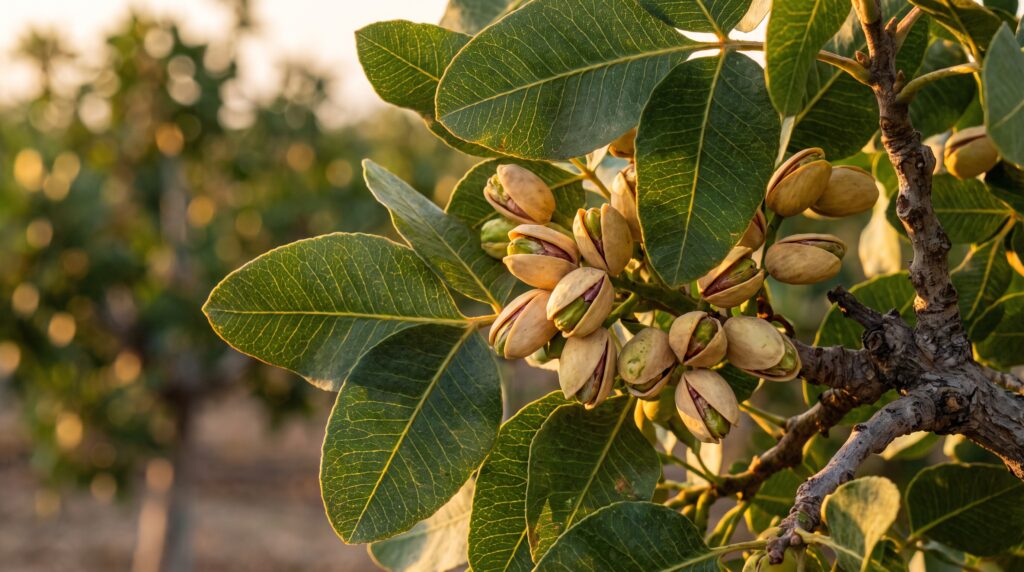
When a grower asks us which variety to choose for their pistachio orchard, the conversation usually comes down to two names: Kerman and Larnaka. Today we focus on the Larnaka pistachio, a variety that has gained a lot of ground in warm Mediterranean-climate regions thanks to its early ripening, its good performance with limited winter chill and the quality of its nuts. 🌰
At Agro Vivero del Mediterráneo we work every day with pistachio plants, new orchards and expansions of established farms. That is why we know the questions people ask when they are about to decide: how much it yields, which pollinator to pair it with, what climate it needs and whether it is worthwhile compared with other options. We will answer them one by one, with indicative data and the experience that comes from working directly with small and large growers.
What Is the Larnaka Pistachio and Why Does It Attract So Much Interest? 🌳
Larnaka is a female Pistacia vera tree named after the Cypriot city of Larnaca, where the material that gave rise to the selection originated. It is grown in several Mediterranean countries and in recent years has made a strong entry into new orchards.
Why is it so popular? For four reasons that come up again and again in conversations with our customers:
- Early flowering, which makes it very interesting in areas where winter chill is limited.
- Early ripening, which allows the harvest to be organised ahead of late-maturing varieties.
- Good nut size and good split rate, two factors directly linked to the selling price.
- Adaptation to hot climates, very useful in the areas where pistachio growing is expanding.
It is not a miracle variety, and it does not suit every farm. Like any agronomic decision, it needs to fit the climate, soil, available water and the right pollinator. This is where prior advice makes the difference.
Origin and Expansion of the Larnaka Variety 🌍
The pistachio tree has been cultivated for centuries in the Middle East and the Mediterranean basin. Cyprus, with its mild winters and long, dry summers, has over time provided plant material adapted to warmer conditions than those of the major inland producing countries of Asia. Larnaka emerged from that local selection.
Its international expansion has gone hand in hand with new plantings in warm-temperate regions. In Spain, pistachio has gone from being an almost marginal crop to a real alternative for many farms in the south and centre of the country. In this context, varieties with lower chill requirements, such as Larnaka, have found their place.
Tree Characteristics: Vigour, Habit and Development 🌿
The Larnaka tree has medium-to-high vigour and an open, slightly spreading habit, which makes it easier to build a balanced canopy and allows light to penetrate. These are its most notable traits:
- Abundant branching, with a good capacity to renew productive wood.
- Compound leaves of an intense green colour, typical of the species.
- Relatively fast development in the early years if irrigation and fertilisation are adequate.
- Good response to formative pruning when carried out on time.
A practical point: an open habit requires good tying and training in the first years. A poorly formed structure from the start leads later to weak branches, breakage problems under crop load and a harder harvest. In our services we insist strongly on this point, because the first three years shape the entire life of the orchard.
Nut Characteristics of Larnaka 🥜
This is where much of the variety’s commercial appeal lies. The Larnaka nut is characterised by:
- Medium-to-large size, with a good in-shell appearance.
- High natural split rate, a key factor for the in-shell pistachio market.
- Green kernel, prized by both the processing industry and the end consumer.
- Balanced flavour and pleasant texture.
- A reasonable percentage of blank (empty) nuts, provided pollination and management are correct.
Split rate is one of the indicators we look at most when evaluating a variety. A nut that splits well dries better, is easier to market and fetches higher prices. Specific values depend on the year, the area and the management of irrigation and fertilisation, so they should always be taken as a reference rather than a promise.
Larnaka Pistachio Flowering and Chill Requirements ❄️
Pistachio flowering is the most delicate stage of the cycle, and Larnaka stands out for flowering early. This has important consequences:
- It requires fewer chill hours than later varieties, so it adapts better to mild winters.
- Its flowers are more exposed to late spring frosts in cold areas or valleys with temperature inversions.
- It requires a pollinator whose flowering period coincides with it.
As an indication, Larnaka’s winter chill requirements are lower than those of Kerman, which makes it well suited to coastal areas and warm inland regions. Even so, insufficient chill causes uneven bud break, staggered flowering and poorer fruit set. Before planting, we therefore always recommend checking the chill-hour records and frost history of the area.
Compatibility and Pollination: The Factor That Decides the Harvest 🐝
The pistachio is a dioecious species: there are female trees, which produce the nuts, and male trees, which only provide pollen. Without a suitable pollinator there is no profitable harvest, however good the female variety may be. Pistachio pollen is carried mainly by wind, so the position of the males in the orchard also matters.
For Larnaka, the pollinator must have a flowering period that coincides with the female’s. The males most commonly used with this variety are:
- Peters, the classic and most widespread, highly compatible in flowering time with early-to-mid-season varieties.
- C-Especial, with a slightly earlier flowering period, useful for covering the start of female flowering.
- Other selected males, depending on the region and availability of plants.
Many orchards combine more than one pollinator to widen the pollen window and ensure fruit set even in years of mismatched flowering.
| Aspect | Indicative recommendation |
|---|---|
| Male ratio | Between 1 male per 8 females and 1 per 10 |
| Distribution | Spread across the whole plot, not concentrated at one edge |
| Most common males | Peters and C-Especial |
| Prevailing wind | Place more males on the upwind side |
| Flowering overlap | Essential between female and male |
A common mistake is to reduce the number of males in order to gain productive area. It is a false saving: every female without enough pollen loses yield. If you would like to fine-tune the ratio and placement for your farm, on our pistachio plants page you will find the available varieties and pollinators.
Larnaka Pistachio Productivity: What Can We Expect? 📈
Pistachio productivity depends on so many factors that quoting a single figure would not be serious. Even so, we can give an indicative reference for how a well-managed irrigated Larnaka orchard develops:
| Orchard age | Typical situation |
|---|---|
| Years 1 to 3 | Tree formation, no commercial production |
| Years 4 to 5 | First token harvests |
| Years 6 to 7 | Increasing production |
| Years 8 to 10 | Reaching full production |
| From year 10 onwards | Stabilised production, with alternate bearing depending on management |
Pistachio comes into production slowly compared with other crops. It is a long-term crop, and any serious project should be planned with many years in mind. The good news is that the tree is long-lived and, if well looked after, produces for a very long time.
The factors that weigh most on final production are:
- Pollination, as we have seen.
- Irrigation, both in quantity and in timing.
- Fertilisation, especially the balance between nitrogen, potassium and micronutrients.
- Pruning, which regulates crop load and light penetration.
- Plant health, above all the control of fungi and pests.
- The year’s weather, especially during flowering.
Alternate Bearing: How to Reduce It 🔄
The pistachio tree has a natural tendency towards alternate bearing: one year it carries a heavy crop and the next it produces less. Larnaka is no exception, although good management reduces the irregularity.
These practices help:
- Adjust pruning so as not to leave an excess of fruiting wood.
- Maintain regular irrigation, without stress during critical stages.
- Apply balanced fertilisation, especially potassium.
- Harvest on time, without delays that exhaust the tree.
- Monitor the condition of the tree after years of very heavy crops.
The aim is not to eliminate alternate bearing, which is almost impossible, but to keep the differences between years as small as possible so that income is predictable.
Planting Layout and Recommended Density 📐
The planting layout determines mechanisation, light interception and yield. For Larnaka, given its medium-to-high vigour and open habit, the most common configurations are:
- 6 x 5 metres, with around 333 trees per hectare.
- 6 x 6 metres, with around 278 trees per hectare.
- 7 x 5 metres, with around 285 trees per hectare.
- 7 x 6 metres, on very fertile soils with high vigour.
Very dense orchards come into production sooner but become overcrowded and require more pruning. More open layouts are better suited to deep soils and large machinery. The decision must take into account slope, soil type, machinery and water availability. If you would like to study your specific case, you can write to us through our contact page.
Rootstocks: The Base of the Tree Matters Too 🌱
No variety performs well if the rootstock is not adapted to the soil. In pistachio, the rootstock determines resistance to drought, salinity and soil-borne diseases, as well as the uniformity of the orchard. The most widely used are:
- UCB-1, a vigorous and uniform hybrid rootstock, widely used in modern orchards for its consistency.
- Pistacia terebinthus, hardy and well adapted to calcareous soils and drier conditions.
- Other Pistacia atlantica rootstocks, valued for their vigour and drought tolerance.
The choice depends on the soil, pH, presence of diseases and climate. An unsuitable rootstock can compromise an investment that is paid back over many years, so this is a decision that should be made on technical grounds, before buying the plants.
Soil, Climate and Irrigation for Larnaka ☀️
Soil. The pistachio tree appreciates deep, well-drained soils with neutral or slightly alkaline pH. It tolerates lime and a certain level of salinity well, but it cannot withstand waterlogging, which favours root asphyxia and fungal diseases. A soil analysis before planting and a study of the soil profile (depth, hardpans, drainage) avoid surprises.
Climate. Larnaka adapts well to hot, dry climates, with long, hot summers and mild winters. Its early flowering requires care with spring frosts. In areas with a high frost risk, it is preferable to consider a later-flowering variety.
Irrigation. Although the pistachio tree tolerates drought, stable commercial production requires water at key moments. Pistachio irrigation by drip is the most efficient system. The most sensitive stages are fruit set, kernel filling and the post-harvest period, when the tree replenishes its reserves. Controlled deficit irrigation can be useful at certain stages, but it must be well designed so as not to harm nut size or the following year’s crop.
Pruning and Tree Management ✂️
Formative pruning in the first years is what most determines the future of the orchard. The aim is to achieve a tree with a straight trunk, three or four well-distributed main branches and an open canopy.
Maintenance pruning follows, lighter in nature, which seeks to:
- Remove crossing, dead or poorly oriented branches.
- Renew productive wood.
- Control height to facilitate mechanical harvesting.
- Maintain light and air penetration inside the canopy.
In Larnaka, because of its open habit, pruning must prevent the lower branches from dragging under the weight of the crop load. Light but regular intervention usually gives better results than drastic pruning spaced far apart.
Fertilisation and Nutrition 🧪
Well-adjusted fertilisation improves fruit set, nut size and production regularity. The elements we monitor most closely are:
- Nitrogen, essential for growth, but not to be overapplied, because an excess favours vigour at the expense of production.
- Potassium, key for kernel filling and for reducing alternate bearing.
- Phosphorus and magnesium, depending on soil and leaf analysis.
- Boron and zinc, micronutrients that influence flowering and fruit set.
Leaf analyses carried out in mid-summer are a very useful tool for correcting deficiencies before they show up in the harvest. Adapting the programme to each farm always gives better results than applying generic formulas.
Plant Health: Diseases and Pests to Watch 🔍
A well-managed orchard prevents more than it cures. The most common health problems in pistachio are:
- Foliar and fruit fungi, such as Botryosphaeria or Alternaria, favoured by wet springs.
- Soil-borne diseases, such as Phytophthora or Verticillium, linked to excess moisture and poorly drained soils.
- Insect pests, such as stink bugs and psyllids, which can damage fruit and shoots.
The best strategy combines choosing a suitable rootstock, good drainage, balanced irrigation, pruning that promotes aeration and regular monitoring of the orchard. Treating blindly only makes production more expensive; the most efficient approach is to detect the problem early and act with technical criteria.
Larnaka Harvest and Post-Harvest 🚜
The pistachio harvest with Larnaka begins earlier than with late varieties, normally in late summer or early autumn depending on the area. This earliness has advantages:
- It reduces the risk of autumn rains affecting the nuts.
- It allows work to be staggered if varieties with different cycles are combined.
- It gives the tree time to replenish reserves before winter.
What matters most after harvest is acting quickly. The nuts must be hulled and dried within a few hours, because freshly harvested pistachios, with their outer hull, are very sensitive to staining and fungi, and any delay translates into a loss of quality and price.
The usual process includes:
- Shaking the trees and mechanical collection.
- Hulling, or removal of the outer skin.
- Washing and flotation to separate blank nuts.
- Drying to the appropriate moisture level.
- Grading by size and, where applicable, roasting and packing.
Having a nearby receiving plant or good logistical organisation is as important as the cultivation itself.
Larnaka vs Kerman: A Practical Comparison ⚖️
This is the most common comparison, and it should be made with balance, because neither is always better. This table summarises the general differences:
| Aspect | Larnaka | Kerman |
|---|---|---|
| Flowering | Early | Late |
| Chill requirements | Lower | Higher |
| Ripening | Earlier | Later |
| Frost risk at flowering | Higher | Lower |
| Adaptation to hot areas | Very good | More limited |
| Usual pollinator | Peters, C-Especial | Peters |
| Commercial track record | Expanding | Very well established |
In areas with many chill hours and a risk of spring frosts, Kerman is usually the safer bet. In warmer areas or those with mild winters, Larnaka offers clear advantages. Many farms even combine both varieties to diversify risk, spread harvest workloads and extend the pollination period.
Profitability of a Larnaka Orchard 💶
The profitability of a pistachio orchard depends on the initial investment, maintenance costs, production and selling price. Like any woody crop, it has a long investment phase before the first income, but it then offers a stable cash flow for many years.
The factors that most influence the economic result are:
- The correct choice of variety and pollinator.
- The quality of the plants and the rootstock.
- The irrigation design and water availability.
- Mechanisation and labour costs.
- The final quality of the nuts, with their split rate and size.
- The marketing strategy.
If you would like to go deeper into the numbers, we have gathered practical information on our orchard profitability page. Every farm is different, and that is why the most advisable approach is to study an economic plan adapted to your case, with realistic costs and forecasts and without inflated figures.
Who Is the Larnaka Variety Suitable For? 👨🌾
For small growers. Larnaka can fit small farms located in warm areas, where earliness allows the harvest to be brought forward and activity to be diversified. On small areas, nut quality and direct sales can make the difference.
For large growers. On large farms, Larnaka works very well as a complement to other varieties, to stagger the harvest and gain efficiency in the use of machinery and labour.
For those expanding. If you already have a Kerman orchard, adding Larnaka can balance the work calendar and extend the period of available pollen.
In all cases, it is advisable to first analyse the local climate, water quality, soil and the market you intend to sell to. Careful planning avoids mistakes that are very costly to correct later.
Common Mistakes When Planting Larnaka ⚠️
Over the years we have seen mistakes that keep repeating and that can be avoided with good information:
- Planting in areas with frequent late frosts, without taking the early flowering into account.
- Reducing the proportion of males to gain area.
- Choosing a pollinator with mismatched flowering.
- Neglecting drainage, with the resulting loss of trees to soil-borne fungi.
- Buying plants without guarantees, of doubtful origin or with an unsuitable rootstock.
- Irrigating without criteria, either too little or too much.
- Not planning harvest and drying logistics.
Almost all of them are solved through prior planning and quality plants from a specialised nursery with traceability and phytosanitary control.
How to Choose Larnaka Pistachio Plants 🌱
The plant is the first link in the chain, and the hardest to correct afterwards. Before buying, it is advisable to check:
- The origin and traceability of the plant material.
- The health status of the plants, with no symptoms of disease.
- The rootstock used and its suitability for your soil.
- The quality of the graft and the uniformity of the batch.
- The availability of compatible pollinators.
- The advice of the nursery, which should guide you, not just sell to you.
If you are looking to buy pistachio plants with guarantees, at Agro Vivero del Mediterráneo we help you define the most suitable combination of variety, rootstock and pollinator for your farm. You can browse our pistachio plants or request a proposal tailored to your area through our reservation and quotation form.
Frequently Asked Questions About the Larnaka Pistachio ❓
How many chill hours does the Larnaka pistachio need?
It needs fewer than Kerman, so it adapts well to mild winters. Even so, it is advisable to check the area’s chill-hour history before planting.
Which pollinator is best for Larnaka?
Peters is the most widely used, and C-Especial is frequently used to cover the start of flowering. Ideally, combine both if the farm allows it.
How many males do I need per hectare?
A common reference is one male for every 8 to 10 females, spread across the plot and with a greater presence on the upwind side.
When does it start to produce?
The first token harvests come between the fourth and fifth year, and full production between the eighth and tenth.
Is it more profitable than Kerman?
It depends on the area. In warm climates with few chill hours it can be the best option, while in cold areas Kerman is usually safer. Ideally, each farm should be studied individually.
Can it be grown without irrigation?
The pistachio tree tolerates drought, but for stable, quality commercial production we recommend having irrigation, even if only supplementary.
Which rootstock should I choose?
It depends on the soil and climate. UCB-1 and Pistacia terebinthus are two common options, and the decision should be made after prior analysis.
Our Advice: Plan Well Before Planting 🤝
Larnaka is a variety with great potential for those with a warm climate, mild winters and a good pollination plan. Its early flowering, early ripening and nut quality make it a very interesting option, provided that frost risk and the choice of pollinator are taken into account.
What we should remember is simple:
- Choose the variety according to the climate, not according to trends.
- Combine females and males correctly.
- Choose a rootstock suited to the soil.
- Look after irrigation, pruning and nutrition from the very first year.
- Plan harvesting and drying before the first nuts arrive.
- Have technical advice from the start.
At Agro Vivero del Mediterráneo we have spent years supporting growers at every step of their orchard, from choosing the plants to monitoring the crop. If you are considering planting Larnaka or expanding your farm, visit our website and tell us about your project. We will be delighted to help. 🌰💚