


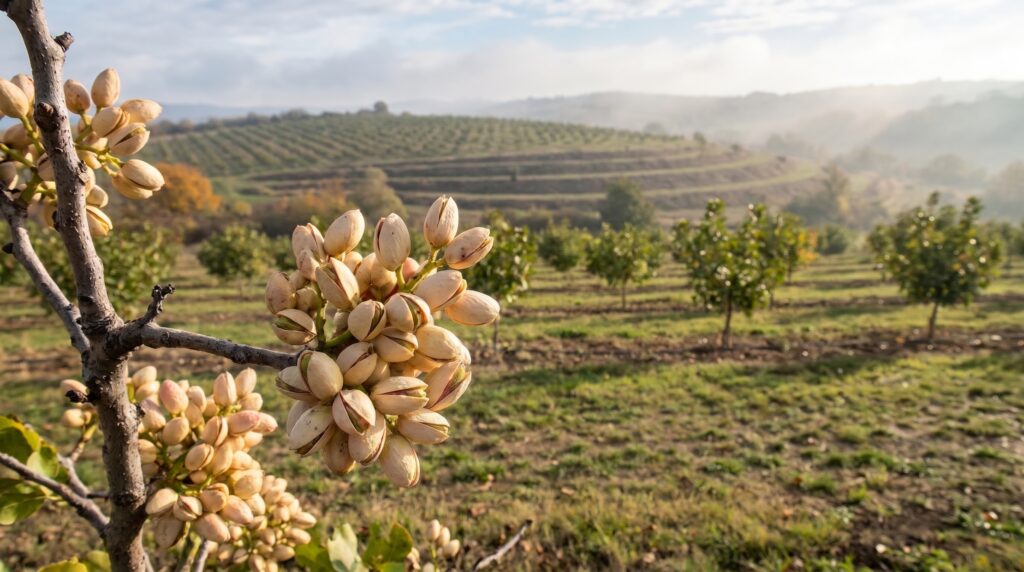
Growing pistachios in Hungary is a question we receive more and more often at Agro Vivero del Mediterráneo. 🌰 It comes from farmers looking for an alternative to extensive crops, growers who want to diversify and investors drawn by the growing demand for this nut. It is a reasonable question, but the answer cannot be reduced to a simple yes or no.
Our experience in the nursery and in the field has taught us that the pistachio tree does not stake everything on winter cold. Surviving the winter is only the first test. After that, the orchard has to get through spring frosts, complete ripening in a summer that is long and warm enough, and stay healthy for many years. In this article we explain, clearly and without easy promises, what happens to pistachios in the Hungarian climate and how a pistachio orchard in Hungary should be planned by anyone who wants to try. ❄️☀️
Short Answer: Is Pistachio Cultivation Viable in Hungary? 🤔
The honest answer is that growing pistachios in Hungary is possible on a small scale and in specific locations, but we would not recommend a large commercial orchard without a prior study and a trial phase. The tree is hardier than many people imagine, although the Hungarian climate poses three obstacles that add up:
- 🥶 Extreme winter minimums that, in the harshest years, can exceed the tree’s tolerance, especially in young plants.
- 🌸 Late spring frosts that damage buds and flowers just when the harvest is decided.
- ☁️ Shorter, cooler and more humid summers than those of the classic pistachio-growing regions, with effects on ripening, shell splitting and plant health.
There is also a positive side. Hungary offers winters with more than enough cold to meet the tree’s requirements and, in the south and southeast of the country, there are sunnier areas with sandy or deep, well-drained soils where a well-designed trial makes sense. What a project like this needs is information, prudence and a phased approach. 🧭
Why Pistachios and Continental Climates Get Along Better Than They Seem 🏔️
The pistachio (Pistacia vera) is not a mild-climate tree. It originates in arid and semi-arid areas of Central Asia and the Near East, continental territories with long, hot, dry summers and cold winters. Even today there are pistachio orchards and wild stands in regions where winter frosts are common.
That heritage explains something that surprises many farmers: the pistachio needs cold. Without a sufficient number of hours below 7 °C during winter dormancy, budbreak and flowering become irregular and production suffers. That is why our orchards in inland Spain, with their continental winters, work so well. ✅
This is where the idea that Hungary could be a good destination comes from: if the pistachio needs cold, a country with cold winters should do. But needing chilling hours does not mean tolerating any frost, and that difference is the key to everything that follows.
What a Pistachio Orchard Needs to Produce Well 🌱
Before looking at Hungary, it is worth being clear about the tree’s requirements. This table summarizes the factors that weigh most, with indicative values that vary according to variety, rootstock and management:
| Factor | What the pistachio needs | Why it matters |
|---|---|---|
| ❄️ Chilling hours (below 7 °C) | Between 800 and 1,000 in varieties such as Kerman; somewhat fewer in early varieties | Uniform budbreak and flowering |
| 🥶 Minimum dormant-season temperature | Prudent reference: down to about -15 °C | Avoid damage to wood and buds |
| 🌸 Spring | No frosts below -1 or -2 °C during budbreak and flowering | Protect shoots, flowers and fruit set |
| ☀️ Summer | Long, hot and dry | Nut filling and shell splitting |
| 💧 Air humidity | Low during flowering and ripening | Lower fungal pressure |
| 🌍 Soil | Deep, well-drained, neutral or alkaline pH | Avoid root asphyxiation |
As you can see, the pistachio does not depend on a single factor. A cold winter does not make up for a short summer, and good soil does not make up for an April frost. What matters is the balance between all the factors. ⚖️
Hungary’s Climate Through a Pistachio Grower’s Eyes 🇭🇺
Hungary has a temperate continental climate, with oceanic influence from the west and a slight Mediterranean touch in the south. For anyone familiar with pistachio growing, these are the most relevant differences compared with an established pistachio-growing region in inland Spain:
| Parameter | Inland Spain (pistachio-growing region) | Hungary (indicative) |
|---|---|---|
| Mean July temperature | 24 to 27 °C | 21 to 23 °C |
| Annual sunshine hours | 2,700 to 3,000 | 1,800 to 2,100 |
| Annual precipitation | 300 to 450 mm | 500 to 700 mm |
| Typical annual absolute minimum | -6 to -12 °C | -12 to -20 °C |
| Winter chilling hours | Sufficient in most areas | Abundant, with room to spare |
These are approximate values, intended for comparison. Data for a specific plot may differ considerably, which is why we insist on measuring on site.
The table makes it clear that Hungary does not lack cold: it has an excess of extreme cold and lacks summer heat. In addition, the heavier rainfall, concentrated in spring and early summer, favors fungal diseases that the pistachio avoids in dry climates. 🌧️
Within the country there are notable differences. Without this being a site recommendation, this is how we see the main areas:
- Southern Great Plain (Szeged area): among the sunniest and warmest areas of the country, with longer summers.
- Between the Danube and the Tisza (Kecskemét and surroundings): sandy, very well-drained soils, with a relatively dry climate by Hungarian standards.
- Southern Transdanubia (Villány, Pécs): somewhat milder winters and warm summers, with Mediterranean influence.
- North and elevated areas: colder, more humid, with shorter summers. These are the least suitable for pistachio growing.
In practice, we would only consider a trial in the southern areas. 📍
Winter Cold: How Low a Temperature Can the Pistachio Withstand? ❄️
This is the question we are asked most often, and the answer is “it depends.” There is no single lethal temperature for the pistachio, because tolerance changes with the condition of the tree. These indicative references help us assess the risk:
| Tree stage | Indicative risk reference |
|---|---|
| Mature tree in dormancy, with well-matured wood | Prudent tolerance down to about -15 °C; below -18 or -20 °C, high risk of severe damage |
| Young plants (1 to 3 years old) | May suffer from -8 or -10 °C, especially with unmatured wood |
| Swollen or breaking buds | Damage from -1 or -2 °C |
| Flowers and newly set fruit | Damage from -1 °C |
But the minimum temperature is only part of the story. These factors can tip the balance for or against the tree:
- Wood maturation (hardening-off). With short summers and mild autumns, shoots keep growing late and enter winter unripened.
- Speed of the temperature drop. A sharp drop after a mild spell does more damage than gradual cooling.
- Duration of the cold. Several consecutive days of intense frost are more punishing than a single cold night.
- Age and vigor. Young trees have fewer reserves and more tender wood.
- Previous crop load. A tree exhausted after a year of heavy production (the well-known alternate bearing) enters winter in worse condition.
- Late nutrition and irrigation. Excess nitrogen or water at the end of summer stimulates late, vulnerable growth.
Cold damage is not always visible immediately. In spring, irregular budbreak, dead branches, split bark or bud death may appear. A harsh winter can delay an orchard’s entry into production by several seasons, and extreme cold on young trees can force replanting. 🌡️
There are measures that help: trunk guards, whitewashing to prevent winter solar heating of the bark, a good location with regard to cold air flow, and management that promotes wood maturation. But none of them replaces choosing the plot well.
Late Frosts: The Biggest Risk for Pistachios in Hungary 🌸
Even if the tree survives the winter, the harvest can be lost in a single night in April or May. Late frosts are, for us, the main risk of a pistachio orchard in Hungary. The pistachio breaks bud and flowers later than the almond or the cherry, and that is an advantage, but in Central Europe cold can persist well into spring.
In Hungary the so-called Ice Saints of mid-May are well known, a late cold spell that can coincide with flowering and nut set. Allowing for it in the calendar is part of prudence.
It is worth distinguishing two types of frost. Radiation frost occurs on clear, calm nights and is worse in hollows. Advective frost arrives with a cold air mass and is much harder to combat. These are the strategies we consider:
- Choose the site carefully: slopes with cold-air drainage, avoiding hollows and low-lying areas.
- Maintain a low ground cover or a firm, moist soil, which stores and releases more heat than loose, dry soil.
- Install windbreaks that protect against the prevailing cold air without creating cold pockets.
- Frost-protection fans or sprinklers in large orchards, weighing their cost and the available water.
There is another important nuance. The pistachio is dioecious, with male and female trees, and is wind-pollinated. A frost that damages the male flowers, or persistent rain during flowering that washes away the pollen, reduces fruit set even if the female trees are intact. 💨
Shorter Summers, Rain and Plant Health: What Shapes the Harvest ☔
The pistachio needs a long, hot summer to fill the nut, split the shell and complete ripening. In our growing areas the harvest takes place between late August and September. With less accumulated heat, in Hungary ripening would shift toward autumn, with colder nights, more humidity and less room for maneuver.
This has direct consequences for quality: a higher proportion of closed-shell pistachios, lower kernel filling and a greater risk of fungal problems during harvest and drying. A lower-quality product sells worse, and that shows in the bottom line. 📉
Humidity also increases disease pressure. These are the diseases we monitor most closely:
- Botryosphaeria, which causes panicle and shoot blight.
- Alternaria, which attacks leaves and fruit.
- Septoria, with leaf spots.
- Phytophthora and other root rots in heavy or waterlogged soils.
- Verticillium, a soil-borne fungus that can affect young and mature trees.
In dry climates these diseases have a lower incidence. In rainy springs and summers they require more vigilance, more preventive treatments, a well-ventilated canopy and, ultimately, a higher cost per hectare. 🔍
Varieties and Rootstocks: How Pistachios Would Adapt in Cold Climates 🌳
For pistachios in cold climates, choosing the variety is always a compromise. Early-flowering and early-ripening pistachio varieties, such as Sirora, finish their cycle sooner but expose their flowers to frost. Kerman, the world’s reference variety, flowers later and avoids spring cold better, although it needs more time and more heat to ripen. This is the great dilemma of growing pistachios in Hungary.
The same applies to rootstocks. Some stand out for their hardiness and cold tolerance, others for their vigor or their resistance to soil-borne diseases, and none is ideal for everything. In a cold area the rootstock weighs as much as the variety, which is why we study with each grower the combination that best suits their farm.
We must not forget the pollinators either. As the pistachio is dioecious, one male tree is needed for every eight to ten female trees, with a flowering period that coincides with that of the female variety. In an area with late frosts it is worth considering more than one male variety so as not to depend on a single flowering calendar. 🌼
The quality of the nursery plant also makes a difference: a healthy plant, with a good root system and a well-healed graft union, reaches its first winter with more reserves. You can learn more about our range of pistachio plants. 🌱
Hungarian Soils: One of the Best Assets 🌍
If there is one factor in which Hungary plays in favor of the pistachio, it is the soil. The tree tolerates poor, calcareous soils with some salinity, as long as they are deep and well-drained. What it does not forgive is waterlogging, which suffocates the roots and opens the door to Phytophthora.
The sandy soils between the Danube and the Tisza drain very well and warm up early in spring, and deep loess soils offer good structure. Care is needed in the low-lying areas of the Great Plain, where the water table is high and excess inland water can flood plots for weeks.
Before deciding, we recommend digging soil pits at least 1.5 m deep, analyzing texture, pH and salinity, and checking the water table at different times of the year.
Water and Irrigation: Does a Pistachio Orchard in Hungary Need Irrigation? 💧
The pistachio is one of the most drought-resistant trees, thanks to its deep root system and arid origin. But resisting is not the same as producing well: with irrigation, nut size, kernel filling and crop regularity improve.
In Hungary it rains between 500 and 700 mm a year, although summer droughts have become frequent. That is why we recommend planning supplementary drip irrigation and applying regulated deficit irrigation, avoiding late-summer irrigation that delays wood maturation. Before planting, it is worth checking water availability and quality.
How to Adapt a Pistachio Orchard in Hungary Step by Step 🛠️
For those who, aware of the risks, want to try, this is how we approach the process:
- Site climate study. Install temperature sensors for at least one winter and one spring, and compare the readings with historical records from the nearest weather station.
- Soil and water analysis. Texture, drainage, pH, salinity, water table and irrigation water quality.
- Location within the farm. South- or southwest-facing slopes, with good cold-air drainage and shelter from prevailing winds.
- Variety, rootstock and pollinators. Choose the combination according to frost risk and summer length.
- Planting layout and training. For example, spacings of 6 × 5 m (333 trees per hectare) and training systems that allow the tree to be protected and rebuilt if cold damages it.
- Spring planting. With the risk of hard frosts already past, so that the plant has a full growing season and time for wood maturation before its first winter.
- Management geared to wood maturation. Balanced fertilization, without excess nitrogen, and irrigation that is reduced at the end of summer.
- Protection during the first winters. Trunk guards, whitewashing and mulching at the base to protect the graft union.
- Strategy against flowering frosts. Low ground cover, fans or sprinklers in large orchards, and close monitoring of forecasts.
- Preventive plant health plan. Pruning that promotes ventilation, regular monitoring and preventive treatments at critical moments.
Among our services, we offer technical advice at each of these stages, from orchard design to follow-up during the first years. Within the European Union, nursery plants travel with their plant passport, and we assess with you the logistics and the optimal delivery time. 🚚
Profitability and Risk: The Numbers to Run Before Planting 💶
The pistachio is a long-term crop. An orchard comes into production around the fourth or fifth year, gives significant harvests around the sixth or seventh and reaches full production around year ten. It also tends toward alternate bearing, with heavier and lighter crop years. This demands patience and financial capacity. ⏳
In Hungary, climate risk must be added. Take a practical example: if an orchard loses its entire crop one year in every four because of frost, its average production falls by 25%. If, in addition, a larger share of the nuts comes out with closed shells, the average price also falls.
That is why we recommend running the numbers under several scenarios: a normal one, one with partial losses and one with major losses. In our content on the profitability of a pistachio orchard, we explain the variables that weigh most in the profit-and-loss account.
Small and Large Farmers: How to Set Up the Project 🤝
The approach changes with scale, but the principle is the same: learn before taking risks.
- Small farmer: a pilot plot of 0.5 to 1 hectare with several variety and rootstock combinations, your own weather station and a monitoring plan. It is an affordable investment to obtain real data about your farm.
- Large farmer or investor: a first phase of 2 to 5 hectares in the best location, expanding only after several winters and springs have passed, including, if possible, a particularly harsh one.
And if the data from your plot does not support it, we prefer to tell you clearly: we will not advise you to plant. Our goal is not to sell plants that will not thrive, but to build orchards that work and lasting relationships of trust.
If you would like us to study your case, you can write to us through our contact page and we will assess your farm with you. 📩
Frequently Asked Questions About Pistachios in Hungary ❓
Can pistachios withstand temperatures of -20 °C?
A mature tree, with well-matured wood and in full dormancy, can survive minimums close to -15 °C. At -20 °C the risk of severe damage is high, especially if the drop is sudden or the tree is young. It is not a limit we would advise testing with an investment.
How many chilling hours does the pistachio need?
Between 800 and 1,000 hours below 7 °C in varieties such as Kerman, and somewhat fewer in early varieties. In Hungary they are met with room to spare, so they are not the limiting factor.
What is the biggest risk in Hungary?
For us, the combination of late frosts at flowering and short summers. Extreme winter cold is a concern, but it can be mitigated through site selection and management. April and May frosts and the lack of summer heat are harder to control.
When would an orchard start producing?
The first harvests appear from the fourth or fifth year, although they are modest. Production stabilizes around year ten. In a marginal climate, a harsh winter can delay this timeline.
Which areas of Hungary would be most suitable?
Those in the south and southeast: the Szeged area, the area between the Danube and the Tisza, and southern Transdanubia. Always with prior measurement of the plot.
Is it worth trying a pilot plot?
Yes, if you approach it as a trial and not as an all-or-nothing bet. A small, well-measured and well-documented plot gives you data of your own that no climate map can offer. 📊
Our Advice Before Planting Pistachios in Hungary ✅
The important question is not whether the pistachio withstands the cold, but whether the combination of climate, soil, variety and management allows for a profitable orchard. Today, the answer for Hungary is this: possible in favorable microclimates in the south, with a prior trial, and risky in the rest of the country. This is what we should remember:
- ✅ Winter cold sufficient to meet the chilling requirement is guaranteed.
- ⚠️ Extreme minimums can damage mainly young trees.
- 🌸 Late frosts at flowering are the main risk.
- ☀️ The short summer conditions ripening and the quality of the nut.
At Agro Vivero del Mediterráneo we prefer prudence to easy promises. If you are considering a pistachio orchard in Hungary, or in any other demanding climate, we can help you analyze the farm, choose the right plant and plan the first years. Request your quote through our booking and quote request form and let’s start by measuring before planting. 🌰