


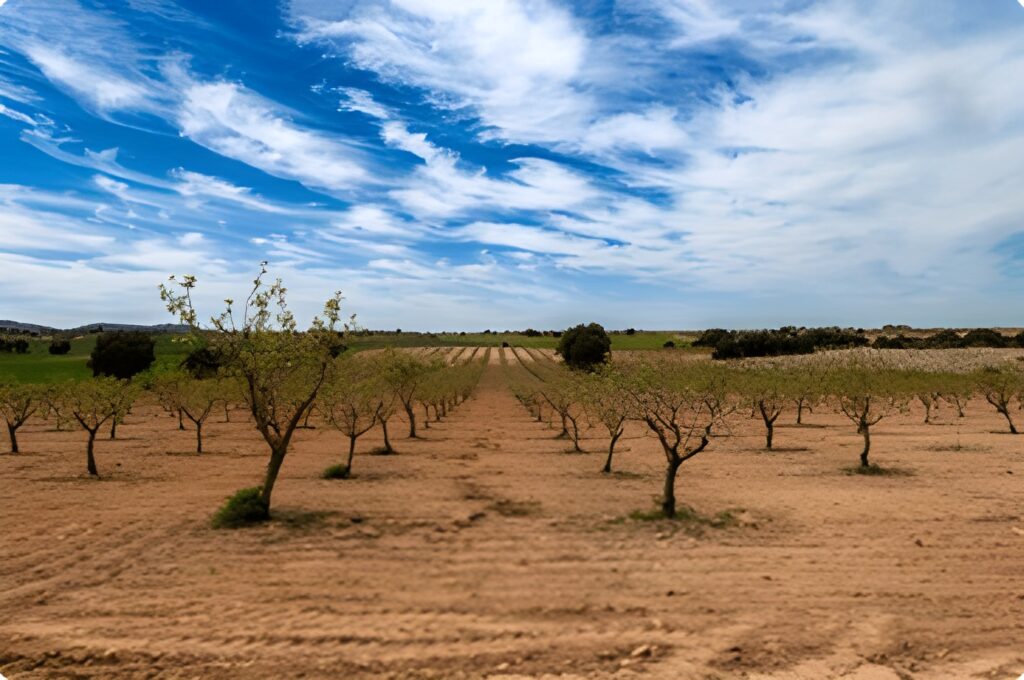
At Agro Vivero del Mediterráneo, we have spent years dedicated body and soul to the fascinating world of the pistachio. Our experience is not based solely on theory; it has been forged in the field, working side by side with farmers, analyzing land, and selecting the best plants for each project. That is why today we want to speak to you from our perspective as experts about a factor that we consider absolutely determining for the success of a plantation: the soil. It is not just another element in the equation; it is the foundation, the bedrock on which profitability and, above all, the quality of the precious pistachio we are so passionate about will be built.
We often receive inquiries from farmers focused on variety choice or planting frame, aspects undoubtedly crucial. However, the importance of a prior and deep soil analysis is frequently underestimated. Inadequate soil can limit tree development, drastically reduce production, and affect organoleptic characteristics of the nut that make a difference in the market. Conversely, optimal soil is the best passport to abundant harvests of exceptional quality. pistachio: A Comprehensive Study of Plant Material and Growing Systems.
Join us on this detailed tour where we will break down, from our experience at Agro Vivero del Mediterráneo, how each soil characteristic directly impacts the green treasure we all seek.
Soil texture: The earth’s embrace of the roots
When we talk about texture, we refer to the proportion of particles of different sizes that make up the soil: sand (the largest), silt (intermediate), and clay (the smallest). This proportion largely defines the soil’s capacity to retain water and nutrients, as well as its aeration level, three fundamental pillars for the correct development of the pistachio root system.
-
Sandy soils: These soils, with a high percentage of sand, are very porous and have excellent drainage. This is a great advantage for the pistachio tree, a tree extremely sensitive to waterlogging and root asphyxia. 💧 Excess water in the root zone is the gateway to fungal diseases such as Verticillium wilt or Phytophthora, which can be devastating for the plantation. However, their high permeability also has a downside: low water and nutrient retention capacity. In these terrains, irrigation must be more frequent and shorter, and a well-adjusted fertilization plan is crucial to prevent nutrients from leaching and being lost in deeper layers, out of reach of roots. From our experience, in these soils, adding organic matter is vital to improve their structure and retention capacity.
-
Clay soils: At the opposite end, clay soils are rich in very fine particles, giving them a high capacity to retain water and nutrients. This may seem ideal, but beware! ⚠️ Excess clay compacts the soil, reduces aeration, and can cause waterlogging problems, exactly what the pistachio tree does not tolerate. Roots need oxygen to breathe and develop; in compact and waterlogged soil, they literally drown. If your land is very clayey, all is not lost. It is possible to improve its structure through organic amendments, the use of agricultural gypsum, or tillage techniques that favor decompaction and the creation of stable aggregates. Choosing a suitable rootstock, such as UCB-1, known for its vigor and powerful root system, can help explore these types of soils better. At Agro Vivero del Mediterráneo, we always advise making trial pits to observe the soil profile in depth and rule out impermeable horizons.
-
Loam soils: The perfect balance. Loam soils present a balanced proportion of sand, silt, and clay, combining the advantages of each. They have good drainage but, at the same time, excellent water and nutrient retention capacity, and good aeration. They are undoubtedly the ideal soils for pistachio cultivation. 🌳 They allow optimal, deep, and extended root development, which translates into healthier, more vigorous, and productive trees. A good root system is the basis for efficiently absorbing water and nutrients that will later be transferred to the nut, influencing its filling, caliber, and composition.
At Agro Vivero del Mediterráneo, before starting any project, we insist on the need for a textural analysis. This simple step gives us invaluable information to plan irrigation, nutrition, and ultimately, to ensure the viability of the plantation. Knowing the soil is the first step to mastering the crop.
Soil pH: The chemical balance that nourishes quality
pH, or potential of hydrogen, is a measure indicating soil acidity or alkalinity. It is a chemical parameter of vital importance because it directly influences nutrient availability for the plant. The pistachio tree has a relatively wide tolerance range, but its optimal development is found in soils with a slightly alkaline pH, between 7.0 and 8.5.
-
The importance of pH in nutrient assimilation: Most essential macronutrients (Nitrogen, Phosphorus, Potassium, Calcium, Magnesium) and micronutrients (Iron, Manganese, Zinc, Copper) are more available to the plant in this pH range. Outside of it, even if nutrients are present in the soil, the plant cannot absorb them correctly.
-
Acidic soils (pH < 6.5): In these conditions, the availability of Phosphorus, Calcium, and Magnesium is drastically reduced. In addition, the concentration of elements such as Aluminum and Manganese can increase to levels toxic to the pistachio tree. In Spain, excessively acidic soils are not the most common in areas suitable for pistachio, but if the case arose, it would be necessary to perform limestone amendments to raise the pH.
-
Very alkaline soils (pH > 8.5): This is a more frequent scenario in the Iberian Peninsula. Very high pH can cause insolubilization of key micronutrients such as Iron, Zinc, and Manganese. The most common deficiency in these cases is iron chlorosis, which manifests with characteristic yellowing of young leaves while veins remain green. 🍃 This deficiency weakens the tree, reduces its photosynthetic capacity, and therefore affects production and pistachio filling. To correct this problem, it is fundamental to resort to applying iron chelates (preferably EDDHA, more stable in calcareous soils) and other micronutrients, either via foliar or through fertigation.
-
Rootstock choice is also determining here. Rootstocks like UCB-1, which we offer in our pistachio plant section, show excellent tolerance to active lime and alkaline soils, being a guarantee to avoid chlorosis problems. Analyzing the pH and active lime content of your soil allows us at Agro Vivero del Mediterráneo to recommend the pistachio plant that best suits your particular conditions, avoiding future problems and unnecessary expenses on correctors.
Effective depth and drainage: The living space to grow
The pistachio tree is a tree with a taproot and very powerful root system, designed to explore a large volume of soil in search of water and nutrients. For this reason, effective soil depth is a first-order limiting factor.
We consider that optimal soil for pistachio must be at least 1.5 meters deep without impediments. What do we mean by impediments?
-
High water table: The presence of groundwater at shallow depth is fatal for the pistachio tree. As we have repeated, it does not tolerate waterlogging. Roots in permanent contact with water rot.
-
Rocky horizons or bedrock: A rock layer less than a meter from the surface will limit the vertical development of the main root, anchoring the tree worse and restricting its access to water and nutrient reserves in deeper layers.
-
Plow pans or compacted layers: Sometimes, poor tillage practices over the years create a hardened and impermeable layer at a certain depth. This “plow pan” acts as a physical barrier for roots and favors waterlogging in upper layers.
Good drainage is, therefore, inseparable from good depth. Deep, well-drained soil allows rainwater or irrigation water to percolate properly, avoiding root asphyxia and allowing roots to colonize a vast territory. This is especially important in dryland farming, where the tree’s ability to access water stored in the soil profile during dry and hot summers will determine harvest viability.
How does this affect quality? A tree with a limited root system will suffer more water stress. This stress at key moments of nut development (such as the kernel filling phase) can cause a higher percentage of empty pistachios, smaller caliber, and irregular ripening. A well-anchored tree with access to resources is a resilient tree, capable of producing high-quality pistachios consistently year after year. That is why one of the services we consider essential at Agro Vivero del Mediterráneo is the study of the soil profile through trial pits, to ensure that there are no limiting layers hidden from plain sight.
Salinity and boron content: The silent enemies
Soil and irrigation water salinity is another major battleground in many producing areas of the peninsula. The pistachio tree is considered a moderately salinity-tolerant crop, much more so than other woody plants like almond or olive. However, “tolerant” does not mean “immune.”
Excess salts in the soil (measured by electrical conductivity, EC) hinder water absorption by roots. It is an osmosis phenomenon: if salt concentration is higher in the soil than inside the root, the plant not only cannot absorb water but can become dehydrated. This causes induced water stress, even with moist soil. 🧂
Symptoms of excess salinity are burns on leaf margins, defoliation, growth reduction, and, in severe cases, tree death. At the production level, salinity negatively affects vigor, which translates into fewer flower buds and, therefore, a smaller harvest. In addition, it impacts pistachio caliber and can increase the percentage of empty fruits.
Boron (B) is an essential micronutrient for the pistachio tree, involved in flowering, fruit set, and kernel development. However, the difference between optimal level and toxic level is very narrow. The pistachio tree is particularly sensitive to excess boron in soil or irrigation water. Boron toxicity manifests with symptoms similar to salinity: necrosis on edges and tips of older leaves, advancing towards the interior of the leaf blade.
It is fundamental to perform a complete chemical analysis of soil and irrigation water before establishing the plantation. If salinity or boron levels are high, one must be very cautious. Although there are rootstocks with greater tolerance to salinity, such as UCB-1, there are limits that should not be exceeded. In some cases, project unfeasibility is clear from the start. Being honest on this point is part of our commitment. We prefer to advise a client against planting if we see that soil conditions are not suitable, because our goal is their long-term success. If you have doubts about the suitability of your land, do not hesitate to contact us.
Organic matter and fertility: The food of quality
Soil is not just a physical support; it is a living and dynamic ecosystem. Organic matter (OM) is the heart of that life. It is composed of remains of plant and animal organisms in different degrees of decomposition, and its presence is an indicator of soil health and fertility.
Organic matter has multiple benefits in pistachio cultivation:
-
Improves soil structure: Acts as a glue binding mineral particles (sand, silt, and clay) forming aggregates. This improves porosity and permeability in clay soils and increases water and nutrient retention capacity in sandy soils.
-
Increases cation exchange capacity (CEC): OM has negative charges that attract and retain nutrient cations such as Calcium (Ca²⁺), Magnesium (Mg²⁺), and Potassium (K⁺), preventing them from washing away and making them available to the plant.
-
It is a source of nutrients: As organic matter decomposes by the action of soil microorganisms, it slowly releases essential nutrients, especially Nitrogen.
-
Stimulates microbial life: Soil rich in OM is a hotbed of bacteria, fungi, and other beneficial microorganisms that help solubilize nutrients and protect roots from pathogens. 🐛🦠
Fertile soil, with adequate levels of organic matter and a good nutrient balance, is the basis for obtaining top-quality pistachios. Plant nutrition has a direct impact on aspects such as:
-
Filling percentage: Balanced nutrition, especially in Potassium (K), is fundamental during the kernel filling phase. Potassium regulates sugar transport from leaves to the nut, being key to obtaining pistachios with good weight and without blanks.
-
Caliber: A well-nourished tree, without deficiencies, will have the necessary vigor to support a good load and correctly fill all pistachios, obtaining larger and more homogeneous calibers.
-
Opening percentage (“split”): Although shell opening has a strong varietal component, adequate nutrition and well-managed irrigation favor natural and clean opening. Boron, for example, plays a role in tissue elasticity.
-
Organoleptic composition: Nutrient availability influences the synthesis of oils, proteins, and other compounds defining the characteristic flavor and aroma of pistachio.
At Agro Vivero del Mediterráneo we are firm defenders of a sustainable agriculture model. We encourage practices such as using cover crops, incorporating shredded pruning remains, or applying compost and well-matured manure. These practices not only improve soil fertility in the long term but also contribute to greater plantation profitability by reducing dependence on mineral fertilizers.
Soil analysis: The treasure map for your plantation
After all the above, it is clear that we cannot leave our land choice to chance. The only way to know with certainty our soil characteristics is by performing a complete analysis in an accredited laboratory. This analysis is not an expense, it is the best investment you can make before planting a single pistachio tree. 📈
A complete soil analysis for pistachio should include, at a minimum:
-
Physical Analysis: Texture (percentage of sand, silt, and clay).
-
-
pH.
-
Electrical Conductivity (EC) or salinity.
-
Organic Matter (%).
-
Active Lime (%).
-
Macronutrient levels: Nitrogen (N), Phosphorus (P), Potassium (K).
-
Secondary nutrient levels: Calcium (Ca), Magnesium (Mg), Sulfur (S).
-
Micronutrient levels: Iron (Fe), Manganese (Mn), Zinc (Zn), Copper (Cu) and, very importantly, Boron (B).
-
Cation Exchange Capacity (CEC).
-
With the results of this analysis in hand, our technical team at Agro Vivero del Mediterráneo can offer you comprehensive and personalized advice. We can interpret that data and “translate” it into practical recommendations:
-
Determine if your plot is suitable or not for pistachio cultivation.
-
Recommend the most suitable rootstock for your conditions.
-
Design a basal dressing plan before planting.
-
Develop a tailored fertilization program for the first years.
-
Advise you on necessary amendments to correct possible imbalances (pH, organic matter, etc.).
-
Plan the most efficient irrigation strategy.
This level of planning is what differentiates a successful plantation from one struggling to survive. It is the key to optimizing investment and maximizing profitability. If you are thinking of starting your project in the pistachio world, we invite you to fill out our booking and quote form. Let us study your case and help you make the best decisions from the beginning.
In conclusion, soil is much more than the physical support of our trees. It is a complex and living system that nourishes, hydrates, and protects the plant. Its texture, chemistry, depth, and biology have a direct and measurable impact on the final quality of the pistachios we harvest. A large-caliber, well-filled pistachio, with perfect opening and exceptional flavor is not the result of chance. It is the result of a healthy and vigorous tree, grown in suitable soil and managed with knowledge and precision.
At Agro Vivero del Mediterráneo, our philosophy is clear: our clients’ success is our success. And that success begins underground, in the roots, in the intimate embrace between plant and soil. Knowing, respecting, and improving our soil is the best guarantee for a prosperous future full of the best nuts. 💚