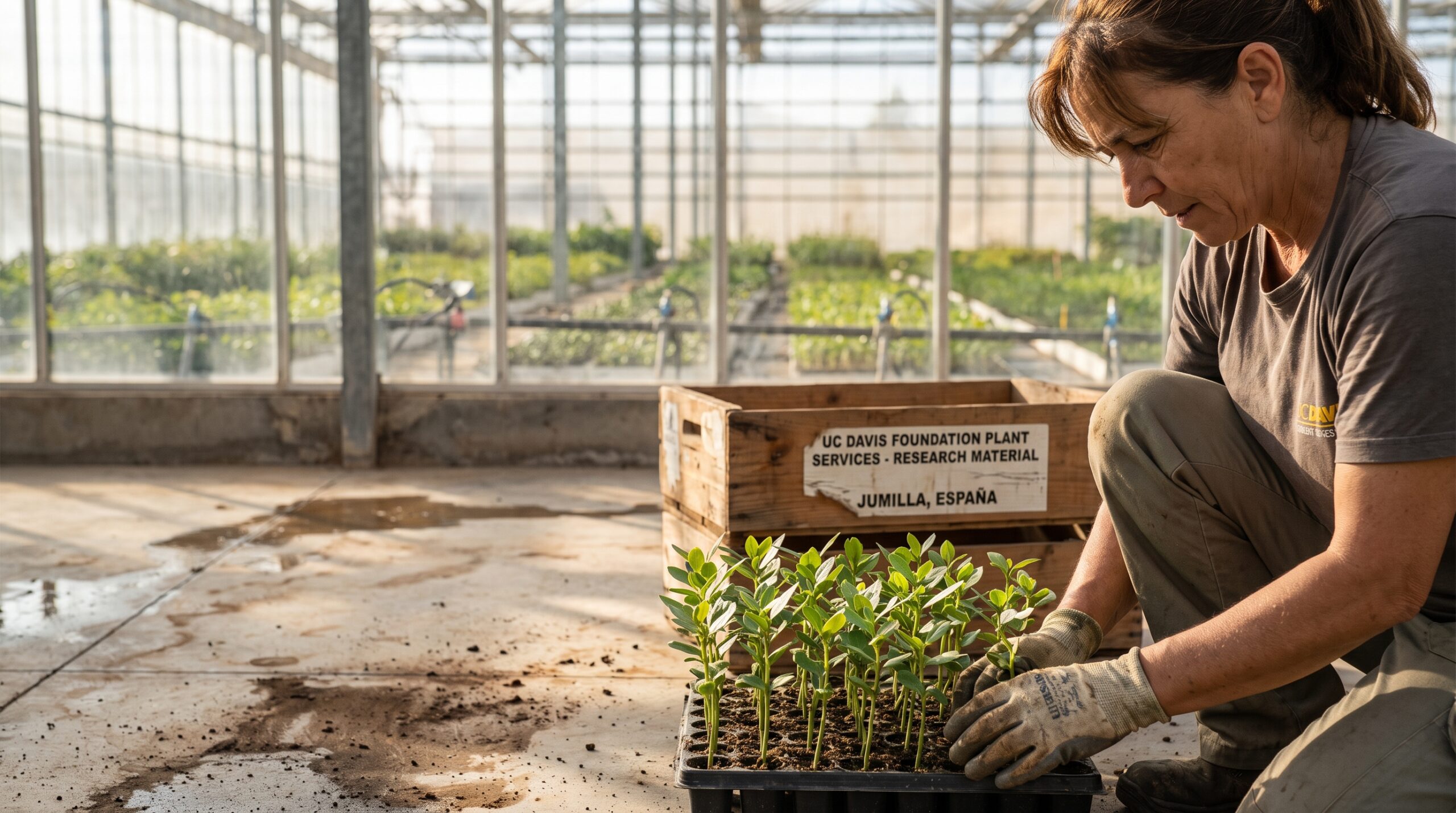
Last week we welcomed Maher Al Rwahnih, Director of Foundation Plant Services (FPS) at UC Davis, to our facilities. FPS supplies the seed from which we produce our UCB#1 pistachio plants. 🌱
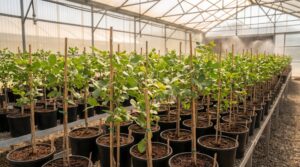
Together with Miguel Gil and Diego Lozano, we toured every stage of growth, from the youngest pistachio seedlings to the pistachio trees on our farm. It was an excellent opportunity to show first-hand how plant material that begins its journey thousands of kilometres away, in California, develops here. 🌍
In this article, we explain what that link means and why the origin of the seed shapes the future of a pistachio orchard. We also cover what you should consider if you are planning a new orchard or expanding an existing one. We write from Agro Vivero del Mediterráneo and from what we see every day among the trays, pots and rows of trees. 🌳
A Visit That Closes the Circle Between California and Jumilla 🤝
When a grower asks us where their plants come from, we want to be able to answer precisely. Having the Director of FPS come to see how the material that originates at UC Davis grows here allows us to do so with a level of certainty that few nurseries can offer.
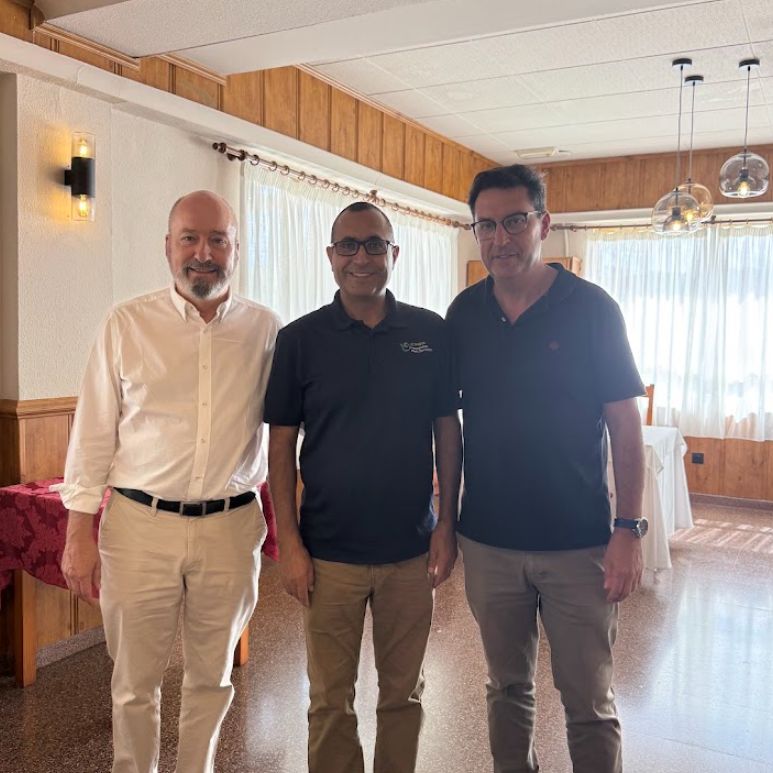
During the tour, we looked at three things:
- The youngest seedlings, newly developed in our covered facilities.
- The older plants, with the characteristic growth that identifies this selection.
- The pistachio trees on the farm, where we check how the material performs once it has left the nursery.
On the FPS side, the message was the same one we stand by: healthy plants start with healthy seed. Seeing their material grown outside California, in a Mediterranean climate, confirms our way of working, which leaves nothing to chance. ✅
What Is Foundation Plant Services and Why It Matters If You Are Planting Pistachios 🔬
Foundation Plant Services is the UC Davis programme dedicated to supplying healthy, clean and properly identified plant material. It works with several crops, and pistachio is one of them. Its purpose is to ensure that anyone planting does so with a known genetic base and with health guarantees from day one.
Why does this matter to you, even if you have never heard of FPS? Because a pistachio orchard is an investment spanning many years. Trees take time to come into production and the orchard must perform over a very long period, so an error in the origin of the material stays with the orchard for its entire life.
A health problem or a varietal misidentification cannot be detected in the nursery. It appears years later, when correcting it costs far more.
That is why, in our pistachio nursery, we place so much importance on:
- The origin of the pistachio seed, which must be known and documented.
- Traceability of every batch, from arrival until it leaves for the orchard.
- The quality of the plant material, which is checked at every stage and not only at the end.
If you would like to know more about how we work, you can see everything we do on our pistachio plant page. 🌿
UCB#1: What It Is and Why We Use It as a Rootstock 🌱
The UCB#1 rootstock is a pistachio rootstock widely used around the world. It comes from a cross between two species of the genus Pistacia: Pistacia atlantica and Pistacia integerrima. This combination gives it characteristics that have made it a benchmark among pistachio rootstocks. It is recognised above all for these advantages:
- Vigour: produces trees with strong development, something many growers look for so that the orchard comes into production early.
- Tolerance to Verticillium: one of the soilborne diseases that causes most concern in pistachio growing.
- Adaptation to different soils: performs well in varied conditions, provided management is correct.
To be honest: no rootstock is perfect or suits every orchard. Performance depends on the soil, the irrigation water, the climate and the management. That is why we never sell a pistachio plant without first discussing where it will grow. 🌍
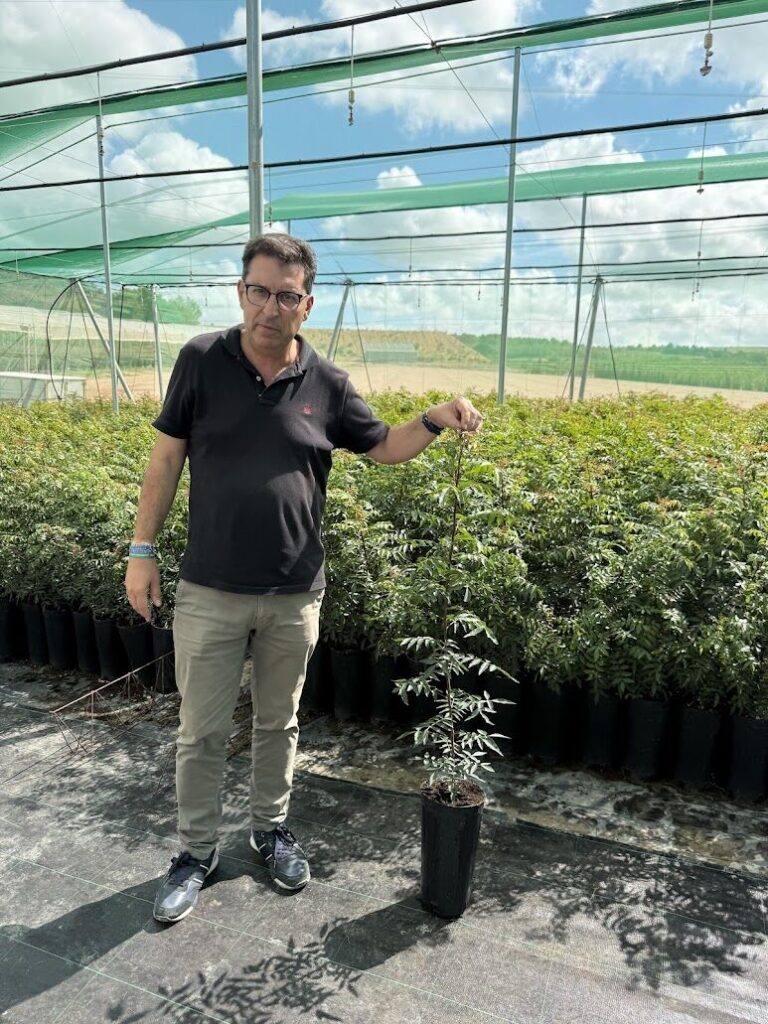
Because this is a seed-propagated material, each seedling shows some variability. This is where our work comes in: selecting, discarding what does not meet the standard, and delivering uniform, well-developed, well-formed plants.
Reddish Growth: How to Recognise a UCB#1 👀
In the photographs from the visit, the older plants display an unmistakable feature: the reddish growth of the new shoots. It is a hallmark of this selection, inherited from one of its parent species.
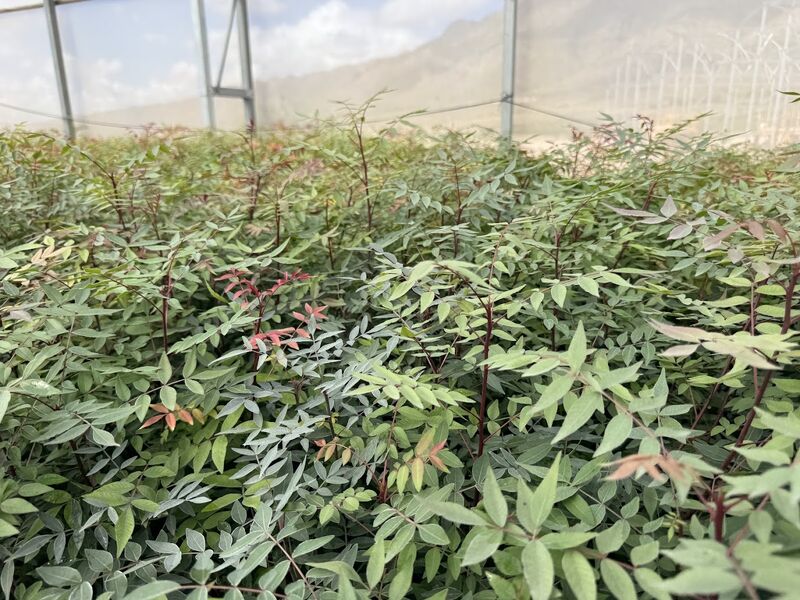
For us it is a useful tool. When we walk along the trays and pots, that colour helps us see at a glance whether a batch is behaving as it should. If a plant clearly departs from the pattern of the rest, we note it and decide what to do with it.
This visual check does not replace any technical control. It is a complement which, repeated every week throughout the whole nursery cycle, allows us to detect issues in time. 🔍
From the Greenhouse to the Orchard: How a Plant Grows in Our Nursery 🏡
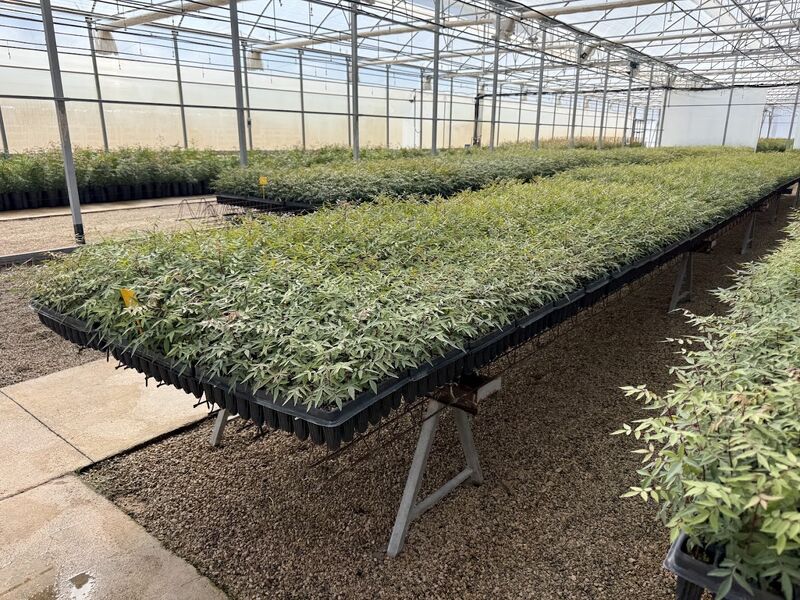
Many people imagine nursery work as something simple: sow, water and wait. Nothing could be further from the truth. Every stage has its own risks and calls for different decisions. This is a summary of our process:
Stage | What happens | What we monitor |
Seed reception | The material arrives from UC Davis | Origin, batch and condition |
Sowing and germination | Seeds are sown under controlled conditions | Uniform emergence |
Early development in covered facilities | ||
The plant gains vigour and height | Roots, stem and shoot colour | |
The productive variety is incorporated | Compatibility and graft take | |
Final selection | Plants that do not meet the standard are discarded | Size grade, structure and plant health |
Dispatch to the orchard | The plant travels to its final site | Preparation and transport |
After leaving the nursery, monitoring does not end. Keeping pistachio trees on our own farm allows us to check how the material performs in the field and to improve whatever is needed. 🌳
We like to say that the nursery and the orchard teach each other. What we see in one corrects us in the other.
Healthy Seeds, Healthy Plants: Plant Health as the Starting Point 🛡️
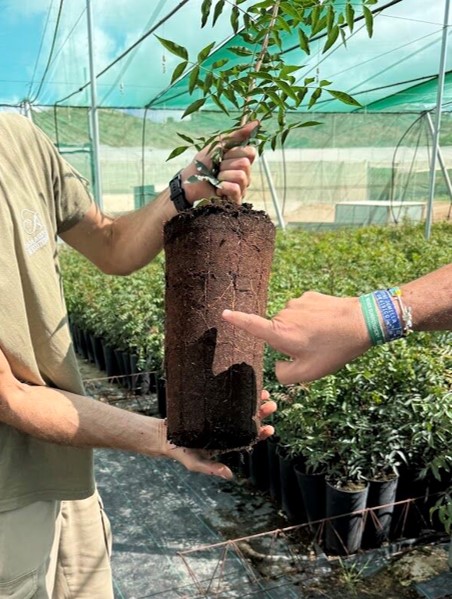
Plant health is one of the ideas Maher repeated most during the visit. It makes sense: a plant that leaves the nursery with a hidden problem does not resolve it in the field, but makes it worse.
In practice, we understand plant health in the nursery as a set of habits:
- Starting from seed of known origin, without mixing batches or doubtful sources.
- Using clean substrates and containers, reducing the risk of carrying over pathogens.
- Controlling irrigation, because excess moisture is the gateway for many root diseases.
- Inspecting the plants frequently, so that any issue is addressed at the outset.
- Separating and removing what does not meet the standard, even if it means losing plants.
Removing a doubtful plant costs very little. Replanting a tree in an established orchard costs far more, and so does the delay in production that it causes.
The Next Step for Your Orchard 🌟
This visit has made it clear that we are on the right track. Working with UC Davis seed, taking care of every stage in the nursery and following the performance of our trees on the farm allows us to offer you plants with a clear origin and well-controlled development.
The essentials to remember:
- The origin of the seed determines the future of the orchard.
- UCB#1 stands out for its vigour and its tolerance to Verticillium, although every orchard requires its own analysis.
- Plant health starts in the nursery and cannot be improvised.
- The quality of the plant material directly influences profitability.
If you are thinking about a new orchard or about expanding the one you already have, we will be delighted to help. You can write to us through our contact page or get to know Agro Vivero del Mediterráneo better. We look forward to welcoming you at the nursery. 🌱
Need a quote?
Tell us about your project and we will send you a proposal with no obligation.
Request a quote