


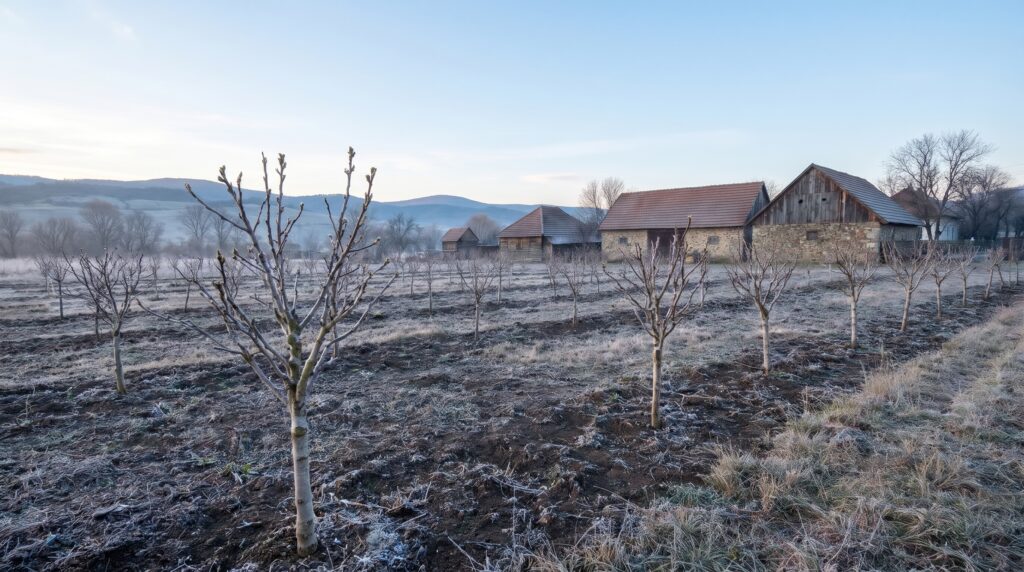
Pistachio trees can grow in Romania, but growing and producing profitably are two very different things. 🌳 A young pistachio tree can come through several winters unscathed and still lose its entire crop in a single April night because of a late frost. That, in a nutshell, is the key to pistachio growing in Romania.
We are receiving more and more enquiries from growers who want to plant outside traditional areas: smallholders looking for an alternative to field crops and large estates wanting to diversify. Romania comes up often in these conversations because of the agricultural land available, land prices and a continental climate with very hot summers in the south of the country. ☀️
In this article, drawing on the experience of the technical team at Agro Vivero del Mediterráneo, we analyse how pistachio trees behave in Romania: what the species needs, what the Romanian climate is really like, what minimum temperatures the trees withstand, when the most dangerous frosts arrive and which measures reduce the risk. No easy promises: just data, sound judgement and honesty. 🔍
🌍 Can You Grow Pistachios in Romania? The Short Answer
We will give the honest answer first and then explain it calmly: pistachio growing in Romania is possible in the warmest, driest areas of the south and southeast of the country, but it is marginal territory for the species, with a much smaller margin for error than in our Mediterranean growing regions.
Three ideas sum up the situation:
- ✅ Chilling hours: Romanian winters provide more than enough cold, so this requirement is not usually the problem.
- ⚠️ Frost: Very low winter minimums and, above all, spring frosts during budbreak and flowering are the main risk.
- 🌤️ Heat and humidity: Summers in the south favour nut ripening, but humidity in spring and early summer can encourage fungal diseases.
Several Romanian media outlets point to Oltenia, Muntenia, southern Moldavia and Dobrogea as the most promising regions for this species, that is, the areas whose climate comes closest to what the pistachio tree needs. We agree with that general approach, with one important caveat: within those regions, the specific plot matters more than the map.
This is not an orchard to improvise. If you are weighing up this step, our advice is to start with a small trial orchard, collect your own data over several seasons and expand only if the results support it. It is the smartest way to protect your investment. 💡
🌡️ What a Pistachio Tree Needs to Grow and Produce
The pistachio tree originates from arid and semi-arid areas of Central Asia and the Middle East. It is used to long, dry, very hot summers and to cold winters that allow it to enter dormancy. That genetic background explains why it adapts so well to the Mediterranean interior and why, in more humid climates or with late frosts, it starts to run into problems.
The table below summarises its requirements as a guide and compares them with what Romania offers:
| Factor | Approximate requirement | Situation in Romania |
|---|---|---|
| Winter chilling hours | 800-1,000 hours below 7 °C in demanding varieties, fewer in early ones | Comfortably met across almost the whole country |
| Winter minimum during dormancy | Prudent reference of -12 °C to -15 °C; some rootstocks withstand more | Can be exceeded in the south during cold winters |
| Budbreak and flowering | Sensitive to temperatures close to 0 °C and slightly below | Late frosts occur in April and even early May |
| Summer heat | Long, dry, hot summer to fill and ripen the nuts | Well covered in the south and southeast |
| Ambient humidity | Low in spring and summer | Variable: low on the coast and in the southeast, higher in the west and north |
| Soil | Deep, well drained, free of waterlogging | Depends on each plot |
It is worth understanding something that is sometimes overlooked: the pistachio tree needs cold, but not that much cold. Romania guarantees its winter dormancy hours; what it does not guarantee is the balance between a winter that does not damage the wood and a spring that does not destroy the flowers. 🌸
It is also a long-lived species. A well-planted tree must produce for many years, so it is not enough for the climate to be favourable in a normal year: it must also be so in the harshest winter and the most treacherous spring that can reasonably be expected over the productive life of the orchard. Thinking in terms of extremes rather than averages is the first rule we apply when assessing any new area.
If you would like to learn more about the species and its requirements, you can read our information on pistachio plants.
🌦️ What the Climate of Romania Is Like for a Pistachio Orchard
Romania has a temperate-continental climate with very different nuances depending on the region. The Carpathian arc divides the country, and on either side temperatures, rainfall and frost frequency change completely. For a pistachio orchard we are interested almost exclusively in the south and southeast, where the plains and plateaus accumulate more heat and where the areas suitable for pistachios are concentrated.
In these areas summers are long and hot, with typical maximums above 30 °C and heatwaves exceeding 40 °C. It is an excellent starting point for ripening. The drawback comes in winter: cold air masses from the east and north can cause very low minimums, and in exceptional episodes values close to -30 °C have been recorded in some inland locations. ❄️
Dobrogea deserves a separate mention. It is one of the driest regions of the country, with less than 400 mm of annual rainfall across large areas, and the Black Sea coast softens winter temperatures somewhat. That makes it one of the most interesting candidates, although wind, drought and the need for irrigation shape the design of the orchard.
This is our indicative assessment by area:
| Area | Summer | Winter | Rainfall | Our assessment |
|---|---|---|---|---|
| Dobrogea coast | Warm, moderated by the sea | Milder | Low | Best candidate with a suitable plot |
| Inland Dobrogea and the Bărăgan Plain | Very hot | Intense cold and wind | Low | Possible with rigorous site selection and protection |
| Oltenia and southern Muntenia | Hot | Cold, with occasional very low minimums | Moderate | Possible on sheltered plots |
| Southern Moldavia | Hot, more continental | Cold | Moderate | Trial orchard only |
| Transylvania and the north | Cool | Very cold | High | Not recommended |
This table does not replace the analysis of a specific plot. Two farms a few kilometres apart can behave very differently in a frost, as we will see later.
❄️ Winter Frost: How Low a Temperature Can a Pistachio Tree Withstand?
A pistachio tree in winter dormancy, with well-hardened wood, withstands sub-zero temperatures without difficulty. As a prudent reference, we are talking about little significant damage down to -12 °C or -15 °C in healthy mature trees, with some variation depending on the variety and the rootstock. Below those values the risk of wood damage increases quickly, especially if the cold is prolonged.
But the winter minimum temperature does not explain everything. These factors can worsen or improve the outcome:
- 🌱 Tree age: Young pistachio trees are considerably more vulnerable during their first two or three winters.
- 🌡️ Sudden drops: Intense cold after a mild spell is far more damaging than the same cold in a regular winter, because the tree loses part of its hardiness.
- 🍃 Prior hardening: Excess nitrogen or irrigation in late summer delays the onset of dormancy and leaves the wood tender when the first cold arrives.
- 💨 Wind and desiccation: Cold combined with dry wind aggravates damage to branches and trunks.
- 🌳 Rootstock and variety: Not all planting material has the same hardiness.
Winter damage is not always visible immediately. It may appear as bark cracks, necrosis around the graft union, branches that fail to bud in spring or trees that resprout weakly. In addition, cold injuries open the door to wood-rotting fungi such as Botryosphaeria, which later complicate the health of the whole orchard.
To protect young trees we recommend trunk guards, whitewashing the base, light hilling over the graft union during the first years and a fertilisation programme that finishes in time for the tree to harden off. These are inexpensive measures that make a big difference. 🧤
🌸 Spring Frost: The Risk That Ruins the Most Harvests
If we had to pick a single risk for pistachio growing in Romania, we would choose spring frosts. The reasons are simple: winter can be managed through a good choice of plot and planting material, but a frost during budbreak or flowering directly damages shoots, flowers and newly set nuts, and that year’s harvest is lost.
The positive side is that the pistachio tree flowers later than almond and apricot trees, which gives it a certain advantage. In Romania, however, that advantage narrows. Agroclimatic records for southern Dobrogea show late frosts up to the first ten days of April on the coast and up to the first days of May in the west of the region. In cool springs, pistachio flowering can coincide with that window of risk.
These are the approximate critical temperatures according to the plant’s stage:
| Phenological stage | Temperature at which damage begins (approximate) |
|---|---|
| Dormant buds | Several degrees below zero |
| Budbreak and first leaves | Between -1.5 °C and -2 °C |
| Full bloom | Between -1 °C and -2 °C |
| Fruit set and newly formed nuts | Around -1 °C |
These values depend on the duration of the frost, ambient humidity and the variety, but they help explain why a night at -2 °C in the middle of April can be devastating.
Other producing regions have experienced this at first hand. In pistachio-growing regions of Iran, years with spring frost damage exceeding 60% of the crop have been documented, and in southeastern Romania itself peach and apricot trees have suffered episodes with losses of up to 60% in some orchards. 🥶 It is a signal worth taking seriously, although each species has its own calendar.
On the other hand, almond orchards already exist in Dobrogea, and how they cope with flowering frosts, which occur earlier than those of the pistachio tree, is a very useful thermometer for anticipating what would happen to our species on the same farm.
Autumn frosts, much less serious. The first frosts appear in late September on the plateaus and in mid-October on the coast. The pistachio is harvested at the end of summer, so these frosts rarely affect the nuts, although they can harm young trees if the cold arrives before the wood has hardened.
💧 Rainfall, Humidity and Plant Health: The Other Major Constraint
The ideal climate for the pistachio tree is dry and sunny from spring onwards. When it rains heavily during flowering and in early summer, problems appear: poorer pollination, because the pollen is carried by the wind, and greater pressure from fungi such as Botryosphaeria, Alternaria and Septoria. That is why we rule out the more humid areas of western and northern Romania from the outset.
In the south and southeast the challenge is the opposite: there is little water. Growers in Dobrogea have long pointed out that water is the farming sector’s first concern. Although the pistachio tree tolerates drought, a commercial orchard yields much more with a well-designed drip irrigation system, and water availability should be secured before planting, not afterwards. 🚰
There are three more points we always check in this region:
- 🌻 Cropping history: Romania is a major sunflower producer, and this crop, like others, can leave the fungus Verticillium in the soil, a serious enemy of the pistachio tree. A soil analysis and a review of the farm’s history are essential.
- 🕳️ Drainage: Clay soils that become waterlogged favour root asphyxia and root rots caused by Phytophthora.
- 🧊 Hail: Spring and summer storms with hail can damage shoots and nuts, and must be included in the risk analysis and in insurance.
All of this shows that assessing a climate does not end with the minimum temperature. Plant health and water matter as much as cold, and any serious project should evaluate them together before buying a single tree. These questions are best resolved with a site visit and a preliminary study; that is why our technical advice, within the services of Agro Vivero del Mediterráneo, always begins by analysing the plot.
🗺️ How to Choose the Plot: The Factor That Decides Whether There Is a Harvest
Within the same climatic zone, the plot changes everything. On a clear, windless night, cold air is heavier and flows down slopes, pooling in hollows, valleys and low-lying areas, where the temperature can be several degrees lower than on a nearby slope. This is what we call cold-air drainage, and it is the first tool against frost.
These are the criteria we assess in plot selection for pistachio trees:
- ⛰️ Gentle slope and an outlet for cold air: We avoid hollows and plots surrounded by barriers, such as walls, dense hedges or embankments, that trap the air.
- 🧭 Aspect: South-facing slopes warm up earlier in spring and advance budbreak; a slightly cooler exposure that delays it is often preferable.
- 🌊 Nearby bodies of water: The Danube, lakes and the Black Sea moderate temperature extremes in their surroundings.
- 🌬️ Wind: A moderate breeze helps mix the air; a strong, dry wind damages young trees.
- 🪨 Soil: Deep, well drained and with a good capacity to absorb heat during the day.
A practical example: imagine two five-hectare plots eight kilometres apart. One is on a slope with a natural outlet for cold air; the other is at the bottom of a valley. On the same frosty night, the first may record -1 °C and the second -3.5 °C. For the first it is an uncomfortable night; for the second, a lost season. 🌙
We recommend installing at least one weather station or several temperature sensors at different heights and in different parts of the farm for one or two winters and springs before planting. Data from official stations, sometimes located many kilometres away, do not capture the real differences between two plots. And do not forget local knowledge: whoever knows the farm well knows which areas freeze first. 📡
🌱 Pistachio Varieties and Rootstocks for Areas at Risk of Frost
Choosing planting material is the most important technical decision after the plot. In areas at risk of frost we look for a delicate balance: late-flowering pistachio varieties to escape the last frosts, but with a cycle short enough to ripen the nuts before autumn.
- 🌸 Varieties: Kerman is the global benchmark, but it requires many chilling hours and flowers at a mid-season date. Others, such as Larnaka or Sirora, are earlier and less demanding in chilling, which in a climate like Romania’s is usually a disadvantage because they advance budbreak. It is worth considering later-flowering varieties and testing their performance in local trials.
- 🌳 Pollinizers: The pistachio is a dioecious species, with male and female trees. The male’s flowering must coincide with that of the female variety; otherwise the crop suffers even without frost. Typically one male tree is planted for every eight to ten females.
- 🌿 Rootstocks: Pistachio rootstocks determine soil adaptation, vigour and cold hardiness. In cold areas we prefer hardy rootstocks and avoid very vigorous materials that are more sensitive to winter cold.
There is no perfect variety for every farm. That is why, for a project in Romania, we recommend combining two or three female varieties with staggered flowering within the same orchard: that way, if a frost damages one, another may save part of the crop. It is also essential to start with healthy, certified planting material, because a poor-quality plant adds risks that no climate can offset.
📚 What Pistachio Growing in Cold Inland Areas of Spain Teaches Us
Although our base is on the Mediterranean, we know well what happens in the inland regions of the Iberian Peninsula, where winters are cold and April frosts are not unusual. Pistachio growing has become established there, and that provides very useful lessons for assessing pistachios in cold climates such as Romania’s.
- 🔎 Bad seasons happen: Even on well-chosen plots, seasons with significant losses after an April frost have been seen. What distinguishes a solid project is that it is prepared for them.
- 🌳 The plot matters more than the region: Within a single municipality, farms with regular harvests coexist with others that freeze frequently.
- 🧩 Diversifying varieties works: With staggered flowering, a frost rarely destroys everything.
That said, we have to be realistic: inland Spain accumulates more heat and has a longer, drier growing season than most of Romania. Transferring that experience without adjustment would be a mistake, which is why we insist on local trials before planting on a large scale.
🛡️ How to Protect a Pistachio Orchard Against Frost
First we need to distinguish two types of frost, because the defence is different. Radiation frost occurs on clear, windless nights, when the ground loses heat and the nearby air cools; it can be tackled with active methods. Advective frost arrives with a cold air mass and wind; it is much harder to fight and almost no active method works. 🌬️
These are the measures we consider for an orchard in Romania, from most to least important:
- Choose the plot and varieties well. This is the cheapest and most durable frost protection.
- Manage the soil. A bare, firm, moist soil stores more heat during the day and releases it at night. Before a forecast frost, it is advisable to mow the ground cover and irrigate.
- Overhead sprinkler frost protection. Water that freezes releases heat and keeps buds close to 0 °C. It works very well in radiation frosts, but it requires a lot of water and a properly sized installation, and the weight of the ice can break branches. 💦
- Wind machines (frost fans). They mix warm air from the upper layers with the cold air at ground level, provided there is a temperature inversion. Each machine covers only a few hectares and the cost is high.
- Orchard heaters and burners. Useful on small areas or as a back-up, but expensive to operate and increasingly regulated because of their environmental impact. 🔥
- Vigour control. Avoid excess nitrogen, which advances and prolongs budbreak.
- Sensors with alarms. They allow you to react in time and activate irrigation or fans when needed.
- Crop insurance and financial planning. No system protects 100%. A sensible plan assumes there will be seasons with reduced harvests and is calculated accordingly.
No method is foolproof and, in many cases, the best strategy is to combine prevention (plot and varieties) with moderate active protection. Every investment must be justified by the expected value of the harvest, which is why we evaluate them with numbers before recommending any.
💶 Is the Risk Worth It? Pistachio Profitability in Romania
The pistachio is a highly valued nut with solid global demand, and that explains the interest it attracts. But its profitability is built over the long term: trees begin to produce from the fourth or fifth year and reach full production around the tenth. Throughout that time, the investment, the costs and the risks have to be sustained.
In a frost-prone area, profitability depends above all on one question: how often is the harvest lost? A simple example illustrates it:
- If a late frost completely ruins the harvest one season in ten, average production is 10% lower than forecast for a perfect year.
- If it happens one season in four, average production falls by 25%.
- If it happens one season in three, the project is probably no longer viable.
The difference between one scenario and another lies in the plot, the varieties and the protection. That is why any serious study of orchard profitability includes the frequency of damaging frosts alongside irrigation, labour and mechanisation costs. You can see how we approach these calculations in our section on the profitability of a pistachio orchard. 📊
For the small grower, the risk has one advantage: with a small area they can learn and correct. For the large grower, the key is to phase the planting: plant in stages, starting with the best-located plots.
✅ Checklist Before Planting Pistachio Trees in Romania
If you are assessing a project, this is the list we go through with those who consult us before taking any step:
- Climate data for the area and, if possible, for the farm itself: absolute winter minimums and dates of the last frosts.
- Historical winter minimum temperature, not just the January average.
- Soil analysis (texture, pH, lime, salinity and drainage) and a review of cropping history to rule out Verticillium.
- Availability and quality of irrigation water.
- Real possibility of protecting the plot against frost: water, electricity and area.
- Varieties and pollinizers with compatible flowering, preferably late flowering.
- Rootstock adapted to the soil and to cold.
- Planting layout and drip irrigation design.
- Financial plan that assumes seasons with reduced harvests.
- An initial trial orchard before expanding the planted area.
If you can answer these ten points clearly, you are much closer to an informed decision. If not, it is time to seek professional help. 🧭
❓ Frequently Asked Questions About Pistachio Trees in Romania
What minimum temperature can a pistachio tree withstand?
In winter dormancy and with well-hardened wood, a healthy mature tree safely withstands down to about -12 °C or -15 °C; some materials tolerate somewhat more. In young trees and after mild spells, the limit drops.
Which areas of Romania offer the best prospects for pistachios?
In the south and southeast: Dobrogea, Muntenia and Oltenia and, with caveats, southern Moldavia, always on well-chosen plots. We do not recommend Transylvania or the north.
How many chilling hours does it need?
Depending on the variety, around 600 to 1,000 hours below 7 °C. In Romania this requirement is met without problems.
What happens if there is a frost during flowering?
Flowers and newly set nuts are lost, and that year’s harvest is reduced or disappears. The tree does not usually die, but it is weakened, and it is advisable to check its condition and keep the orchard healthy for the following season.
When do pistachio trees start to produce?
From the fourth or fifth year, with increasing yields up to around the tenth year.
Is it advisable to plant a large area from the start?
In areas new to the species, no. The prudent approach is to start with a trial plot and expand using your own data.
🤝 The Next Step
Pistachio trees can grow in Romania, and in the warmest, driest areas of the south and southeast there are plots with real potential. But we have also seen that extreme winter cold and, above all, spring frosts make the country a demanding territory, where the choice of plot, varieties and protection makes the difference between a harvest and a loss.
Our advice is clear: go step by step, start with a small area, measure your microclimate and do not be swayed by easy promises. 🌟
At Agro Vivero del Mediterráneo we can help you study your project, choose the most suitable pistachio plants and assess profitability with realistic figures. You can get in touch with us through our contact page or request a quotation directly using our booking and quotation form. Tell us about your plot and we will look for the best option together. 🌱