


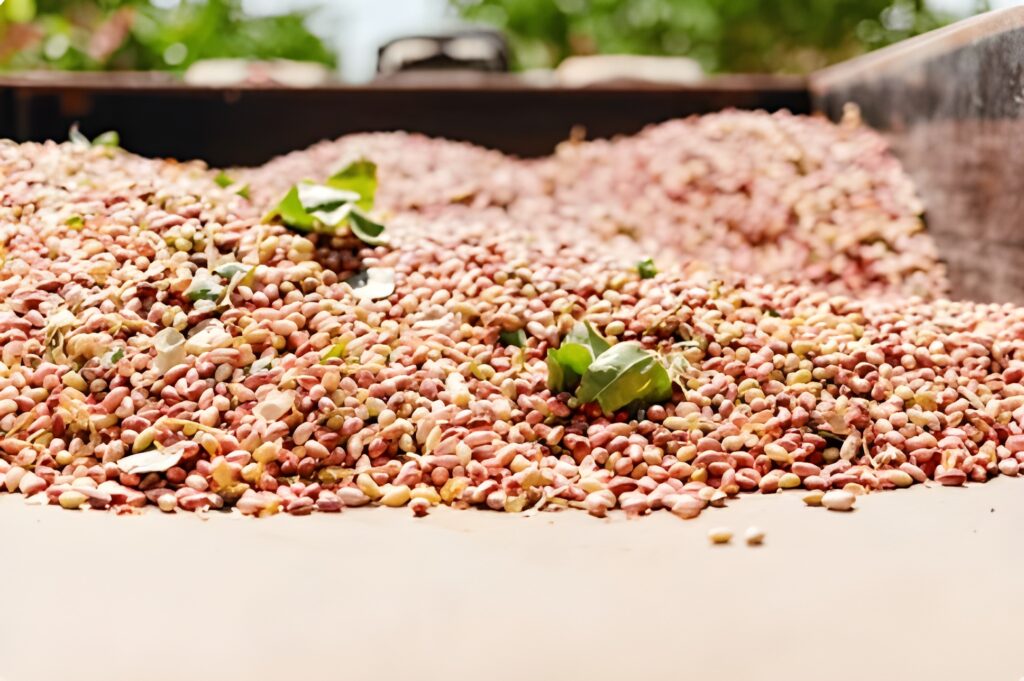
At Agro Vivero del Mediterráneo, we have spent years wholeheartedly dedicated to the fascinating world of pistachio farming. We are more than a nursery — we are your companions at every step of this exciting agricultural journey. From the selection of the perfect pistachio plant to the culminating moment of the harvest, our team of experts is here to ensure that your effort translates into the success you deserve. One of the questions we receive most often — and which is undoubtedly crucial for guaranteeing the quality and profitability of your orchard — is: when exactly is the right time to harvest pistachios? 🤔
Harvesting is not an exact science that can be marked with an X on the calendar months in advance. It is more of an art refined by experience, observation, and an in-depth knowledge of the tree’s cycle. Harvesting too early results in an immature product with lower weight and a flavor that has not yet reached its full potential. On the other hand, waiting too long can cause the nuts to fall to the ground, increasing losses and exposing them to the risk of aflatoxin contamination — a hazard we must avoid at all costs.
That is why, in this article, we are going to share all of our accumulated knowledge with you. We will guide you through the visual cues, techniques, and insider knowledge that we, as specialists, use to determine the optimal ripeness stage. We want you to feel much more confident and prepared, by the time you finish reading, to tackle one of the most exciting and decisive phases of pistachio cultivation. Let’s get to it! 🧑🌾
The Harvest Calendar: A General Guide
Although we have said that there is no fixed date, we can establish a general harvest window for pistachio farming at our latitudes. In the northern hemisphere, and specifically on the Iberian Peninsula, harvesting typically takes place between late August and late September. This window can vary slightly depending on several key factors:
-
Plant variety: Each variety has its own ripening cycle. For example, early varieties such as Kerman may be ready a few weeks before later-maturing ones. It is essential to know the behavior of the plants in your operation.
-
Climatic conditions of the year: A year with a warm spring and many hours of sunshine can advance maturity. Conversely, a cooler year with less sun exposure could delay it. Climate is the conductor of the agricultural cycle. ☀️
-
Geographical location: The altitude and specific microclimate of your orchard also play an important role. Warmer areas with greater sun exposure tend to have earlier harvests.
-
Management practices: Irrigation, fertilization, and pruning directly influence the health and vigor of the tree, and therefore the ripening of its production. Proper management, as we always recommend through our advisory services, is key to a uniform, high-quality harvest.
Understanding these factors will give you a frame of reference, but the real key lies in observing the trees and their production. They will give us the unmistakable signs that the moment has arrived.
Visual Cues: The Language of Pistachios
Pistachio trees “speak” to us through subtle but clear changes. Learning to interpret these visual cues is the first step toward becoming an expert harvester. During our follow-up visits to the orchards we advise, we always emphasize these indicators.
1. The Color Change of the Epicarp (Outer Skin)
The epicarp — that thin, fleshy skin covering the pistachio shell — is our first and most obvious indicator. During its development, this skin is deep green and firmly attached to the shell. As the nut approaches maturity, several significant changes occur:
-
Loss of shine: The deep, glossy green gradually becomes paler and more matte.
-
Appearance of pink or purplish hues: On the sun-exposed side, the epicarp begins to develop beautiful pinkish or even purplish tones. 🌹 This is one of the clearest signs that the ripening process is well advanced. You will see the clusters take on these colors, creating a spectacular visual display in the orchard.
-
Separation from the shell: This is the key sign! If you gently squeeze a ripe pistachio, you will notice that the epicarp slides and separates easily from the hard shell. At its optimal stage, this skin feels loose — almost like a sleeve. If you have to apply force to separate it, it is not yet time.
We recommend carrying out this check on different trees and areas of the plot to get an overall picture of the ripeness stage, as not all trees or all clusters ripen at exactly the same time.
2. Dehiscence or Shell Splitting
The pistachio is a unique nut in many respects, one of which is its characteristic natural splitting or dehiscence. When the inner kernel (the cotyledon) reaches its maximum development, it exerts such pressure on the shell that it forces it to open along its natural suture line. That “crack” is music to our ears. 🎶
-
The splitting percentage: The goal is to begin harvesting when a high percentage of the pistachios on the tree have already split naturally. We generally aim for between 70% and 90% of the pistachios in the cluster to be open. This is a direct indicator of product quality and size.
-
Observing the clusters: Walk through your orchard and observe the clusters. Split pistachios are easily recognizable. A predominance of closed nuts indicates that we need to wait a little longer.
It is important to note that a small percentage of pistachios will remain closed even at full maturity. These are known as “blanks” or “clanks,” which have lower commercial value. Good orchard management and the selection of quality plant material, such as that which we offer at Agro Vivero del Mediterráneo, helps minimize this percentage.
3. The Appearance of the Clusters
The overall structure of the cluster also gives us valuable clues. During growth, clusters are compact and the pistachios are tightly packed. As harvest approaches:
-
Clusters “open up” and hang down: The weight of the ripe pistachios causes the peduncles (the small stems that attach them to the cluster) to yield slightly. Clusters lose their rigidity, become looser, and hang more freely. This image of heavy, drooping clusters is an excellent indicator that harvest time is near.
Sampling Techniques: From Observation to Decision
Visual observation is fundamental, but to make the final decision and mobilize harvesting teams, it is advisable to complement it with more technical sampling. This allows us to obtain objective data on the actual state of the orchard and not rely solely on impressions.
1. Representative Random Sampling
We cannot inspect every one of the thousands of pistachios in our orchard. That is why we carry out representative sampling. The process we follow and recommend is as follows:
-
Select trees at random: Choose between 10 and 15 trees spread across the entire plot. Do not only pick the ones that appear most heavily loaded or those on the edges. Try to ensure the selection is representative of the orchard as a whole.
-
Collect samples from different parts of the tree: From each selected tree, collect around 100 pistachios. It is important to take them from different heights (low, mid, high) and orientations (north, south, east, west), as ripening is not perfectly uniform throughout the tree.
-
Create a composite sample: Combine all the collected pistachios into a single container. This will give you a composite sample of approximately 1,000–1,500 pistachios, which will be a faithful reflection of the overall state of your orchard.
2. Sample Analysis
Once we have our composite sample, we proceed to analyze it. This analysis will provide us with the percentage data we need to make the final decision.
-
Epicarp removal: The first step is to hull all the pistachios in the sample. Although laborious, this process is crucial. As you do so, you can assess how easily the outer skin separates. If it comes away effortlessly in the vast majority of cases, that is an excellent sign. 👍
-
Calculating the split percentage: Once hulled, count how many pistachios are open and how many are closed. Divide the number of open pistachios by the total number in the sample and multiply by 100. The optimal time to begin harvesting is when this split percentage exceeds 80–85%.
-
Evaluating empty nuts: During the count, also separate and count any pistachios that, although open, have no kernel inside or have one that is very small and shriveled. A high percentage of empty nuts may indicate pollination problems or crop management issues during the season. Knowing this figure is vital for planning and for understanding the profitability of the orchard.
-
Kernel color inspection: Open some of the pistachios (both split and closed) and observe the color of the kernel. A ripe kernel should be deep green. Yellowish tones may be indicative of over-maturity, which can affect flavor and quality.
Carrying out this sampling once a week as the harvest window approaches will allow you to track the progression of ripening and determine the “D-Day” with great precision.
Harvest Time: Methods and Considerations
Once all the visual cues and sampling data confirm that the moment has arrived, it is time to begin harvesting. Speed and efficiency at this stage are crucial to preserving product quality.
The Harvesting Method
There are essentially two methods for harvesting pistachios: manual and mechanized. The choice between the two will depend on the size of the orchard, the terrain topography, and the available investment.
-
Manual Harvesting: Traditionally, harvesting was done by hand or by beating the tree branches so that the pistachios fell onto tarps or nets spread on the ground. This method is very gentle on the tree, but it is extremely slow and requires a large workforce, which significantly increases costs. Today, it is only recommended for very small orchards or those that are difficult to access with machinery.
-
Mechanized Harvesting: This is the most widely used method in professional orchards. Trunk shakers with or without an inverted catching umbrella are used. 🚜
-
Shakers with catching umbrella: This machinery is the most efficient. A vibrating head clamps onto the trunk or main branches of the tree and shakes it at a controlled frequency and intensity. The pistachios fall directly into an inverted umbrella that catches them and channels them into a hopper. This method is fast, reduces the need for labor, and most importantly, prevents the product from touching the ground. This minimizes the risk of fungal contamination and aflatoxin production.
-
Shakers without catching umbrella: In this case, nets or tarps are placed on the ground, as in the manual method, but the nuts are knocked from the tree using hand-held or tractor-mounted shakers. This is an intermediate step between the purely manual and fully mechanized approaches.
-
At Agro Vivero del Mediterráneo, we always recommend opting for mechanized harvesting with a catching umbrella, as it guarantees maximum quality and safety of the final product — key factors in achieving a good market price.
Key Considerations During Harvest
Regardless of the chosen method, there are some guidelines that must be rigorously followed:
-
Harvest during the coolest part of the day: It is preferable to harvest early in the morning. The high temperatures at midday can stress both the trees and the workers, as well as accelerating potential degradation of the freshly harvested product.
-
Prevent the product from touching the ground: As already mentioned, this is of vital importance. The soil can harbor fungal spores (such as Aspergillus flavus) that, under conditions of moisture and warmth, can produce aflatoxins — highly harmful mycotoxins.
-
Speed of processing: The pistachio is a perishable product once harvested. The fleshy skin (the epicarp) has a high moisture and sugar content, making it the perfect breeding ground for fermentation and fungi if not removed quickly. The golden rule is that pistachios must be hulled and put to dry within 24 hours of harvesting. This is, without doubt, one of the greatest logistical challenges of the harvest.
Post-Harvest Processing: A Critical Step
The harvest does not end when the pistachio is separated from the tree. In fact, a race against the clock begins to process it properly and ensure its preservation and quality.
1. Hulling
The first step is to remove the epicarp. This process is carried out with hulling machines that, using rollers and pressurized water, rub the pistachios and strip away the outer skin without damaging the shell. It is essential that this step be performed as soon as possible. Any delay can cause shell staining — which reduces the product’s value — and increases the risk of fungal development.
2. Flotation Separation
After hulling, the pistachios typically pass through a water tank or a channel with a current. This clever system allows pistachios to be separated by quality in a very simple way:
-
Full, split pistachios: These are denser and sink to the bottom. This is the highest-quality product.
-
Empty and closed pistachios: These are less dense and float to the surface, along with leaf and branch debris. They are easily removed.
3. Drying
This is possibly the most delicate and crucial step in the entire post-harvest process. The goal is to reduce the kernel’s moisture content from an initial 30–40% down to 5–6% to guarantee long-term preservation. Inadequate drying can completely ruin an otherwise excellent harvest.
-
The process: Drying is carried out in industrial dryers using forced hot air. Temperature and time must be very carefully controlled. Excessively high temperatures can “cook” the kernel and alter its organoleptic properties, while drying that is too slow can encourage the growth of fungi.
-
The importance of good drying: A properly dried pistachio can be stored for months — or even years — without losing quality. A pistachio with moisture content above 7% is a ticking time bomb, prone to going rancid and developing mold.
Mastering the harvest and post-processing is what sets a profitable orchard apart from one that is not. It is a process that requires knowledge, experience, and the right machinery. If you are thinking of starting your own project, we invite you to get in touch with us. We can advise you not only on planting, but also on designing an efficient harvest and processing plan tailored to your needs.
Warning Signs: What Happens if We Get It Wrong?
Understanding the consequences of harvesting too early or too late reinforces the importance of getting the timing right.
Consequences of Harvesting Too Early:
-
Lower weight and size: The kernel has not completed its development, resulting in a lower total harvest weight and therefore lower income.
-
High percentage of closed nuts: Many pistachios will not have had time to split naturally.
-
Difficulty in hulling: The epicarp is more firmly attached to the shell, making the hulling process harder and slower, and potentially damaging the machinery.
-
Immature flavor: The flavor profile has not fully developed, resulting in a less flavorful product.
Consequences of Harvesting Too Late:
-
Losses from nut drop: Ripe pistachios detach easily from the tree, and once on the ground, their value plummets and the risk of contamination skyrockets.
-
Aflatoxin risk: This is the greatest danger. Contact with moist soil and warm temperatures create the perfect conditions for Aspergillus.
-
Shell staining: The epicarp begins to dry out and adhere to the shell, causing dark stains that are very difficult to remove and that significantly reduce the product’s value.
-
Pest and bird attack: The longer the product remains on the tree, the more exposed it will be to insect and bird attack — both of which are highly attracted to ripe pistachios. 🐦
Getting the harvesting window right — which often lasts no more than one or two weeks — is the result of careful planning and constant observation.
The pistachio harvest is the culmination of a year of hard work and dedication. It is the moment when all the effort invested in caring for the trees materializes into a valuable and highly regarded product. Determining the optimal moment is not a task that should be left to chance — it is a skill that is perfected with experience and technical knowledge.
At Agro Vivero del Mediterráneo, our mission is to accompany you throughout this entire process. From initial planning — helping you choose the best plants and design your operation — to technical advice at the most critical moments, such as pruning, irrigation, and of course, harvesting. We understand that every orchard is unique, and that is why we offer personalized solutions.
We hope that this detailed guide on the visual cues and techniques for determining the optimal harvest time proves to be of great use to you. Remember to observe the color and separation of the epicarp, the shell split percentage, and the overall appearance of the clusters. Do not hesitate to carry out sampling to obtain objective data to support your decision. And once you begin, act with speed and efficiency to guarantee maximum quality.
Pistachio cultivation is a long-term investment that offers excellent profitability when done right. If you wish to take the next step and start your own project, or if you already have an orchard and want to optimize your results, we encourage you to fill out our reservation and quote form. Our team of experts will be delighted to study your case and offer you the best solution. Together, we can make your harvest a resounding success! 🌳✨